| English | 意味 |
|---|---|
| specific heat capacity/spəˈsɪfɪk hiːt kəˈpæsɪti/ | 比熱容量 |
| thermal expansion/ˈθɜːml ekˈspænʃn/ | 熱膨張 |
| internal energy/ɪnˈtɜːnl ˈenədʒi/ | 内部エネルギー |
橋に隙間がある理由
- 鉄道レールには小さな隙間があり、橋はローラーの上に置かれ、電力ケーブルは夏に緩やかに垂れる。
- すべて同じ理由のためである:物は加熱すると膨張する。
- 加熱により物質内部にエネルギーが蓄えられ、その量は比熱容量で測られる。
熱膨張
- 材料を加熱すると粒子の運動が大きくなり、より多くの空間を占めるようになる — 膨張する。
- 気体が最も膨張し、次に液体、そして固体(粒子が強く引き結合されているもの)の順である。
- エンジニアはレールに隙間を設け、橋をローラーの上に置くことで、膨張による撓みを防ぐ。
- 金属の密閉缶の蓋を熱湯に浸すと緩む — 金属が膨張するためである。
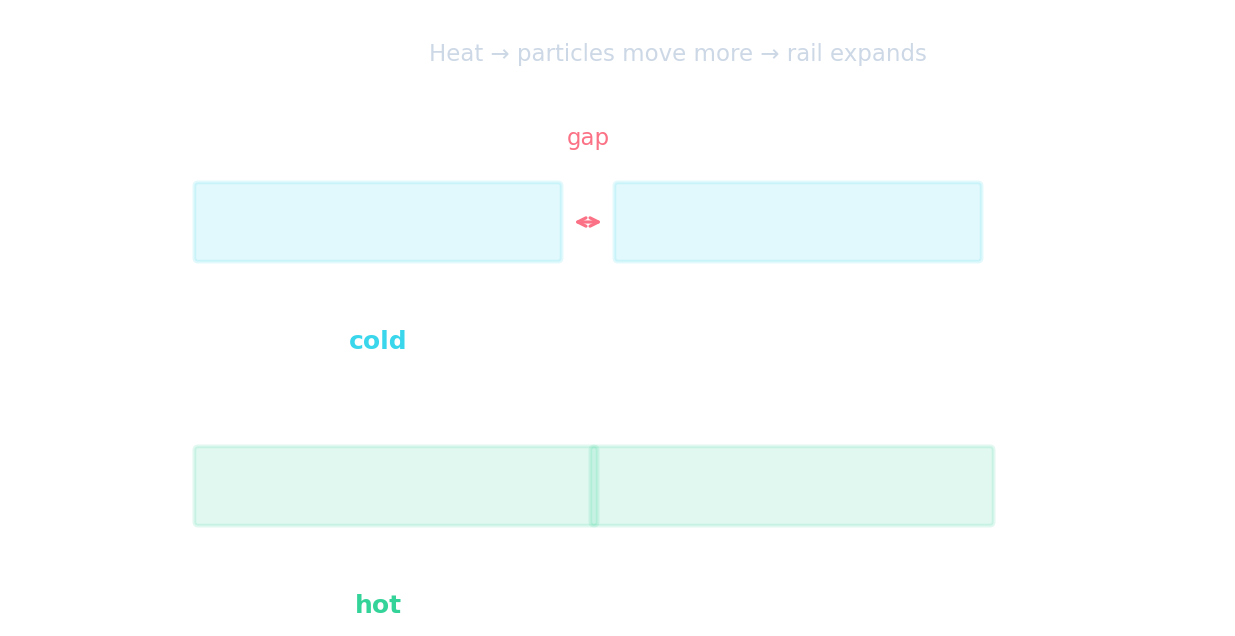
熱膨張:加熱によりレールが長くなり、留めておくために設けた隙間が埋まる。
** worked example.** $50\ \text{m}$ の長さの鉄橋が $10\ {}^{\circ}\text{C}$ で設置されています。鋼材は $0.012\ \text{mm}$ 毎メートルあたり ${}^{\circ}\text{C}$ ずつ膨張します。温度が $40\ {}^{\circ}\text{C}$ に上昇した場合($30\ {}^{\circ}\text{C}$ の上昇)、膨張量は $= 50 \times 0.012 \times 30 = 18\ \text{mm}$ です。これが橋に伸縮継手がある理由です!
粒子自体は大きくならない。 固体が膨張する場合、粒子そのもののサイズは変わらず、単に振動が強まり、互いに遠ざかるだけである。これはよく出題される誤解である。
Heating and specific heat capacity
Q = mcΔT
The heat energy needed is proportional to the temperature rise for a given mass of material.
For the same rise in temperature, which expands the most?
難易度 1/5 · 100 コイン + 今日初回完了時に小ボーナス付与
Gases expand the most, then liquids, then solids (whose particles are held most tightly).
Why are small gaps left between railway lines?
難易度 1/5 · 100 コイン + 今日初回完了時に小ボーナス付与
On a hot day the rails expand. The gaps give the extra length somewhere to go, so the track does not bend out of shape.
内部エネルギー
- 物体の内部エネルギーとは、そのすべての粒子の総エネルギー(運動と配置)のことである。
- 物体を加熱すると内部エネルギーが増加し、通常は温度も上昇する。

通常の光の下と熱線(赤外線)カメラを通して見た同一の手元
比熱容量
- 比熱容量 $c$ とは、$1\ \text{kg}$ の物質の温度を $1\ {}^{\circ}\text{C}$ 上げるのに必要なエネルギーである:
- したがって、あるものを温めるのに必要なエネルギーは $\Delta E = m c\,\Delta\theta$ 。
- 水は非常に高い$c$ ($\approx 4200$ ジュール毎kg毎°C)を持つため、温めるのに多くのエネルギーを要し、冷えるのも遅い。そのため海は穏やかで、水は暖房システムに使われる。
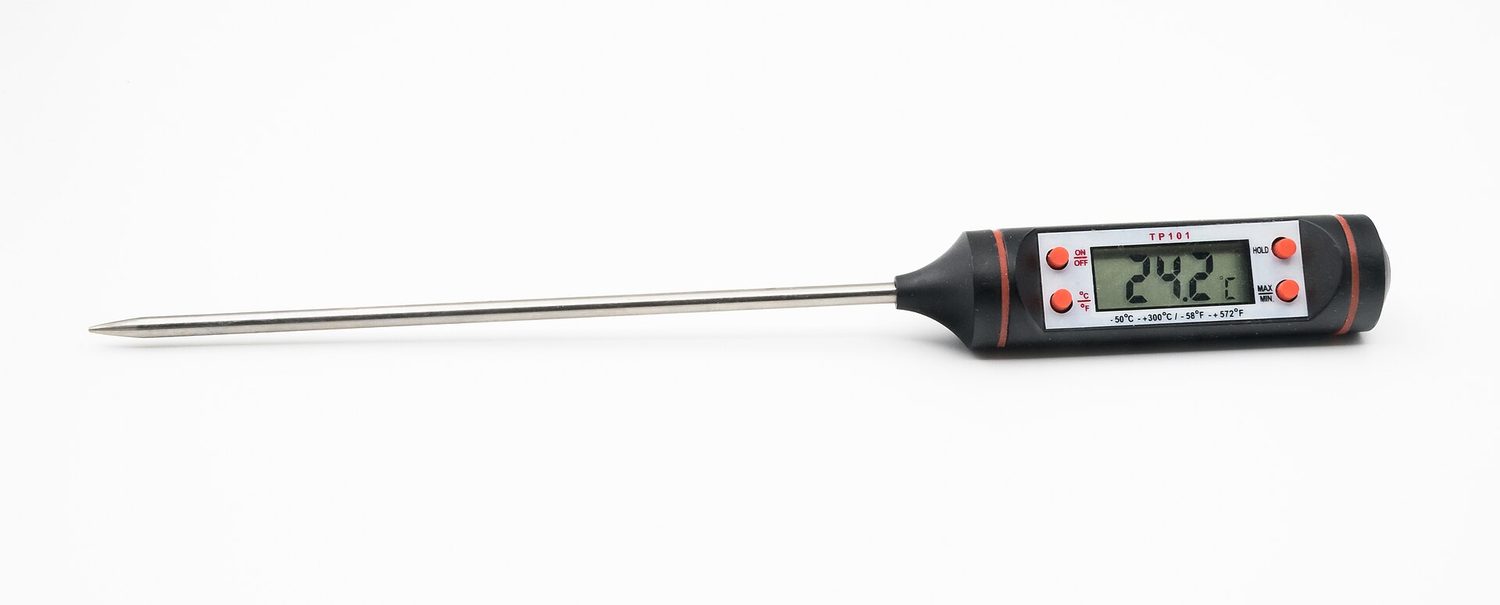
デジタル温度計が温度を測定している
How much energy is needed to heat $2.0\ \text{kg}$ of water by $10\ {}^{\circ}\text{C}$? (Use $c = 4200$ J per kg per °C.)
難易度 2/5 · 140 コイン + 今日初回完了時に小ボーナス付与
$\Delta E = mc\,\Delta\theta = 2.0 \times 4200 \times 10 = 84\,000\ \text{J}$.
Adding $8400\ \text{J}$ raises the temperature of $0.50\ \text{kg}$ of a metal by $40\ {}^{\circ}\text{C}$. What is its specific heat capacity, in J per kg per °C?
難易度 2/5 · 140 コイン + 今日初回完了時に小ボーナス付与
$c = \dfrac{\Delta E}{m\,\Delta\theta} = \dfrac{8400}{0.50 \times 40} = \dfrac{8400}{20} = 420$ J per kg per °C.
Because water has a high specific heat capacity, it warms up and cools down slowly.
難易度 1/5 · 100 コイン + 今日初回完了時に小ボーナス付与
A high specific heat capacity means a lot of energy is needed per degree, so water changes temperature slowly.
理解できましたか
- 加熱すると物質は膨張する — 気体で最も大きく、固体で最も小さく;膨張のための隙間を設ける
- 内部エネルギー = 全粒子のエネルギーの総和
- 比熱容量 $c = \dfrac{\Delta E}{m\,\Delta\theta}$、したがって $\Delta E = mc\,\Delta\theta$
- 水は高い $c$を持つ → 暖まりも冷めも遅い