| English | 意味 |
|---|---|
| particles/ˈpɑːtɪklz/ | 粒子 |
| kinetic particle model/kɪˈnetɪk ˈpɑːtɪkl ˈmɒdl/ | 分子運動論モデル |
| solid/ˈsɒlɪd/ | 固体 |
| liquid/ˈlɪkwɪd/ | 液体 |
| gas/ɡæs/ | 気体 |
| temperature/ˈtemprɪtʃə/ | 温度 |
| absolute zero/ˈæbsəluːt ˈzɪərəʊ/ | 絶対零度 |
| kelvin/ˈkelvɪn/ | ケルビン |
| Brownian motion/ˈbraʊnɪən ˈməʊʃn/ | ブラウン運動 |
物質は粒子でできている
- 注意深く見れば、すべての物質は絶えず運動している微小な粒子から構成されていることがわかる。
- この一つの考え方——運動論的粒子モデル——が固体、液体、気体、熱、圧力を説明する。
- 粒子たちが何をしているか見てみよう。
物質の三状態
- 固体 — 粒子が規則正しく詰まっており、振動するのみ。固定された形状と体積を持つ。
- 液体 — 粒子は依然として近接しているが乱れており、互いの上を滑り動く。固定された体積を持ち、容器の形を取る。
- 気体 — 粒子同士は離れており、高速でランダムに運動する。容器全体を満たす。

Squeeze a gas (Boyle's law)
Slide the piston in to shrink the volume. The same particles get crammed into less space, so they hit the walls more often and the pressure climbs — while pressure × volume stays constant.
In which state are the particles far apart, fast, and moving in random directions?
難易度 1/5 · 100 コイン + 今日初回完了時に小ボーナス付与
Gas particles are far apart and move quickly in random directions, filling the container. Solids only vibrate; liquids slide past each other.
温度と粒子エネルギー
- 物質を加熱すると粒子は速く動き、運動エネルギーを得る。
- 温度とは、粒子の平均運動エネルギーの尺度である。
- あり得る最低の温度は絶対零度であり、$-273\ {}^{\circ}\text{C}$ — 粒子が最も少ないエネルギーを持つ。
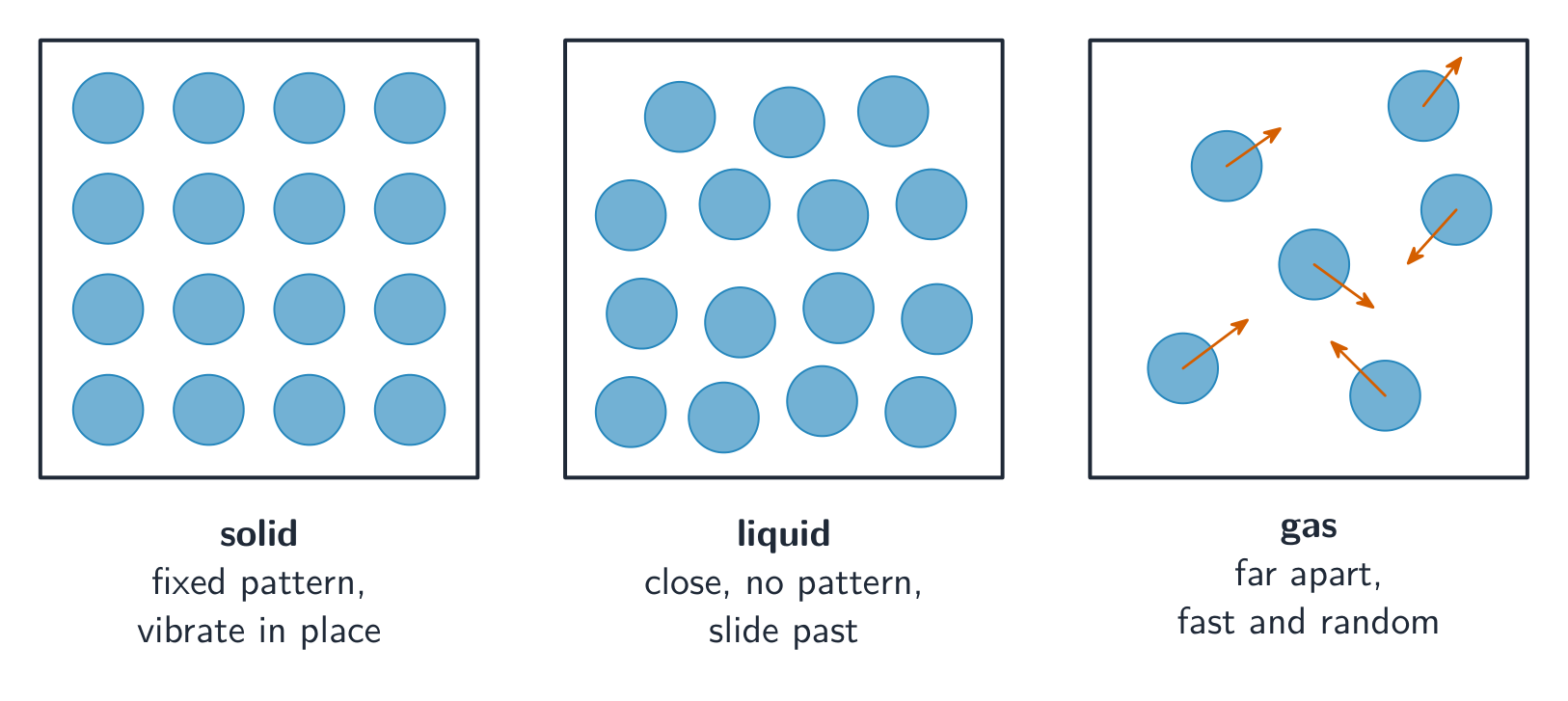
固体、液体、気体の粒子モデル
Temperature is a measure of:
難易度 1/5 · 100 コイン + 今日初回完了時に小ボーナス付与
Hotter means the particles move faster, so temperature measures their average kinetic energy.
ケルビンスケール
- 科学者はよく、絶対零度を起点としてケルビン (K) で温度を測定する。
- 変換には:
- したがって $0\ {}^{\circ}\text{C} = 273\ \text{K}$ と $27\ {}^{\circ}\text{C} = 300\ \text{K}$ 。

Convert $27\ {}^{\circ}\text{C}$ to kelvin.
難易度 2/5 · 140 コイン + 今日初回完了時に小ボーナス付与
$T = \theta + 273 = 27 + 273 = 300\ \text{K}$.
気体圧力
- 気体粒子は常に容器の壁に衝突している。各衝突は微小な押し出しである。
- 圧力とは、これらの衝突による全力が単位面積あたりに及ぼすものである。
- 気体を加熱(体積一定)→ 高速・強力・高頻度の衝突 → 圧力上昇。
- 壓縮して小さくする(温度一定)→ 単位面積あたりの秒間衝突数増加 → 圧力上昇。
- 一定質量の気体において一定温度なら、$pV = \text{constant}$ (体積を半分にする → 圧力を倍にする)。

A gas has a volume of $200\ \text{cm}^3$ at $100\ \text{kPa}$. It is squeezed to $100\ \text{cm}^3$ at constant temperature. What is the new pressure, in kPa?
難易度 2/5 · 140 コイン + 今日初回完了時に小ボーナス付与
$pV$ is constant: $100 \times 200 = p \times 100$, so $p = 200\ \text{kPa}$. Halving the volume doubles the pressure.
Heating a gas in a sealed, fixed-volume can increases its pressure.
難易度 1/5 · 100 コイン + 今日初回完了時に小ボーナス付与
Hotter particles move faster and hit the walls harder and more often, so the pressure rises.
ブラウン運動
- 顕微鏡下では、空気中の煙の微粒子が不規則でランダムな軌道に沿ってジグザグに揺れているのが見える。
- これはブラウン運動であり、大きな微粒子が高速で目に見えない空気粒子によって叩き潰されているためである。
- 物質が実際に運動する粒子から構成されているという強い証拠である。
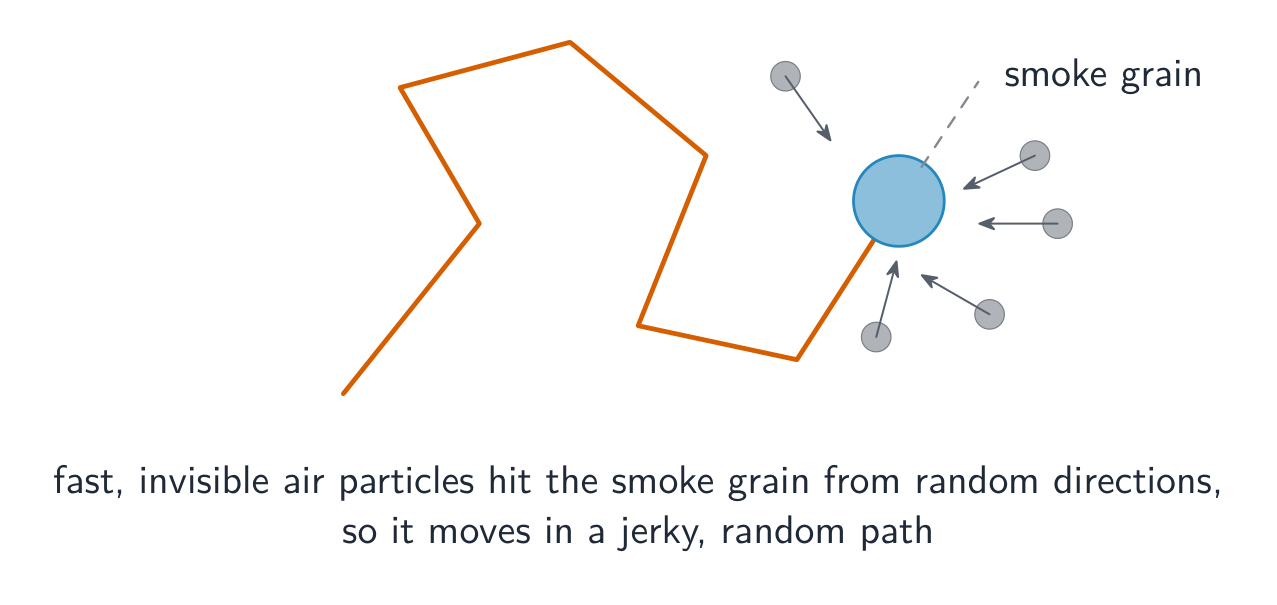
高速で目に見えない空気粒子からのランダムな衝突が、煙粒子を不規則でランダムな軌道に押し出す
Smoke specks seen under a microscope jiggle randomly. This is because:
難易度 1/5 · 100 コイン + 今日初回完了時に小ボーナス付与
Brownian motion: tiny fast air particles knock the larger smoke specks about, evidence for moving particles.
理解できましたか
- 固体(固定、振動)・液体(近接、滑走)・気体(離散、高速)
- 温度 = 粒子の平均運動エネルギー;絶対零度 $= -273\ {}^{\circ}\text{C}$
- $T\,(\text{K}) = \theta\,({}^{\circ}\text{C}) + 273$
- 気体圧力 = 単位面積あたりの粒子衝突数;一定温度なら $pV = \text{constant}$