| English | 意味 |
|---|---|
| kinetic energy/kɪˈnetɪk ˈenədʒi/ | 運動エネルギー |
| gravitational potential energy/ˌɡrævɪˈteɪʃənl pəˈtenʃl ˈenədʒi/ | 位置エネルギー(重力) |
| conservation of energy/ˌkɒnsəˈveɪʃn ɒv ˈenədʒi/ | エネルギーの保存 |
| Sankey diagram/ˈsæŋki ˈdaɪəɡræm/ | サンキー図 |
| work done/wɜːk dʌn/ | 仕事 |
| joule/dʒuːl/ | ジュール |
| power/ˈpaʊə/ | 仕事率 |
| efficiency/ɪˈfɪʃənsi/ | 効率 |
| watt/wɒt/ | ワット |
Energy never disappears
- At the top of a roller-coaster hill the car is slow but high; at the bottom it is fast but low.
- The energy did not vanish — it just moved from one store to another.
- This is the big idea of this lesson: energy is stored, transferred, and always conserved.
Energy stores and transfers
- Energy can be stored as: kinetic, gravitational potential, chemical, elastic (strain), nuclear, electrostatic, and internal (thermal).
- It is transferred between stores by: forces (mechanical work), electric currents, heating, and waves (such as light and sound).
- "Using energy" really means moving it from one store to another.
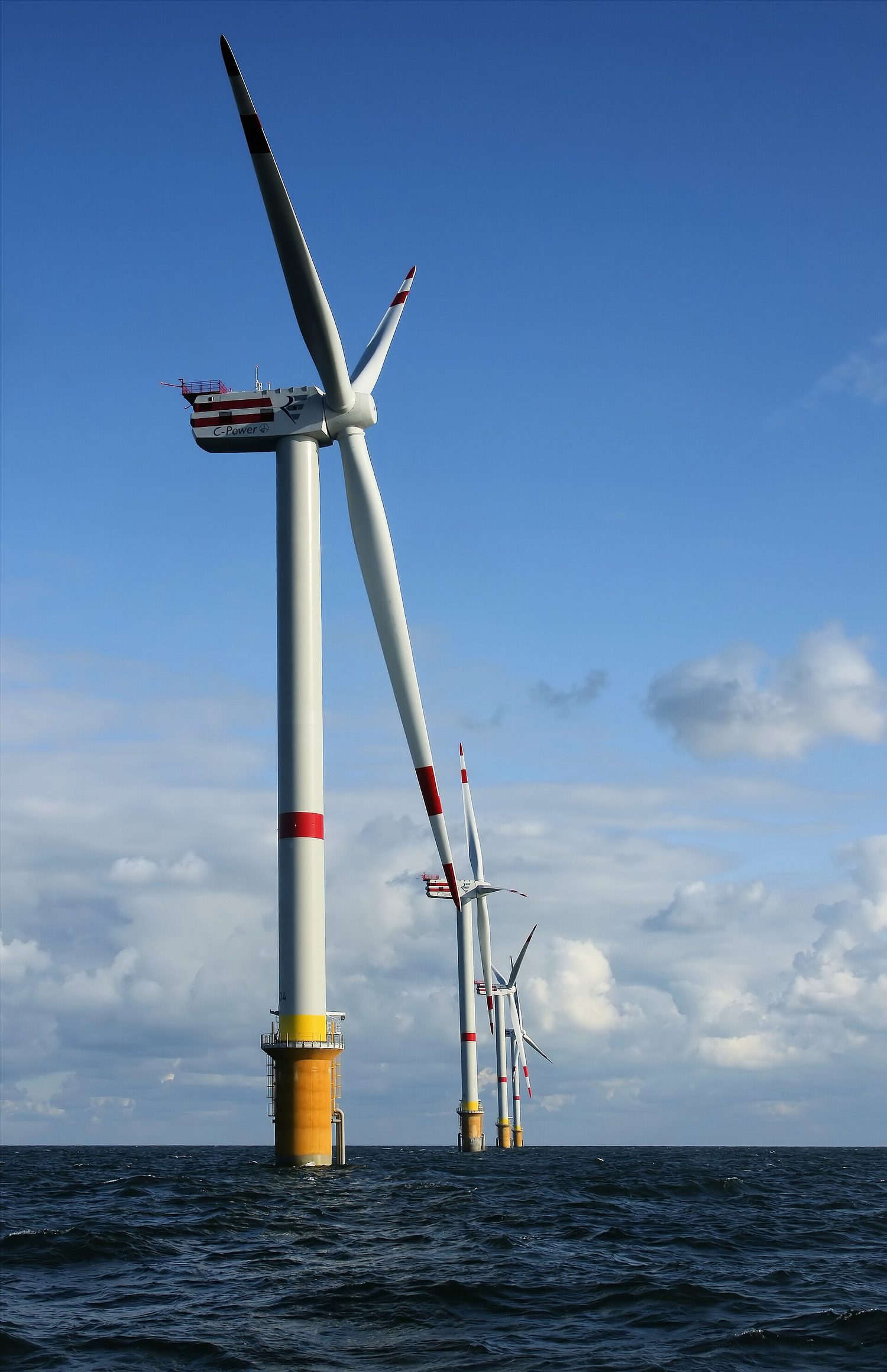
Wind turbines transfer energy from moving air to electricity
エネルギーの流れと効率
入力エネルギーは有用な出力と散逸エネルギーに分かれ、効率は有用な割合であり、総エネルギーは常に保存される。
エネルギー、仕事、 power(出力)
PE + KE = 一定
物体が落下すると、位置エネルギーが運動エネルギーに変換され、総エネルギーは一定である。
すべてのエネルギー蓄積体を選ぶ。
難易度 2/5 · 140 コイン + 今日初回完了時に小ボーナス付与
運動エネルギー、化学エネルギー、重力位置エネルギーはエネルギー蓄積体である。「大きな音」や「速い」は物の性質を表すが、エネルギー蓄積体ではない。
Kinetic and potential energy
- Kinetic energy 动能 is the energy of a moving object:
- Lifting a mass by a height $\Delta h$ changes its gravitational potential energy 重力势能:
- A falling object turns gravitational PE into kinetic energy.

$2.0\ \text{kg}$ の球が $3.0\ \text{m/s}$ で動いている。運動エネルギーは J単位でいくつになるか?
難易度 2/5 · 140 コイン + 今日初回完了時に小ボーナス付与
$E_k = \tfrac{1}{2}mv^2 = \tfrac{1}{2} \times 2.0 \times 3.0^2 = 9.0\ \text{J}$.
Conservation of energy 能量守恒
- The principle of conservation of energy: energy is never made or destroyed — it only moves between stores.
- Some energy is always wasted — usually spread out as heat to the surroundings.
- A Sankey diagram 桑基图 shows the input energy splitting into useful energy and wasted energy.
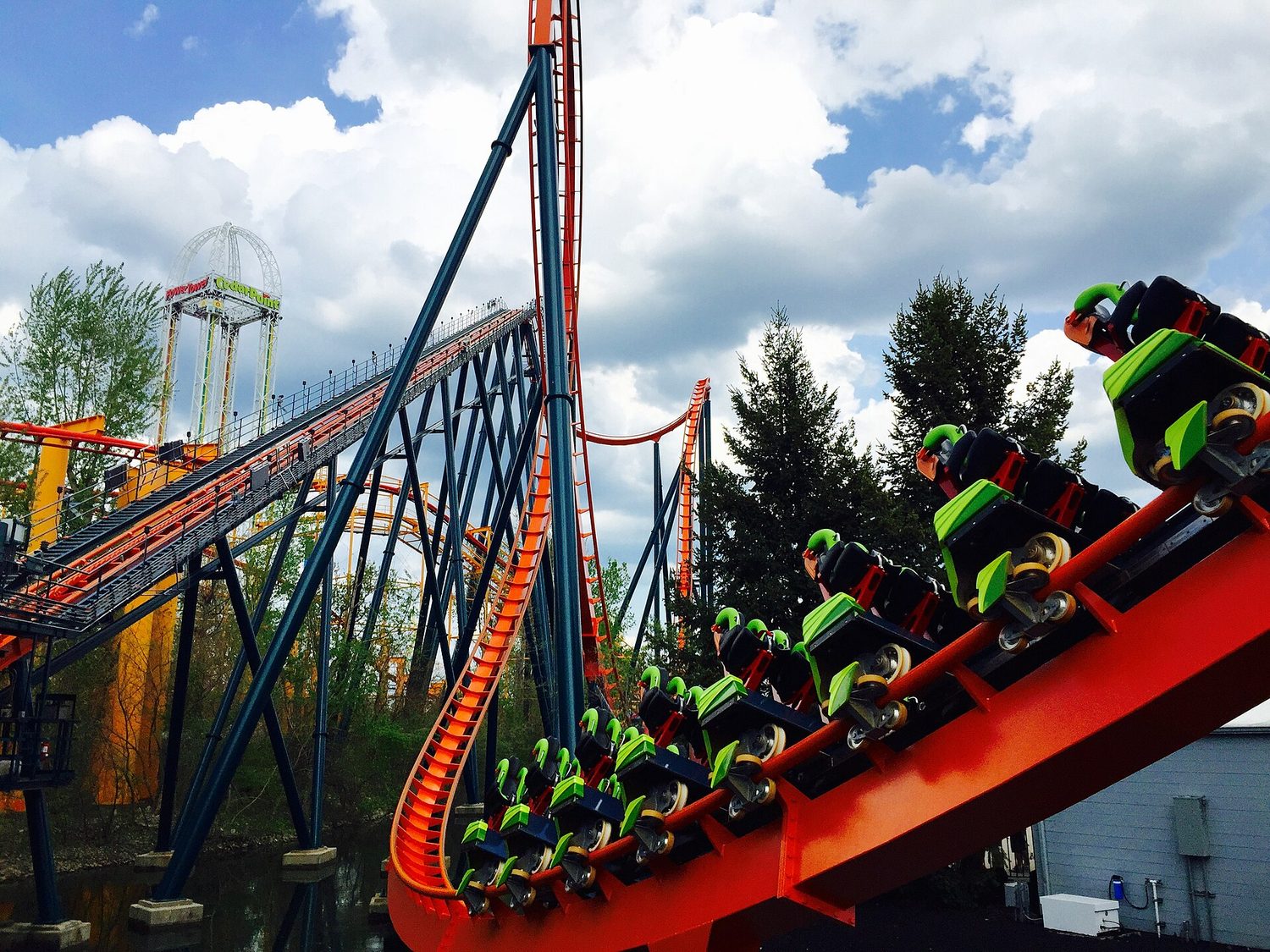
On a roller-coaster, stored energy at the top becomes kinetic energy lower down
機械がエネルギーを散逸させる場合、散逸したエネルギーは通常どこへ行くか?
難易度 1/5 · 100 コイン + 今日初回完了時に小ボーナス付与
エネルギーは保存され、決して消失することはない。散逸したエネルギーは通常、熱として広がり、再び使用するのが困難になる。
Work
- Work done 做功 equals the energy transferred. When a force moves an object along its direction:
- The unit of work and energy is the joule 焦耳 (J).
- Lifting a heavier load, or moving it further, does more work.
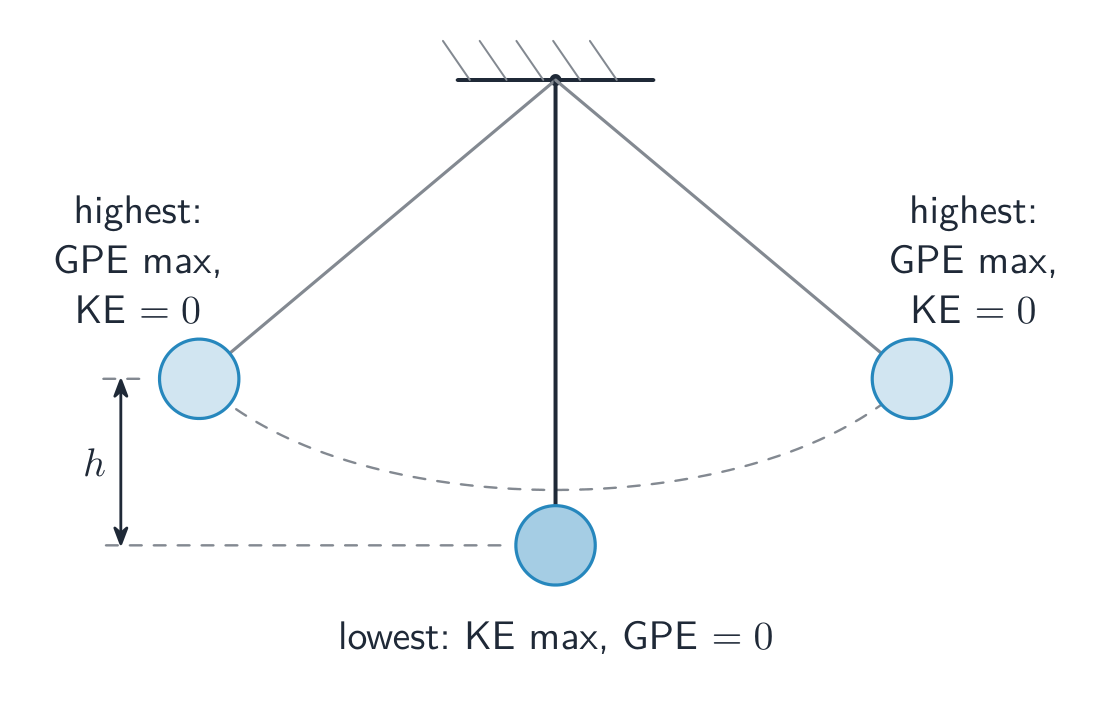
A swinging pendulum trades gravitational potential energy for kinetic energy and back
力$50\ \text{N}$で箱を床面沿いに$4.0\ \text{m}$だけ動かす際、行われた仕事量(J)はいくらか?
難易度 2/5 · 140 コイン + 今日初回完了時に小ボーナス付与
$W = Fd = 50 \times 4.0 = 200\ \text{J}$.
Power 功率 and efficiency 效率
- Power is the work done (energy transferred) each second:
- The unit is the watt 瓦特 (W); $1\ \text{W} = 1\ \text{J/s}$.
- Efficiency is how much of the input energy becomes useful:
- It is always less than $100\%$ because some energy is always wasted.
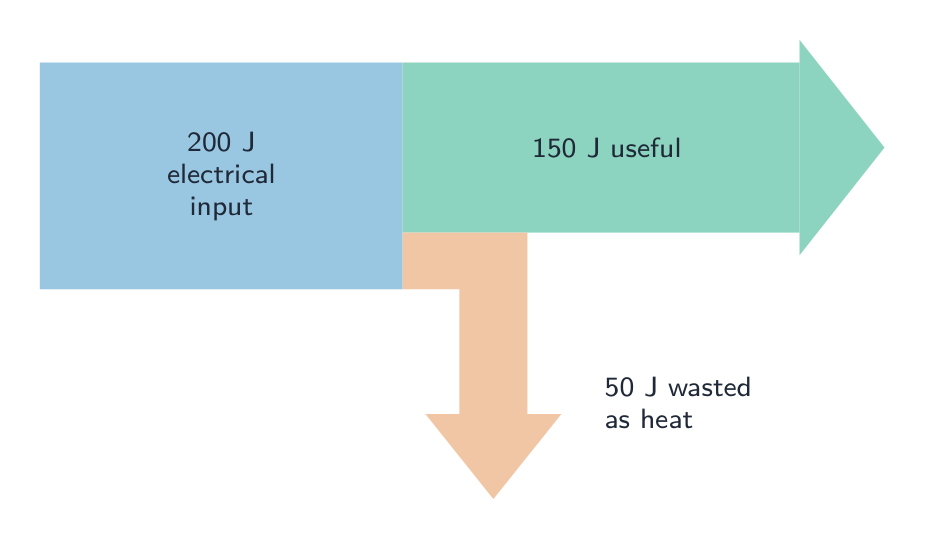
A Sankey diagram: the band widths are proportional to the energy, so the input splits into useful output and wasted heat
モーターが$200\ \text{J}$の仕事を$10\ \text{s}$で行う。このモーターの出力はWで幾つか?
難易度 2/5 · 140 コイン + 今日初回完了時に小ボーナス付与
$P = \dfrac{W}{t} = \dfrac{200}{10} = 20\ \text{W}$.
ランプが $50\ \text{J}$ の電気エネルギーを取り込み、有用な光として $30\ \text{J}$ を放出する。効率はいくつ % か?
難易度 2/5 · 140 コイン + 今日初回完了時に小ボーナス付与
効率 $= \dfrac{\text{useful}}{\text{total}} \times 100\% = \dfrac{30}{50} \times 100\% = 60\%$ 。
You've got it
- $E_k = \tfrac{1}{2}mv^2$ · $\Delta E_p = mg\,\Delta h$
- energy is conserved — wasted energy usually ends up as heat
- work $W = Fd$ (joule); power $P = \dfrac{W}{t}$ (watt)
- efficiency $= \dfrac{\text{useful}}{\text{total}} \times 100\%$, always below $100\%$