| English | 意味 |
|---|---|
| linear equations/ˈlɪnɪə ɪˈkweɪʒnz/ | 一次方程式 |
| simultaneous equations/ˌsɪməlˈteɪnɪəs ɪˈkweɪʒnz/ | 連立方程式 |
| eliminate/ɪˈlɪmɪneɪt/ | 消元 |
| quadratic/kwɒˈdrætɪk/ | 二次 |
| subject/ˈsʌbdʒekt/ | 主項 |
The ancient art of balancing
- The word "equation" comes from "equal" — both sides must be the same, like a balance scale.
- Babylonians solved linear equations 一次方程 4000 years ago using clay tablets. Today we use the same principle: do the same to both sides.
Linear equations
- Solve by doing the same operation to both sides until the unknown is alone.
- $3x + 7 = 22 \Rightarrow 3x = 15 \Rightarrow x = 5$.
Watch the signs. $-2x + 5 = 11 \Rightarrow -2x = 6 \Rightarrow x = -3$. Dividing by a negative flips the sign of the answer.

Solve by doing the same to both sides
方程式を解く
y = ax² + bx + c
解くとは根を見つけること——曲線がx軸と交わる点である。
3x + 7 = 22 を解け。
難易度 2/5 · 140 コイン + 今日初回完了時に小ボーナス付与
3x = 22 − 7 = 15 なので、x = 5。
Simultaneous equations 联立方程
- Two equations, two unknowns. Eliminate 消元 one variable by adding or subtracting.
- $2x + y = 7$ and $3x - y = 8$: adding gives $5x = 15$, so $x = 3$, then $y = 1$.
Check your answer. Substitute back: $2(3) + 1 = 7$ ✓ and $3(3) - 1 = 8$ ✓.
2x + y = 7 および 3x − y = 8 を解き、xの値を求めよ。
難易度 2/5 · 140 コイン + 今日初回完了時に小ボーナス付与
方程式を足すと:5x = 15、よって x = 3(その後 y = 1)。
2x + y = 7 および 3x − y = 8 から、y はいくつか?
難易度 2/5 · 140 コイン + 今日初回完了時に小ボーナス付与
足し算して x = 3 が得られる。代入すると: 2(3) + y = 7 → y = 1。
Quadratic 二次 equations (Extended)
- A quadratic $ax^2 + bx + c = 0$ can have two, one, or zero real solutions.
- By factorising: $x^2 + 5x + 6 = 0 \Rightarrow (x+2)(x+3) = 0 \Rightarrow x = -2$ or $x = -3$.
- By the formula: $x = \dfrac{-b \pm \sqrt{b^2 - 4ac}}{2a}$ (given in the exam).
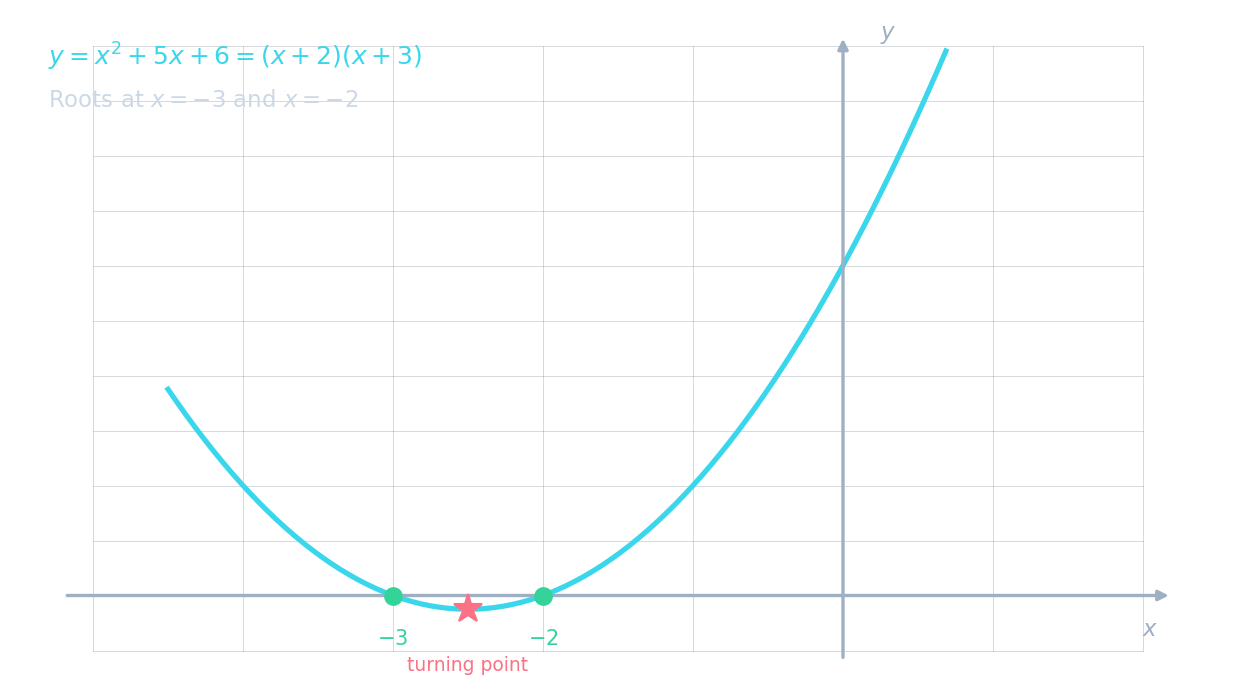
The roots of a quadratic are where the parabola crosses the $x$-axis — the solutions of $y = 0$.
因数分解により x² + 5x + 6 = 0 を解け。
難易度 1/5 · 100 コイン + 今日初回完了時に小ボーナス付与
(x + 2)(x + 3) = 0 より、x = −2 または x = −3。
二次方程式の公式は x = (−b ± √(b² − 4ac)) / (2a) である。
難易度 1/5 · 100 コイン + 今日初回完了時に小ボーナス付与
この公式は任意の二次方程式 ax² + bx + c = 0 を解くことができる。
Powers in rearranging formulae (Extended)
- Make a letter the subject 主项 by reversing the operations applied to it.
- Make $r$ the subject of $V = \dfrac{4}{3}\pi r^3$: $\;r^3 = \dfrac{3V}{4\pi}$, so $r = \sqrt[3]{\dfrac{3V}{4\pi}}$.
V = (4/3)πr³ の変数 r を解け。r = ∛(____)。
難易度 1/5 · 100 コイン + 今日初回完了時に小ボーナス付与
両辺に 3/(4π) を掛けて r³ = 3V/(4π) とし、その後立方根を取る。
Build an equation, then choose a method
- A ticket problem gives $2a+c=31$ and $a+2c=26$. Double the second and subtract the first: $3c=21$, so $c=7$, then $a=12$. Check both original totals.
- Core rearrangement: $C=5t+8$ gives $C-8=5t$, then $t=(C-8)/5$. The subject appears once and has no power or root.
2a + c = 31 および a + 2c = 26 のとき、a を求めよ。
難易度 2/5 · 140 コイン + 今日初回完了時に小ボーナス付与
a を消去する: 3c = 21、c = 7。次に 2a = 24、a = 12。
Completing the square and the formula (Extended)
- $x^2+6x+5=0$ becomes $(x+3)^2-4=0$, so $x+3=\pm2$, giving $x=-1,-5$.
- For $2x^2+x-3=0$, choose $a=2,b=1,c=-3$ in $x=(-b\pm\sqrt{b^2-4ac})/(2a)$. Thus $x=(-1\pm5)/4=1,-1.5$. Substitution checks each root.
2x² + x − 3 = 0 の正の解を求めよ。
難易度 2/5 · 140 コイン + 今日初回完了時に小ボーナス付与
公式より (−1+5)/4 = 1 となり、もう一つの解は −1.5 である。
Fractional equations (Extended)
- For $x/(x+2)=3/5$, exclude $x=-2$. Multiply by $5(x+2)$: $5x=3(x+2)$, so $2x=6$ and $x=3$. Check $3/5=3/5$.
- For $2/(x+1)+1/(x-1)=1$, exclude $x=-1,1$. Multiply through by $(x+1)(x-1)$: $2(x-1)+(x+1)=x^2-1$. This gives $x^2-3x=0$, so $x=0$ or 3; both are allowed.
x/(x+2) = 3/5 を解け。
難易度 2/5 · 140 コイン + 今日初回完了時に小ボーナス付与
5x = 3x+6 より x = 3 となるが、これは除外される値 −2 ではない。
One line and one curve (Extended)
- Solve $y=x+2$ and $y=x^2$ by substituting: $x^2=x+2$, so $(x-2)(x+1)=0$. Thus $x=2$ or $-1$.
- Find the matching $y$ for each: the pairs are $(2,4)$ and $(-1,1)$. Do not mix one root with the other root's $y$ value.
y = x+2 および y = x² を解き、正の x の解を答えよ。
難易度 2/5 · 140 コイン + 今日初回完了時に小ボーナス付与
x²−x−2 = (x−2)(x+1) であるため、正の解は 2 である。
A subject appearing twice (Extended)
- Rearrange $y=(3x+2)/(x-1)$ for $x$: $y(x-1)=3x+2$, then $yx-3x=y+2$.
- Factor the subject: $x(y-3)=y+2$, giving $x=(y+2)/(y-3)$, $y\ne3$. The original also requires $x\ne1$.
You've got it
- linear: same operation to both sides; simultaneous: add/subtract to eliminate
- quadratics: factorise, complete the square, or use the formula
- rearrange: undo the operations in reverse order to make a letter the subject