| English | 意味 |
|---|---|
| exponential growth/ˌekspəˈnenʃl ɡrəʊθ/ | 指数関数的増加 |
| compound/ˈkɒmpaʊnd/ | 複利 |
| decay/dɪˈkeɪ/ | 減少 |
| depreciation/dɪˌpriːʃɪˈeɪʃn/ | 減価償却 |
| half-life/hɑːf laɪf/ | 半減期 |
One bacterium becomes a billion
- A bacterium divides every 20 minutes. After 10 hours (30 divisions), one cell becomes $2^{30} \approx 1\,073\,741\,824$ — over a billion.
- That's exponential growth 指数增长: the same percentage increase every period, compounding 复利.
- Linear growth adds a fixed amount; exponential growth multiplies — and it always wins in the end.
The compound formula
- When a quantity changes by the same percentage each period:
- $P$ = starting value, $r$ = percentage rate per period, $t$ = number of periods.
- Growth: $r > 0$; decay 衰减: $r < 0$ (or use a multiplier below 1).
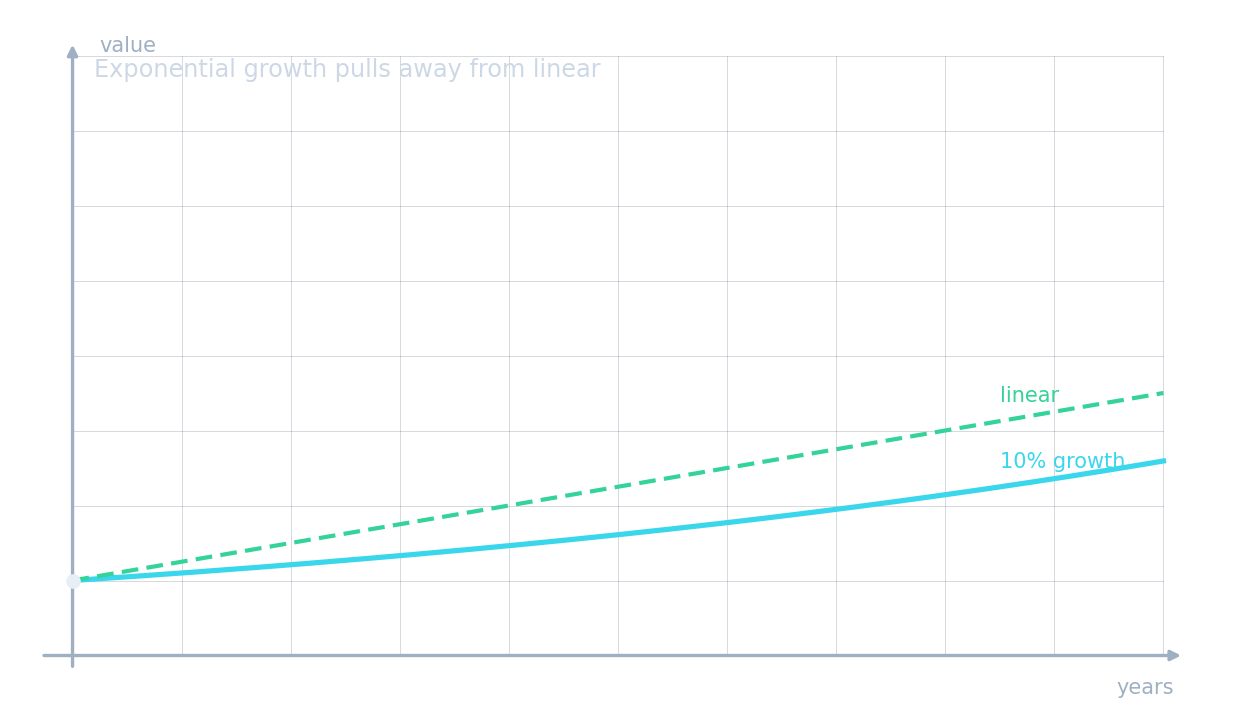
Exponential growth (curve) starts slowly but eventually pulls far ahead of linear growth (straight line).
複利
お金は毎年 (1 + r) ずつ増えるため、複利曲線は単利曲線より上に描かれる。利率と年数Dragして確認せよ。
指数関数的増加・減少
y = a·bˣ
底 b を変更する:b > 1 で 増加し、0 < b < 1 で 減少する — 利子や人口に有用。
自動車が毎年その価値の15%を減失する。年ごとの乗数として何を使うか?
難易度 2/5 · 140 コイン + 今日初回完了時に小ボーナス付与
15%減少すると85%残るため、乗数は0.85となる。
車の価値が毎年値崩れすることは以下の例のどれですか:
難易度 1/5 · 100 コイン + 今日初回完了時に小ボーナス付与
毎年一定の割合を失うことは指数関数的減少です(乗数 < 1、繰り返し適用)。
複利成長の公式は:最終 = P × (1 + ______)^t です。ここで r は百分率です。
難易度 1/5 · 100 コイン + 今日初回完了時に小ボーナス付与
rate r% を小数に変換する必要があります:r/100。したがって、乗数は (1 + r/100) となります。
Exponential decay and depreciation 折旧
- Decay works the same way with a multiplier below 1.
- A car worth 20 000 loses 15% each year → multiplier $0.85$.
- After 4 years: $20\,000 \times 0.85^4 = 20\,000 \times 0.5220 \approx 10\,440$.
Half-life 半衰期. A radioactive isotope decays 10% per year. Its "half-life" (time to halve) is $\dfrac{\ln 2}{\ln(1/0.9)} \approx 6.6$ years — you can find it by solving $0.9^t = 0.5$.
20000円の価値を持つ車が、毎年15%値崩れします。4年後の価値(10位に丸めたもの)は:
難易度 2/5 · 140 コイン + 今日初回完了時に小ボーナス付与
20000 × 0.85⁴ = 20000 × 0.5220 ≈ 10440.
Worked example
- Population of 5000 grows 8% per year. After 6 years:
- $5000 \times 1.08^6 = 5000 \times 1.5869 \approx 7934$.
Compound ≠ simple. 8% per year for 6 years is not $8 \times 6 = 48\%$ total (that would give $5000 \times 1.48 = 7400$). Compounding gives $58.7\%$ total — almost 11% more, because each year's growth earns growth too.
人口 5000 が年率 8% で増加する。6年後の人口(四捨五入した整数)はいくらか?
難易度 2/5 · 140 コイン + 今日初回完了時に小ボーナス付与
5000 × 1.08⁶ = 5000 × 1.5869 ≈ 7934.
8%の年率で6年間成長すると、合計増加分はちょうど48%になります。
難易度 1/5 · 100 コイン + 今日初回完了時に小ボーナス付与
複利により 1.08⁶ ≈ 1.587 となり、58.7% の増加となる — 成長自体が成長を生むため、48% よりも大きい。
Where exponential growth shows up
- Epidemics: early spread is often exponential (each infected person infects others).
- Investments: compound interest is exponential growth of your money.
- Technology: Moore's Law predicted computing power doubling every ~2 years for decades.
You've got it
- exponential change uses the compound formula $P(1 + r/100)^t$
- growth = multiplier $> 1$; decay/depreciation = multiplier $< 1$
- a 15% yearly loss → multiplier $0.85$; after 4 years: $20\,000 \times 0.85^4 \approx 10\,440$
- exponential always beats linear eventually — compounding earns growth on growth