Now the function, not the identification
- Units 1 and 3 asked what setting is and which details convey it.
- This objective asks you to explain the function of setting in a narrative.
- The CED gives one function explicitly: a setting may help establish the mood and atmosphere.
Rain may set a mood; if it traps everyone indoors, it has also joined the plot.
CEDは舞台設定のどの機能を明示的に命名しているか?
難易度 1/5 · 100 コイン + 今日初回完了時に小ボーナス付与
ムードと雰囲気は舞台設定の効果である — それが本来あるべき場所である。
Mood and atmosphere are effects
- This is where the words excluded from the definition come back — as effects, which is their proper place.
- Mood is what the reader is made to feel; atmosphere is the quality of the world the reader is put into.
- Both are produced by concrete details, and an analysis has to point at those details.
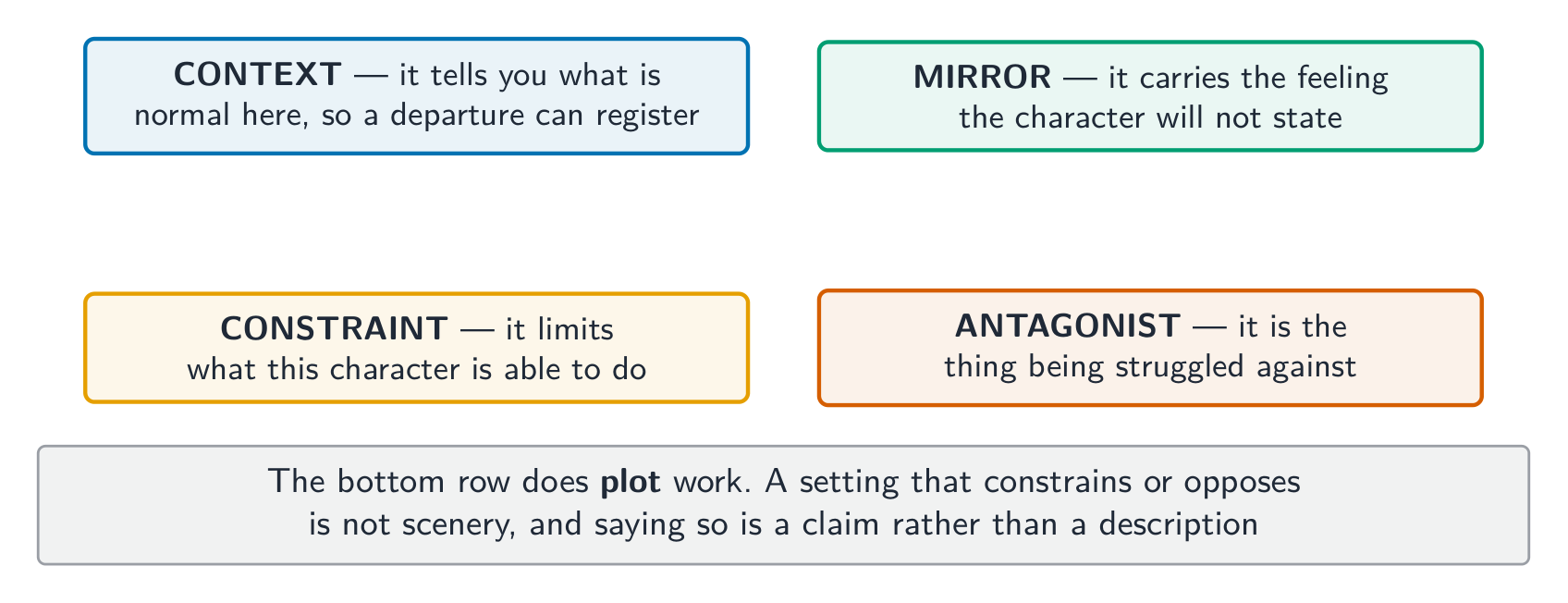
Setting does four jobs, and the bottom row does plot work
各用語をその名指すものに匹配せよ。
難易度 2/5 · 140 コイン + 今日初回完了時に小ボーナス付与
最初の二つは効果であり、三つ目が定義である。
From detail to effect, always in that direction
- Weak: the setting creates a tense atmosphere. Strong: the unlit stair and the door left ajar produce it.
- The effect without its cause is an assertion; the cause without the effect is a list.
- Every setting-function sentence needs both halves.
詳細か、効果か、それとも完全な文か?
各断片をそれが提供するものによって分類せよ。
舞台設定の機能を持つ文は ____ から効果へと進む必要がある。
難易度 1/5 · 100 コイン + 今日初回完了時に小ボーナス付与
原因のない効果とは、読者が検証できない主張である。
An effect asserted without its cause earns nothing. "The setting creates a tense atmosphere" is a conclusion the reader cannot check. Point at the unlit stair, the door left ajar, the clock that is still going — then the atmosphere is evidence rather than opinion.
物語の中で舞台設定の機能は、詳細が変わらなくても変化することがある。
難易度 1/5 · 100 コイン + 今日初回完了時に小ボーナス付与
同じ家でも、あるシーンでは庇となり、次のシーンでは閉じ込めとなる可能性がある。
Settings can change function mid-story
- The same house can be shelter in one scene and confinement in the next.
- Nothing about the house changed; the narrative changed around it.
- A shift in what a setting does is often where a short story turns.
すべての舞台設定の機能確認ステップを選択せよ。
難易度 2/5 · 140 コイン + 今日初回完了時に小ボーナス付与
天候は詳細であり、ステップではない。
A setting-function pass
- List the concrete details. Name the mood or atmosphere they produce.
- Write one sentence containing both, in that order.
- Then check whether the same setting does something different later.
The kitchen is warm, full, and the only room with a lock. In the first half those three details make it shelter. After the argument, the same three make it confinement — and the story never adds a detail to accomplish the turn.
This subtopic asks for function, not identification: a setting may help establish the mood and atmosphere. Move from detail to effect in that order — an asserted effect cannot be checked. And a setting's function can change mid-story without any detail changing.