| English | 意味 |
|---|---|
| luminosity/ˌluːmɪˈnɒsɪti/ | 光度 |
| inverse-square law/ɪnˈvɜːs skweə lɔː/ | 平方反比の法則 |
| standard candle/ˈstændəd ˈkændl/ | 標準ローソク |
| total power/ˈtəʊtl ˈpaʊə/ | 全放射能 |
| energy/ˈenədʒi/ | エネルギー |
| radiant flux intensity/ˈreɪdɪənt flʌks ɪnˈtensɪti/ | 放射束密度 |
| Cepheid variables/ˈsefiɪd ˈveərɪəblz/ | セフェイド変光星 |
| Type Ia supernovae/taɪp wʌn ˈeɪ ˌsuːpəˈnəʊviː/ | Ia型超新星 |
Two stars, equally bright, nothing alike
- Pick two stars out of the sky that look exactly as bright as each other. One may be a modest star nearby; the other a monster a hundred times further away.
- Brightness on its own tells you nothing. It is the product of two unknowns: how much light the star makes, and how far it has had to spread.
- Break that deadlock and you have measured the distance to another galaxy. The trick is to find an object whose output you already know.
- This lesson is luminosity 光度, the inverse-square law for flux, and the standard candle 标准烛光.
Luminosity
- The luminosity of a star is the total power 功率 of radiation emitted by the star, in watts. Equivalently, the total energy 能量 emitted per unit time.
- It is a property of the star alone. How bright it looks from Earth is not.
- Asked for two reasons one star appears brighter than another, give exactly these two: a greater luminosity, and a smaller distance.
- Anything else, including colour or size, only matters through those two.
The luminosity of a star is:
難易度 1/5 · 100 コイン + 今日初回完了時に小ボーナス付与
Luminosity $L$ is the energy radiated per second in all directions (watts).
Why might one star appear brighter than another? Select all that apply.
難易度 2/5 · 140 コイン + 今日初回完了時に小ボーナス付与
Colour and size only matter through the luminosity they produce. The two marked reasons are greater luminosity and smaller distance.
Flux and the inverse-square law
- At a distance $d$ that power has spread over a sphere of area $4\pi d^2$, so the radiant flux intensity 辐射通量密度 is
- Units: $\text{W/m}^2$. This is the inverse-square law 平方反比定律. Double the distance and the flux falls to a quarter.
- A telescope measures $F$. If $L$ is known too, the distance follows:

Same light, four times the area
Standard candle distance lab
brightness proportional to 1 / distance^2
Move distance and see why brightness falls quickly.
The flux received from a star falls as 1 over the distance ____.
難易度 1/5 · 100 コイン + 今日初回完了時に小ボーナス付与
$F = \dfrac{L}{4\pi d^{2}}$ — the inverse-square law.
Doubling the distance to a star reduces the radiant flux intensity to one half.
難易度 1/5 · 100 コイン + 今日初回完了時に小ボーナス付与
To one QUARTER. The power spreads over a sphere of area 4 pi d^2, so flux goes as 1/d^2. Using pi d^2 instead is out by a factor of four.
Worked example: sunlight at the Earth
- The Sun's luminosity is $3.8\times10^{26}\ \text{W}$ and the Earth is $1.5\times10^{11}\ \text{m}$ away. Find the radiant flux intensity here.
- $F = \dfrac{L}{4\pi d^2} = \dfrac{3.8\times10^{26}}{4\pi(1.5\times10^{11})^2} = 1.4\times10^{3}\ \text{W/m}^2$.
- That is the number behind every solar-panel calculation you will ever do.
- The $4\pi d^2$ is the area of a sphere, not a circle. Using $\pi d^2$ or $\pi r^2$ is the standard slip and it is out by a factor of four.
A star gives a flux of $100\ \dfrac{\text{W}}{\text{m}^2}$ at distance $d$. What is the flux at $3d$?
難易度 2/5 · 140 コイン + 今日初回完了時に小ボーナス付与
Inverse-square: $\dfrac{100}{3^{2}} = \dfrac{100}{9} \approx 11\ \dfrac{\text{W}}{\text{m}^2}$.
The graph that gives you $L$
- Plot $F$ against $1/d^2$ for one star and the inverse-square law becomes a straight line through the origin.
- Its gradient is $L/4\pi$, so $L = 4\pi \times \text{gradient}$.
- A more luminous star gives a steeper line. The origin matters: a line that misses it is not obeying an inverse-square law.
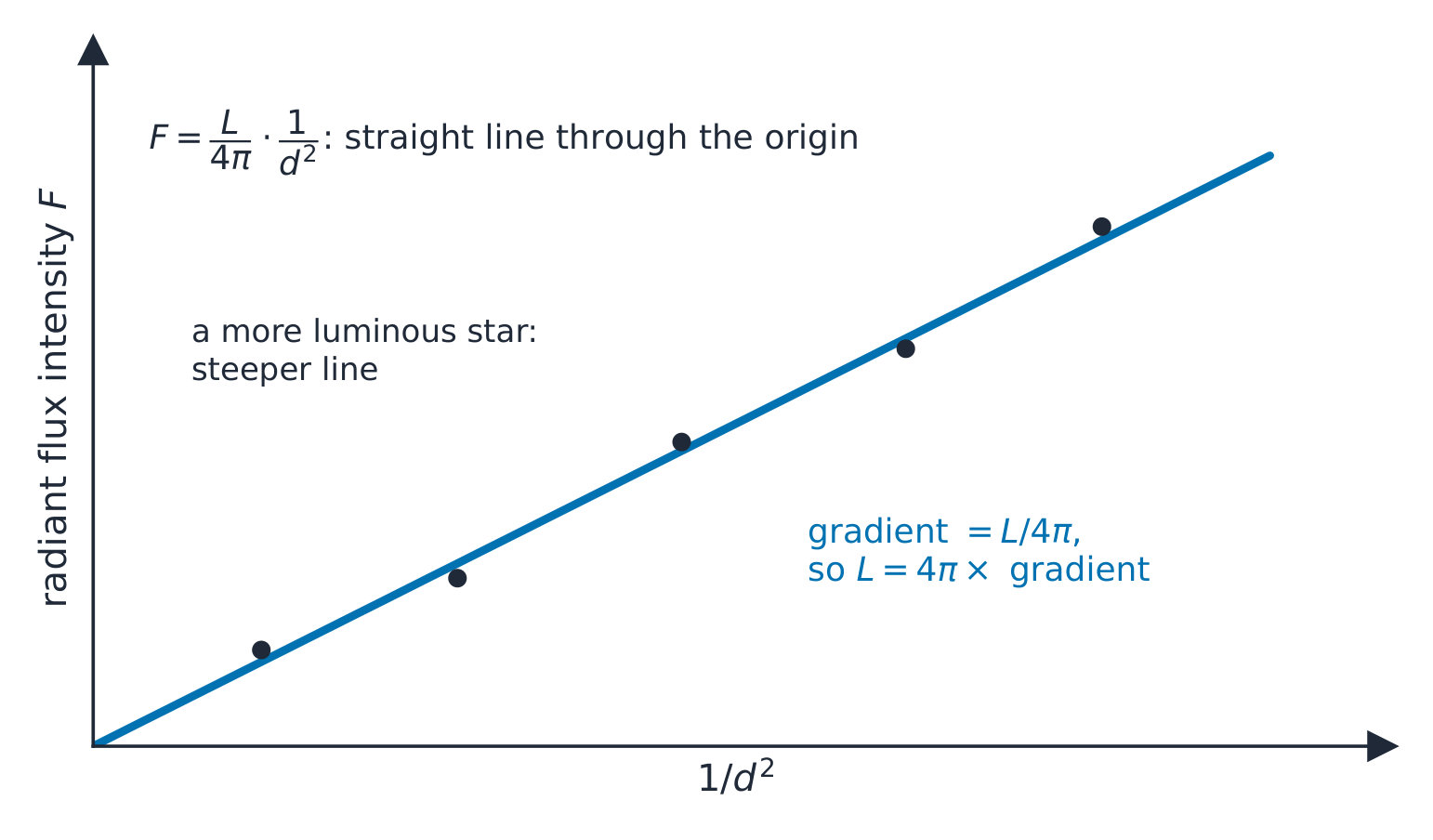
Straighten the curve and read off the luminosity
A graph of flux against $1/d^2$ is a straight line through the origin whose gradient equals the luminosity divided by ____.
難易度 1/5 · 100 コイン + 今日初回完了時に小ボーナス付与
F = (L/4pi)(1/d^2), so L = 4pi x gradient. A more luminous star gives a steeper line, and a line missing the origin is not obeying an inverse-square law.
Worked example: a solar panel on a probe
- The Sun has radius $6.96\times10^{8}\ \text{m}$ and surface temperature $5780\ \text{K}$. A probe $4.5\times10^{10}\ \text{m}$ from the Sun's centre carries a $2.0\ \text{m}^2$ panel facing the Sun. Find the power falling on it.
- Luminosity: $L = 4\pi\sigma r^2 T^4 = 4\pi(5.67\times10^{-8})(6.96\times10^{8})^2(5780)^4 = 3.85\times10^{26}\ \text{W}$.
- Flux there: $F = \dfrac{L}{4\pi d^2} = \dfrac{3.85\times10^{26}}{4\pi(4.5\times10^{10})^2} = 1.5\times10^{4}\ \text{W/m}^2$, eleven times the flux at the Earth.
- Power: $P = FA = 1.5\times10^{4}\times2.0 = 3.0\times10^{4}\ \text{W}$.
- Flux is power per unit area perpendicular to the radiation. A panel tilted at $\theta$ receives $FA\cos\theta$, which is why the question says "facing the Sun".
A probe 4.5e10 m from the Sun (L = 3.85e26 W) carries a 2.0 m^2 panel facing the Sun. What power falls on it, in kW?
難易度 2/5 · 140 コイン + 今日初回完了時に小ボーナス付与
F = L/(4 pi d^2) = 1.5e4 W/m^2, so P = FA = 3.0e4 W = 30 kW. A tilted panel receives FA cos(theta), which is why the question says the panel faces the Sun.
Standard candles
- A standard candle is an object whose luminosity is known from what type of object it is.
- Find one in a distant galaxy, measure the flux $F$ we receive from it, and the distance falls out of $d = \sqrt{L/(4\pi F)}$.
- This is the only way to reach galaxies far too distant for parallax. The whole distance ladder rests on it.
- The logic is worth stating cleanly in an answer: known $L$, measured $F$, therefore $d$.
A standard candle is an object whose ____ is known from its type.
難易度 1/5 · 100 コイン + 今日初回完了時に小ボーナス付与
Knowing $L$ (without first knowing distance) lets you get the distance from the measured flux.
Put the use of a standard candle in order.
難易度 3/5 · 200 コイン + 今日初回完了時に小ボーナス付与
Known L, measured F, therefore d. This is the only way to reach galaxies far too distant for parallax.
The two standard candles to name
- Cepheid variables 造父变星 are pulsating stars whose pulsation period is tightly linked to their luminosity. Time the pulsation and you know $L$.
- Type Ia supernovae 超新星 are white dwarfs that explode on reaching a critical mass, so they always have very nearly the same peak luminosity.
- Both are extremely bright, which is what lets them be seen in other galaxies at all.
- Name the mechanism, not just the object: "the period gives the luminosity", "they all explode at the same mass".
A Cepheid variable's pulsation period tells you its luminosity.
難易度 1/5 · 100 コイン + 今日初回完了時に小ボーナス付与
The period–luminosity relation makes Cepheids excellent standard candles.
Match each standard candle to why its luminosity is known.
難易度 2/5 · 140 コイン + 今日初回完了時に小ボーナス付与
Name the mechanism, not just the object. Both are extremely bright, which is what lets them be seen in other galaxies at all.
Marks that slip away
- The area in the inverse-square law is $4\pi d^2$, a sphere. Not $\pi d^2$.
- Luminosity is a property of the star; flux is what we receive. Questions swap the words deliberately.
- The two reasons one star looks brighter are greater luminosity and smaller distance. Nothing else.
- A standard candle needs a known luminosity. Saying it is "a very bright star" is not the point.
- Keep the distance in metres throughout, and remember flux is measured perpendicular to the radiation.
You've got it
- luminosity is the total power of radiation emitted by a star, a property of the star alone
- radiant flux intensity is $F = L/(4\pi d^2)$, so doubling the distance quarters the flux, and $F$ against $1/d^2$ is a straight line of gradient $L/4\pi$
- a standard candle has a known luminosity, so a measured flux gives the distance $d = \sqrt{L/(4\pi F)}$
- Cepheid variables give $L$ from their pulsation period, and Type Ia supernovae all peak at nearly the same luminosity