| English | 意味 |
|---|---|
| electric potential/ɪˈlektrɪk pəˈtenʃl/ | 電位 |
| scalar/ˈskeɪlə/ | スカラー量 |
| electric potential energy/ɪˈlektrɪk pəˈtenʃl ˈenədʒi/ | 静電気エネルギー |
| infinity/ɪnˈfɪnɪti/ | 無限遠 |
| potential gradient/pəˈtenʃl ˈɡreɪdɪənt/ | 電位勾配 |
| bound/baʊnd/ | 束縛された |
The graph that answers four questions at once
- A favourite exam question draws the electric potential along the line between two charged spheres and asks four things: the signs of the charges, where the field is zero, the ratio of the charges, and the force on a charge placed at a point.
- All four come from the same curve, because potential is a scalar that simply adds, and the field is the gradient of the graph.
- Learn to read that one picture and a whole class of questions becomes routine.
- This lesson is electric potential 电势, its link to the field, and electric potential energy 电势能.
Defining potential
- The electric potential at a point is the work done per unit positive charge in bringing a small test charge from infinity 无穷远 to that point:
- Both marks: work done per unit positive charge, and from infinity to the point. The potential is zero at infinity, which is what makes the definition well posed.
- For a positive source charge $V > 0$ everywhere outside it, because work must be done on a positive test charge to push it in against the repulsion. For a negative source charge $V < 0$.
ある点における電位とは、正の電荷を以下から単位電荷あたりの仕事量として持ち込むことを指す:
難易度 1/5 · 100 コイン + 今日初回完了時に小ボーナス付与
重力ポテンシャルと同様に、電位は無限遠でゼロと定義されることから無限遠で測定される。
電位の2点定義に必要な要素はどれか?すべて選びなさい。
難易度 2/5 · 140 コイン + 今日初回完了時に小ボーナス付与
単位正電荷あたり、かつ無限遠からである。無限遠でのゼロが定義を適切にするものであり、静止性は定義に含まれない。
Potential of a point charge
- Note the $\dfrac{1}{r}$, where the field goes as $\dfrac{1}{r^2}$. That difference is the most-tested fact in the topic.
- $V$ is a scalar 标量. For several charges, add the potentials with their signs: no directions, no resolving, just a sum.
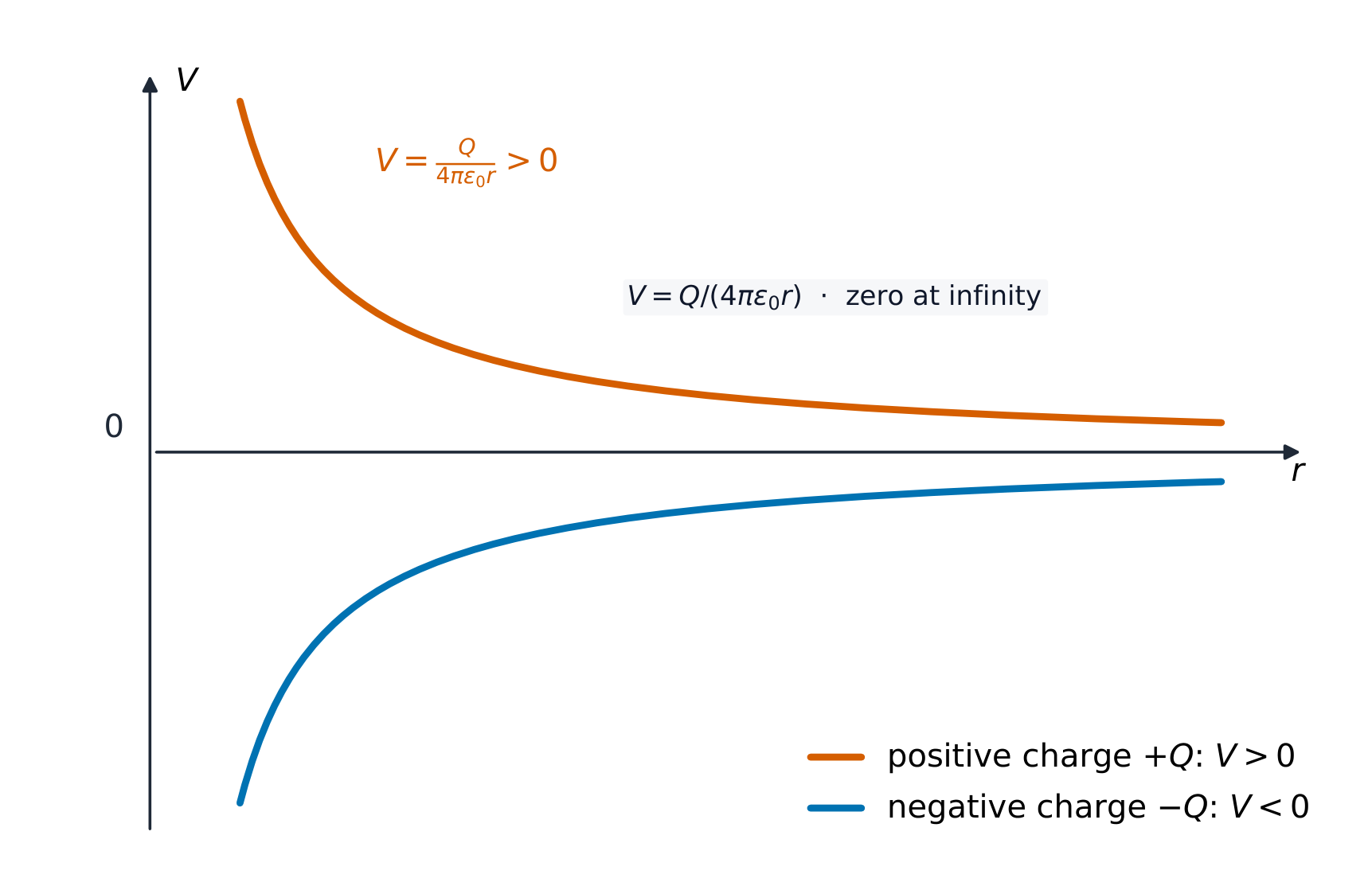
A curve above the axis, or below it, depending only on the sign of Q
電位
V = kQ / r
電荷周囲の電位は∝ 1/r で、電荷付近では急峻で遠ざかるにつれて平坦になる。
点電荷の近傍における電気ポテンシャルは1/rに比例して変化する。
難易度 1/5 · 100 コイン + 今日初回完了時に小ボーナス付与
はい — $V = \dfrac{Q}{4\pi\varepsilon_0 r}$ は $1/r$ に比例し、一方、場は $1/r^{2}$ に比例します。
複数の電荷によるある点でのポテンシャルを求めるには、符号を考慮して個々のポテンシャルを加算します。
難易度 1/5 · 100 コイン + 今日初回完了時に小ボーナス付与
ポテンシャルはスカラー量であるため、分解する必要はありません。一方、場はベクトルとして方向を考慮して加算する必要があります。
Field is the negative potential gradient
- The field at a point equals minus the potential gradient 电势梯度 there:
- The minus sign says the field points towards lower potential: a positive charge released in the field runs "downhill" in $V$.
- In a uniform field the potential falls steadily, so the gradient is constant and this reduces to $E = V/d$, which is the parallel-plate result from earlier.
- Practically: to get the field from a $V$ against $x$ graph, draw a tangent and take minus its gradient.
電気場はポテンシャルの勾配の負の値で表されます ____ (E = −dV/dx)。
難易度 1/5 · 100 コイン + 今日初回完了時に小ボーナス付与
場はポテンシャルが「下り坂」になる方向、すなわち低いVの方向へ向かいます。
距離に対するポテンシャルのグラフから、どのようにして電気場を求められますか?
難易度 1/5 · 100 コイン + 今日初回完了時に小ボーナス付与
E = -dV/dx。マイナス符号は場が低いポテンシャル方向を指すことを示しており、一様場では一定の勾配により E = V/d が成り立ちます。
Worked example: reading the two-sphere graph
- The potential along the line between spheres X and Y, $1.2\ \text{m}$ apart, is positive everywhere and has a minimum at $0.50\ \text{m}$ from X. State three conclusions.
- Both charges are positive, because the potential is positive everywhere along the line.
- The field is zero at $x = 0.50\ \text{m}$, because the gradient is zero there and $E = -dV/dx$.
- Y carries the larger charge, because the zero-field point lies closer to X. Quantitatively $Q_{\text{Y}}/Q_{\text{X}} = (0.70/0.50)^2 = 2.0$.
- If instead the curve crossed zero, the charges would be opposite, and there the ratio comes from $Q_{\text{X}}/x = Q_{\text{Y}}/(d-x)$, without the square.
2つの球体の間のポテンシャルは everywhere 正であり、Xに近い側で最小値をとります。どのような結論が導かれますか?すべて選択してください。
難易度 2/5 · 140 コイン + 今日初回完了時に小ボーナス付与
Vの最小値は勾配、つまり場がゼロとなる地点であり、それはより小さな電荷に近い位置にあります。那里的ポテンシャルは最小値でありゼロではないため、qVもゼロではありません。
Electric potential energy
- A charge $q$ placed at a point of potential $V$ has electric potential energy $E_{\text{P}} = qV$. For two point charges:
- Like charges give positive potential energy: released, they fly apart. Opposite charges give negative energy, a bound 束缚 system, and work must be done to separate them to infinity.
- This is the same pattern as gravitational potential energy, which is always negative because gravity always attracts.
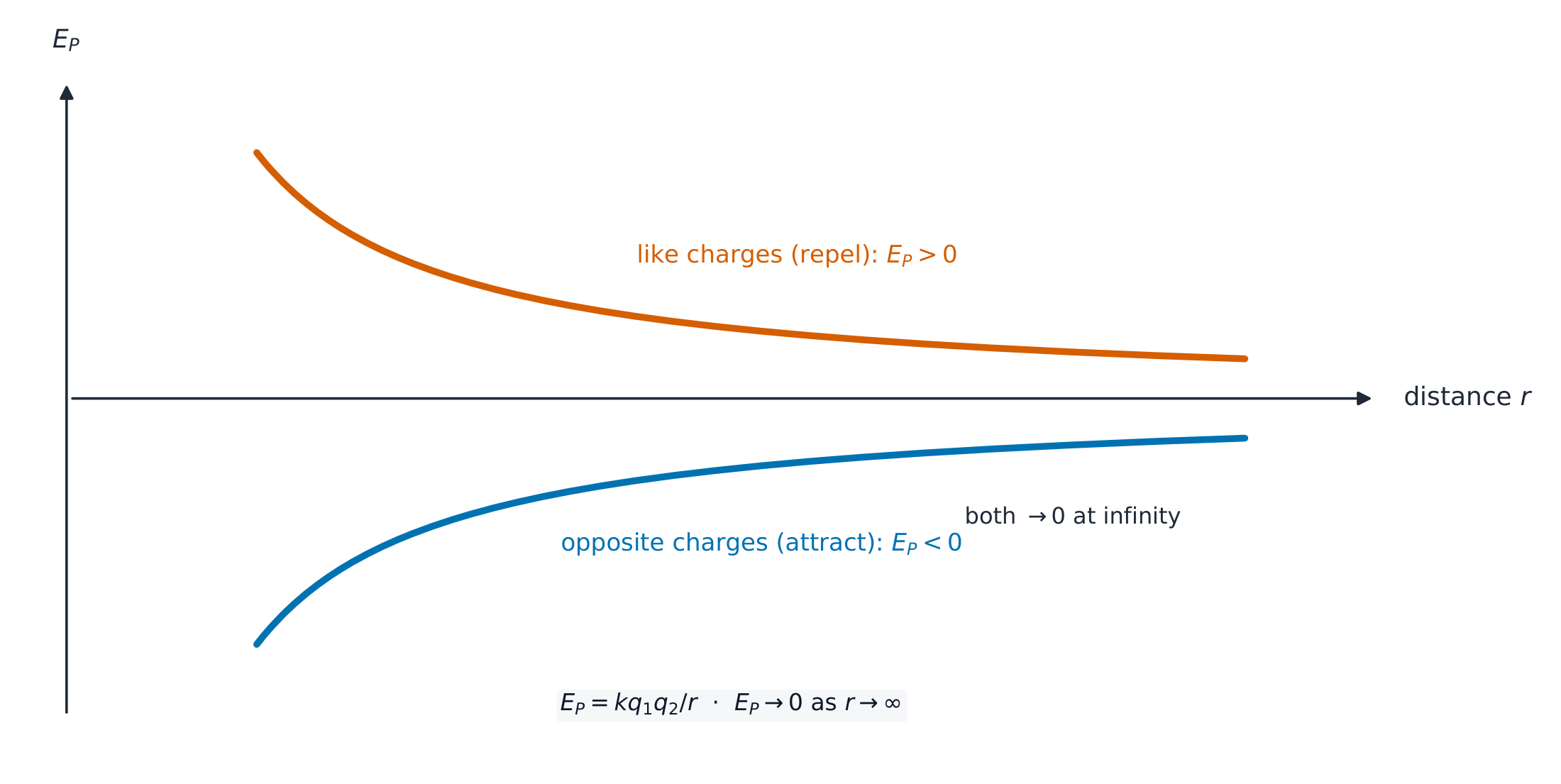
Above the axis they would fly apart; below it they are bound
電荷 $q$ が電位 $V$ の点にあるときの電気ポテンシャルエネルギーは:
難易度 1/5 · 100 コイン + 今日初回完了時に小ボーナス付与
$E_{\text{P}} = qV$; 2つの点電荷の場合、これは $\dfrac{Qq}{4\pi\varepsilon_0 r}$ となります。
反対の極性を持つ2つの電荷は負の電気ポテンシャルエネルギーを持ちます(束縛系)。
難易度 1/5 · 100 コイン + 今日初回完了時に小ボーナス付与
負のPEとは、それらを離すためにエネルギーを与えなければならないことを意味します — これらは束縛されており、電子と原子核のようなものです。
反対の極性を持つ2つの電荷は負の電気ポテンシャルエネルギーを持つため、この系は ____ と呼ばれます。
難易度 1/5 · 100 コイン + 今日初回完了時に小ボーナス付与
それらを無限遠(エネルギーがゼロとなる場所)まで離すためには仕事が必要です。同様の極性の電荷は正のエネルギーを持ち、解放されれば互いに跳ね返します。
Electric and gravitational, side by side
| gravitational | electric | |
|---|---|---|
| force | $F = \dfrac{Gm_1m_2}{r^2}$ | $F = \dfrac{Q_1Q_2}{4\pi\varepsilon_0 r^2}$ |
| field | $g = \dfrac{GM}{r^2}$ | $E = \dfrac{Q}{4\pi\varepsilon_0 r^2}$ |
| potential | $\phi = -\dfrac{GM}{r}$ | $V = \dfrac{Q}{4\pi\varepsilon_0 r}$ |
- Identical shapes throughout. The one difference: mass has a single sign so gravity always attracts and $\phi$ is always negative, while charge has two signs so the electric quantities can be either.
各物理量を、点電荷からの距離に対してどのように変化するかと対応させなさい。
難易度 2/5 · 140 コイン + 今日初回完了時に小ボーナス付与
場は逆二乗則に従い、ポテンシャルは逆比例(rのべき乗が1だけ緩やか)です。
Worked example: describe the motion
- A positive charge is placed at a point P on the two-sphere line and released. Describe and explain its motion.
- It moves towards lower potential, that is, down the slope of the $V$ graph, because the field points that way and the force on a positive charge is along the field.
- The force, and so the acceleration, is not constant: it equals $-q\,dV/dx$, and the gradient changes along the line.
- It speeds up wherever it moves to lower potential, gaining kinetic energy equal to $q\Delta V$ lost in potential energy.
Marks that slip away
- Potential is $\dfrac{1}{r}$; field is $\dfrac{1}{r^2}$. Check which the question wants before substituting.
- The definition needs per unit positive charge and from infinity. Zero at infinity is what the definition rests on.
- Potentials add as scalars with signs; fields add as vectors. Never resolve potentials.
- Zero field is where the $V$ graph has zero gradient, not where $V$ itself is zero. Between opposite charges the curve crosses zero while its gradient is not zero.
You've got it
- electric potential is the work done per unit positive charge bringing a small test charge from infinity; it is zero at infinity, positive near a positive charge
- $V = \dfrac{Q}{4\pi\varepsilon_0 r}$ varies as $\dfrac{1}{r}$ and is a scalar, so several charges add with signs
- $E = -\dfrac{dV}{dx}$: the field is minus the potential gradient, so zero field means zero gradient, and in a uniform field this gives $E = V/d$
- electric potential energy $E_{\text{P}} = qV = \dfrac{Qq}{4\pi\varepsilon_0 r}$: positive for like charges, negative for opposite ones, which are bound