| English | 意味 |
|---|---|
| first law of thermodynamics/fɜːst lɔː ɒv ˌθɜːməʊdaɪˈnæmɪks/ | 熱力学第一法則 |
| sign convention/saɪn kənˈvenʃn/ | 符号の規約 |
| conservation of energy/ˌkɒnsəˈveɪʃn ɒv ˈenədʒi/ | エネルギー保存の法則 |
| isothermal/ˌaɪsəˈθɜːml/ | 等温 |
| adiabatic/ˌædiəˈbætɪk/ | 断熱 |
バイicycleポンプが熱くなる理由
- タイヤを急速に空気注入すると、シリンダーが握りきれないほど熱くなります。何も燃えたり加熱されたりしたわけではなく、腕の力以外にエネルギーは供給されていません。
- 腕は空気に対して仕事を行い、圧縮しました。圧縮が速 enough ため熱が逃げる時間もなく、この仕事はすべて空気の内部エネルギーへ変換されました。
- 入ったエネルギー=蓄積されたエネルギーです。この単一の文を符号付きで慎重に記すことが、熱力学第一法則です。
- このレッスンは $W = p\Delta V$、符号の慣例、第一法則、そして4つの標準過程について扱います。
気体の体積変化に伴う仕事
- 気体が外部の圧力に抗して体積を変化させる際、機械的仕事が行われます。一定圧力 $p$ で体積変化 $\Delta V$ の場合:
- $p$-$V$ グラフ上ではこれは曲線下の面積であり、これが一定圧力変化が単純な長方形となる理由です。
- 気体が膨張するときは周囲に対して仕事を行います。気体が圧縮される場合は、周囲から仕事を受け取ります。
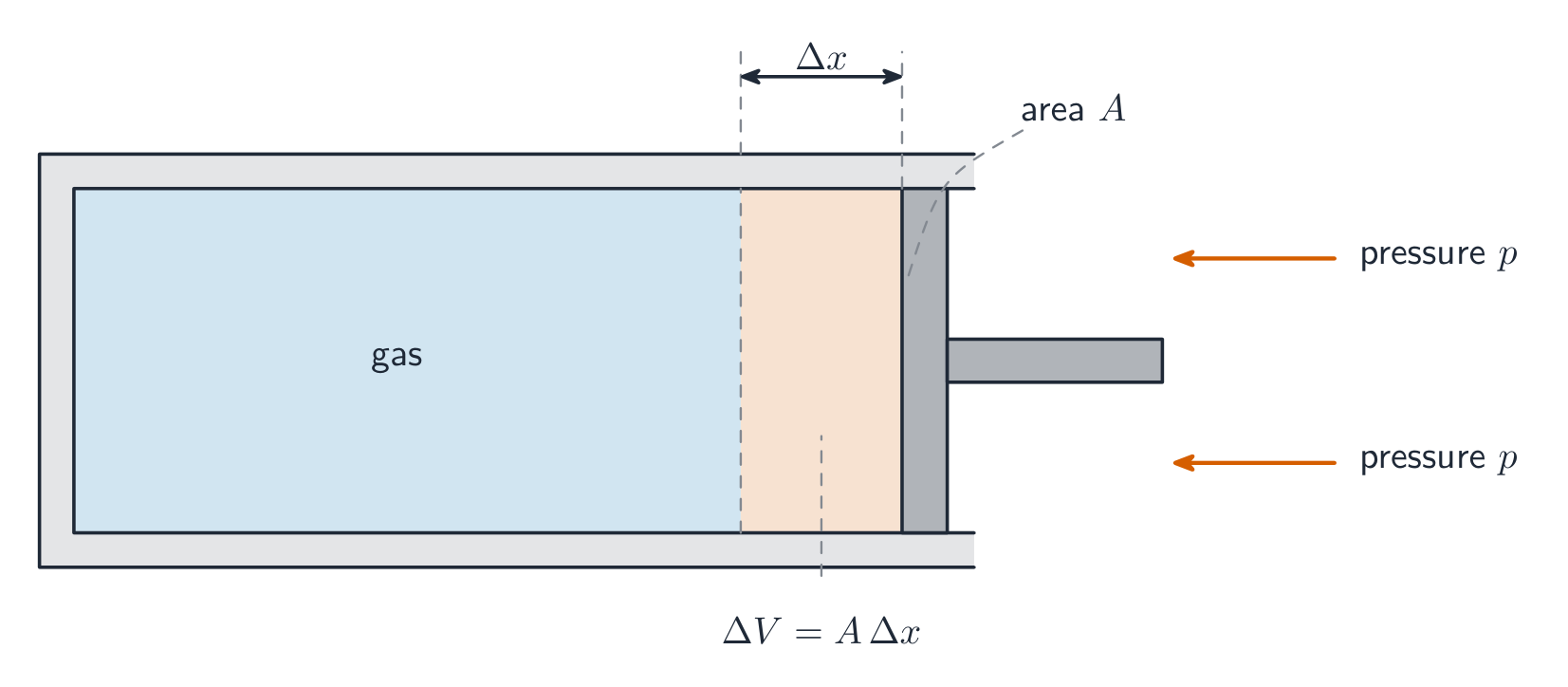
力×距離を、圧力×掃引体積として書き換えたもの
The work done by a gas expanding at constant pressure is:
難易度 1/5 · 100 コイン + 今日初回完了時に小ボーナス付与
Force = $pA$, distance = $\Delta x$, so work $= pA\Delta x = p\,\Delta V$.
符号の慣例
- このカリキュラムでは、気体に対する仕事 $W$ を用いて第一法則を表します。
- 圧縮: $\Delta V$ は負であり、気体に対する仕事は正であり、気体はエネルギーを得ます。
- 膨張: $\Delta V$ は正であり、気体に対する仕事は負であり、気体は周囲へエネルギーを失います。
- 問題を注意深く読んでください。「気体に対する仕事」と「気体による仕事」は大きさが等しく符号が逆であり、これらを混同することがこの分野で最も一般的な誤りです。

一つの量、二つの名前、反対の符号
When a gas expands, it does work on its surroundings.
難易度 1/5 · 100 コイン + 今日初回完了時に小ボーナス付与
Yes — it pushes the piston/atmosphere outward. So the work done on the gas is negative.
A gas expands. In this syllabus's convention, what is the sign of W, the work done ON the gas?
難易度 1/5 · 100 コイン + 今日初回完了時に小ボーナス付与
Work done BY the gas and work done ON it are equal in size and opposite in sign. Confusing the two is the commonest error in this topic.
第一法則
- $\Delta U$ は内部エネルギーの増分、$q$ は加熱によって系に流入するエネルギー、$W$ は系に対する仕事です。
- 2点満点の記述では、すべての記号に方向性を含めて定義する必要があります。「系へ向かって」と「系に対して」が採点ポイントです。
- これは気体に適用されたエネルギー保存則です。加熱または仕事によってエネルギーが流入し、その分が蓄積されます。
Work done on a gas
Push the piston in and you do work on the gas (W = pΔV); the first law says that work plus the heat added equals the rise in internal energy.
The first law of thermodynamics: $\Delta U = q +$ ____.
難易度 1/5 · 100 コイン + 今日初回完了時に小ボーナス付与
$\Delta U = q + W$, where $W$ is the work done on the gas and $q$ is the heat added.
A two-mark statement of the first law must define its symbols with direction. Which are correct? Select all that apply.
難易度 2/5 · 140 コイン + 今日初回完了時に小ボーナス付与
"To the system" and "on the system" are where the marks are. Defining W as the work done by the system flips the sign of the whole equation.
演習例:熱の流入、仕事の流出
- ある気体が $500\ \text{J}$ の熱を吸収しながら膨張し、周囲に対して $200\ \text{J}$ の仕事を行いました。内部エネルギーの変化を求めよ。
- 熱は気体へ流入しているため、$q = +500\ \text{J}$ です。
- 気体が仕事を行うため、気体に対する仕事は $W = -200\ \text{J}$ です。これが符号の慣例が存在する理由です。
- $\Delta U = q + W = 500 + (-200) = +300\ \text{J}$ :内部エネルギーは 300 J 上昇します。
$100\ \text{J}$ of heat is added to a gas while $30\ \text{J}$ of work is done on it. What is the rise in internal energy?
難易度 2/5 · 140 コイン + 今日初回完了時に小ボーナス付与
$\Delta U = q + W = 100 + 30 = 130\ \text{J}$.
演習例:同じ上昇、異なる方法
- 理想気体を $2.0 \times 10^5\ \text{Pa}$ の一定圧力で加熱し、内部エネルギーを $7600\ \text{J}$ 上昇させながら体積を $1.2 \times 10^{-2}\ \text{m}^3$ 増加させました。加えた熱エネルギーを求めよ。次に、同一の $U$ の上昇を一定体積で行う場合の熱エネルギーも求めよ。
- 気体による仕事は $p\Delta V = 2.0 \times 10^5 \times 1.2 \times 10^{-2} = 2400\ \text{J}$ であるため、気体に対する仕事は $W = -2400\ \text{J}$ です。
- 第一法則:$q = \Delta U - W = 7600 - (-2400) = 1.0 \times 10^4\ \text{J}$ 。
- 一定体積では仕事を行わないため、$q = \Delta U = 7600\ \text{J}$ です。
- 最初のケースにおける追加の 2400 J は、気体が周囲を押し戻すために消費したエネルギーそのものです。同一の $\Delta U$ に対し、仕事量が異なったため $q$ が異なります。
An ideal gas at constant pressure 2.0 x 10^5 Pa gains 7600 J of internal energy while expanding by 1.2 x 10^-2 m^3. How many joules of thermal energy were supplied?
難易度 2/5 · 140 コイン + 今日初回完了時に小ボーナス付与
Work done by the gas is 2400 J, so W on the gas is -2400 J and q = 7600 - (-2400) = 10 000 J. At constant volume the same rise would need only 7600 J.
4つの標準過程
| 過程 | 一定 | $\Delta U$ | 気体に対する$W$ | $q$ |
|---|---|---|---|---|
| 等温 | $T$ | $0$ | $W$ | $-W$ |
| 一定体積 | $V$ | $\tfrac32 nR\Delta T$ | $0$ | $\Delta U$ |
| 一定圧力 | $p$ | $\tfrac32 nR\Delta T$ | $-p\Delta V$ | $\Delta U - W$ |
| 断熱 | 熱なし | $W$ | $W$ | $0$ |
- 各行は $\Delta U = q + W$ に一つの量がゼロとなったものです。等温: $\Delta T = 0$ があるため、$\Delta U = 0$ と $q = -W$ となり、流入した熱がそのまま仕事として排出されます。断熱: $q = 0$ であるため、$\Delta U = W$ となり、これが自転車ポンプの原理です。
- 理想気体では $\Delta U = \tfrac32 nR\Delta T$ が常に成立します。なぜなら、$U$ は温度にのみ依存するためです。
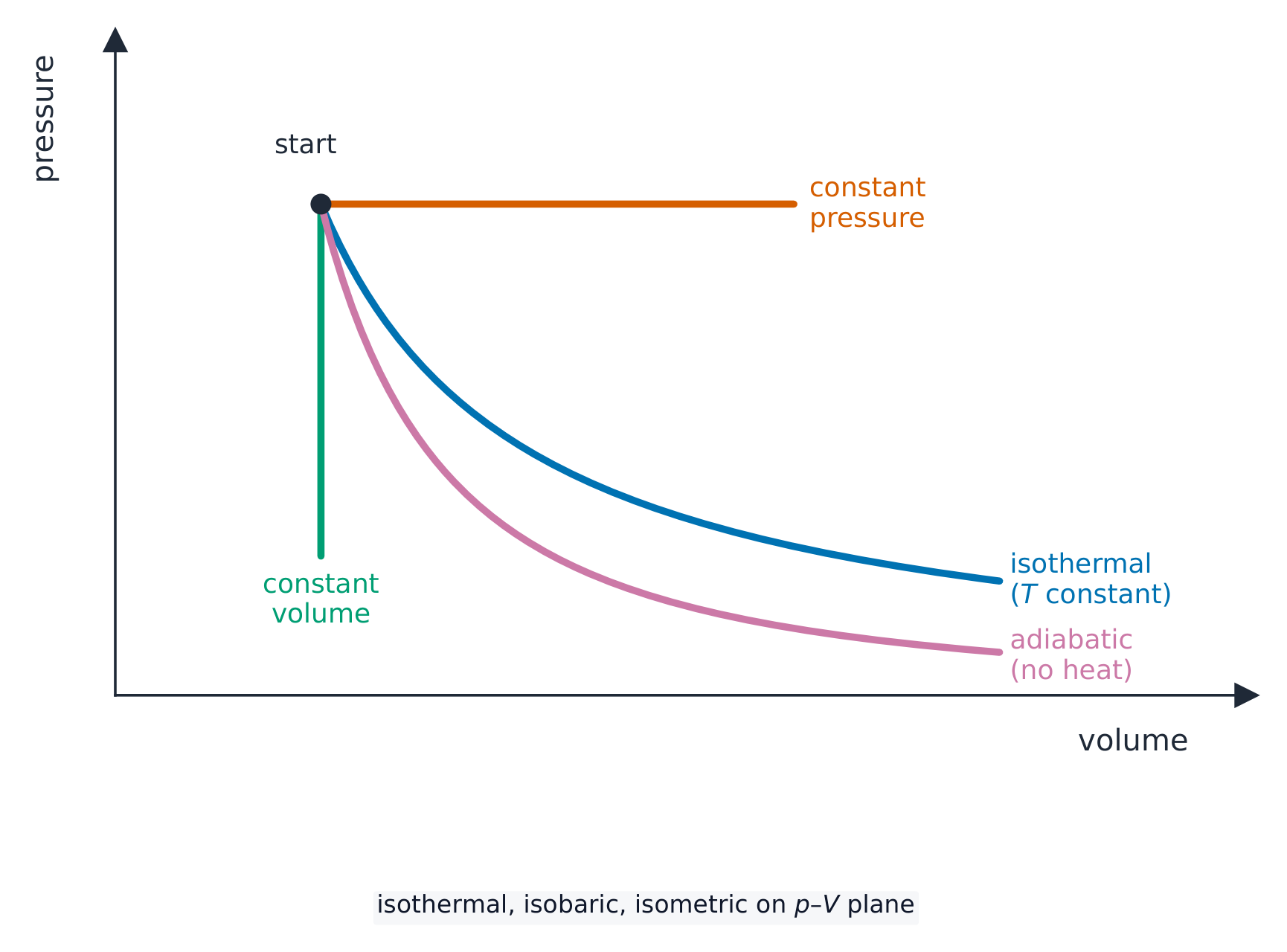
4つの軌道、一つの法則
Match each process to what it makes zero.
難易度 2/5 · 140 コイン + 今日初回完了時に小ボーナス付与
Constant $T$ → no change in internal energy; constant $V$ → no work; adiabatic → no heat flow.
In an isothermal change of an ideal gas, the internal energy does not change.
難易度 1/5 · 100 コイン + 今日初回完了時に小ボーナス付与
For an ideal gas $U \propto T$, so constant $T$ means $\Delta U = 0$ (and then $q = -W$).
演習例:第一法則を用いて説明する
- 3点満点の「第一法則を使って説明せよ」への回答には3つのステップがあります:$q$ を符号付きで述べ、$W$ を符号付きで述べ、それらを組み合わせて $\Delta U$ を導き出します。
- 自転車ポンプが熱くなる理由: 空気が圧縮されるため気体に対する仕事が行われ、$W > 0$ ;圧縮が速いため熱エネルギーが逃げる時間もなく、$q \approx 0$ ;したがって $\Delta U = W > 0$ 、温度が上昇しポンプが暖まります。
- 暑い日の水蒸発: 熱エネルギーが水へ移転し、$q > 0$ ;蒸気ははるかに大きな体積を占めるため系は大気に対して仕事を行い、$W < 0$ ;$q$ が仕事量を上回るため、分子が分離されたことでポテンシャルエネルギーとして $\Delta U$ が依然として増加します。
Put the first-law explanation of why a bicycle pump gets hot in order.
難易度 3/5 · 200 コイン + 今日初回完了時に小ボーナス付与
State q with its sign, state W with its sign, combine, then say what the change means. That is the three-mark shape for every first-law explanation.
見落としやすいポイント
- このカリキュラムにおける $W$ は気体に対する仕事です。膨張すると負になります。
- 法則の2点満点の記述では、各記号に方向性を含めて定義する必要があります:系へ向かう加熱、系に対する仕事。
- 一定体積では $W = 0$ であるため、すべての熱が内部エネルギーとなります。一定圧力では一部が仕事として排出されます。
- $p\Delta V$ は気体にとって重要です。加熱された固体の場合、大気に抗して行われる仕事は加熱量の百万分之一に過ぎないため、$\Delta U \approx q$ です。
理解できましたか
- 一定圧力における $W = p\Delta V$ は、$p$ -$V$ 曲線下の面積;膨張は周囲に対して仕事を行う
- 符号の慣例: $W$ は気体に対する仕事であり、圧縮時は正、膨張時は負
- 第一法則 $\Delta U = q + W$ はエネルギー保存則であり、$q$ 系への熱の付与と $W$ 系に対する仕事、および各記号の向きが定義されている。
- 等温 $\Delta U = 0$ なので $q = -W$;定容 $W = 0$ なので $q = \Delta U$;断熱 $q = 0$ なので $\Delta U = W$