| English | 意味 |
|---|---|
| tangent/ˈtændʒənt/ | 接線 |
| centripetal acceleration/senˈtrɪpɪtl əkˌseləˈreɪʃn/ | 向心加速度 |
| centripetal force/senˈtrɪpɪtl fɔːs/ | 向心力 |
| perpendicular/ˌpɜːpənˈdɪkjʊlə/ | 垂直 |
| tension/ˈtenʃn/ | 張力 |
| banked/bæŋkt/ | 傾斜した |
放てば直進する
- 紐につけたボールを円を描くように振り回し、手放す。
- ボールは直線に飛び出す — 外向きに飛ぶのではなく、接線に沿って進む。
- つまり、円を描いていた間、何かによって内向きに引かれていたことになる。
向心加速度
- 一定の速さだが絶えず変化する方向は、速度が変化している(=加速度がある)ことを意味する。
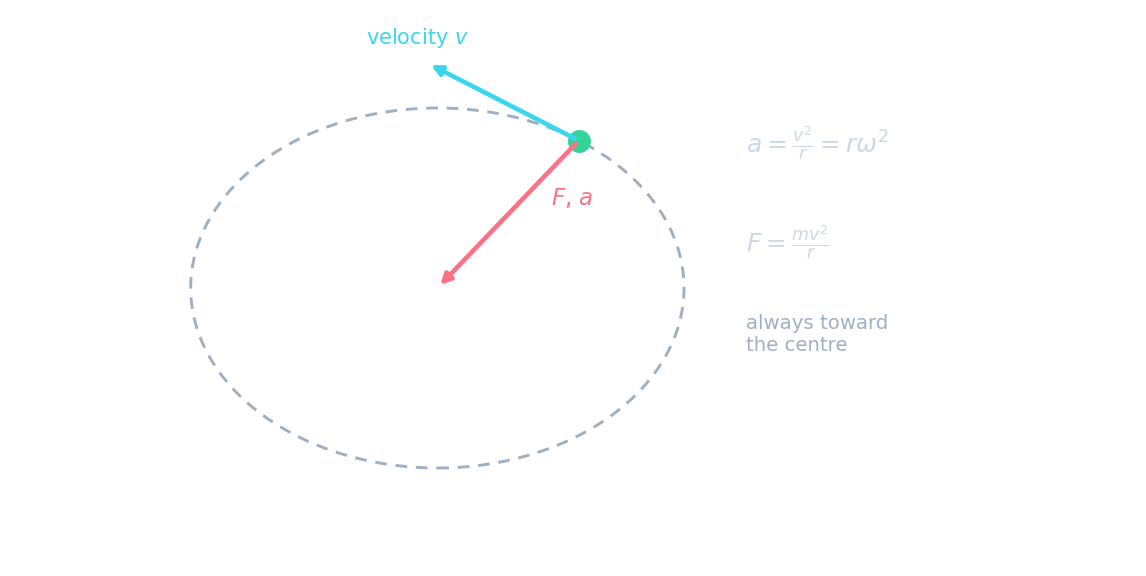
- それは中心を指す:$a = \dfrac{v^{2}}{r} = r\omega^{2}$ (かつ、$v = r\omega$ であるため、$a = v\omega$ でもある)。
Centripetal force and speed
F = mv²/r
For circular motion the force needed grows with the square of the speed — double v, four times the force.
An object moving round a circle at constant speed is still accelerating because:
難易度 1/5 · 100 コイン + 今日初回完了時に小ボーナス付与
Velocity is a vector. Even at constant speed, the changing direction means a changing velocity — an acceleration toward the centre.
An object moves at $4.0\ \dfrac{\text{m}}{\text{s}}$ round a circle of radius $2.0\ \text{m}$. Find its centripetal acceleration.
難易度 2/5 · 140 コイン + 今日初回完了時に小ボーナス付与
$a = \dfrac{v^{2}}{r} = \dfrac{4.0^{2}}{2.0} = 8.0\ \dfrac{\text{m}}{\text{s}^2}$.
遠心力(向心力)
- $F = ma$ より:$F = \dfrac{mv^{2}}{r} = mr\omega^{2}$ 、中心を向く。
- 常に速度と垂直であるため、仕事を行わず、速さは一定のまま保たれる。

回転する遊園地の乗り物には中心に向かう向心力が必要
The centripetal force points toward the centre of the circle.
難易度 1/5 · 100 コイン + 今日初回完了時に小ボーナス付与
Yes — always toward the centre, perpendicular to the velocity.
A $2.0\ \text{kg}$ ball moves at $4.0\ \dfrac{\text{m}}{\text{s}}$ round a circle of radius $2.0\ \text{m}$. What centripetal force is needed?
難易度 2/5 · 140 コイン + 今日初回完了時に小ボーナス付与
$F = \dfrac{mv^{2}}{r} = \dfrac{2.0 \times 4.0^{2}}{2.0} = 16\ \text{N}$.
新たな力ではない
- 「向心力」は新たな種類の力ではない。
- それは、張力、重力、摩擦力、垂直抗力といった実在の力の合力である。

速度は接線方向を指し、力と加速度は中心を指す
The centripetal force is:
難易度 1/5 · 100 コイン + 今日初回完了時に小ボーナス付与
It is whatever real force(s) happen to point to the centre — not a separate force of its own.
その正体
- 紐についた球 → 張力。水平なカーブを走る車 → 摩擦力。
- 惑星や衛星 → 重力。傾斜したレール → 垂直抗力の内向き成分。

傾斜したレールでは、路面の力の水平成分が向心力となる
Match each circular motion to the force that provides the centripetal force.
難易度 2/5 · 140 コイン + 今日初回完了時に小ボーナス付与
Different situations, different real forces — but each points to the centre and provides $\dfrac{mv^{2}}{r}$.
worked example: カーブを走る速さは?
質量 $1200\ \text{kg}$ の車が、半径 $50\ \text{m}$ の水平なカーブを通る。タイヤが提供できる最大の摩擦力は $8200\ \text{N}$ である。
- 摩擦力は向心力である: $F = \dfrac{mv^{2}}{r}$ 因此、最も速い安全な速度は $\dfrac{1200\,v^{2}}{50} = 8200$ です。
- 計算: $v^{2} = \dfrac{8200 \times 50}{1200} = 342$ より、$v = 18\ \dfrac{\text{m}}{\text{s}}$ (約 $65\ \dfrac{\text{km}}{\text{h}}$ )。
- より急なカーブ: $r$ を半分にすると、$v_{\text{max}}$ は $\sqrt{2}$ だけ減少する — 必要な力は $\dfrac{1}{r}$ に比例して増大する。
- 検証: 湿った路面では利用可能な摩擦力が低下するため、安全速度も下がる。これは物理法則が示す通りであり、道路標識もこれを前提としている。
A $800\ \text{kg}$ car rounds a flat bend of radius $40\ \text{m}$. The maximum friction force available is $6400\ \text{N}$. What is the maximum safe speed, in m/s?
難易度 2/5 · 140 コイン + 今日初回完了時に小ボーナス付与
$\dfrac{mv^{2}}{r} = F$, so $v^{2} = \dfrac{6400 \times 40}{800} = 320$ and $v = 17.9\ \dfrac{\text{m}}{\text{s}}$.
垂直円運動
- 垂直なループ内を回る場合、速度は変化する(重力が仕事をするため)。
- 最上部では、重さと張力の両方が中心向きを指す:$T + mg = \dfrac{mv^{2}}{r}$ 。最下部では互いに逆向きになる:$T - mg = \dfrac{mv^{2}}{r}$ 。
- 紐がただ直ぐに伸びる状態での最上部の最小速度は $v_{\text{min}} = \sqrt{gr}$ (張力を $= 0$ と置く)である。

垂直円運動では、最上部では重力が助け、最下部では反対方向に働く — よって、最下部で紐の張力が最大となる
At the top of a vertical loop, the slowest speed (string just tight) is:
難易度 1/5 · 100 コイン + 今日初回完了時に小ボーナス付与
With tension $= 0$, gravity alone is the centripetal force: $mg = \dfrac{mv^{2}}{r}$, so $v_{\text{min}} = \sqrt{gr}$.
worked example: 最上部と最下部の張力
質量 $0.50\ \text{kg}$ の球を、長さ $1.0\ \text{m}$ の紐で垂直円運動させる。最下部での速度は $8.0\ \dfrac{\text{m}}{\text{s}}$ である。
- 最下部: $T - mg = \dfrac{mv^{2}}{r}$ より、$T = 0.50 \times 9.81 + \dfrac{0.50 \times 8.0^{2}}{1.0} = 4.9 + 32 = 37\ \text{N}$ となる。
- 最上部の速度: 高さ $2r$ の上昇におけるエネルギー保存則より:$v_{\text{top}}^{2} = 8.0^{2} - 2g(2.0) = 64 - 39 = 25$ 、よって $v_{\text{top}} = 5.0\ \dfrac{\text{m}}{\text{s}}$ 。
- 最上部: $T + mg = \dfrac{mv^{2}}{r}$ より、$T = \dfrac{0.50 \times 25}{1.0} - 4.9 = 12.5 - 4.9 = 7.6\ \text{N}$ となる。
- 検証: 最下部での張力は非常に大きく、ここで紐が切れることが多い。最上部では $v_{\text{top}} > \sqrt{gr} = 3.1\ \dfrac{\text{m}}{\text{s}}$ より、紐は常に張った状態を保つ。
受力図に「向心力」を別の矢印として描いてはいけない — それは実在の力の合力であり、このコースでは外向きの「遠心力」は存在しない。ループの最上部では重力が助ける($T + mg$ )、最下部では反対方向に働く($T - mg$ )。また、垂直円運動では速度は一定ではないので、最上部と最下部の間ではエネルギー保存則を用いる。
At the top of a vertical circle the string tension is smallest, because there the ____ of the ball also acts towards the centre.
難易度 1/5 · 100 コイン + 今日初回完了時に小ボーナス付与
At the top $T + mg = \dfrac{mv^{2}}{r}$: the weight supplies part of the centripetal force, so the string needs to supply less.
理解できましたか
- 円運動には内向き(向心)の加速度 $a = \dfrac{v^{2}}{r} = r\omega^{2} = v\omega$ が必要
- 向心力 $F = \dfrac{mv^{2}}{r}$ — 中心に向かう実力の合力であり、仕事は行わない
- 垂直ループ:最上部で $T + mg = \dfrac{mv^{2}}{r}$ 、最下部で $T - mg = \dfrac{mv^{2}}{r}$ ;最上部での最低速度は $v_{\text{min}} = \sqrt{gr}$