| English | 意味 |
|---|---|
| Hooke's law/hʊks lɔː/ | フークの法則 |
| tensile/ˈtensaɪl/ | 引張 |
| extension/ekˈstenʃn/ | 伸長量 |
| compressive/kəmˈpresɪv/ | 圧縮 |
| load/ləʊd/ | 負荷 |
| spring constant/sprɪŋ ˈkɒnstənt/ | ばね定数 |
| limit of proportionality/ˈlɪmɪt ɒv prəˌpɔːʃəˈnælɪti/ | 比例限度 |
| stress/stres/ | 応力 |
| strain/streɪn/ | ひずみ |
| Young modulus/jʌŋ ˈmɒdjʊləs/ | ヤング率 |
Pull twice as hard
- Pull a spring twice as hard and it stretches twice as far.
- That neat straight-line rule is Hooke's law 胡克定律 — true up to a point.
- It lets us measure forces with springs and test materials.
Stretching and squeezing
- A tensile 拉伸 force stretches an object, giving an extension 伸长量 $x$.
- A compressive 压缩 force squeezes it. The applied force is the load 负载.

A modern universal testing machine stretches a sample and records the force and extension
フックの法則
F = k·x
力は伸びに比例 — 傾斜がばね定数 k です。
Hooke's law
- The extension is proportional to the load: $F = kx$.
- $k$ is the spring constant 劲度系数 (stiffness), in $\dfrac{\text{N}}{\text{m}}$ — the gradient of an $F$–$x$ graph.
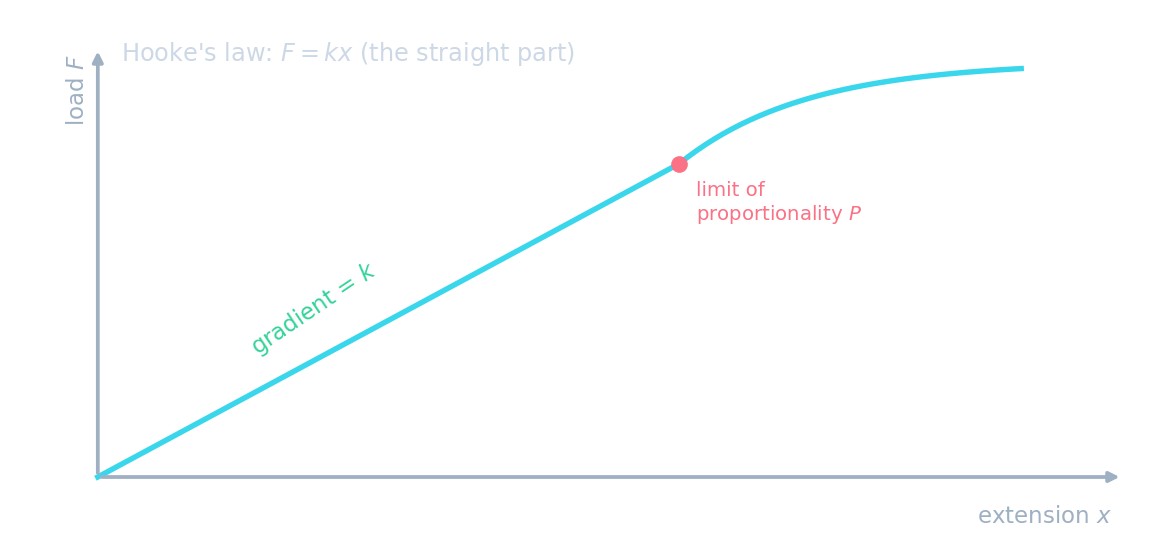
フックの法則に従うバネ
実物のバネに荷重を掛ける:弾性限界までなら伸びは力に比例するが、それを超えると永久に伸びてしまう。
重量$12\ \text{N}$ の荷重がばねを$0.040\ \text{m}$ だけ伸ばしました。ばね定数はいくつですか?
難易度 2/5 · 140 コイン + 今日初回完了時に小ボーナス付与
$k = \dfrac{F}{x} = \dfrac{12}{0.040} = 300\ \dfrac{\text{N}}{\text{m}}$.
フックの法則において、負荷を倍にすると伸びも倍になります。
難易度 1/5 · 100 コイン + 今日初回完了時に小ボーナス付与
はい — $F = kx$ は直線(比例)関係なので、$x$ は$F$ に比例してスケールされます。
The limit of proportionality 比例极限
- Hooke's law only holds up to the limit of proportionality.
- Past it the $F$–$x$ line curves — the simple $F = kx$ no longer works.

A spring obeys Hooke's law: extension is proportional to the force applied
直線則 $F = kx$ が成立するのは以下の点までです:
難易度 1/5 · 100 コイン + 今日初回完了時に小ボーナス付与
比例限度を超えると、$F$–$x$グラフは曲がり、$F = kx$はもはや適用されなくなる。
フックの法則の完全な文脈に以下のどれが含まれるか?すべて選択せよ。
難易度 2/5 · 140 コイン + 今日初回完了時に小ボーナス付与
この条件は法則の一部であり、追加の制約ではない。ゴムのようなものはこれに従わず、金属も直線を超えれば従わなくなる。
Springs together
- Series (end to end): $\dfrac{1}{k_{\text{total}}} = \dfrac{1}{k_1} + \dfrac{1}{k_2}$ — softer overall.
- Parallel (side by side): $k_{\text{total}} = k_1 + k_2$ — stiffer overall.
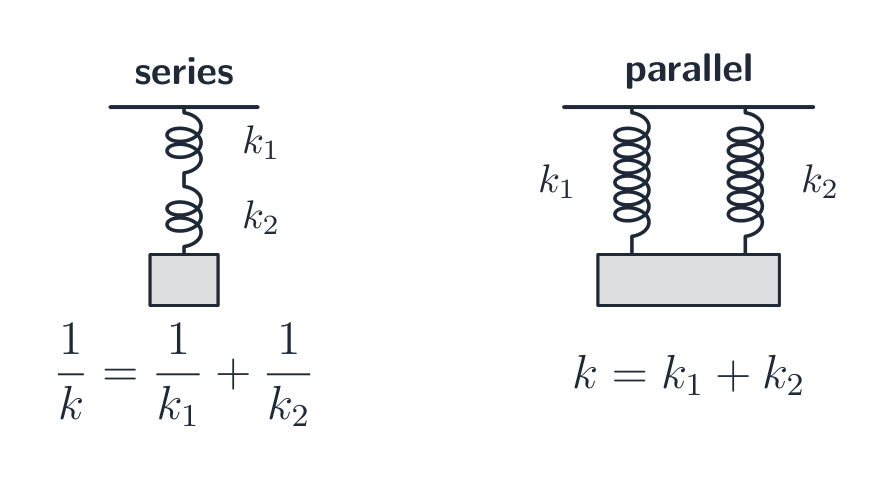
Springs in series are softer (1/k adds); springs in parallel are stiffer (k adds)
定数$k$の同一スプリングが2つ直列に接続されている。合成スプリング定数は:
難易度 1/5 · 100 コイン + 今日初回完了時に小ボーナス付与
$\dfrac{1}{k_{\text{total}}} = \dfrac{1}{k} + \dfrac{1}{k} = \dfrac{2}{k}$であるため、$k_{\text{total}} = \tfrac{1}{2}k$ — パーアはより簡単に伸びる。
Stress 应力 and strain 应变
- Stress $\sigma = \dfrac{F}{A}$ (force per area, in Pa).
- Strain $\varepsilon = \dfrac{x}{L_0}$ (extension ÷ original length — no unit).
各物理量を対応する式と結べ。
難易度 2/5 · 140 コイン + 今日初回完了時に小ボーナス付与
応力は単位面積あたりの力、ひずみは相対伸び、バネ定数は荷重に対する伸びの比率である。
各用語を、試験官が採点基準として示す定義と結びつけなさい。
難易度 2/5 · 140 コイン + 今日初回完了時に小ボーナス付与
ヤング係数は材料の性質であり、バネ定数は試料の性質であるため、同じ金属でも太い線ほどヤング係数は変わらずバネ定数が変化する。
The Young modulus 杨氏模量
- $E = \dfrac{\sigma}{\varepsilon} = \dfrac{F L_0}{A x}$, in Pa (about $2 \times 10^{11}$ for steel).
- It is a property of the material only; the spring constant $k = \dfrac{EA}{L_0}$ also depends on size.
ヤング率$2.0 \times 10^{11}\ \text{Pa}$を持つ材料に応力$1.0 \times 10^{8}\ \text{Pa}$がかかっている。ひずみはいくらか?
難易度 2/5 · 140 コイン + 今日初回完了時に小ボーナス付与
$\varepsilon = \dfrac{\sigma}{E} = \dfrac{1.0 \times 10^{8}}{2.0 \times 10^{11}} = 5.0 \times 10^{-4}$.
線のヤング係数はその長さと太さに依存する。
難易度 1/5 · 100 コイン + 今日初回完了時に小ボーナス付与
いいえ — ヤング率は材料固有の性質です。サイズに依存するのはスプリング定数$k = EA/L_0$です。
線の直径は0.50 mmです。断面積を1e-7 m^2単位の値で求めよ。
難易度 2/5 · 140 コイン + 今日初回完了時に小ボーナス付与
半径0.25 mm = 2.5e-4 m なので、A = pi r^2 = 1.96e-7 m^2。直径を半径として扱うと4倍过大になり、これがこの問題でよくある誤りです。
Measuring the Young modulus
- Use a long, thin wire so the extension is big enough to measure.
- Find the area from the diameter (a micrometer), load it step by step, and plot $F$ against $x$: gradient $= \dfrac{EA}{L_0}$.

A long, thin wire is loaded step by step; the gradient of F against x gives EA/L₀
同じ金属の太い線の方がヤング係数が大きい。
難易度 1/5 · 100 コイン + 今日初回完了時に小ボーナス付与
ヤング係数は材料固有の性質であり太さによって変わらない。太い線はバネ定数が大きくなるが、これは試料の性質である。
Marks that slip away
- Hooke's law needs its condition. "The extension is directly proportional to the applied force" is only half of it; add "provided the limit of proportionality is not exceeded".
- The limit of proportionality is the end of the straight line. The elastic limit is the end of elastic behaviour, a little beyond it. They are not the same point.
- In $A = \pi r^2$ use the radius, so halve a diameter first, and convert $\text{mm}^2$ to $\text{m}^2$ by $10^{-6}$, not $10^{-3}$.
- A thicker wire does not have a larger Young modulus. The modulus belongs to the material; the thicker wire has a larger spring constant.
- Stress is force per unit cross-sectional area and strain is extension per unit original length. Strain has no unit.
You've got it
- Hooke's law $F = kx$ holds up to the limit of proportionality
- stress $\sigma = \dfrac{F}{A}$, strain $\varepsilon = \dfrac{x}{L_0}$
- Young modulus $E = \dfrac{\sigma}{\varepsilon}$ — a property of the material, not its shape