| English | 意味 |
|---|---|
| kinetic energy/kɪˈnetɪk ˈenədʒi/ | 運動エネルギー |
| gravitational potential energy/ˌɡrævɪˈteɪʃənl pəˈtenʃl ˈenədʒi/ | 重力位置エネルギー |
| thermal energy/ˈθɜːml ˈenədʒi/ | 熱エネルギー |
| momentum/məʊˈmentəm/ | 運動量 |
| elastic potential energy/ɪˈlæstɪk pəˈtenʃl ˈenədʒi/ | 弾性位置エネルギー |
| compression/kəmˈpreʃn/ | 圧縮 |
ロールコースの入れ替え
- 落下の頂点ではコースカーがゆっくり進み、底では激しく疾走する。
- 高さが速さに変わり、位置エネルギーが運動エネルギーに変換された。
- エネルギーは単に2つの形態の間を移動しているだけである。
重力位置エネルギー
- 質量 $m$ を高さ $\Delta h$ だけ持ち上げると、 $\Delta E_{\text{P}} = mg\Delta h$ が蓄えられる。
- これは重力に逆らって行われた仕事に由来する: $W = mg \times \Delta h$ 。

重力PEは経路ではなく、高さの変化Δhのみに依存する

風車は風の運動エネルギーを電気エネルギーに変換する
Kinetic & potential energy
PE + KE = 一定
Potential energy turns into kinetic energy — the total never changes.
A $2.0\ \text{kg}$ book is lifted $5.0\ \text{m}$. How much gravitational PE does it gain? (Use $g = 9.81\ \dfrac{\text{m}}{\text{s}^2}$.)
難易度 2/5 · 140 コイン + 今日初回完了時に小ボーナス付与
$\Delta E_{\text{P}} = mg\Delta h = 2.0 \times 9.81 \times 5.0 \approx 98\ \text{J}$.
運動エネルギー
- 質量 $m$ が速度 $v$ で動くとき、 $E_{\text{K}} = \tfrac{1}{2}mv^{2}$ を持つ。
- これは加速するために加えた仕事に由来する: $W = Fs = \tfrac{1}{2}mv^{2}$ 。
A $4.0\ \text{kg}$ trolley moves at $3.0\ \dfrac{\text{m}}{\text{s}}$. What is its kinetic energy?
難易度 2/5 · 140 コイン + 今日初回完了時に小ボーナス付与
$E_{\text{K}} = \tfrac{1}{2}mv^{2} = \tfrac{1}{2} \times 4.0 \times 3.0^{2} = 18\ \text{J}$.
Match each energy store to what it depends on.
難易度 2/5 · 140 コイン + 今日初回完了時に小ボーナス付与
Two of the three go as a square, which is why doubling a speed or an extension quadruples the energy while doubling a height only doubles it.
二つの罠。二乗: 速度を2倍にすると、運動エネルギーは2倍ではなく4倍になる。高さ: $\Delta h$は斜面に沿った距離ではなく鉛直方向の高さの変化である。長さ$3\ \text{m}$で高さが$1.5\ \text{m}$下がるスロープにおいて、使用される鉛直高度は$1.5\ \text{m}$である。
エネルギーの変換
- 摩擦のないスロープ上では重力ポテンシャルエネルギーが運動エネルギーに変換される:$mgh = \tfrac{1}{2}mv^{2}$ なので、$v = \sqrt{2gh}$ となる。
- 質量は約分されて消える — どの物体も同じ高さからは同じ速さに達する。
- 摩擦がある場合、その一部は熱エネルギーに変換される。
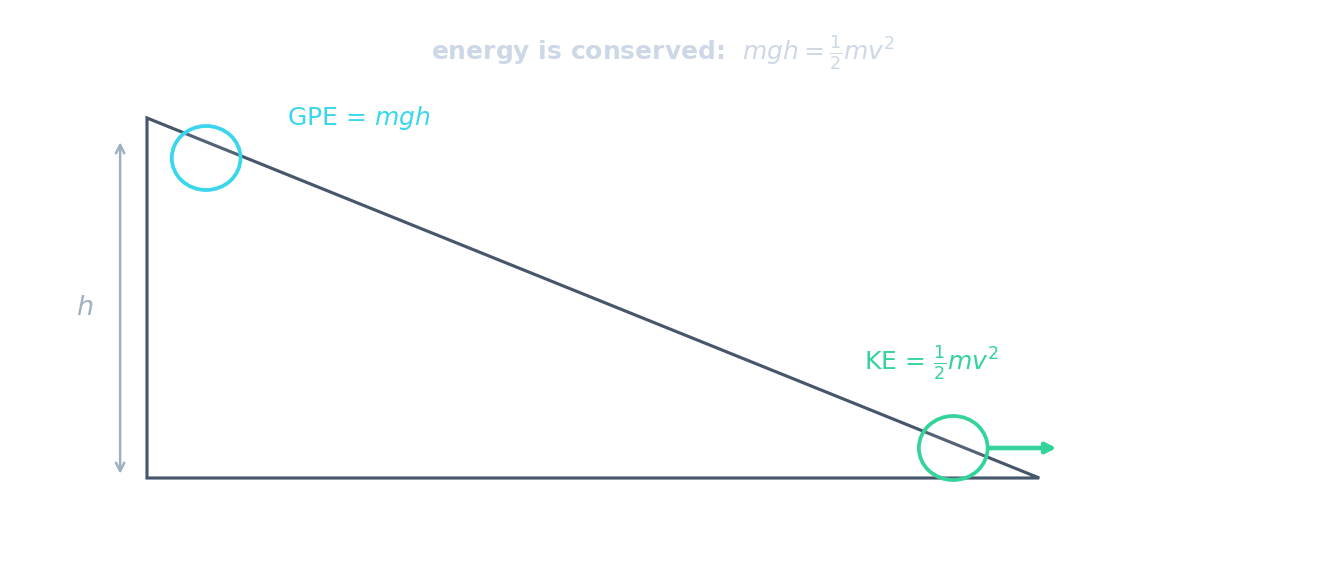
As a ball rolls down a frictionless ramp, its gravitational PE turns mainly into:
難易度 1/5 · 100 コイン + 今日初回完了時に小ボーナス付与
With no friction, all the lost GPE becomes kinetic energy: $mgh = \tfrac{1}{2}mv^{2}$.
A 2.0 kg block slides from rest down a smooth ramp, dropping 1.5 m in height. What is its speed at the bottom, in m/s? (g = 9.81 m/s^2)
難易度 2/5 · 140 コイン + 今日初回完了時に小ボーナス付与
mgh = mv^2/2, and the mass cancels: v = sqrt(2 x 9.81 x 1.5) = 5.4 m/s. Use the VERTICAL drop, never the distance along the ramp.
In $mg\Delta h$ the height is the distance travelled along the slope.
難易度 1/5 · 100 コイン + 今日初回完了時に小ボーナス付与
It is the VERTICAL height gained or lost. Using the slope distance always overestimates the energy change, by a factor of 1/sin(theta).
worked example: 摩擦のあるスロープ
質量 $2.0\ \text{kg}$ のカートが長さ $3.0\ \text{m}$ 、高さ $1.5\ \text{m}$ のスロープの上から静止して放たれ、底で速度 $4.0\ \dfrac{\text{m}}{\text{s}}$ に達した。摩擦力に対する仕事と平均摩擦力を求めよ。
- 失われたGPE: $mg\Delta h = 2.0 \times 9.81 \times 1.5 = 29\ \text{J}$ 。
- 得られたKE: $\tfrac{1}{2}mv^{2} = \tfrac{1}{2} \times 2.0 \times 4.0^{2} = 16\ \text{J}$ 。
- その差が摩擦力に対する仕事である: $29 - 16 = 13\ \text{J}$ 。
- 摩擦力: 仕事 = 力 × スロープに沿う距離 なので、 $F = \dfrac{13}{3.0} = 4.5\ \text{N}$ 。
- 確認: 摩擦がない場合の速さは $\sqrt{2 \times 9.81 \times 1.5} = 5.4\ \dfrac{\text{m}}{\text{s}}$ となり、 $4.0$ よりも大きいはずである。
A trolley rolls down a rough ramp. Compared with a frictionless ramp, which statements are true? Select all that apply.
難易度 2/5 · 140 コイン + 今日初回完了時に小ボーナス付与
The GPE lost is fixed by the height drop and is the same on both ramps. Friction takes some of it as thermal energy, so the KE at the bottom is smaller by exactly the work done against friction.
エネルギーと運動量
- $p = mv$ と $E_{\text{K}} = \tfrac{1}{2}mv^{2}$ を組み合わせると $E_{\text{K}} = \dfrac{p^{2}}{2m}$ となる。
- 運動量は知っているが速度がわからない場合に便利である。
Kinetic energy written in terms of momentum $p$ is:
難易度 1/5 · 100 コイン + 今日初回完了時に小ボーナス付与
From $p = mv$ and $E_{\text{K}} = \tfrac{1}{2}mv^{2}$, substituting $v = p/m$ gives $E_{\text{K}} = \dfrac{p^{2}}{2m}$.
エネルギー法
- 開始時と終了時のエネルギーを書き出し、バランスを取る。
- スプリング:ブロックのKEが最大圧縮時に弾性位置エネルギー $\tfrac{1}{2}kx^{2}$ に変換される。
- バウンド:高さの比 $\dfrac{h_2}{h_1}$ が保持されるエネルギーの割合である。

引き伸ばされたり圧縮されたりしたスプリングは弾性PE ½kx² を蓄え、運動エネルギーに変換できる準備ができている
A block slides into a spring on a frictionless surface. At greatest compression its kinetic energy has all become ____ potential energy.
難易度 1/5 · 100 コイン + 今日初回完了時に小ボーナス付与
KE → elastic PE $= \tfrac{1}{2}kx^{2}$ at the point of greatest compression, then back to KE as the spring pushes it off.
When friction acts, some mechanical energy becomes thermal energy.
難易度 1/5 · 100 コイン + 今日初回完了時に小ボーナス付与
Yes — that "lost" energy is not destroyed; it heats the surfaces and surroundings.
worked example: ブロックとスプリングの衝突
ブロックがスロープを滑り降りてバネに衝突したとき、運動エネルギーは $60\ \text{J}$ である。バネが最大まで圧縮される間、ブロックの重力ポテンシャルエネルギーはさらに $10\ \text{J}$ 減少する。ブロックが失う全エネルギーがバネの弾性ポテンシャルエネルギーとなり、そのばね定数は $k = 3500\ \dfrac{\text{N}}{\text{m}}$ である。最大圧縮量と、その地点でのブロックにかかる力を求めよ。
- スプリングへのエネルギー投入: $60 + 10 = 70\ \text{J}$ (ブロックは両方の KE と一部の GPE を失う)。
- 圧縮量: $\tfrac{1}{2}kx^{2} = 70$ なので、 $x^{2} = \dfrac{140}{3500} = 0.040$ および $x = 0.20\ \text{m}$ 。
- 最大圧縮時の力: $F = kx = 3500 \times 0.20 = 700\ \text{N}$ 。
- 確認: 力-圧縮グラフにおいて、 $x = 0.20\ \text{m}$ までの線の下にある面積は $\tfrac{1}{2} \times 700 \times 0.20 = 70\ \text{J}$ — 同じエネルギーが別の方法で見つかった。
A block with $40\ \text{J}$ of kinetic energy hits a spring of constant $k = 2000\ \dfrac{\text{N}}{\text{m}}$ on a level surface. All its KE becomes elastic PE. What is the maximum compression, in m?
難易度 2/5 · 140 コイン + 今日初回完了時に小ボーナス付与
$\tfrac{1}{2}kx^{2} = 40$, so $x^{2} = \dfrac{80}{2000} = 0.040$ and $x = 0.20\ \text{m}$.
理解できましたか
- 重力PE $\Delta E_{\text{P}} = mg\Delta h$ (垂直高さ!); 運動エネルギー $E_{\text{K}} = \tfrac{1}{2}mv^{2}$
- 摩擦のないスロープでは $mgh = \tfrac{1}{2}mv^{2}$ なので $v = \sqrt{2gh}$ ; 摩擦がある場合は、失われたエネルギーが摩擦力に対する仕事である
- 運動量の観点からは $E_{\text{K}} = \dfrac{p^{2}}{2m}$ ; スプリングは $\tfrac{1}{2}kx^{2}$ を蓄える