| English | 意味 |
|---|---|
| vertical/ˈvɜːtɪkl/ | 垂直方向 |
| horizontal/ˌhɒrɪˈzɒntl/ | 水平方向 |
| parabola/pəˈræbələ/ | 放物線 |
| range/reɪndʒ/ | 射程 |
| symmetric/sɪˈmetrɪk/ | 対称 |
| projectile/prəˈdʒektaɪl/ | 投射体 |
Drop one, throw one
- Drop a ball and throw another one sideways at the same instant.
- They hit the ground at the same time.
- The sideways motion does not change how fast it falls.
Two motions, side by side
- Horizontal 水平 and vertical 竖直 motion are independent.
- Treat each direction as its own SUVAT problem, linked only by the time $t$.

A high-speed train: its motion can be shown on a distance-time graph
投射体を発射する
ボールを打ち上げ、角度と速度を変えてみろ。水平方向の運動は一定で、重力が下向きに引く——これらを合わせると放物線が描かれる。最長飛距離となる角度を探してみよう。月面でも試してみよう。
A horizontal throw
- Horizontal: constant velocity $u_{\text{H}}$, so $x = u_{\text{H}}t$.
- Vertical: free fall from rest, so $y = \tfrac{1}{2}gt^{2}$.
- The time to land depends only on the height, not on $u_{\text{H}}$.

Displacement–time graph of a car on a test track
水平方向に投げられたボールと、同じ高さから落としたボールは、同時に地面に着地する(空気抵抗なし)。
難易度 1/5 · 100 コイン + 今日初回完了時に小ボーナス付与
はい — 垂直方向の運動はどちらも同じ自由落下であり、水平速度は落下時間を変化させない。
Launched at an angle
- Split the launch velocity: horizontal $u\cos\theta$ (stays constant), vertical $u\sin\theta$.
- The vertical part slows, stops at the top, then grows downward — tracing a parabola 抛物线.

投射角$20\ \dfrac{\text{m}}{\text{s}}$、初速度$30^{\circ}$ で弾道体が発射された。発射速度の垂直成分はいくつか?
難易度 2/5 · 140 コイン + 今日初回完了時に小ボーナス付与
垂直成分 $= u\sin\theta = 20 \times \sin 30^{\circ} = 20 \times 0.5 = 10\ \dfrac{\text{m}}{\text{s}}$ 。
At the top and the range 射程
- At the highest point $v_{\text{V}} = 0$, but $v_{\text{H}} = u\cos\theta$ is unchanged.
- Time to the top $= \dfrac{u\sin\theta}{g}$; the flight is symmetric 对称, so total time is twice that.
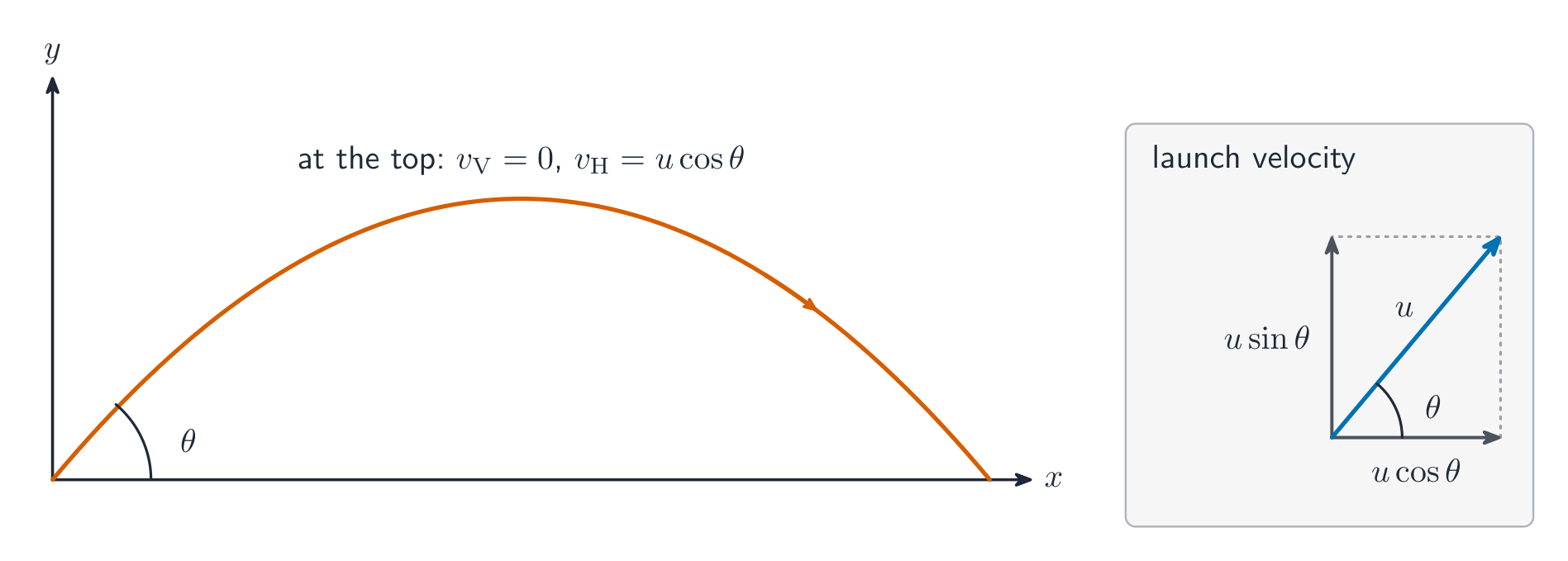
Projectile 抛体 launched at angle $\theta$ — horizontal and vertical motions are independent
弾道体について正しいものをすべて選択せよ(空気抵抗は無視する)。
難易度 2/5 · 140 コイン + 今日初回完了時に小ボーナス付与
最高点では 垂直 速度のみがゼロであり、水平速度 $u\cos\theta$ は継続するため、ボールは動き続ける。質量は自由落下を変化させない。
その弾道体の垂直発射速度は$10\ \dfrac{\text{m}}{\text{s}}$ である。最高点に到達するには何秒かかるか? ($g = 9.81\ \dfrac{\text{m}}{\text{s}^2}$ を用いる。)
難易度 2/5 · 140 コイン + 今日初回完了時に小ボーナス付与
最高点までの時間 $= \dfrac{u\sin\theta}{g} = \dfrac{10}{9.81} \approx 1.0\ \text{s}$ 。
A bouncing ball
- Between bounces the velocity–time graph is a straight sloping line (constant $g$).
- Each bounce is a sudden jump: the velocity flips direction (and shrinks if energy is lost).
バウンスボールの速度-時間グラフにおいて、各バウンスはどのように表示されるか:
難易度 1/5 · 100 コイン + 今日初回完了時に小ボーナス付与
バウンス時、速度はほぼ瞬時に下方から上方へ反転し、グラフ上で急激な垂直ジャンプとして表れる(エネルギーが失われる場合は小さくなる)。
Two objects meeting
- Write a displacement equation for each, using the same start time and positive direction.
- They are level again when their displacements are equal — set $s_1 = s_2$ and solve.
同一直線上を動く2つの物体が再び並ぶのは、それらの____が等しいときである。
難易度 1/5 · 100 コイン + 今日初回完了時に小ボーナス付与
2つの変位の方程式を等しく設定し($s_1 = s_2$)、時間を解く。
Worked example: thrown off a cliff
- A ball is thrown horizontally at $15\ \text{m/s}$ from a cliff $20\ \text{m}$ high. Find the time to land and how far from the base it lands. Take $g = 9.81\ \text{m/s}^2$.
- Vertical, to get the time. The initial vertical velocity is zero, so $s = \tfrac{1}{2}gt^2$ gives $20 = \tfrac{1}{2}(9.81)t^2$ and $t = 2.02\ \text{s}$.
- Horizontal, to get the range. There is no horizontal acceleration, so $x = ut = 15 \times 2.02 = 30\ \text{m}$.
- The horizontal speed plays no part in finding the time. A ball dropped from the same cliff lands at exactly the same moment.
- Time is the only quantity the two motions share, and it is always the bridge between them.
小球を水平方向に15 m/sで、高さ20 mの崖から投げる。着地までにかかる時間はいく秒か?(重力加速度 g = 9.81 m/s^2)
難易度 2/5 · 140 コイン + 今日初回完了時に小ボーナス付与
垂直成分のみ:20 = 0.5 × 9.81 × t^2 より、t = 2.02 s。15 m/s は関係なく、落としたボールも同じタイミングで着地する。
そのボールを水平に15 m/sで投げ、2.02 s後に着地した場合、崖の基部からどれだけ離れて着地するか、メートル単位で求めよ。
難易度 2/5 · 140 コイン + 今日初回完了時に小ボーナス付与
水平方向には加速度がないので、x = ut = 15 × 2.02 = 30 m。時間が2方向をつなぐ橋である。
Worked example: launched at an angle
- A ball leaves the ground at $18\ \text{m/s}$ at $60°$ to the horizontal. Show that it reaches its greatest height at $t = 1.6\ \text{s}$.
- Resolve first. Vertical: $u_y = 18\sin 60° = 15.6\ \text{m/s}$. Horizontal: $u_x = 18\cos 60° = 9.0\ \text{m/s}$.
- At the top the vertical velocity is zero, so $v = u + at$ gives $0 = 15.6 - 9.81t$ and $t = 1.59 \approx 1.6\ \text{s}$.
- The horizontal velocity is still $9.0\ \text{m/s}$ at the top. The speed there is $9.0\ \text{m/s}$, not zero.
- Total time of flight is twice this, $3.2\ \text{s}$, and the range is $u_x \times 3.2 = 29\ \text{m}$.
角度で発射された弾道体に対する手順を正しい順序で並べ替えよ。
難易度 3/5 · 200 コイン + 今日初回完了時に小ボーナス付与
時間が2方向に共通する唯一の量であるため、常にまず垂直運動から求める。
弾道体の軌道の最高点において、各物理量を対応させる。
難易度 2/5 · 140 コイン + 今日初回完了時に小ボーナス付与
最高点での速さはゼロではなく水平成分である。また加速度は一度も停止せず、最高点でも一瞬たりとも止まらない。
Marks that slip away
- Resolve before you start. Every projectile question is two one-dimensional problems sharing a value of $t$.
- The horizontal velocity is constant and takes no part in the time calculation.
- At the highest point the vertical velocity is zero, not the speed. The horizontal component is unchanged.
- A ball thrown horizontally and a ball dropped from the same height land at the same time.
- Keep the sign convention for the whole flight. With up positive, $a = -9.81\ \text{m/s}^2$ on the way down too.
崖から水平に投げられたボールは、同じ崖から同じ瞬間に落としたボールより遅く着地する。
難易度 1/5 · 100 コイン + 今日初回完了時に小ボーナス付与
一緒に着地する。垂直運動は同一であり、水平速度はそれに影響しない。これが2方向を別々に扱う理由そのものである。
You've got it
- horizontal and vertical motion are independent — share only the time $t$
- a horizontal throw lands in a time set only by its height
- resolve a launch: $u\cos\theta$ stays constant, $u\sin\theta$ behaves like a vertical throw