| English | 意味 |
|---|---|
| function/ˈfʌŋkʃn/ | 関数 |
| domain/dəˈmeɪn/ | 定義域 |
| range/reɪndʒ/ | 値域 |
| composition/ˌkɒmpəˈzɪʃn/ | 合成 |
| inverse/ɪnˈvɜːs/ | 逆関数 |
| one-one/wʌn wʌn/ | 一対一 |
The vending machine test
- A vending machine takes one code and gives exactly one snack. If code A7 sometimes gives crisps and sometimes chocolate, it's broken.
- A function 函数 works the same way: each input maps to exactly one output. This simple rule underpins all of calculus.
Functions, domain 定义域 and range 值域
- A function $f(x)$ sends each input to exactly one output.
- The domain = allowed inputs; the range = the outputs produced.
- Example: $f(x) = \sqrt{x}$ has domain $x \geq 0$ and range $f(x) \geq 0$.
Domain restrictions. $g(x) = \dfrac{1}{x-3}$ has domain $x \neq 3$ (division by zero is undefined). The range is all real numbers except $0$.
関数を探索する
y = ax³ + bx² + cx + d
関数は各入力をちょうど1つの出力に変換する — 係数をドラッグして、曲線が上昇したり下降したりする場所を見る。
f(x) = √(x − 4) の定義域は:
難易度 1/5 · 100 コイン + 今日初回完了時に小ボーナス付与
ルート内の式は非負でなければならない:x − 4 ≥ 0 より、x ≥ 4。
Composition 复合 and inverses 反函数
- A function is one-one 一一对应 if different inputs always give different outputs — only then does it have an inverse $f^{-1}$.
- Composition $fg(x) = f(g(x))$ — do $g$ first, then $f$.
f(x) = x²、g(x) = x + 1 のとき、fg(2) = f(g(2)) はいくつか?
難易度 2/5 · 140 コイン + 今日初回完了時に小ボーナス付与
g(2) = 3、次に f(3) = 3² = 9。
単射関数のみ逆関数を持つ。
難易度 1/5 · 100 コイン + 今日初回完了時に小ボーナス付与
2つの入力が同じ出力を与えると、逆の規則が曖昧になるため、単射関数のみが逆変換可能である。
Finding an inverse
- To find $f^{-1}$: write $y = f(x)$, make $x$ the subject, then swap letters.
- Example: $f(x) = 2x + 6$ → $x = \dfrac{y-6}{2}$ → $f^{-1}(x) = \dfrac{x-6}{2}$.
- The graph of $y = f^{-1}(x)$ is the reflection of $y = f(x)$ in the line $y = x$.
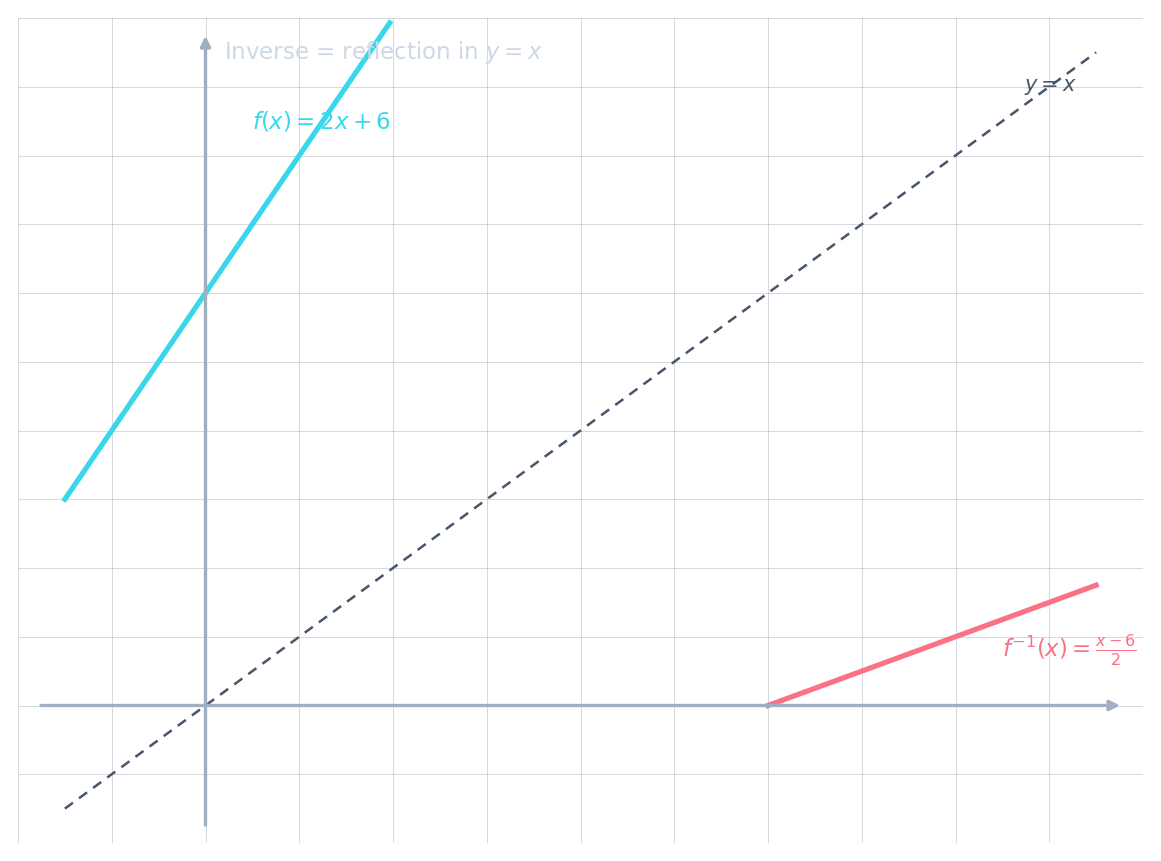
Inverse functions are reflections in $y = x$: the point $(a, b)$ on $f$ becomes $(b, a)$ on $f^{-1}$.
Not all functions have inverses. $f(x) = x^2$ is not one-one (both $2$ and $-2$ give $4$), so it has no inverse unless you restrict the domain to $x \geq 0$.
f(x) = 2x + 6 の逆関数は f⁻¹(x) = (x − 6)/2 である。f⁻¹(10) はいくつか?
難易度 2/5 · 140 コイン + 今日初回完了時に小ボーナス付与
f⁻¹(10) = (10 − 6)/2 = 4/2 = 2.
y = f⁻¹(x) のグラフは、y = f(x) のグラフを直線关于対称移动したものである:
難易度 1/5 · 100 コイン + 今日初回完了時に小ボーナス付与
逆関数は元のグラフを y = x の直線关于対称移動する。点 (a, b) は (b, a) になる。
Properties of inverses
- $f(f^{-1}(x)) = x$ and $f^{-1}(f(x)) = x$ — they undo each other.
- The domain of $f^{-1}$ is the range of $f$, and vice versa.
- Graphically: swap the axes.
- Know the composition of functions $fg(x)$ and graph transformations — a translation, a stretch, and reflections.

Adding to the output or input slides the curve; a multiplier stretches it
逆関数を持つ任意の関数 f について、f(f⁻¹(x)) = x。
難易度 1/5 · 100 コイン + 今日初回完了時に小ボーナス付与
関数を適用してからその逆を適用すると、元の入力が戻ってくる — 互いに打ち消し合う。
You've got it
- function: each input → exactly one output; domain = inputs, range = outputs
- one-one functions have inverses; find $f^{-1}$ by swapping and solving
- composition $fg(x) = f(g(x))$ — do $g$ first, then $f$
- the graph of $f^{-1}$ is the reflection of $f$ in $y = x$