| English | 意味 |
|---|---|
| positive integer/ˈpɒzɪtɪv ˈɪntɪdʒə/ | 正の整数 |
| mathematical induction/ˌmæθɪˈmætɪkl ɪnˈdʌkʃn/ | 数学的帰納法 |
| base case/beɪs keɪs/ | 基底ケース |
| inductive step/ɪnˈdʌktɪv step/ | 帰納的段階 |
| conjecture/kənˈdʒektʃə/ | 仮説 |
| divisible/dɪˈvɪzɪbl/ | 割り切れる |
The domino proof
- How do you prove something is true for every positive integer 正整数 — infinitely many cases?
- Mathematical induction 数学归纳法 works like dominoes: knock over the first one (base case 基础情形), and show each domino knocks over the next (inductive step 归纳步骤). If both work, they all fall.
帰納法による証明のプロセス
帰納法を、最初のドミノ再加上すべての次のケースを押すルールと捉える。
The two steps of induction
- Mathematical induction proves a result for every positive integer $n$ in two steps:
- Base case: show it's true for $n = 1$.
- Inductive step: assume it's true for $n = k$, then prove it for $n = k + 1$.
Worked example. Prove $\sum_{r=1}^{n} r = \dfrac{n(n+1)}{2}$. Base case ($n=1$): LHS $= 1$, RHS $= \dfrac{1(2)}{2} = 1$. ✓ Inductive step: Assume true for $n = k$. For $n = k+1$: $\sum_{r=1}^{k+1} r = \dfrac{k(k+1)}{2} + (k+1) = \dfrac{(k+1)(k+2)}{2}$. ✓
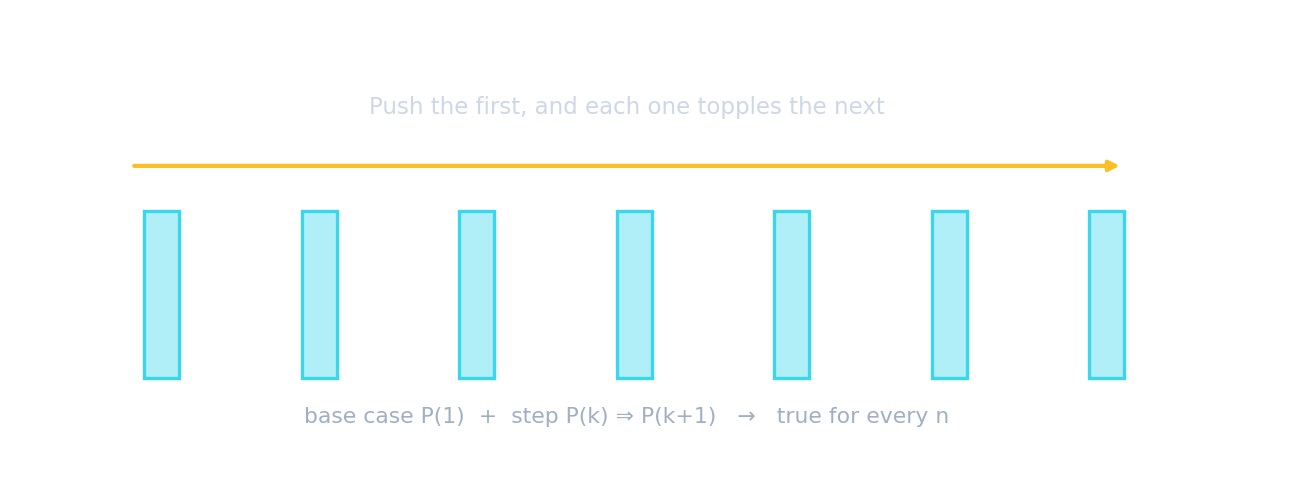
Proof by induction works like a chain of falling dominoes
帰納法による証明の2つのステップは基底ケースと次のうち:
難易度 1/5 · 100 コイン + 今日初回完了時に小ボーナス付与
帰納法には、基底ケース加上 k から k+1 への帰納的ステップが必要である。
基底ケースは通常、結果が真であることが示される:
難易度 1/5 · 100 コイン + 今日初回完了時に小ボーナス付与
基底ケースは最小値を確認し、通常 n = 1 である。
基底ケースと帰納的ステップの両方が成り立つなら、結果はすべての正の整数 n に対して真である。
難易度 1/5 · 100 コイン + 今日初回完了時に小ボーナス付与
これがまさに帰納法の原理が保証することである。
Why both steps are essential
- The base case starts the chain. Without it, you could "prove" false statements.
- The inductive step extends it. Without it, you've only proved one case.
Both steps are essential. A proof with only the inductive step is like a row of dominoes that nobody pushes — they never start falling. A proof with only the base case is like pushing one domino — only one falls.
基底ケースなしでも帰納的ステップのみを使って結果を帰納法で証明できる。
難易度 1/5 · 100 コイン + 今日初回完了時に小ボーナス付与
両方のステップが不可欠である。基底ケースがないと連鎖は始まらない。
Conjecture 猜想 then prove
- Often you make a conjecture (a sensible guess) from a few cases, then confirm it by inductive proof.
- Example: $1 + 3 + 5 + 7 = 16 = 4^2$. Conjecture: the sum of the first $n$ odd numbers is $n^2$.
帰納法を用いて、和 1 + 2 + ... + n = n(n+1)/2 を证明せよ。n = 10 のとき和を求めよ。
難易度 2/5 · 140 コイン + 今日初回完了時に小ボーナス付与
10(11)/2 = 55.
Induction for divisibility
- Prove $3^n - 1$ is divisible 整除 by $2$ for all positive integers $n$.
- Base case ($n=1$): $3^1 - 1 = 2$, divisible by $2$. ✓
- Inductive step: $3^{k+1} - 1 = 3 \cdot 3^k - 1 = 3(3^k - 1) + 2$. Since $3^k - 1$ is divisible by $2$ (by assumption), so is the whole expression. ✓
数学において、予想とは:
難易度 1/5 · 100 コイン + 今日初回完了時に小ボーナス付与
予想は証拠に基づく未証明の命題であり、それを証明しようとする(しばしば帰納法による)。
You've got it
- induction = base case ($n=1$) + inductive step ($n=k \Rightarrow n=k+1$)
- both steps together prove it for all positive integers
- often conjecture from cases, then prove by induction