| English | 意味 |
|---|---|
| business cycle/ˈbɪznəs ˈsaɪkl/ | 景気循環 |
| potential growth/pəˈtenʃl ɡrəʊθ/ | 潜在成長 |
| actual growth/ˈæktʃuːəl ɡrəʊθ/ | 実質成長 |
| recession/rɪˈseʃn/ | 不況 |
| recovery/rɪˈkʌvəri/ | 回復 |
| human capital/ˈhjuːmən ˈkæpɪtl/ | 人件資本 |
Why economies boom and bust
- No economy grows in a smooth line — it surges, overheats, slumps, and recovers, again and again.
- Understanding the business cycle 经济周期 and what drives growth is the heart of macro policy.
Potential growth is best shown on a PPF as:
難易度 1/5 · 100 コイン + 今日初回完了時に小ボーナス付与
Potential (capacity) growth shifts the whole PPF out; actual growth can be a move toward/along it.
Actual vs potential growth 潜在增长
- Actual growth 实际增长 = the real rise in GDP this year (moving toward, or along, the PPF).
- Potential growth = the rise in the economy's capacity (the PPF shifting out) — from more or better resources and technology.
Economic growth shifts the frontier out
Growth means the economy can produce more of BOTH goods — the whole frontier moves outward as resources or technology improve.
A recession is conventionally two consecutive quarters of falling real GDP.
難易度 1/5 · 100 コイン + 今日初回完了時に小ボーナス付与
Two quarters of negative real GDP growth is the common definition.
Put the phases of the business cycle in order, starting from the peak.
難易度 3/5 · 200 コイン + 今日初回完了時に小ボーナス付与
The cycle runs boom → slowdown → recession → recovery, then back to boom.
The business cycle
- Real GDP cycles around its long-run trend: boom → slowdown → recession 衰退 → recovery 复苏.
- A recession is conventionally two consecutive quarters of falling real GDP.
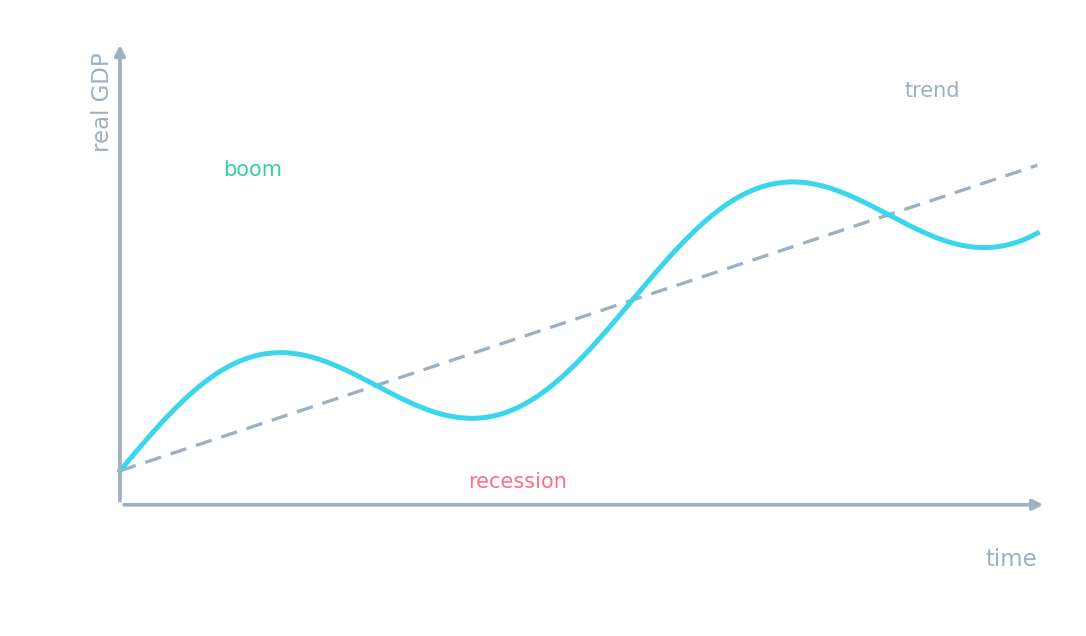
Real GDP swings above and below its long-run trend — booms and recessions.
Worked example. GDP rises from 500bn to 520bn in a year. Growth rate = (20 ÷ 500) × 100 = 4%.
GDP rises from 500bn to 520bn in a year. What is the growth rate (%)?
難易度 2/5 · 140 コイン + 今日初回完了時に小ボーナス付与
(20 / 500) × 100 = 4%.
Causes and costs
- Causes of growth: investment, technology, education (human capital 人力资本), more labour.
- Benefits: higher incomes, more jobs, better public services. Costs: inflation risk, inequality, environmental damage, resource depletion.
Spending by firms on capital goods, which raises future capacity, is called ______.
難易度 1/5 · 100 コイン + 今日初回完了時に小ボーナス付与
Investment is a key driver of both actual and potential growth.
You've got it
- actual growth = real GDP rise; potential growth = capacity rise (PPF shifts out)
- the business cycle: boom → slowdown → recession → recovery, around a rising trend
- growth comes from investment, technology, human capital; it has benefits and costs