| English | 意味 |
|---|---|
| nucleotide/ˈnjuːklɪɒtaɪd/ | ヌクレオチド |
| nucleic acid/njuːˈklɪɪk ˈæsɪd/ | 核酸 |
| double helix/ˈdʌbl ˈhiːlɪks/ | 二重らせん |
| purine/ˈpjʊəriːn/ | プリン |
| pyrimidine/ˈpɪrɪmɪdiːn/ | ピリミジン |
| deoxyribose/diːˈɒksɪrɪbəʊs/ | デオキシリボース |
| phosphodiester bond/ˈfɒsfəʊdɪstə bɒnd/ | 磷酸二エステル結合 |
| antiparallel/ˌæntɪˈpærəlel/ | 反平行 |
| complementary base pairing/ˌkɒmplɪˈmentəri beɪs ˈpeərɪŋ/ | 塩基相補性 |
Nucleotides 核苷酸 and DNA
- DNA and RNA are nucleic acids 核酸 — polymers of small units called nucleotides.
- The same building block also powers the cell as ATP.
- DNA's famous shape, the double helix 双螺旋, comes from how its bases pair up.
Nucleotides and bases
- Each nucleotide has three parts: a phosphate, a 5-carbon sugar, and a base.
- ATP is a nucleotide with the base adenine, the sugar ribose, and three phosphates — breaking off the last one releases energy.
- Five bases, in two groups:
- purines 嘌呤 (double ring): adenine (A), guanine (G).
- pyrimidines 嘧啶 (single ring): cytosine (C), thymine (T), uracil (U).

Purines (A, G) have a double ring; pyrimidines (C, T, U) have a single ring

A space-filling model of the DNA double helix, showing its twisted-ladder shape
単一のヌクレオチドは次のものから成る:
難易度 1/5 · 100 コイン + 今日初回完了時に小ボーナス付与
すべてのヌクレオチドには3つの部分がある:ホスフェート基、ペントース糖、窒素を含む塩基。
ATPが細胞のためにエネルギーを放出するのは:
難易度 1/5 · 100 コイン + 今日初回完了時に小ボーナス付与
ATPには3つのホスフェートがあり、末端のホスフェートを切り離すとエネルギーが放出される。
The DNA backbone
- DNA is two strands twisted into a double helix.
- Each strand has a backbone of alternating deoxyribose 脱氧核糖 sugar and phosphate, joined by phosphodiester bonds 磷酸二酯键.
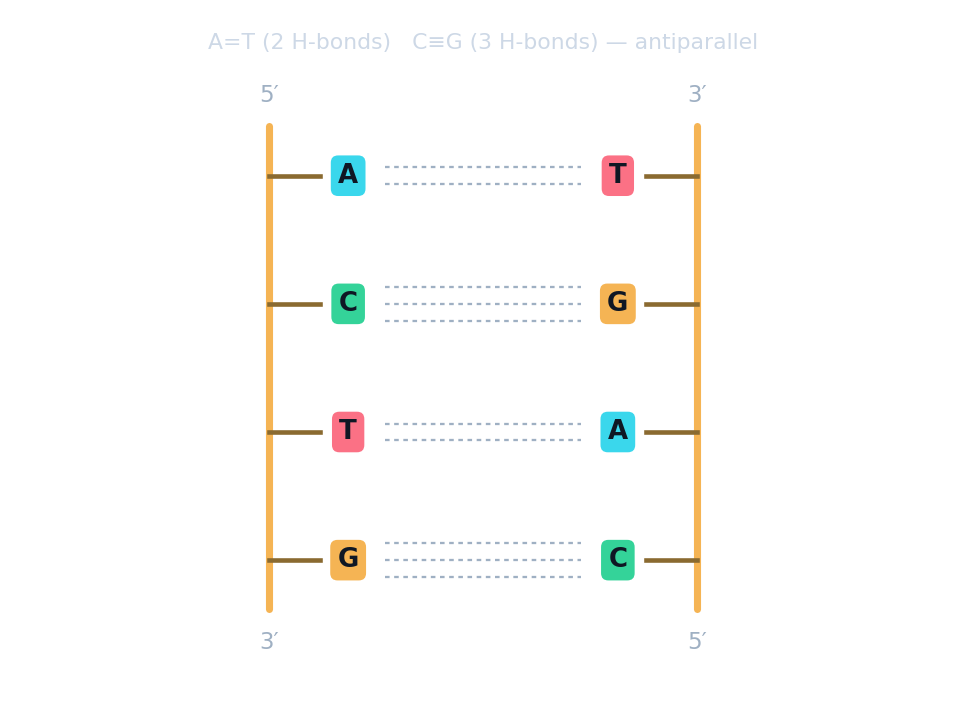
- The two strands run in opposite directions — they are antiparallel 反平行 (one 5′→3′, the other 3′→5′).

A nucleotide and ATP
DNAの梯子を調べる
二重らせんの各部分にタップする — 補合塩基対を横木とする2本の反平行骨格。
2本のDNA鎖は反平行であるとされるが、その理由は:
難易度 1/5 · 100 コイン + 今日初回完了時に小ボーナス付与
反平行とは、鎖が逆向きを指していることを意味する:一本は 5′→3′、もう一本は 3′→5′。
Complementary base pairing 碱基互补配对
- The strands are held together by their bases in the middle, paired exactly:
- A pairs with T — 2 hydrogen bonds.
- C pairs with G — 3 hydrogen bonds (so C–G is harder to separate).
各塩基グループとその説明を対応させよ。
難易度 2/5 · 140 コイン + 今日初回完了時に小ボーナス付与
プリン類(二環式)は常にピリミジン類(単環式)と対をなす:A–T および C–G。
DNAにおいて、A は常に T と対をなし、C は常に ______ と対をなす。
難易度 1/5 · 100 コイン + 今日初回完了時に小ボーナス付与
補合塩基対:A–T(水素結合2本)および C–G(水素結合3本)。
あるDNA試料には30%のアデニンが含まれている。A は T と対をなすので、チミンの割合はいくらか?
難易度 2/5 · 140 コイン + 今日初回完了時に小ボーナス付与
A は常に T と対をなすため %A = %T となる。アデニンが30%であれば、チミンも30%(残りの40%は C と G に割り振られる)。
C–G 塩基対には水素結合3本あり、A–T 対よりも離すのが難しい。
難易度 1/5 · 100 コイン + 今日初回完了時に小ボーナス付与
C–G は水素結合3本、A–T は水素結合2本のみで結ばれているため、C–G の多い DNA ほど安定性が高い。
You've got it
- nucleotide = phosphate + sugar + base; ATP = adenine + ribose + 3 phosphates (energy)
- purines (A, G, double ring) vs pyrimidines (C, T, U, single ring)
- DNA = double helix; backbone = deoxyribose + phosphate (phosphodiester bonds); strands antiparallel
- A–T (2 H-bonds), C–G (3 H-bonds) — complementary base pairing