Original teaching practice. Read one pattern, cover its model and try the questions before checking the separate answer section. Examples adapted from Chinese Grammar Wiki (AllSet Learning, CC BY-NC-SA) retain the course-reference provenance.
not to be concerned不管 … ,all / both都 / also也 … (no matter)
Whatever the weather
- Your grandfather walks in the park every morning, rain or shine.
- not to be concerned不管weather天气how about怎么样,(coll.) father's father爷爷all / both都to go去park (for public recreation)公园to take a walk散步。 — "No matter what the weather is like, Grandpa goes for a walk in the park."
not to be concerned不管 + open question,all / both都 / also也 + result
- not to be concerned不管 + question word / A-not-A / or / still还是, then all / both都 or also也: the result stays the same in every case.
- not to be concerned不管 must be followed by an open choice: not to be concerned不管who谁, not to be concerned不管多忙, not to be concerned不管去不去.
no matter不管how多busy忙,he他always都to给Mum妈妈calls打电话。

Three ways to open the choice
- Question word: not to be concerned不管who谁to come来,I / me我all / both都to welcome欢迎。 — "Whoever comes, they're welcome."
- A-not-A / or / still还是: not to be concerned不管you你去不去,I / me我all / both都to go去。 / not to be concerned不管to take the car, bus, train…坐车or / still还是to walk走路,all / both都want / will / need要一个hour小时.
no matter不管you你go去or not不go去,I我anyway都go去。
No plain statement after not to be concerned不管
- not to be concerned不管to rain下雨 is wrong; it needs an open choice: not to be concerned不管down下不下雨 or not to be concerned不管weather天气how about怎么样.
- Put all / both都 / also也 after the subject of the result: I / me我all / both都to go去, not all / both都I / me我to go去.
not to be concerned不管 versus although虽然
- although虽然 + one fact: although虽然to rain下雨,I / me我or / still还是to go去(completed / change)了 (it did rain).
- not to be concerned不管 + every possibility: not to be concerned不管down下不下雨,I / me我all / both都to go去 (rain or no rain).
although虽然it rained下雨,I我still还是went去了。
Recap
- not to be concerned不管 + QW / A-not-A / Aor / still还是B,Subject + all / both都/also也 + result = no matter …, ….
- Needs an open choice, never a single fact (that is although虽然).
Practise this pattern step by step.
no matter what or how无论 / whatever不论 … ,all / both都 / also也 … (regardless)
The same rule for everyone
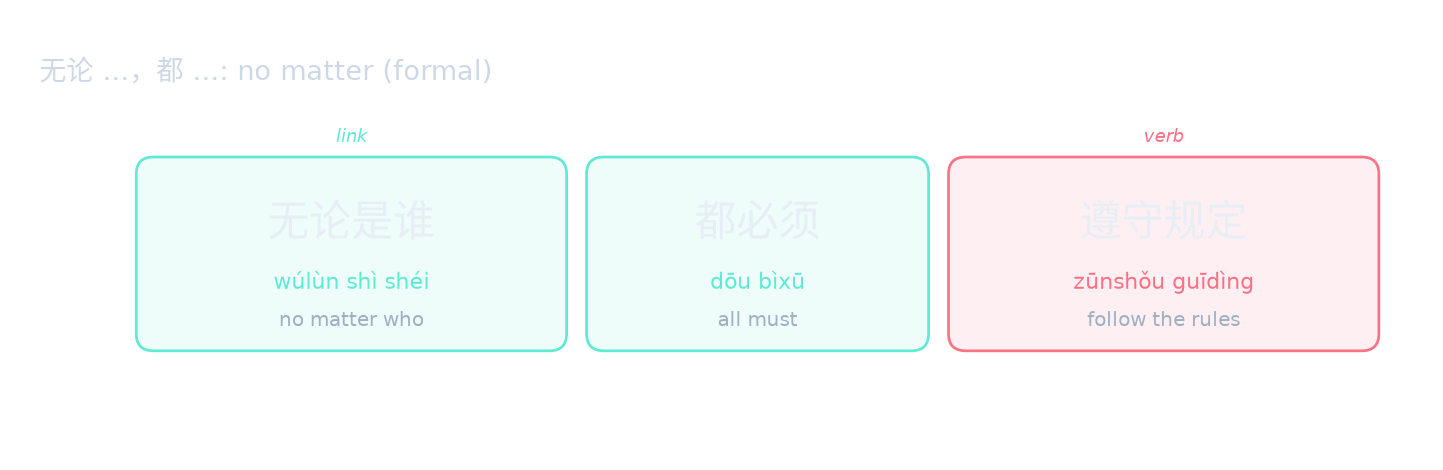
- The new school rules are read out at assembly.
- 无论是who谁,all / both都to have to必须to comply with遵守to stipulate规定。 — "Whoever you are, you must follow the rules."
no matter what or how无论 / whatever不论 + open choice,all / both都 / also也 + result
- no matter what or how无论 and whatever不论 mean "no matter, regardless of", like not to be concerned不管 but more formal.
- The same structure: an open choice (QW, A-not-A, or / still还是), then all / both都 / also也.
no matter无论meet遇到what什么difficulty困难,he他always都not不give up放弃。
Formal promises and rules
- no matter what or how无论多晚,we / us我们all / both都can / will会to wait for等you你。 — "However late it is, we'll wait for you."
- whatever不论large and small大小,每件事all / both都want / will / need要conscientious认真to make做。 — "Big or small, every task must be done carefully."
regardless of不论size大小,every每(measure word)件task事all都must要carefully认真be done做。
Same rules as not to be concerned不管
- An open choice must follow: no matter what or how无论weather天气how about怎么样, not no matter what or how无论to rain下雨.
- all / both都 / also也 goes after the subject of the result: he / him他all / both都not不to renounce放弃.
no matter what or how无论 / whatever不论 versus not to be concerned不管
- not to be concerned不管 is spoken and casual: not to be concerned不管you你variant of 说说what什么,I / me我all / both都not不to listen to听.
- no matter what or how无论 / whatever不论 suit speeches, rules and writing; whatever the case无论如何 = "in any case, whatever happens".
whatever happens无论如何,I我(definitely)都will会come来。
Recap
- no matter what or how无论 / whatever不论 + open choice,all / both都/also也 + result = no matter …, regardless of … (formal).
- not to be concerned不管 is the spoken version; whatever the case无论如何 = in any case.
Practise this pattern step by step.
Practice without the models
not to be concerned不管 … ,all / both都 / also也 … (no matter)
1801.1 Complete: “No matter how busy he is, he calls his mum.” not to be concerned不管多忙,he / him他…………to / for / give给mama妈妈to make a telephone call打电话。
1801.2 Which sentence is correct?
- A. not to be concerned不管down下不下雨,I / me我all / both都to go去。
- B. not to be concerned不管down下不下雨,all / both都I / me我to go去。
- C. not to be concerned不管to rain下雨,I / me我all / both都to go去。
- D. not to be concerned不管to rain下雨,I / me我or / still还是to go去。
1801.3 Build: “Whoever comes, they're welcome.”
Arrange all chunks: , / not to be concerned不管who谁to come来 / to welcome欢迎。 / I / me我all / both都
1801.4 not to be concerned不管 introduces one fact that really happened.
True or false? Explain or repair the statement.
1801.5 Your grandfather walks in the park every morning, rain or shine. Close the examples. Say a Mandarin response, then write it in Chinese. Explain briefly in English what the lesson’s pattern adds. Compare with the model, then change one detail and try again.
Write or say your own response before reading the key.
no matter what or how无论 / whatever不论 … ,all / both都 / also也 … (regardless)
1802.1 Complete (formal): “Whatever difficulties he meets, he never gives up.” …………to meet遇到what什么difficult困难,he / him他all / both都not不to renounce放弃。
1802.2 Which sentence is correct?
- A. no matter what or how无论多忙,all / both都he / him他to come来。
- B. no matter what or how无论多忙,he / him他but但是to come来。
- C. no matter what or how无论degree / adjective linker很busy忙,he / him他all / both都to come来。
- D. no matter what or how无论多忙,he / him他all / both都to come来。
1802.3 Build: “Whatever happens, I'll come.”
Arrange all chunks: whatever the case无论如何 / I / me我all / both都 / , / can / will会to come来。
1802.4 not to be concerned不管 is more formal than no matter what or how无论.
True or false? Explain or repair the statement.
1802.5 The new school rules are read out at assembly. Close the examples. Say a Mandarin response, then write it in Chinese. Explain briefly in English what the lesson’s pattern adds. Compare with the model, then change one detail and try again.
Write or say your own response before reading the key.
Answers and explanations
not to be concerned不管 … ,all / both都 / also也 … (no matter)
1801.1 all / both都
not to be concerned不管…,all / both都/also也….
1801.2 A. not to be concerned不管down下不下雨,I / me我all / both都to go去。
not to be concerned不管 needs an open choice, and all / both都 follows the subject.
1801.3 not to be concerned不管who谁to come来,I / me我all / both都to welcome欢迎。
not to be concerned不管 + QW, subject + all / both都 + result.
1801.4 False.
It covers every possibility; a single fact takes although虽然.
1801.5 One possible response: not to be concerned不管weather天气how about怎么样,(coll.) father's father爷爷all / both都to go去park (for public recreation)公园to take a walk散步。
Check meaning and form:
- My response conveys a message that fits the opening situation.
- I can explain the meaning of the pattern, rather than only naming it.
- not to be concerned不管to rain下雨 is wrong; it needs an open choice: not to be concerned不管down下不下雨 or not to be concerned不管weather天气how about怎么样.
- Put all / both都 / also也 after the subject of the result: I / me我all / both都to go去, not all / both都I / me我to go去.
- I tried a second response with a name, time, place, or description changed.
This is supported productive practice. Compare meaning and structure; your answer need not copy the model. A partner or teacher must hear the spoken response to comment on pronunciation.
no matter what or how无论 / whatever不论 … ,all / both都 / also也 … (regardless)
1802.1 no matter what or how无论
no matter what or how无论 + open choice, all / both都 + result.
1802.2 D. no matter what or how无论多忙,he / him他all / both都to come来。
no matter what or how无论多忙,he / him他all / both都to come来 is right: no matter what or how无论 needs an open choice such as 多忙 or what什么, not a fixed degree / adjective linker很busy忙, and the result clause uses subject + all / both都.
1802.3 whatever the case无论如何,I / me我all / both都can / will会to come来。
whatever the case无论如何 + all / both都 + result.
1802.4 False.
no matter what or how无论 / whatever不论 are the formal ones.
1802.5 One possible response: 无论是who谁,all / both都to have to必须to comply with遵守to stipulate规定。
Check meaning and form:
- My response conveys a message that fits the opening situation.
- I can explain the meaning of the pattern, rather than only naming it.
- An open choice must follow: no matter what or how无论weather天气how about怎么样, not no matter what or how无论to rain下雨.
- all / both都 / also也 goes after the subject of the result: he / him他all / both都not不to renounce放弃.
- I tried a second response with a name, time, place, or description changed.
This is supported productive practice. Compare meaning and structure; your answer need not copy the model. A partner or teacher must hear the spoken response to comment on pronunciation.