Rangkaian — seri, paralel dan pembagi potensial
Diperkenalkan| English | Makna |
|---|---|
| components/kəmˈpəʊnənts/ | komponen |
| series/ˈsɪəriːz/ | seri |
| parallel/ˈpærəlel/ | paralel |
| potential divider/pəˈtenʃl dɪˈvaɪdə/ | pembagi potensial |
| fuse/fjuːz/ | sekerat |
| thermistor/ˈθɜːmɪstə/ | termistor |
| LDR/ˌel diː ˈɑː/ | LDR |
Building circuits
- Real gadgets are circuits built from a handful of components 元件, wired in two basic ways.
- Get the rules for series 串联 and parallel 并联 and you can predict any simple circuit.
- We finish with a clever trick: the potential divider 分压器.
Components to know
- cell / battery — drives the current; a switch breaks or completes the circuit.
- resistor (fixed) and variable resistor (to control the current).
- fuse 保险丝 — melts if the current is too big; diode / LED — current one way only (an LED also lights).
- thermistor 热敏电阻 — resistance falls as it gets hotter; LDR 光敏电阻 — resistance falls as light gets brighter.
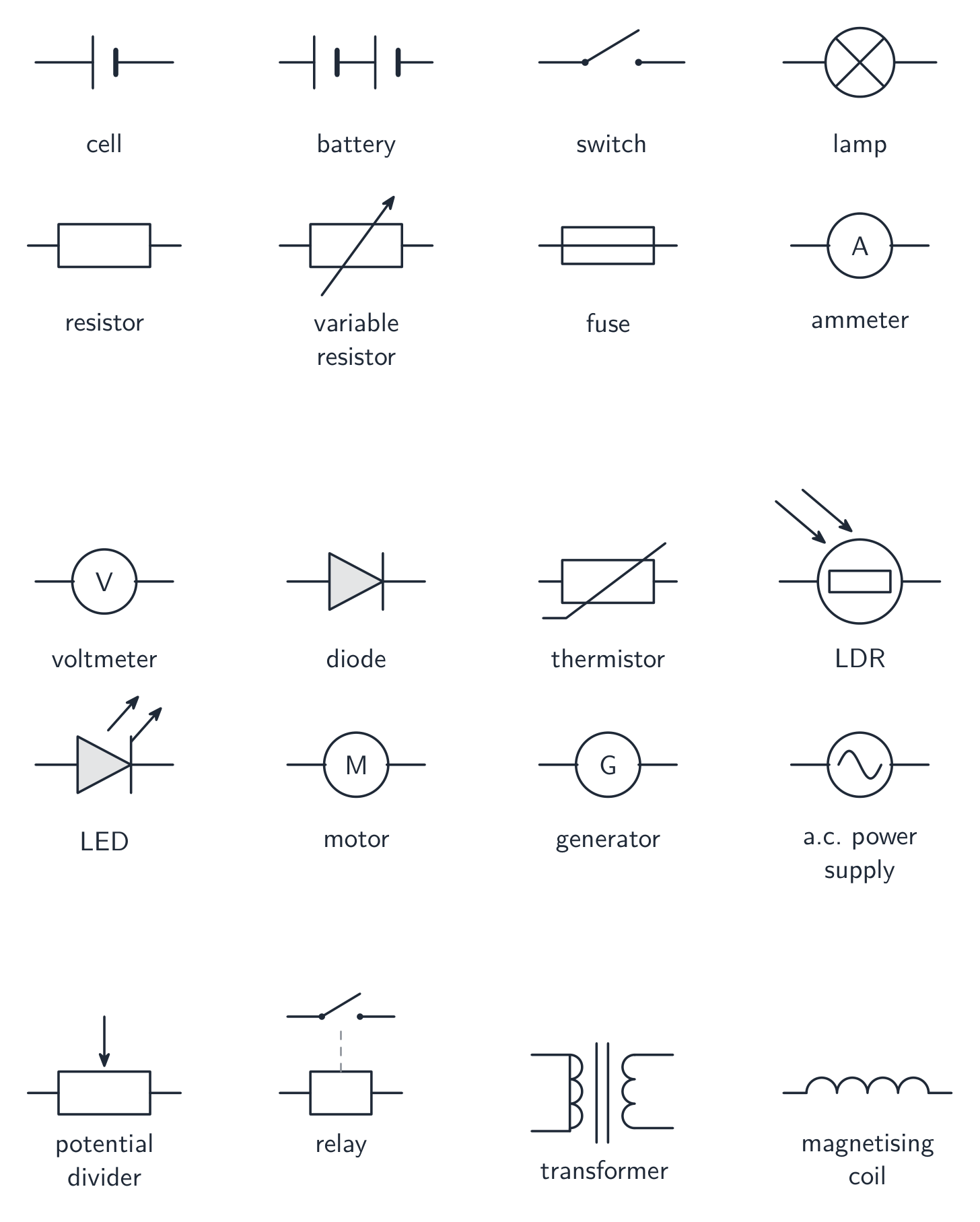
Standard circuit symbols
Bangun arus dengan hukum Ohm
Naikkan tegangan dan elektron berakselerasi dan bohlam menyala lebih terang; tambahkan hambatan dan arus turun. I = V/R, kecerahan = daya.
Apa yang terjadi pada hambatan termistor saat semakin panas?
Kesulitan 1/5 · 100 koin + bonus kecil pada penyelesaian pertama hari ini
Hambatan termistor turun seiring kenaikan suhu — berguna dalam rangkaian pendeteksi suhu.
Pasangkan setiap aturan rangkaian dengan tempat penerapannya.
Kesulitan 2/5 · 140 koin + bonus kecil pada penyelesaian pertama hari ini
Setiap item menghubungkan istilah ke maknanya yang benar.
Series circuits
- The parts form one single loop.
- The current is the same at every point.
- The supply p.d. is shared between the components.
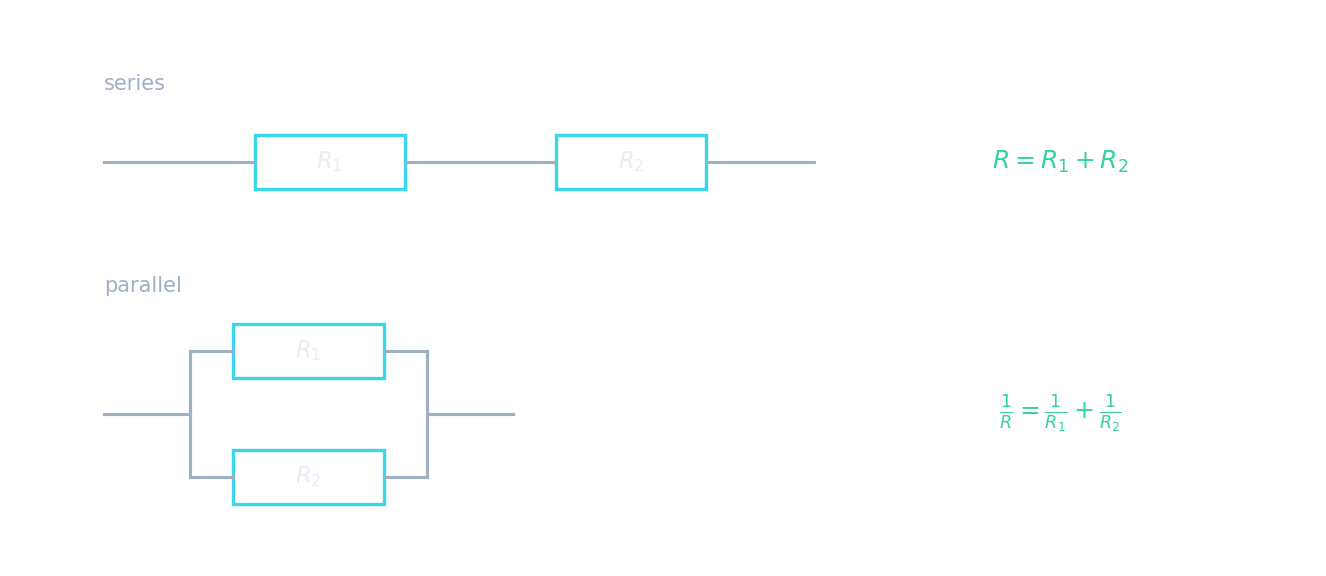
- Resistors in series add up: $R_{\text{total}} = R_1 + R_2 + \dots$
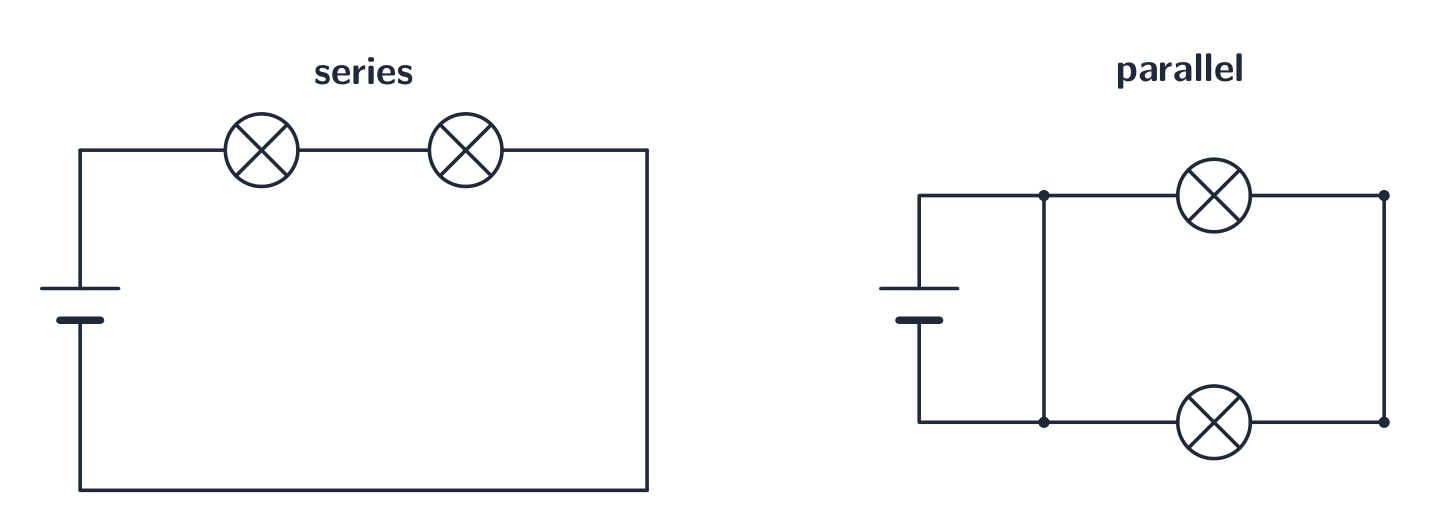
Series and parallel circuits
Resistor $3.0\ \Omega$ dan $5.0\ \Omega$ dihubungkan seri. Berapakah hambatan total, dalam Ω?
Kesulitan 2/5 · 140 koin + bonus kecil pada penyelesaian pertama hari ini
Seri, hambatan dijumlahkan: $R = 3.0 + 5.0 = 8.0\ \Omega$.
Dalam rangkaian seri, arusnya:
Kesulitan 1/5 · 100 koin + bonus kecil pada penyelesaian pertama hari ini
Hanya ada satu jalur, sehingga arus yang sama mengalir melalui setiap komponen dalam rangkaian seri.
Parallel circuits
- The parts are on separate branches.
- Each branch gets the full supply p.d.; the current splits between branches.
- The total resistance is less than the smallest single resistor: $\dfrac{1}{R_{\text{total}}} = \dfrac{1}{R_1} + \dfrac{1}{R_2}$
- Home lamps are wired in parallel — each gets full voltage, and one failing leaves the others on.
Resistor $6.0\ \Omega$ dan $3.0\ \Omega$ dihubungkan paralel. Berapakah hambatan total, dalam Ω?
Kesulitan 2/5 · 140 koin + bonus kecil pada penyelesaian pertama hari ini
$\dfrac{1}{R} = \dfrac{1}{6.0} + \dfrac{1}{3.0} = \dfrac{1}{6} + \dfrac{2}{6} = \dfrac{3}{6}$, jadi $R = 2.0\ \Omega$ — kurang dari resistor terkecil.
Mengapa lampu-lampu di rumah dirangkai paralel?
Kesulitan 1/5 · 100 koin + bonus kecil pada penyelesaian pertama hari ini
Secara paralel, setiap lampu menerima tegangan penuh dari sumber, dan kerusakan pada satu cabang tidak menghentikan arus di cabang lainnya.
Potential dividers
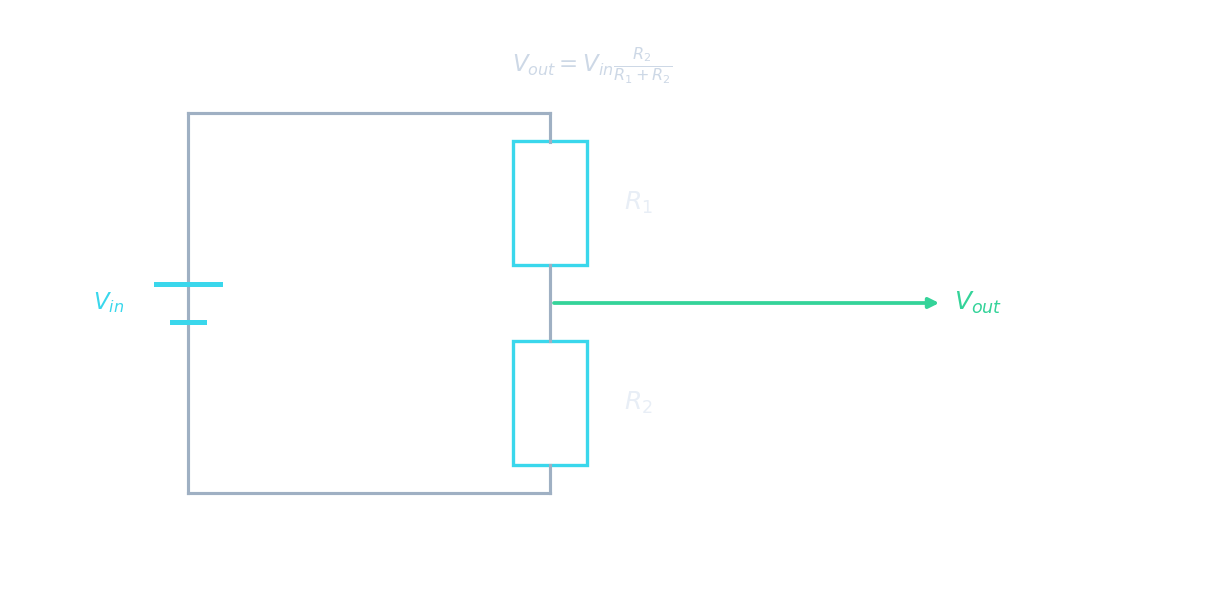
- Two resistors in series share the supply voltage — a potential divider.
- The bigger resistor takes the bigger share of the voltage:
- Use a thermistor or LDR as one resistor and the output voltage changes with temperature or light — perfect for switching a heater or lamp on automatically.
Dua resistor yang sama dirangkai seri melintasi sumber $12\ \text{V}$. Berapakah tegangan di salah satu resistor tersebut, dalam V?
Kesulitan 2/5 · 140 koin + bonus kecil pada penyelesaian pertama hari ini
Resistor yang sama membagi tegangan secara merata: masing-masing menerima $\dfrac{12}{2} = 6\ \text{V}$.
Worked examples
1. A $4.0\ \Omega$ and a $6.0\ \Omega$ resistor are in series with a $12\ \text{V}$ battery. $R_{\text{total}} = 10\ \Omega$, so $I = \dfrac{V}{R} = \dfrac{12}{10} = 1.2\ \text{A}$.
2. The same current flows through both, so they share the voltage in the ratio of their resistances: $1.2 \times 4.0 = 4.8\ \text{V}$ and $1.2 \times 6.0 = 7.2\ \text{V}$, which add up to $12\ \text{V}$.
Parallel resistors do not add. A $6\ \Omega$ and a $3\ \Omega$ resistor in parallel have a combined resistance of $2\ \Omega$, less than either one. The current is the same at every point in a series circuit; it is not used up.
Temukan total seri dan paralel dari resistor 6 ohm dan resistor 12 ohm. Jika dua resistor identik membagi sumber tegangan 18 V secara seri, berapakah beda potensial (p.d.) pada salah satu resistornya?
Resistansi seri ditambahkan. Hasil kali paralel dibagi jumlah adalah 72 dibagi dengan 18, yaitu 4 ohm.
Berapakah total seri?
Kesulitan 1/5 · 100 koin + bonus kecil pada penyelesaian pertama hari ini
6 ditambah 12 sama dengan 18 ohm, dan kombinasi paralelnya adalah 4 ohm.
You've got it
- series: one loop, same current everywhere, p.d. shared, $R_{\text{total}} = R_1 + R_2$
- parallel: branches, each gets full p.d., current splits, $\dfrac{1}{R_{\text{total}}} = \dfrac{1}{R_1} + \dfrac{1}{R_2}$
- thermistor: R falls when hot · LDR: R falls in bright light
- potential divider: two series resistors share the voltage by their ratio
Write from the data given
- One resistor is 6 ohms and the other is 12 ohms.
- Find the series total and the parallel total. Two equal resistors share 18 V.