Arus, g.g.b. dan beda potensial
Diperkenalkan| English | Makna |
|---|---|
| electric current/ɪˈlektrɪk ˈkʌrənt/ | arus listrik |
| potential difference/pəˈtenʃl ˈdɪfrəns/ | beda potensial |
| amperes/ˈæmpeəz/ | ampere |
| ammeter/ˈæmiːtə/ | amperemeter |
| conventional current/kənˈvenʃənl ˈkʌrənt/ | arus konvensional |
| direct current/daɪˈrekt ˈkʌrənt/ | arus searah |
| alternating current/ˈɔːltəneɪtɪŋ ˈkʌrənt/ | arus bolak-balik |
| volts/vəʊlts/ | volt |
| voltmeter/ˈvəʊltmiːtə/ | voltmeter |
What is flowing?
- Switch on a lamp and something flows through the wires — an electric current 电流.
- A cell gives that flow the push it needs.
- Three quantities describe it all: current, e.m.f. and potential difference 电势差.
Electric current
- An electric current is a flow of electric charge, measured in amperes 安培 (A) with an ammeter 电流表 joined in series.
- Current is the charge passing a point each second:
- $I$ in amperes, $Q$ in coulombs (C), $t$ in seconds.
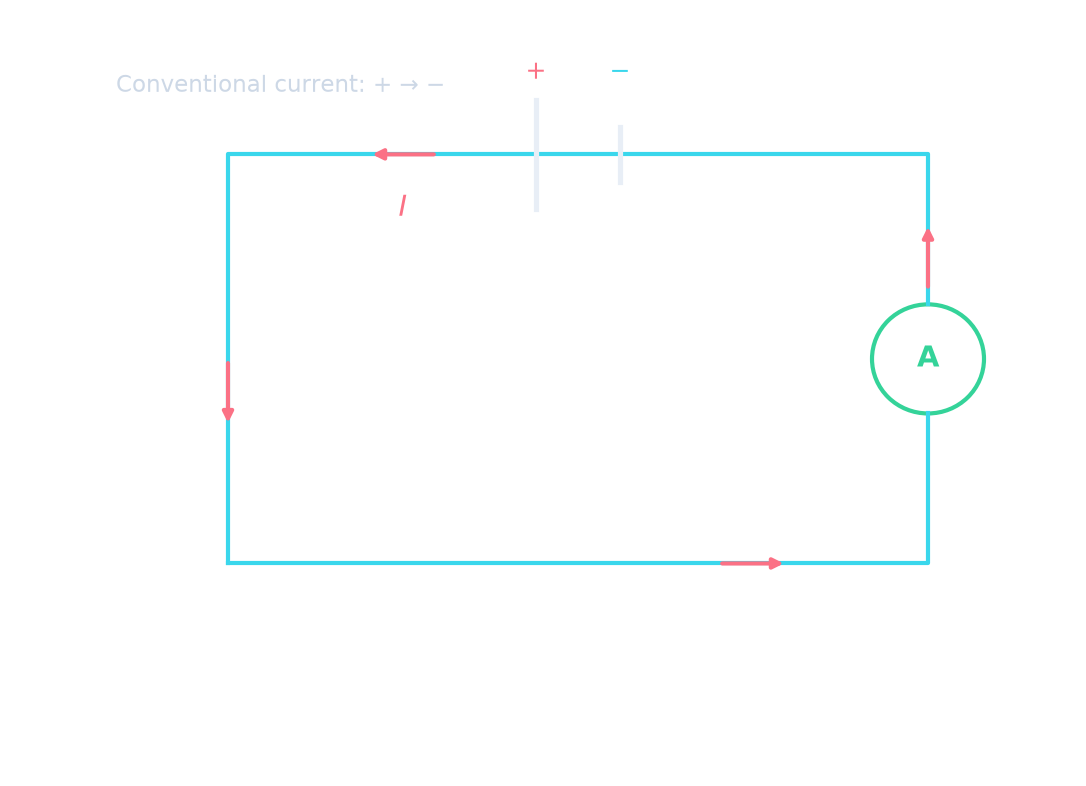
Conventional current 常规电流 flows from the positive terminal to the negative terminal, through the external circuit. The ammeter (A) is connected in series to measure the current.
Worked example. A current of $2\ \text{A}$ flows for $30\ \text{s}$. Charge $= It = 2 \times 30 = 60\ \text{C}$.
Conventional current vs electron flow. Conventional current is drawn from $+$ to $-$, but the actual electrons in a metal wire drift the opposite way ($-$ to $+$). The convention was set before electrons were discovered, and we still use it today.
Hukum Ohm
V = IR
Untuk konduktor ohmik, arus sebanding dengan tegangan — kemiringan adalah 1/hambatan.
Muatan $30\ \text{C}$ mengalir melewati suatu titik dalam waktu $10\ \text{s}$. Berapakah arus, dalam A?
Kesulitan 2/5 · 140 koin + bonus kecil pada penyelesaian pertama hari ini
$I = \dfrac{Q}{t} = \dfrac{30}{10} = 3.0\ \text{A}$.
Arus $2.0\ \text{A}$ mengalir selama waktu $5.0\ \text{s}$. Berapa banyak muatan yang lewat, dalam C?
Kesulitan 2/5 · 140 koin + bonus kecil pada penyelesaian pertama hari ini
$Q = It = 2.0 \times 5.0 = 10\ \text{C}$.
Bagaimana amperemeter dihubungkan untuk mengukur arus melalui lampu?
Kesulitan 1/5 · 100 koin + bonus kecil pada penyelesaian pertama hari ini
Amperemeter dipasang seri agar arus yang sama mengalir melalui amperemeter dan lampu. (Voltmeter dipasang paralel.)
Direction and type of current
- Conventional current flows from + to − round the outside of the cell.
- The free electrons in a metal really drift the other way (− to +).
- Direct current 直流电 (d.c.) always flows one way (a battery). Alternating current 交流电 (a.c.) keeps swapping direction (the mains).
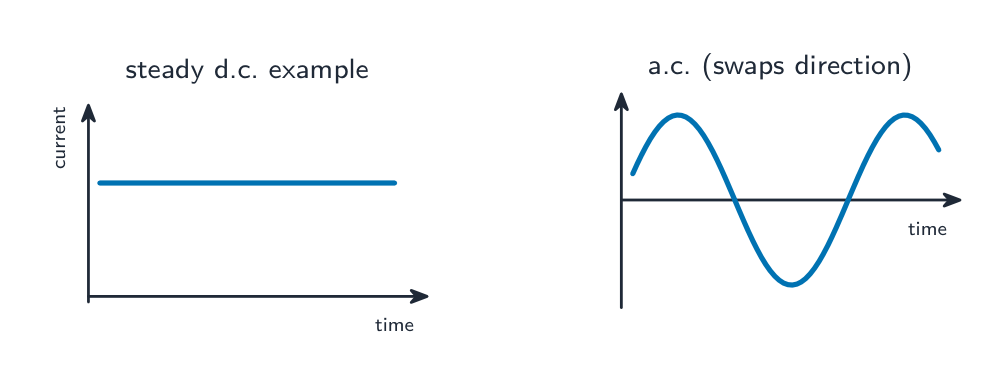
Direct current is steady in one direction; alternating current keeps swapping direction, crossing zero many times each second
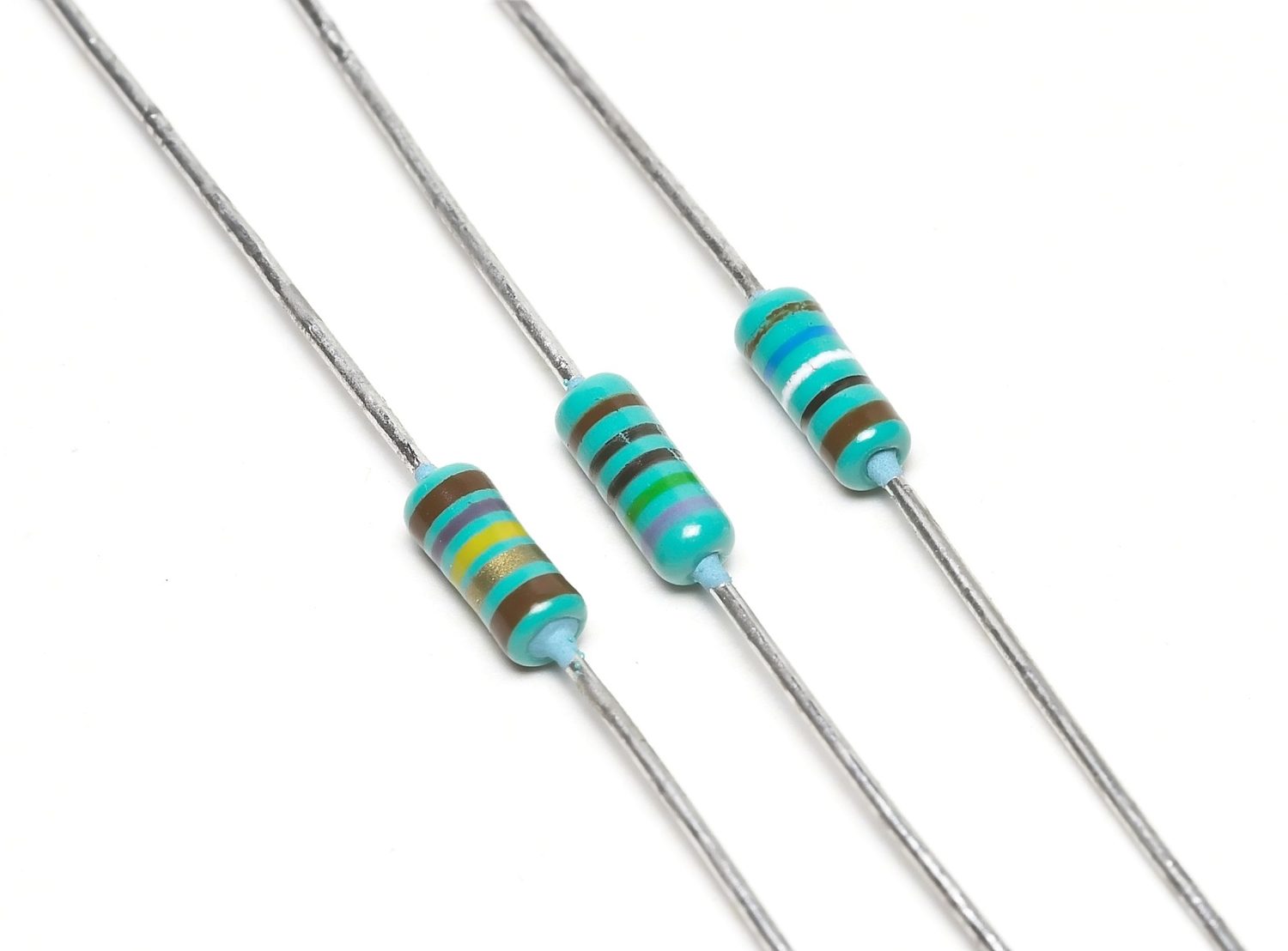
Resistors, components that control the current in a circuit
Arus konvensional mengalir mengelilingi luar sel dari:
Kesulitan 1/5 · 100 koin + bonus kecil pada penyelesaian pertama hari ini
Arus konvensional diambil dari + ke −. Elektron itu sendiri berger drift ke arah sebaliknya (− ke +).
E.m.f. and potential difference
- Both are measured in volts 伏特 (V) and both are work done per unit charge:
- e.m.f. is the energy a source gives each coulomb to drive it round the whole circuit.
- potential difference (p.d.) is the energy each coulomb gives up in one component.
- A voltmeter 电压表 measures them, joined in parallel (across the component).
Sebuah sel melakukan $120\ \text{J}$ usaha mendorong $60\ \text{C}$ muatan mengelilingi sebuah rangkaian. Berapakah g.g.b.-nya, dalam V?
Kesulitan 2/5 · 140 koin + bonus kecil pada penyelesaian pertama hari ini
$E = \dfrac{W}{Q} = \dfrac{120}{60} = 2.0\ \text{V}$.
Voltmeter dihubungkan:
Kesulitan 1/5 · 100 koin + bonus kecil pada penyelesaian pertama hari ini
Voltmeter mengukur beda potensial melintasi komponen, jadi dihubungkan paralel dengannya.
Pasangkan setiap besaran listrik dengan maknanya.
Kesulitan 2/5 · 140 koin + bonus kecil pada penyelesaian pertama hari ini
Setiap item menghubungkan istilah ke maknanya yang benar.
You've got it
- current = flow of charge: $I = \dfrac{Q}{t}$; ammeter in series, in amperes
- conventional current + → −; electrons drift − → +; d.c. one way, a.c. swaps
- e.m.f. (whole circuit) and p.d. (one component) are both $\dfrac{W}{Q}$ in volts
- voltmeter in parallel
Write from the data: find the current
- 48 coulomb pass a point in 6 s. A cell does 90 J of work on 15 coulomb.
- Find the current and the e.m.f. Say where an ammeter goes.
48 coulomb melewati suatu titik dalam 6 s, dan sel melakukan 90 J kerja untuk menggerakkan 15 coulomb mengelilingi rangkaian. Berapakah arus dan g.g.b., serta di mana posisi amperemeter?
48 dibagi dengan 6 adalah 8 ampere. 90 dibagi dengan 15 adalah 6 volt.
Berapa kuat arusnya?
Kesulitan 1/5 · 100 koin + bonus kecil pada penyelesaian pertama hari ini
48 dibagi 6 menghasilkan 8 ampere.