Thermal expansion and specific heat capacity
Diperkenalkan| English | Makna |
|---|---|
| specific heat capacity/spəˈsɪfɪk hiːt kəˈpæsɪti/ | kapasitas kalor jenis |
| thermal expansion/ˈθɜːml ekˈspænʃn/ | pemuaian termal |
| internal energy/ɪnˈtɜːnl ˈenədʒi/ | energi dalam |
Why bridges have gaps
- Railway lines have small gaps; bridges sit on rollers; power cables hang loose in summer.
- All for the same reason: things get bigger when they are heated.
- Heating also stores energy inside matter — measured by its specific heat capacity 比热容.
Thermal expansion 热膨胀
- Heat a material and its particles move more, so they take up more space — it expands.
- Gases expand the most, then liquids, then solids (whose particles are held tightly).
- Engineers leave gaps in rails and put bridges on rollers so the expansion does not buckle them.
- A tight metal jar lid loosens when you run it under hot water — the metal expands.
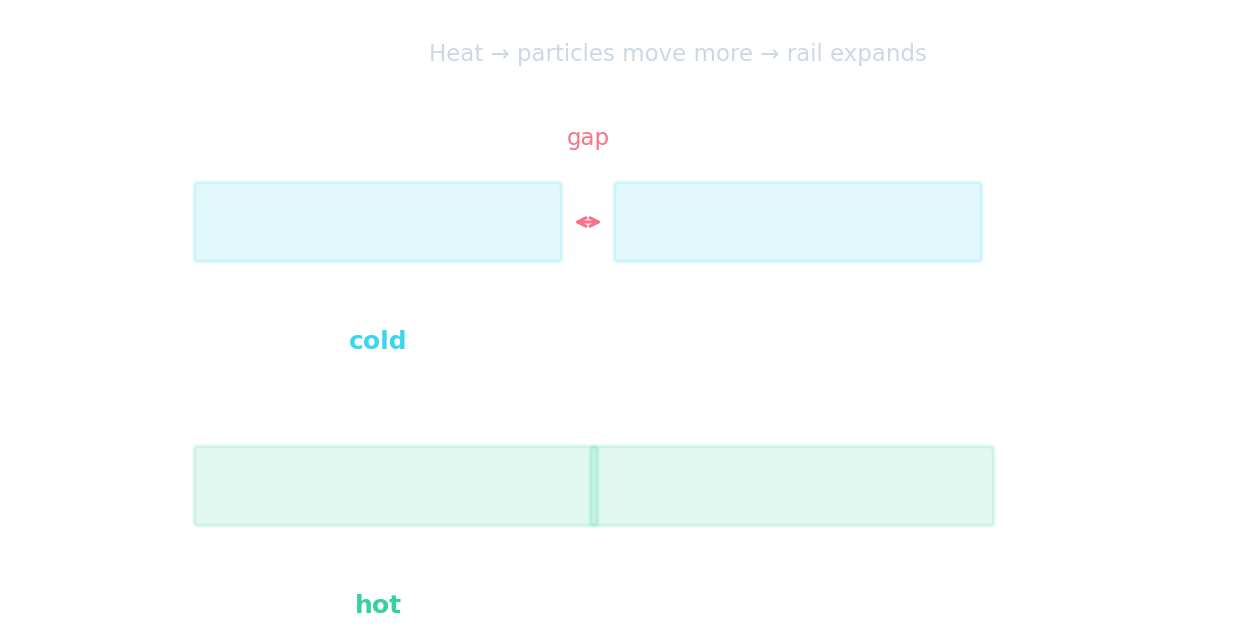
Thermal expansion: heating makes the rail longer, closing the gap left for it.
The particles don't get bigger. When a solid expands, the particles themselves stay the same size — they just vibrate more and push further apart. This is a common exam misconception.
For the same rise in temperature, which expands the most?
Kesulitan 1/5 · 100 koin + bonus kecil pada penyelesaian pertama hari ini
Gases expand the most, then liquids, then solids (whose particles are held most tightly).
Why are small gaps left between railway lines?
Kesulitan 1/5 · 100 koin + bonus kecil pada penyelesaian pertama hari ini
On a hot day the rails expand. The gaps give the extra length somewhere to go, so the track does not bend out of shape.
Internal energy 内能
- The internal energy of an object is the total energy of all its particles (their movement and arrangement).
- Heating an object raises its internal energy — usually raising its temperature too.
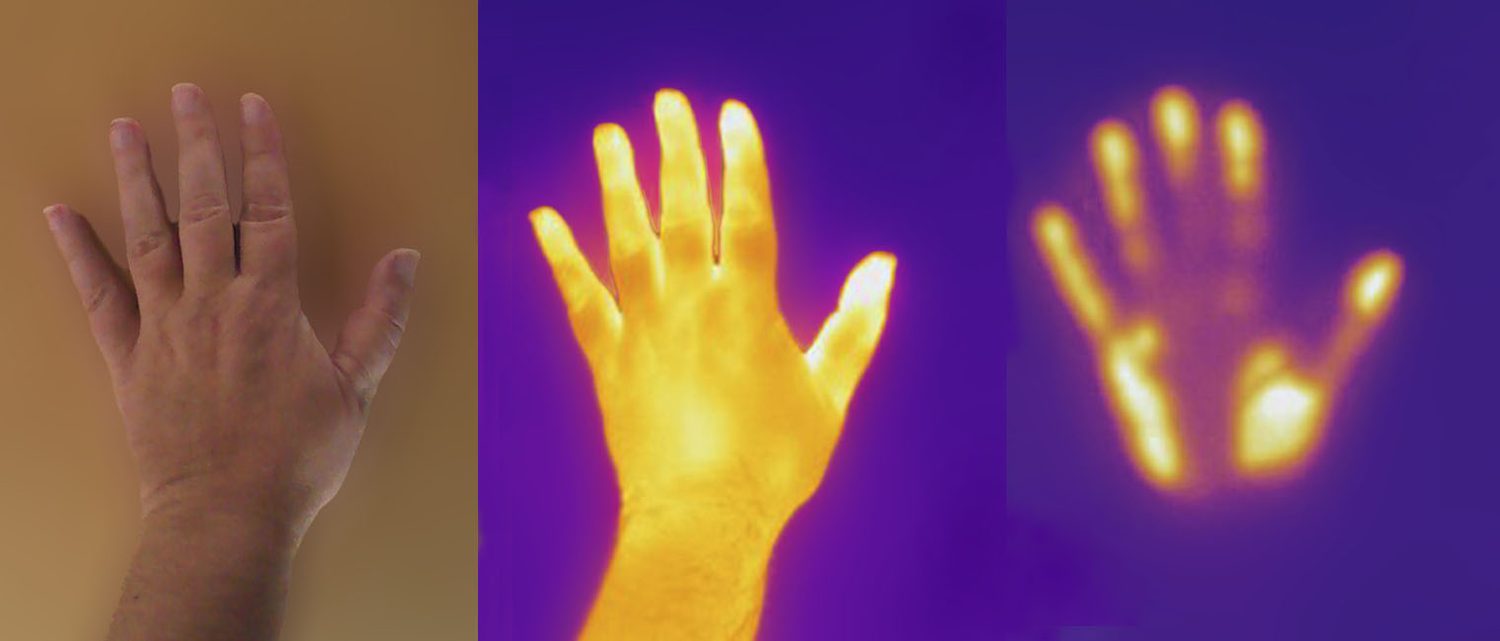
The same hand in ordinary light and through a thermal (infrared) camera
Specific heat capacity
- The specific heat capacity $c$ is the energy needed to raise the temperature of $1\ \text{kg}$ of a material by $1\ {}^{\circ}\text{C}$:
- So the energy to warm something is $\Delta E = m c\,\Delta\theta$.
- Water has a very high $c$ ($\approx 4200$ joules per kg per °C): it needs a lot of energy to warm up and cools down slowly. That is why the sea stays mild and water is used in heating systems.
Worked example. A kettle heats $0.50\ \text{kg}$ of water from $20\ {}^{\circ}\text{C}$ to $100\ {}^{\circ}\text{C}$. How much energy does the water gain? ($c = 4200$ J per kg per °C)
- Temperature rise: $\Delta\theta = 100 - 20 = 80\ {}^{\circ}\text{C}$. Then $\Delta E = mc\,\Delta\theta = 0.50 \times 4200 \times 80 = 168\,000\ \text{J}$ (168 kJ).
- An aluminium pan of the same mass ($c = 900$) would need only $0.50 \times 900 \times 80 = 36\,000\ \text{J}$ — under a quarter as much — because its specific heat capacity is lower.
Heating and specific heat capacity
Q = mcΔT
The heat energy needed is proportional to the temperature rise for a given mass of material.
How much energy is needed to heat $2.0\ \text{kg}$ of water by $10\ {}^{\circ}\text{C}$? (Use $c = 4200$ J per kg per °C.)
Kesulitan 2/5 · 140 koin + bonus kecil pada penyelesaian pertama hari ini
$\Delta E = mc\,\Delta\theta = 2.0 \times 4200 \times 10 = 84\,000\ \text{J}$.
Adding $8400\ \text{J}$ raises the temperature of $0.50\ \text{kg}$ of a metal by $40\ {}^{\circ}\text{C}$. What is its specific heat capacity, in J per kg per °C?
Kesulitan 2/5 · 140 koin + bonus kecil pada penyelesaian pertama hari ini
$c = \dfrac{\Delta E}{m\,\Delta\theta} = \dfrac{8400}{0.50 \times 40} = \dfrac{8400}{20} = 420$ J per kg per °C.
Because water has a high specific heat capacity, it warms up and cools down slowly.
Kesulitan 1/5 · 100 koin + bonus kecil pada penyelesaian pertama hari ini
A high specific heat capacity means a lot of energy is needed per degree, so water changes temperature slowly.
How much energy is needed to warm 2.0 kg of water from 15 °C to 25 °C? (c = 4200 J per kg per °C) Give your answer in J.
Kesulitan 2/5 · 140 koin + bonus kecil pada penyelesaian pertama hari ini
Δθ = 10 °C, so ΔE = 2.0 × 4200 × 10 = 84 000 J.
A 2.0 kg metal block takes 36 000 J to warm by 20 °C. What is its specific heat capacity, in J per kg per °C?
Kesulitan 2/5 · 140 koin + bonus kecil pada penyelesaian pertama hari ini
c = ΔE ÷ (m Δθ) = 36 000 ÷ (2.0 × 20) = 900 J per kg per °C.
You've got it
- heating makes matter expand — gases most, solids least; leave gaps for it
- internal energy = total energy of all the particles
- specific heat capacity $c = \dfrac{\Delta E}{m\,\Delta\theta}$, so $\Delta E = mc\,\Delta\theta$
- water has a high $c$ → warms and cools slowly
Write from the data: find the heating energy
- 1.5 kg of water is heated by 4 degrees. Use c = 4200 J per kg per degree.
- Find the energy. Say why water warms slowly compared with many metals.
How much energy heats 1.5 kg of water by 4 degrees if c is 4200 J per kg per degree, and why does the same energy warm many metals by more?
1.5 times 4200 is 6300, and 6300 times 4 is 25200 joules.
How much energy is needed?
Kesulitan 1/5 · 100 koin + bonus kecil pada penyelesaian pertama hari ini
1.5 times 4200 times 4 is 25200 joules. Other options — 84000 joules (the lesson example's result for 2.0 kg of water through 10 degrees); 420 joules per kg per degree (the lesson metal result).