Usaha
Diperkenalkan 7:46
Usaha, Energi, dan Daya
Blok meluncur ke pegas dan memampatkannya hingga berhenti. Berapa jauh pegas terkompresi? Cobalah itu dengan persamaan kinematika. Anda tidak dapat — gayanya bertambah…
Narasi bahasa Inggris · takarir bahasa Inggris dan 中文 yang dapat dipilih
In this lesson
| English | Makna |
|---|---|
| work/wɜːk/ | usaha |
| dot product/dɒt ˈprɒdʌkt/ | perkalian titik |
Effort is not work
- Hold a heavy suitcase still for a minute and your arms ache, yet you do no work on it. Carry it across a level room at steady speed: still no work by your upward force. Lift it onto a shelf: now you do work.
- In physics, work 功 is the energy a force transfers into or out of a system as the system moves. Only the part of the force along the motion counts.
You carry a bag horizontally across a room. The work gravity does on the bag is...
Kesulitan 1/5 · 100 koin + bonus kecil pada penyelesaian pertama hari ini
Gravity points down, motion is horizontal -- perpendicular, so $\cos 90^\circ = 0$ and the work is zero.
Work of a constant force: a dot product
- The dot product 点积 $\vec A\cdot\vec B=AB\cos\theta$ is a scalar. With components, $\vec A\cdot\vec B=A_xB_x+A_yB_y+A_zB_z$. Only the force component parallel to the displacement does work.
- Work is a scalar that can be positive (force has a component along the motion, $\theta<90°$), negative (against the motion, like kinetic friction) or zero ($\theta=90°$, or no displacement).
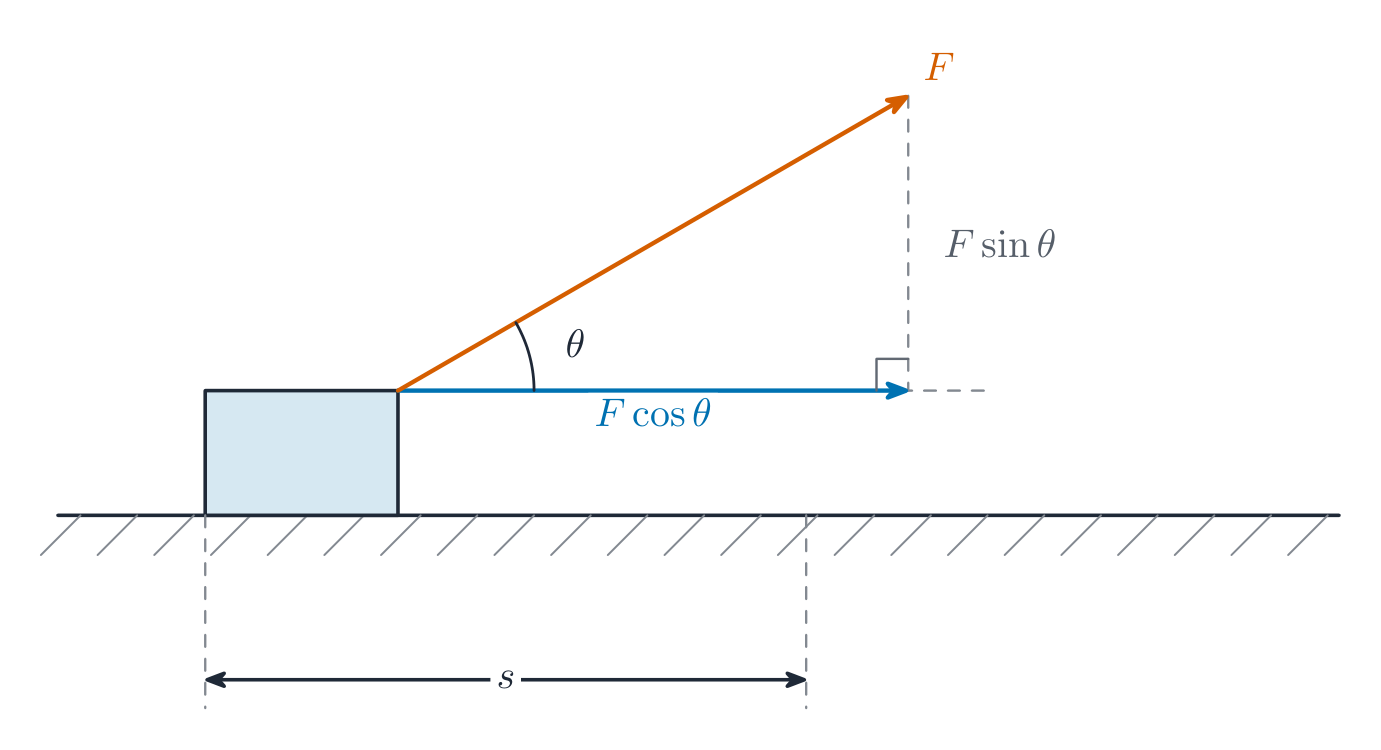
$\vec F=(3\hat\imath+4\hat\jmath)$ N acts while an object moves $\Delta\vec r=(2\hat\imath-1\hat\jmath)$ m. $W=(3)(2)+(4)(-1)=$ 2 J. Note that $|\vec F|=5$ N and $|\Delta\vec r|\approx2.24$ m, yet the work is small, because the force is mostly sideways to the motion.
Positive, negative or zero work?
Work depends on the angle between the force and the motion. Sort each case.
A $10\ \text{N}$ force pushes a box $4\ \text{m}$ in the same direction. How much work is done (in J)?
Kesulitan 2/5 · 140 koin + bonus kecil pada penyelesaian pertama hari ini
With $\theta = 0$, $W = Fd\cos 0 = 10 \times 4 \times 1 = 40\ \text{J}$.
Friction, which opposes motion, does negative work on a sliding object.
Kesulitan 1/5 · 100 koin + bonus kecil pada penyelesaian pertama hari ini
The friction force points against the motion ($\theta = 180^\circ$), so its work is negative -- it removes energy.
A $50\ \text{N}$ force at $60^\circ$ to the motion drags a crate $3\ \text{m}$. Work done (in J)?
Kesulitan 2/5 · 140 koin + bonus kecil pada penyelesaian pertama hari ini
$W = Fd\cos\theta = 50 \times 3 \times \cos 60^\circ = 50 \times 3 \times 0.5 = 75\ \text{J}$.
Select semua cases where the force does sifar work.
Kesulitan 2/5 · 140 koin + bonus kecil pada penyelesaian pertama hari ini
Perpendicular force ($\cos 90^\circ = 0$) and no displacement both give zero work. A force along the motion does positive work.
A force $\vec F=(5\hat\imath-2\hat\jmath)$ N acts on an object that moves $\Delta\vec r=(4\hat\imath+3\hat\jmath)$ m. Find the work done by the force, in J.
Kesulitan 2/5 · 140 koin + bonus kecil pada penyelesaian pertama hari ini
$W=F_x\Delta x+F_y\Delta y=(5)(4)+(-2)(3)=20-6=14$ J.
Variable forces: integrate
- When the force changes along the path, add the work over tiny steps $d\vec r$. In one dimension, $W=\int_{x_a}^{x_b}F(x)\,dx$: the signed area under the $F$–$x$ graph.
- Spring example: the spring force is $F=-kx$. Stretching from $0$ to $x$, the spring does $W=\int_0^x(-kx')\,dx'=-\tfrac12kx^2$ on the object.
For a force that changes with position, work is the ____ under the force-position graph.
Kesulitan 1/5 · 100 koin + bonus kecil pada penyelesaian pertama hari ini
$W = \int F\,dx$ is exactly the area under the force-versus-position curve.
A force $F(x)=4x^3$ (N, $x$ in m) acts along the $x$-axis. Find the work it does from $x=1$ m to $x=2$ m, in J.
Kesulitan 2/5 · 140 koin + bonus kecil pada penyelesaian pertama hari ini
$\int_1^2 4x^3\,dx=[x^4]_1^2=16-1=15$ J.
A spring with $k=200$ N/m is stretched from $x=0.10$ m to $x=0.30$ m. How much work does the pegas do on the object, in J?
Kesulitan 2/5 · 140 koin + bonus kecil pada penyelesaian pertama hari ini
$W=\int_{0.10}^{0.30}(-200x)\,dx=-100(0.09-0.01)=-8.0$ J. Negative: the spring force points opposite to the stretch.
Conservative and nonconservative forces
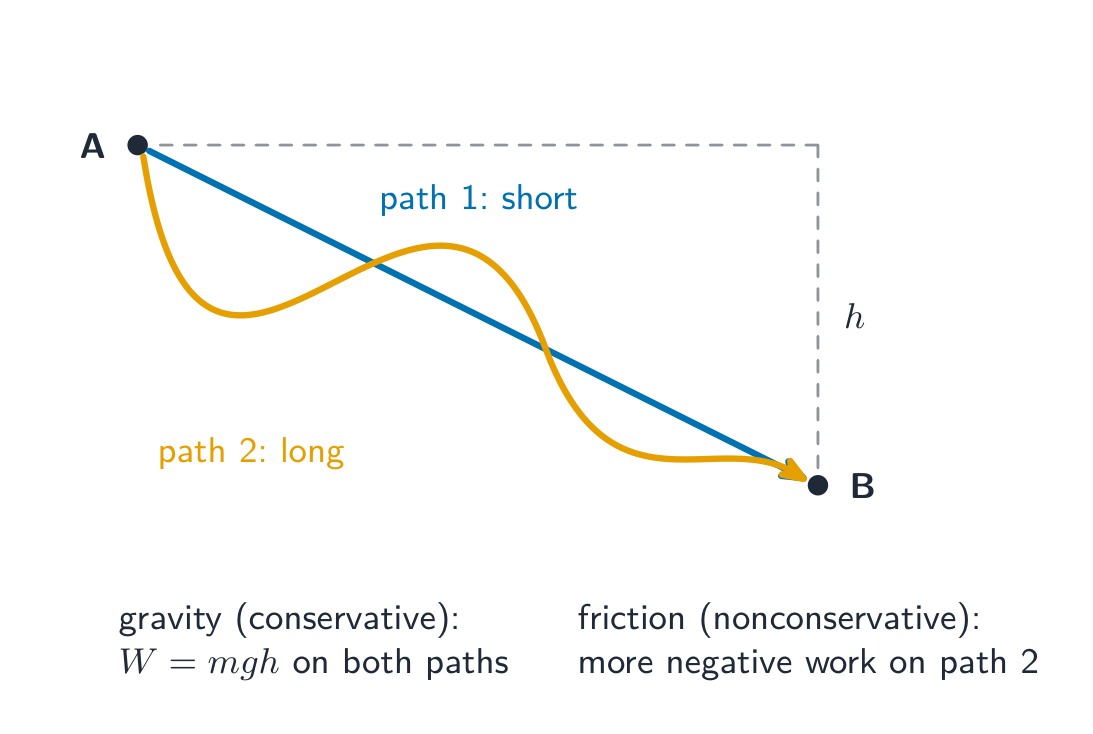
- A conservative force (gravity, spring force) does work that is path-independent: it depends only on the start and end positions. Around a closed path, its work is zero. Only conservative forces have a potential energy.
- A nonconservative force (friction, air resistance) does work that depends on the path: a longer path means more negative work from friction.
A box is pushed around a closed loop on a rough floor and returns to its starting point. Which statement is correct?
Kesulitan 1/5 · 100 koin + bonus kecil pada penyelesaian pertama hari ini
Gravity is conservative, so its work around a closed path is zero. Friction is nonconservative; it opposes the motion on every part of the path.
Worked FRQ: a variable force
A single net force $F(x)=12-3x^2$ (N, $x$ in m) acts along the $x$-axis on a 2.0 kg object that starts at rest at $x=0$.
(A) Calculate the work done by the force from $x=0$ to $x=2.0$ m.
(B) Find the object's speed at $x=2.0$ m. All the work goes into kinetic energy: $\tfrac12(2.0)v^2=16$, so $v=$ 4.0 m/s.
(C) At what position is the speed greatest? Justify. At $x=2.0$ m. For $0<x<2$, $F>0$, so positive work is still being done and the speed rises. Beyond $x=2$, $F<0$ and the speed falls. Maximum speed is where $F=0$.
- Why it scores: limits and units on the integral; (C) uses the sign of the force (or of $dK/dx=F$), not a guess.
- $\theta$ is the angle between $\vec F$ and the displacement, not the angle of the force with the horizontal (unless the motion is horizontal).
- Work by a force ≠ net work. Gravity, the normal force and friction each do their own work; add them for the net work.
- The area under $F$–$x$ is signed: area below the axis is negative work.
Work is energy transferred by a force over a displacement: $W=\vec F\cdot\Delta\vec r=F\Delta r\cos\theta$ for a constant force, $W=\int\vec F\cdot d\vec r$ (area under $F$–$x$) for a variable one. It is a scalar: positive, negative or zero. Conservative forces (gravity, springs) do path-independent work, zero around a closed path, and have potential energies; nonconservative forces (friction, air resistance) do path-dependent work.