Spring Forces
Diperkenalkan 9:06
Gaya dan Dinamika Translasi
Troli melintas di lintasan vertikal. Di bagian paling atas ia sepenuhnya terbalik, dengan tidak ada yang menahannya. Mengapa ia tidak jatuh? Jawabannya bukan beberapa…
Narasi bahasa Inggris · takarir bahasa Inggris dan 中文 yang dapat dipilih
In this lesson
| English | Makna |
|---|---|
| restoring force/rɪˈstɔːrɪŋ fɔːs/ | gaya pemulih |
| Hooke's law/hʊks lɔː/ | Hukum Hooke |
| displacement/dɪˈspleɪsmənt/ | perpindahan |
| spring constant/sprɪŋ ˈkɒnstənt/ | konstanta pegas |
| in parallel/ɪn ˈpærəlel/ | paralel |
| in series/ɪn ˈsɪəriːz/ | seri |
The more you stretch, the harder it pulls
- Pull a spring a little and it tugs back gently; pull it twice as far and it tugs back twice as hard.
- Let go and it snaps toward its rest position every time.
- This tidy, proportional push-back is what makes springs so predictable.
- It is also the force law behind simple harmonic oscillation; other oscillations can have different restoring forces.
Hooke's law
- Hooke's law 胡克定律 describes an ideal spring:
- The force is proportional to how far the spring is stretched or squeezed.
- The minus sign says the force always points back toward equilibrium.
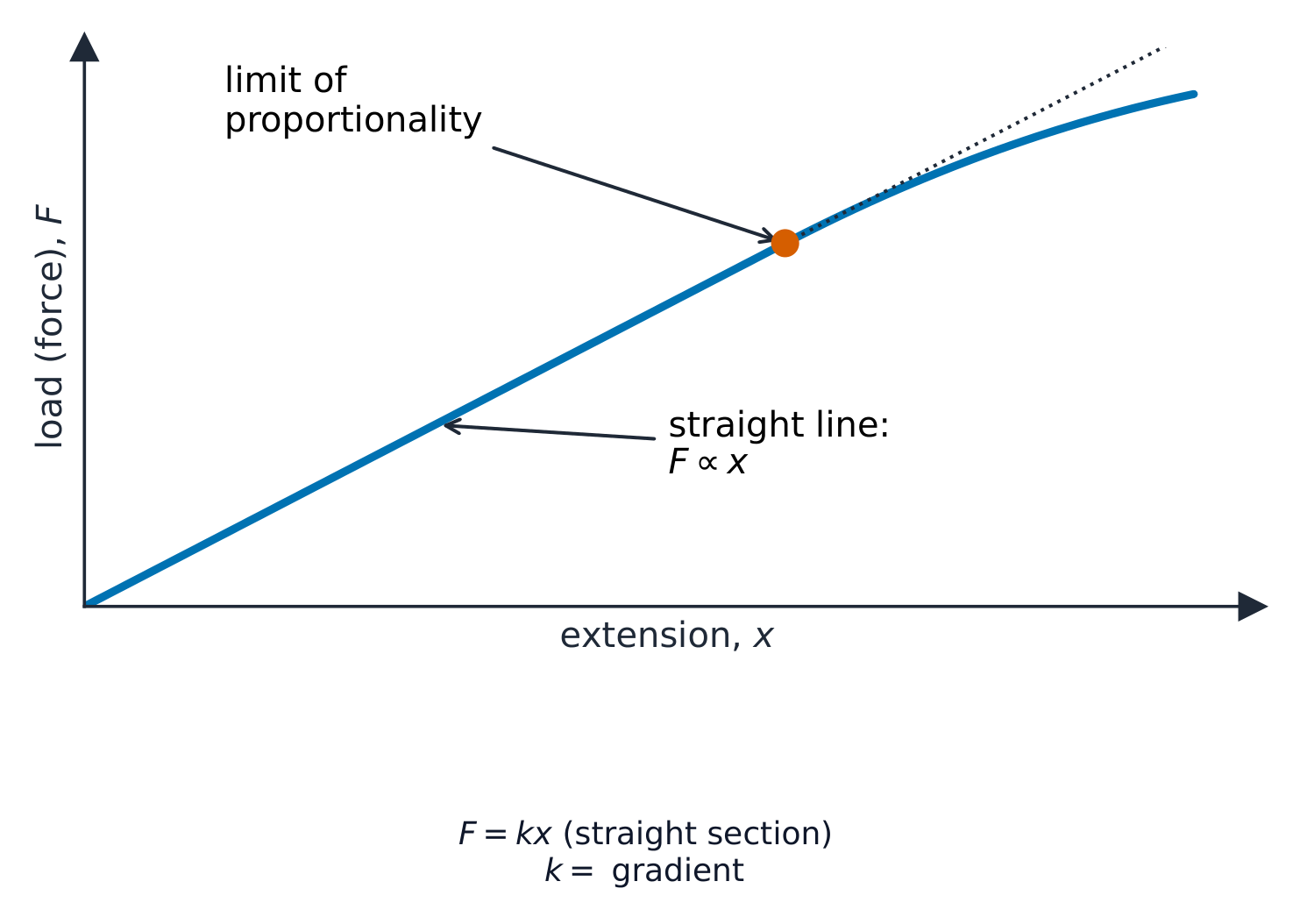
Hooke's law: extension is proportional to load up to the limit of proportionality
Select semua true statements about an ideal spring.
Kesulitan 2/5 · 140 koin + bonus kecil pada penyelesaian pertama hari ini
The first two are Hooke's law. The third is backwards -- a stiffer spring has a lebih besar $k$.
Stiffness and displacement
- The spring constant 弹簧劲度系数 $k$ measures stiffness — a bigger $k$ is a harder spring.
- The displacement 位移 $x$ is measured from the spring's natural rest length.
- On a graph of applied holding force versus extension, the slope is $+k$; for the signed spring force $F_s = -kx$, it is $-k$.
Hooke's law: applied load F = kx
Increase the applied load and watch extension grow proportionally within the linear range; load divided by extension is k. Spring force opposes extension.
A $6\ \text{N}$ force stretches a spring by $0.30\ \text{m}$. What is its spring constant (in N/m)?
Kesulitan 2/5 · 140 koin + bonus kecil pada penyelesaian pertama hari ini
$k = F/x = 6/0.30 = 20\ \tfrac{\text{N}}{\text{m}}$.
On a graph of applied holding force versus extension, the spring constant is the ____ of the line.
Kesulitan 1/5 · 100 koin + bonus kecil pada penyelesaian pertama hari ini
Since $F = kx$ (magnitude), the graph is a straight line whose slope is $k$.
A restoring force
- Because it always points back to the middle, the spring force is a restoring force 回复力.
- Stretch right → it pulls left; compress left → it pushes right.
- That constant "return to center" is exactly what drives a mass on a spring to oscillate.
You stretch a spring to the right. The spring force points...
Kesulitan 1/5 · 100 koin + bonus kecil pada penyelesaian pertama hari ini
A restoring force always opposes the displacement -- stretch right, it pulls left.
The minus sign in $F_s = -kx$ shows that the spring force opposes the displacement.
Kesulitan 1/5 · 100 koin + bonus kecil pada penyelesaian pertama hari ini
Yes -- the sign encodes the "restoring" direction, always back toward equilibrium.
Combining springs
- Springs in parallel 并联 (side by side) act stiffer: $k_{eq} = k_1 + k_2$.
- Springs in series 串联 (end to end) act softer: $\dfrac{1}{k_{eq}} = \dfrac{1}{k_1} + \dfrac{1}{k_2}$.
- It is the exact opposite of how resistors combine.
Two identical springs of $k = 100\ \tfrac{\text{N}}{\text{m}}$ are placed in parallel. What is the equivalent spring constant (in N/m)?
Kesulitan 2/5 · 140 koin + bonus kecil pada penyelesaian pertama hari ini
Parallel springs add, giving $k_{eq} = 100 + 100 = 200\ \tfrac{\text{N}}{\text{m}}$ -- stiffer together.
A spring stretches $0.20\ \text{m}$ when a $10\ \text{N}$ force pulls it.
- Spring constant: $k = \dfrac{F}{x} = \dfrac{10}{0.20} = 50\ \tfrac{\text{N}}{\text{m}}$.
- Stretch it twice as far ($0.40\ \text{m}$) and it pulls back with $20\ \text{N}$ — always toward its rest position.
The minus sign in $F_s = -kx$ is not decoration — it encodes the direction. The spring force is never in the direction you pulled; it always opposes the displacement. Drop the sign and you lose the whole "restoring" idea.
Hooke's law: $F_s = -kx$ — a spring's force is proportional to its displacement and always points back to equilibrium (a restoring force). The spring constant $k$ is its stiffness (the magnitude of the slope of $F_s$ vs $x$). Parallel springs add stiffness; series springs soften.
Write from the data: find the spring constant
- An 8 N force stretches a spring by 0.20 m.
- Find the spring constant.
A force of 8 N stretches a spring by 0.20 m. What is the spring constant, in N/m, and which way does the spring force point?
8 divided by 0.20 is 40.
An applied force of 8 N stretches an ideal spring by 0.20 m. What is the spring constant?
Kesulitan 1/5 · 100 koin + bonus kecil pada penyelesaian pertama hari ini
Force divided by extension is 8 divided by 0.20. Other options — 20 N/m (the lesson spring); 8 N/m (the force used as k).