Newton's First Law
Diperkenalkan 9:06
Gaya dan Dinamika Translasi
Troli melintas di lintasan vertikal. Di bagian paling atas ia sepenuhnya terbalik, dengan tidak ada yang menahannya. Mengapa ia tidak jatuh? Jawabannya bukan beberapa…
Narasi bahasa Inggris · takarir bahasa Inggris dan 中文 yang dapat dipilih
In this lesson
| English | Makna |
|---|---|
| Newton's first law/ˈnjuːtnz fɜːst lɔː/ | Hukum I Newton |
| net force/net fɔːs/ | gaya resultan |
| inertia/ɪˈnɜːʃə/ | inersia |
| translational equilibrium/trænˈsleɪʃənl ˌiːkwɪˈlɪbrɪəm/ | keseimbangan translasi |
| inertial reference frame/ɪˈnɜːʃl ˈrefrəns freɪm/ | kerangka acuan inersia |
A puck that never stops
- Slide a hockey puck across smooth ice and it glides on and on, barely slowing.
- Make the ice perfectly frictionless and it would glide forever.
- Nothing keeps it going — it just refuses to stop on its own.
- That refusal is one of the deepest ideas in physics.
Newton's first law
- Newton's first law 牛顿第一定律: an object keeps constant velocity unless a net force acts on it.
- At rest? It stays at rest. Moving? It keeps the same speed and direction.
- "No net force" does not mean "no motion" — it means "no change in motion."
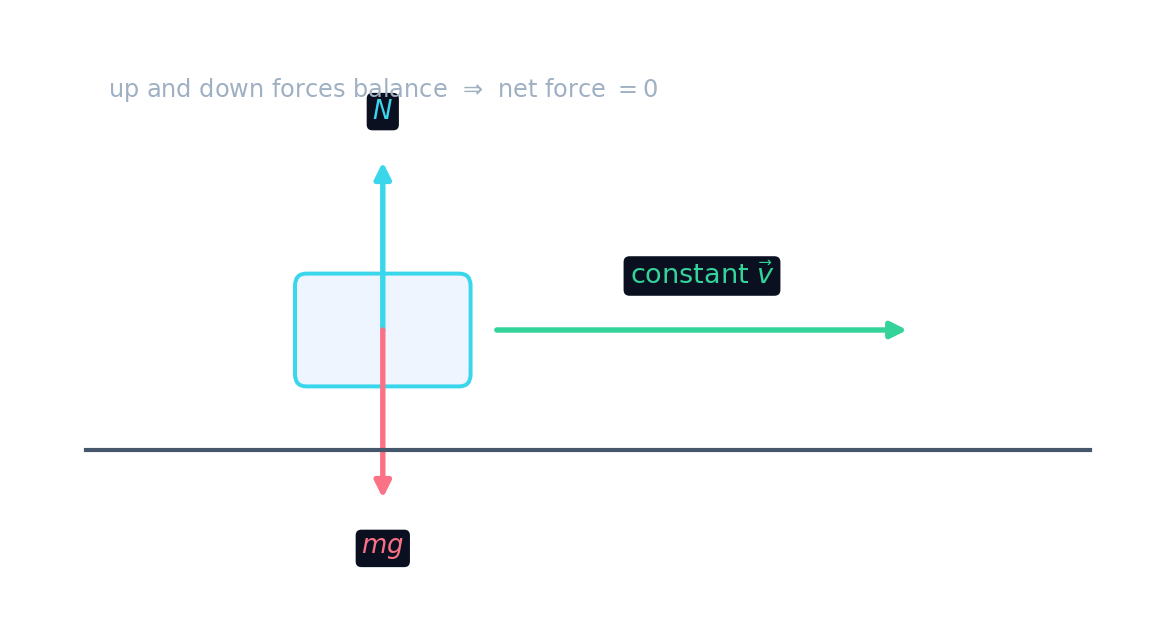
Balanced forces: zero net force, so the velocity stays constant
An object moving at constant velocity must have a nonzero net force pushing it.
Kesulitan 1/5 · 100 koin + bonus kecil pada penyelesaian pertama hari ini
Constant velocity means zero net force. A force is needed only to perubahan velocity, not to maintain it.
Inertia
- The property that makes objects resist changes in motion is inertia 惯性.
- More mass means more inertia — a loaded truck is far harder to start or stop than a bike.
- Inertia is why the first law holds.
Which object has the most inertia?
Kesulitan 1/5 · 100 koin + bonus kecil pada penyelesaian pertama hari ini
Inertia is measured by mass -- the $2000\ \text{kg}$ car resists changes in motion the most.
Translational equilibrium
- When the net force 合力 is zero, an object is in translational equilibrium 平动平衡.
- That covers both an object at rest and one moving at constant velocity.
- To solve these problems, set $\sum F_x = 0$ and $\sum F_y = 0$.
Balanced or unbalanced?
By Newton's first law, decide whether the forces on each object are balanced.
An object with zero net force is said to be in translational ____.
Kesulitan 1/5 · 100 koin + bonus kecil pada penyelesaian pertama hari ini
Zero net force → translational equilibrium, which covers rest dan constant velocity.
Select semua situations in translational equilibrium (zero net force).
Kesulitan 2/5 · 140 koin + bonus kecil pada penyelesaian pertama hari ini
Rest and constant velocity both mean zero net force. A falling ball accelerates, so its net force is not zero.
A crate sits still while pulled right with $40\ \text{N}$ and left with $40\ \text{N}$. What is the net horizontal force (in N)?
Kesulitan 2/5 · 140 koin + bonus kecil pada penyelesaian pertama hari ini
$40 - 40 = 0\ \text{N}$ -- balanced forces, so it stays in equilibrium (at rest).
Inertial reference frames
- The first law only holds in an inertial reference frame 惯性参考系 — one that is not accelerating.
- In a braking bus you lurch forward with no force pushing you — because the bus is a non-inertial frame.
- Physics is written from the point of view of inertial frames.
When a bus brakes hard and you lurch forward, a force pushed you forward.
Kesulitan 1/5 · 100 koin + bonus kecil pada penyelesaian pertama hari ini
No forward force acts -- your body's inertia keeps it moving while the bus (a non-inertial frame) slows beneath you.
A lamp hangs still from two angled cords.
- It is in translational equilibrium, so the net force is zero.
- The cords' horizontal pulls cancel, and their vertical pulls together hold up the weight — two equations, $\sum F_x = 0$ and $\sum F_y = 0$, solve for the tensions.
Constant velocity does not require a forward force. A car cruising at a steady $100\ \text{km/h}$ has zero net force — its engine thrust exactly balances air drag and friction. Force is needed only to change velocity, not to maintain it.
Newton's first law: velocity stays constant unless a net force acts — objects resist change through their inertia. Zero net force means translational equilibrium (at rest or constant velocity), solved with $\sum F_x = 0$, $\sum F_y = 0$. It holds only in a non-accelerating inertial reference frame.
Write from the data: find the net force
- A 3 kg puck slides at a steady 6 m/s on frictionless ice.
- Find the net force.
A 3 kg puck moves at a constant 6 m/s on frictionless ice. What is the net force on it?
Zero acceleration means zero net force.
A 3 kg puck moves in a straight line at a constant 6 m/s on frictionless ice. What is the net force on it?
Kesulitan 1/5 · 100 koin + bonus kecil pada penyelesaian pertama hari ini
Constant velocity needs no net force.