Newton's Second Law
Diperkenalkan 9:06
Gaya dan Dinamika Translasi
Troli melintas di lintasan vertikal. Di bagian paling atas ia sepenuhnya terbalik, dengan tidak ada yang menahannya. Mengapa ia tidak jatuh? Jawabannya bukan beberapa…
Narasi bahasa Inggris · takarir bahasa Inggris dan 中文 yang dapat dipilih
In this lesson
| English | Makna |
|---|---|
| mass/mæs/ | massa |
| Newton's second law/ˈnjuːtnz ˈsekənd lɔː/ | Hukum II Newton |
| net force/net fɔːs/ | gaya resultan |
| acceleration/əkˌseləˈreɪʃn/ | percepatan |
| inertia/ɪˈnɜːʃə/ | inersia |
| components/kəmˈpəʊnənts/ | komponen |
| pulley/ˈpʊli/ | katrol |
The same shove — a feather flies, a fridge barely budges
- Give a feather a gentle push and it shoots off; push a fridge just as hard and it hardly moves.
- Same force, wildly different results — the difference is mass 质量.
- One equation ties force, mass, and motion together.
- It is the engine of mechanics: give it the forces and the mass, and it hands you the motion.
Newton's second law
- Newton's second law 牛顿第二定律 states:
- The net force 合力 on an object equals its mass times its acceleration 加速度.
- Rearranged, $\vec{a} = \dfrac{\vec{F}_{net}}{m}$ — the forces set the acceleration.
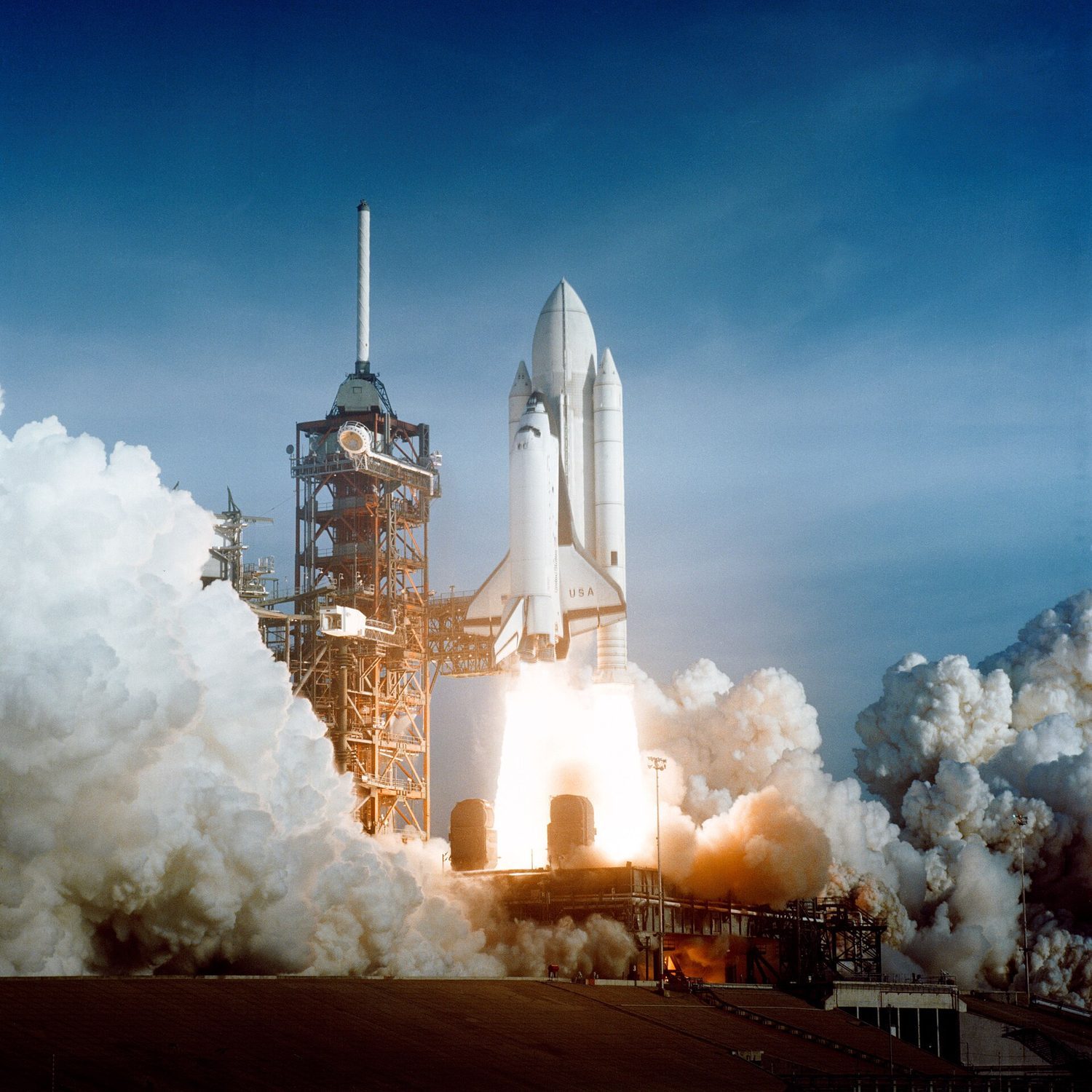
A rocket launch: net force changes momentum— F_net = ma for translational dynamics
A net force of $20\ \text{N}$ acts on a $4\ \text{kg}$ cart. What is its acceleration (in $\tfrac{\text{m}}{\text{s}^2}$)?
Kesulitan 2/5 · 140 koin + bonus kecil pada penyelesaian pertama hari ini
$a = \dfrac{F_{net}}{m} = \dfrac{20}{4} = 5\ \tfrac{\text{m}}{\text{s}^2}$.
Rearranging the second law: acceleration equals the net force divided by the ____.
Kesulitan 1/5 · 100 koin + bonus kecil pada penyelesaian pertama hari ini
$\vec{a} = \dfrac{\vec{F}_{net}}{m}$ -- the net force over the mass.
More force, less mass
- The one equation carries two rules:
- More net force → proportionally more acceleration.
- More mass → proportionally less acceleration (mass resists change — its inertia 惯性).
- That is exactly why the light feather leaps and the massive fridge barely stirs.
Keep the force the same but double the mass. The acceleration...
Kesulitan 1/5 · 100 koin + bonus kecil pada penyelesaian pertama hari ini
Since $a = F_{net}/m$, doubling $m$ halves $a$ -- mass and acceleration are inversely proportional.
Select semua changes that would meningkat an object's acceleration.
Kesulitan 2/5 · 140 koin + bonus kecil pada penyelesaian pertama hari ini
More net force or less mass both raise $a = F_{net}/m$; more mass lowers it, and cancelling forces gives zero net force.
It is the net force that counts
- An object usually feels several forces at once — a push, gravity, friction.
- Only their vector sum, the net force, drives the acceleration.
- If the forces cancel to zero, there is no acceleration: the object stays at rest or keeps constant velocity.
If all the forces on an object cancel, it cannot be moving.
Kesulitan 1/5 · 100 koin + bonus kecil pada penyelesaian pertama hari ini
Zero net force means zero percepatan, not zero velocity. A moving object simply keeps its constant velocity.
Splitting forces into components
- When forces point in awkward directions (say, on a ramp), split each into components 分量 along chosen axes.
- Apply $\sum F = ma$ separately in each direction.
- For connected objects on a pulley 滑轮, write the law for each mass and solve together.
Free-body diagram: F = ma
The resultant of the forces, divided by the mass, gives the acceleration. Change a force and watch the acceleration respond.
A $2\ \text{kg}$ box is pulled with $30\ \text{N}$ while friction drags back $10\ \text{N}$. Find its acceleration (in $\tfrac{\text{m}}{\text{s}^2}$).
Kesulitan 2/5 · 140 koin + bonus kecil pada penyelesaian pertama hari ini
Net force $= 30 - 10 = 20\ \text{N}$, so $a = 20/2 = 10\ \tfrac{\text{m}}{\text{s}^2}$. Use the net force, not the $30\ \text{N}$ alone.
A net force of $20\ \text{N}$ acts on a $5\ \text{kg}$ box.
- Acceleration: $a = \dfrac{F_{net}}{m} = \dfrac{20}{5} = 4\ \tfrac{\text{m}}{\text{s}^2}$.
- Double the mass to $10\ \text{kg}$ with the same force, and the acceleration halves to $2\ \tfrac{\text{m}}{\text{s}^2}$.
Use the net force, not one force you happen to notice. A box pulled with $30\ \text{N}$ while friction drags back $10\ \text{N}$ has a net force of $30 - 10 = 20\ \text{N}$ — so $a = 20/m$, not $30/m$.
Newton's second law is $\vec{F}_{net} = m\vec{a}$, or $\vec{a} = \dfrac{\vec{F}_{net}}{m}$: acceleration equals the net force divided by the mass. More force means more acceleration; more mass means less. Always add the forces as vectors first, then divide.
Write from the data: find the acceleration
- The net force on a 3 kg cart is 18 N.
- Find the acceleration.
A net force of 18 N acts on a 3 kg cart. What is its acceleration, in m/s squared?
18 divided by 3 is 6.
A net force of 18 N acts on a 3 kg cart. What is its acceleration?
Kesulitan 1/5 · 100 koin + bonus kecil pada penyelesaian pertama hari ini
18 newtons divided by 3 kilograms is 6. Other options — 5 m/s squared (the lesson cart); 18 m/s squared (the force used as an acceleration).