Exchange Rates
Diperkenalkan 8:00
Ekonomi Terbuka—Perdagangan dan Keuangan Internasional
Periksa label pada hampir segala yang Anda miliki. Dibuat di tempat lain. Menyeberangi lautan dalam kotak baja seperti ini, dan seseorang membayarnya dengan mata uang yang berbeda.…
Narasi bahasa Inggris · takarir bahasa Inggris dan 中文 yang dapat dipilih
In this lesson
| English | Makna |
|---|---|
| exchange rate/eksˈtʃeɪndʒ reɪt/ | Nilai tukar |
| currency/ˈkʌrənsi/ | Mata uang |
| Appreciation/əˌpriːʃɪˈeɪʃn/ | Apresiasi |
| Depreciation/dɪˌpriːʃɪˈeɪʃn/ | Depresiasi |
| floating exchange rate/ˈfləʊtɪŋ eksˈtʃeɪndʒ reɪt/ | Sistem nilai tukar mengambang |
Why a holiday suddenly got cheaper
- In 2022, one US dollar bought about 115 Japanese yen at the start of the year and about 150 by October. A hotel room priced at 15,000 yen fell from about 130 dollars to about 100 dollars for American tourists, without the hotel changing its price.
- An exchange rate 汇率 is the price of one currency 货币 in terms of another. When it changes, the prices of every import and export change too.
A hotel room costs 15,000 yen. 1 dollar buys 120 yen. What is the price in dollars?
Kesulitan 2/5 · 140 koin + bonus kecil pada penyelesaian pertama hari ini
15,000 ÷ 120 = 125 dollars.
Appreciation and depreciation
- Appreciation 升值: a currency becomes more valuable, so one unit buys more foreign currency. Depreciation 贬值: one unit buys less.
- Every change has two sides. In 2022 the dollar appreciated against the yen (1 dollar bought more yen), so the yen depreciated against the dollar (1 yen bought fewer dollars). Always name the currency: "the dollar appreciated against the yen."
Appreciation or depreciation?
A currency appreciates when it buys more foreign currency, and depreciates when it buys less. One currency's appreciation is the other's depreciation.
1 dollar used to buy 5 pesos. Now it buys 4 pesos. What happened?
Kesulitan 1/5 · 100 koin + bonus kecil pada penyelesaian pertama hari ini
Each dollar buys fewer pesos, so the dollar lost value; each peso now buys more dollars.
Converting and flipping a rate
- To change a price into another currency, use the units as a guide: 15,000 yen ÷ 150 yen per dollar = 100 dollars; 100 euros × 1.20 dollars per euro = 120 dollars.
- To flip a rate, divide 1 by it: if 1 dollar = 150 yen, then 1 yen = 1 ÷ 150 ≈ 0.0067 dollars. If 1 euro = 1.20 dollars, then 1 dollar = 1 ÷ 1.20 ≈ 0.83 euros.
1 pound = 1.25 dollars. How many pounds does 1 dollar buy?
Kesulitan 2/5 · 140 koin + bonus kecil pada penyelesaian pertama hari ini
1 ÷ 1.25 = 0.80 pounds.
What a change does to trade
| The dollar appreciates | The dollar depreciates |
|---|---|
| US exports become dearer abroad, so foreigners buy fewer | US exports become cheaper abroad, so foreigners buy more |
| imports become cheaper for Americans, so they buy more | imports become dearer for Americans, so they buy fewer |
| US net exports tend to fall | US net exports tend to rise |
- Memory aid: a strong currency is good for tourists and importers, bad for exporters.
The dollar appreciates. Match each item to what happens.
Kesulitan 2/5 · 140 koin + bonus kecil pada penyelesaian pertama hari ini
A strong dollar helps importers and tourists, and hurts exporters.
Floating exchange rates
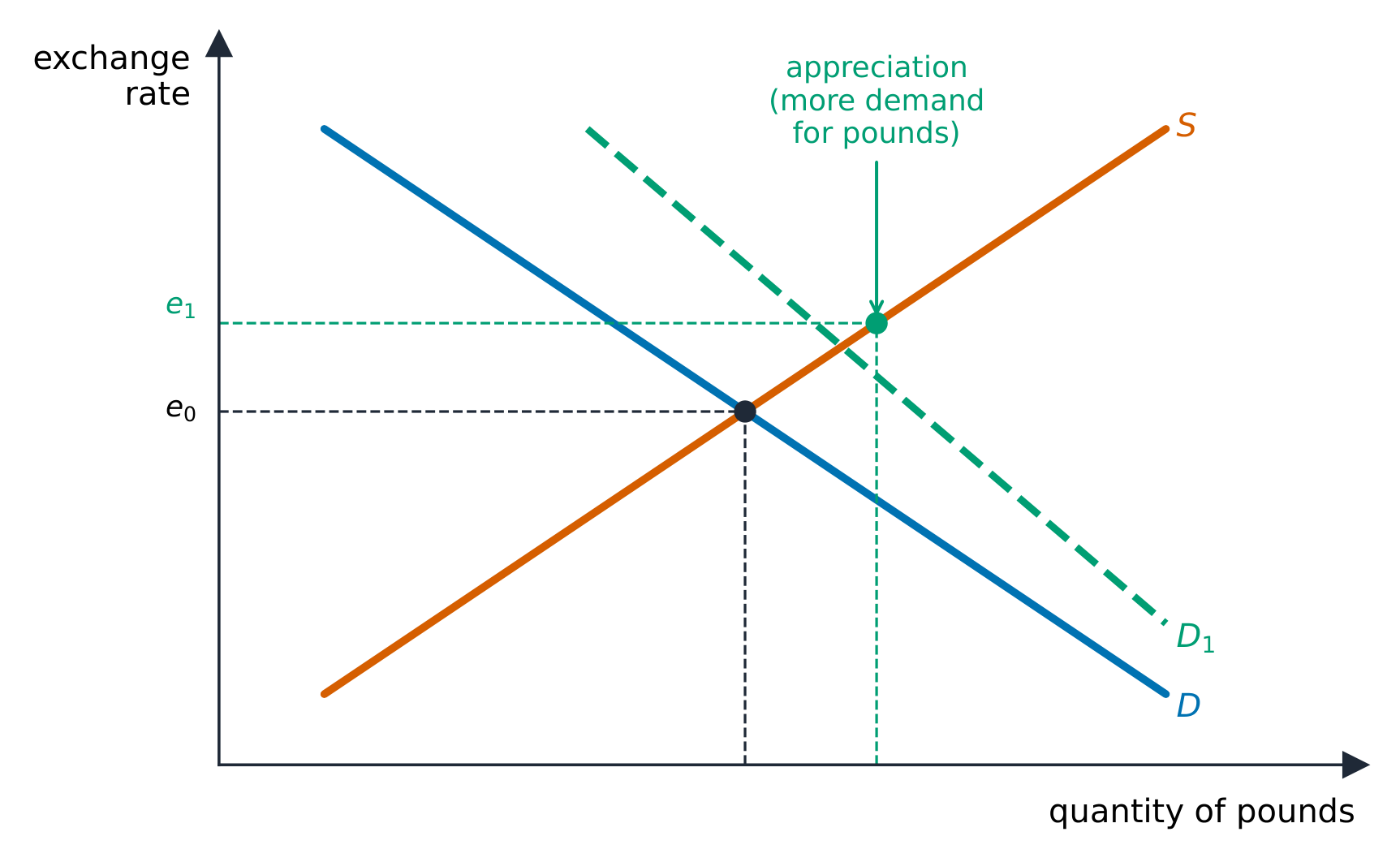
- Most major currencies have a floating exchange rate 浮动汇率: the rate is set by the demand for and supply of the currency in the foreign exchange market, and it moves every minute.
- The next lessons model this market with a supply and demand graph and explain what shifts it (interest rates, inflation, incomes, tastes).
Under a floating exchange rate, the government sets the rate each day.
Kesulitan 1/5 · 100 koin + bonus kecil pada penyelesaian pertama hari ini
A floating rate is set by supply and demand in the foreign exchange market.
Worked FRQ answer
Question: Last year 1 euro bought 1.20 US dollars. Now 1 euro buys 1.05 dollars. (a) Has the euro appreciated or depreciated against the dollar? (b) A bottle of French wine costs 100 euros. What happens to its price in dollars? (c) What happens to US imports from France? Explain.
(a) The euro depreciated: each euro now buys fewer dollars (1.05 instead of 1.20).
(b) The price falls from 100 × 1.20 = 120 dollars to 100 × 1.05 = 105 dollars.
(c) US imports from France increase, because French goods are now cheaper for Americans.
- Why it scores: each part names the currency and the direction, and (c) gives the reason (cheaper in dollars), not just the result.
Read the rate the right way round. "1 dollar = 150 yen" rising to 160 means the dollar appreciated. But "1 yen = 0.0067 dollars" falling to 0.0063 says exactly the same thing from the yen's side. Ask: does one unit of this currency buy more or less?
An exchange rate is the price of one currency in another. Appreciation = buys more foreign currency; depreciation = buys less; one currency's appreciation is the other's depreciation. An appreciation makes exports dearer and imports cheaper (net exports fall); a depreciation does the opposite. Most rates float, set by supply and demand.
FRQ practice. 1 US dollar used to buy 7.0 yuan. It now buys 7.3 yuan. (a) Did the yuan appreciate or depreciate against the dollar? (b) A Chinese bicycle costs 730 yuan. What is its new price in dollars? (c) What happens to Chinese exports to the US? Explain.
Name the currency, the direction and the reason in every part.