Current account of the balance of payments
Diperkenalkan 9:06
Masalah ekonomi internasional
Lihat label di ponsel, sepatu, atau meja lampu Anda. Hampir tidak ada yang dibuat di negara tempat Anda duduk. Barang-barang itu tiba dalam kotak baja, melalui…
Narasi bahasa Inggris · takarir bahasa Inggris dan 中文 yang dapat dipilih
In this lesson
| English | Makna |
|---|---|
| balance of payments/ˈbæləns ɒv ˈpeɪmənts/ | neraca pembayaran |
| current account/ˈkʌrənt əˈkaʊnt/ | rekening berjalan |
| trade in goods/treɪd ɪn ɡʊdz/ | perdagangan barang |
| trade in services/treɪd ɪn ˈsɜːvɪsɪz/ | perdagangan jasa |
| remittances/rɪˈmɪtənsɪz/ | kiriman uang |
| deficit/ˈdefɪsɪt/ | defisit |
| surplus/ˈsɜːpləs/ |
One country's surplus is another's deficit
- In 2007, China's current account surplus reached about 10% of its GDP: it sold far more goods to the world than it bought. In the same year, the United States ran a deficit of about 5% of its GDP, buying more than it sold and borrowing the difference from abroad, much of it from China.
- A country records all its transactions with the rest of the world in its balance of payments 国际收支. The most-watched part is the current account 经常账户.
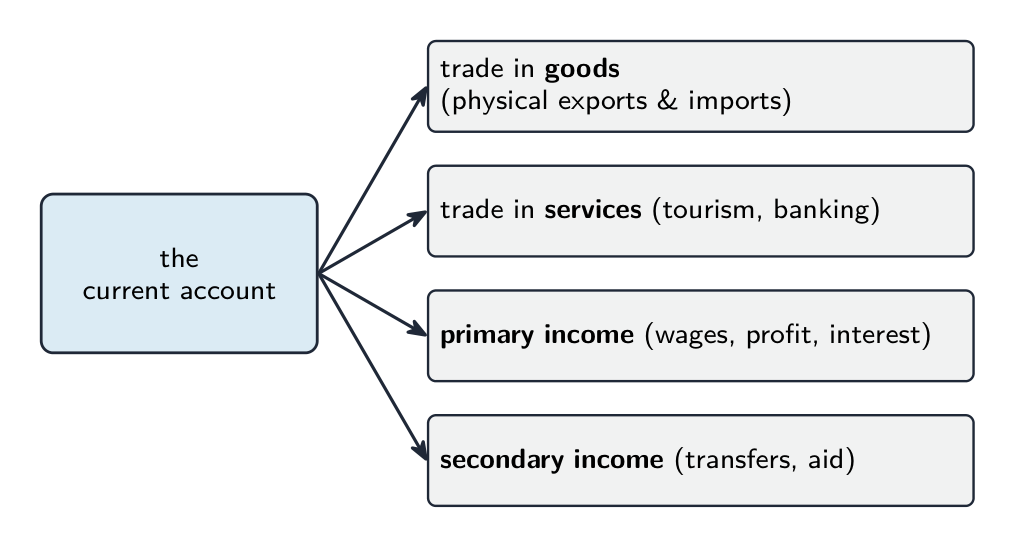
The four parts of the current account
| Part | What it records | Example (for the UK) |
|---|---|---|
| Trade in goods 货物贸易 | exports minus imports of physical goods | cars sold abroad; oil bought from Norway |
| Trade in services 服务贸易 | exports minus imports of services | banking for foreign clients; UK tourists abroad (an import) |
| Primary income | wages, profits and interest flowing in and out | profits of a UK firm's factory in India |
| Secondary income | transfers with nothing given in return | foreign aid; remittances 侨汇 sent home by migrants |
Arus akun berjalan
Track exports, imports and income flows into the current account.
Match each transaction to its part of the current account.
Kesulitan 2/5 · 140 koin + bonus kecil pada penyelesaian pertama hari ini
Goods, services, income from assets or work, and transfers.
Surplus and deficit
- A current account deficit 赤字: total payments out are greater than total receipts in. A surplus 盈余: receipts are greater than payments. Other parts of the balance of payments (the financial account) record how a deficit is financed, through borrowing or selling assets.
Worked example. Goods: exports 80, imports 110. Services: exports 50, imports 30. Primary income: +5. Secondary income: −8.
Trade in goods = 80 − 110 = −30. Trade in services = 50 − 30 = +20. Current account = −30 + 20 + 5 − 8 = −13, a deficit of 13.
Exports of goods are 80 and imports of goods are 110. What is the balance of trade in goods? (Use a minus sign for a deficit.)
Kesulitan 2/5 · 140 koin + bonus kecil pada penyelesaian pertama hari ini
80 − 110 = −30.
Trade in goods −40, trade in services +25, primary income +10, secondary income −5. What is the current account balance?
Kesulitan 2/5 · 140 koin + bonus kecil pada penyelesaian pertama hari ini
−40 + 25 + 10 − 5 = −10, a deficit.
Causes of a deficit
| Cause | Why it leads to a deficit |
|---|---|
| Fast growth of incomes at home | households buy more imports |
| High inflation compared with trading partners | exports become less price competitive |
| A strong (appreciated) exchange rate | exports dearer abroad, imports cheaper |
| Low productivity or poor quality | foreign goods are better value |
| Recession in trading partners | foreign demand for exports falls |
Which could cause a current account deficit to widen?
Kesulitan 2/5 · 140 koin + bonus kecil pada penyelesaian pertama hari ini
A boom abroad raises demand for exports, which reduces a deficit.
Does a deficit matter?
- It may matter if it is large and lasts many years: it must be financed by borrowing or by selling assets to foreigners, the currency may fall sharply if lenders lose confidence, and it may show that domestic firms are not competitive.
- It may not matter if it is small, temporary, or caused by importing machinery that will raise future output and exports. Surpluses can also cause problems: they mean the country consumes less than it produces, and trading partners may complain.
A current account deficit caused by importing machinery that raises future exports is less worrying than one caused by importing consumer goods.
Kesulitan 1/5 · 100 koin + bonus kecil pada penyelesaian pertama hari ini
It can raise future productive capacity and export earnings.
Worked data-response answer
A country's current account deficit widens from 2% to 5% of GDP while its real GDP growth rises from 1% to 4%. Explain one likely link between these changes. [4]
Faster growth means higher real incomes, so households spend more, including on imported goods and foreign holidays; firms also import more materials and machinery to increase output. If exports do not rise as fast, imports grow faster than exports, so the deficit widens by 3 percentage points of GDP.
- Why it scores: uses the data (percentage points), names the mechanism (income → imports), and states the condition (exports grow more slowly).
The current account is not only trade in goods. Include services, primary income and secondary income. A country can have a goods deficit but an overall surplus if services and income are large.
The current account = trade in goods + trade in services + primary income + secondary income. A deficit means more is paid out than received; a surplus the reverse. Deficits come from fast income growth, high relative inflation, a strong currency, low productivity or weak foreign demand. A large, persistent deficit must be financed and may harm confidence; a small or investment-driven one may not matter.
Essay practice. Assess whether a large current account deficit is always a problem for an economy. [12]
Cause and duration decide.