The reasons for international trade
Diperkenalkan| English | Makna |
|---|---|
| comparative advantage/kəmˈpærətɪv ədˈvæntɪdʒ/ | keunggulan komparatif |
| specialise/ˈspeʃəlaɪz/ | spesialisasi |
| absolute advantage/ˈæbsəluːt ədˈvæntɪdʒ/ | keunggulan mutlak |
| opportunity cost/ɒpəˈtjuːnɪti kɒst/ | biaya peluang |
| over-specialisation/ˈəʊvə ˌspeʃəlaɪˈzeɪʃn/ | over-spesialisasi |
Why Bangladesh makes shirts
- Clothing makes up more than 80% of Bangladesh's exports. Germany could make shirts more efficiently, with better machines and more skilled workers, yet it buys them from Bangladesh and sells cars and machinery instead. Why would a country buy something it could make better itself?
- The answer is comparative advantage 比较优势: countries gain by specialising 专业化 in what they give up least to produce, then trading.
Absolute and comparative advantage
- Absolute advantage 绝对优势: a country can produce more of a good than another with the same resources.
- Comparative advantage: a country can produce a good at a lower opportunity cost 机会成本 than another. Trade depends on comparative, not absolute, advantage, so even a country that is better at everything gains from trade.
Match each term to its meaning.
Kesulitan 2/5 · 140 koin + bonus kecil pada penyelesaian pertama hari ini
Trade depends on comparative advantage.
Worked example: who should make what?
| Country | Shirts | Laptops | Cost of 1 laptop |
|---|---|---|---|
| A | 20 | 10 | 2 shirts |
| B | 12 | 3 | 4 shirts |
- Each row is what a country can make with the same resources. A has an absolute advantage in both goods. But A gives up only 2 shirts per laptop (B gives up 4), so A has a comparative advantage in laptops. B gives up only 0.25 laptops per shirt (A gives up 0.5), so B has a comparative advantage in shirts.
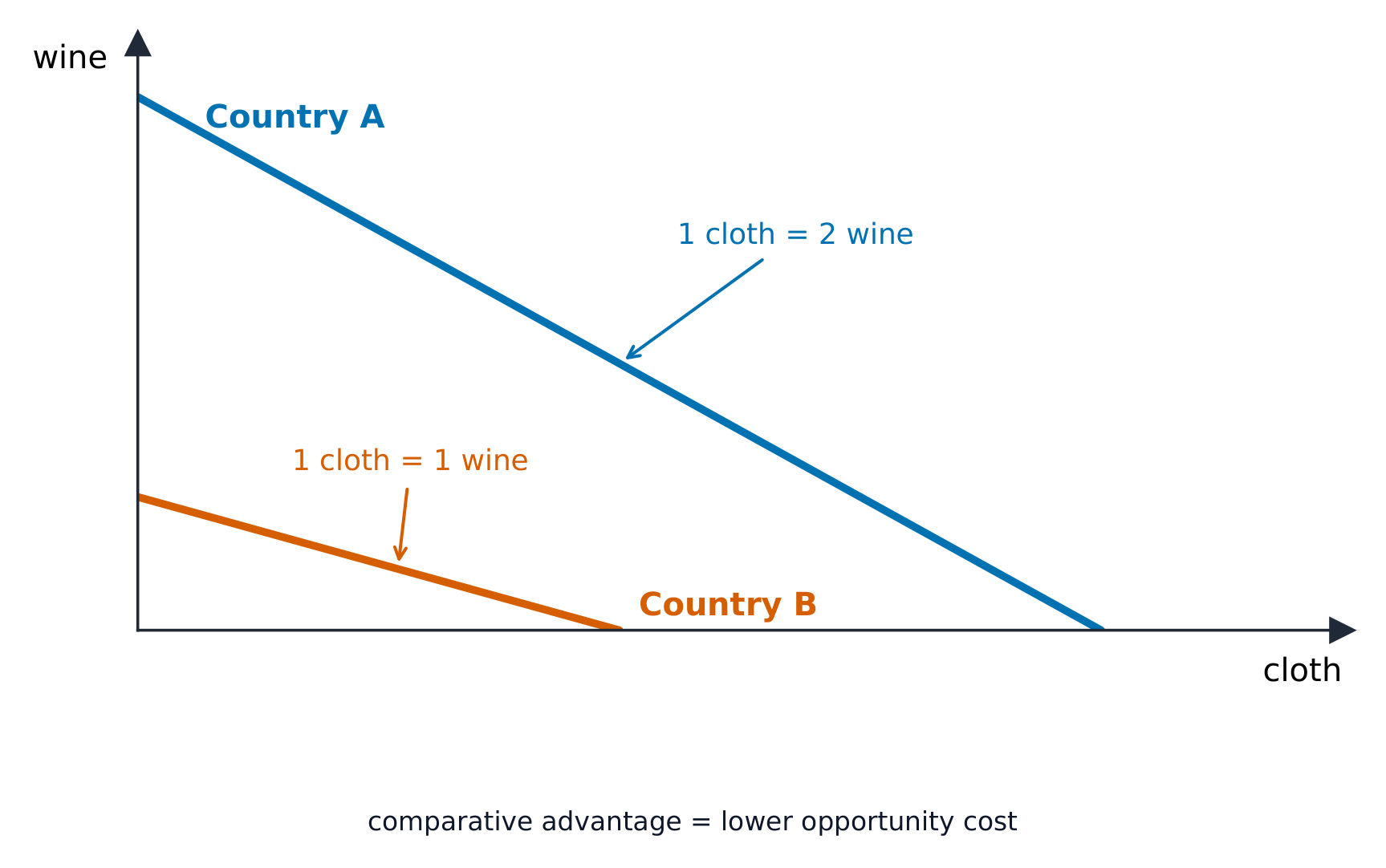
Why countries trade
Each country specialises where its opportunity cost is lowest, then trades — both can consume beyond their own frontier.
Country A can make 12 shirts or 3 laptops with the same resources. What is A's opportunity cost of 1 laptop, in shirts?
Kesulitan 2/5 · 140 koin + bonus kecil pada penyelesaian pertama hari ini
12 ÷ 3 = 4 shirts.
Country A can make 12 shirts or 3 laptops; Country B can make 8 shirts or 4 laptops. Which country has the comparative advantage in laptops?
Kesulitan 1/5 · 100 koin + bonus kecil pada penyelesaian pertama hari ini
B's opportunity cost of a laptop (2 shirts) is lower than A's (4 shirts).
The gains from specialisation
Before trade: each country splits its resources half and half. A makes 10 shirts and 5 laptops; B makes 6 shirts and 1.5 laptops. Total: 16 shirts, 6.5 laptops.
After specialisation: B makes only shirts (12); A makes 4 shirts and 8 laptops. Total: 16 shirts, 8 laptops. The world gains 1.5 laptops with the same resources.
- Both countries gain if they trade at terms of trade between their opportunity costs: here, between 2 and 4 shirts per laptop (for example, 3 shirts for 1 laptop).
In the lesson's example (A gives up 2 shirts per laptop, B gives up 4), which terms of trade benefit both countries?
Kesulitan 1/5 · 100 koin + bonus kecil pada penyelesaian pertama hari ini
The rate must lie between 2 and 4 shirts per laptop.
Assumptions and limits
- The theory assumes low transport costs, no trade barriers, constant opportunity costs, and that workers and capital can move easily from one industry to another. In reality, workers in a declining industry may become unemployed.
- Over-specialisation 过度专业化 is risky: a country that depends on one export (Bangladesh on clothing, Zambia on copper) is hit hard when demand or prices fall.
A country that depends on one export is vulnerable when world demand for it falls.
Kesulitan 1/5 · 100 koin + bonus kecil pada penyelesaian pertama hari ini
This is the risk of over-specialisation.
Worked exam answer
Explain why a country with an absolute advantage in both goods can still gain from trade. [6]
Gains from trade depend on opportunity cost, not on absolute output. In the example, A can make more of both goods, but making a laptop costs A only 2 shirts while it costs B 4 shirts; making a shirt costs B only 0.25 laptops while it costs A 0.5. If A specialises more in laptops and B in shirts, world output rises (here by 1.5 laptops). If they trade at a rate between 2 and 4 shirts per laptop, each country can consume more than it could produce alone.
- Why it scores: uses opportunity cost figures for both goods, shows the rise in total output, and explains why the terms of trade must lie between the two opportunity costs.
Compare opportunity costs, not outputs. The country with the lower opportunity cost of a good has the comparative advantage in it, even if it produces less of that good.
Absolute advantage means more output from the same resources; comparative advantage means a lower opportunity cost. Countries gain by specialising where their opportunity cost is lower and trading at terms of trade between the two opportunity costs. The theory assumes low transport costs and free trade; over-specialisation brings risks.
Exam practice. Country X can produce 30 tonnes of rice or 10 tractors; Country Y can produce 20 tonnes of rice or 4 tractors. (a) Identify which country has a comparative advantage in each good. [2] (b) Explain ONE reason why the gains from trade may be smaller in reality. [2]
Calculate both opportunity costs before deciding.