Economic growth
Diperkenalkan| English | Makna |
|---|---|
| actual growth/ˈæktʃuːəl ɡrəʊθ/ | Pertumbuhan aktual |
| potential growth/pəˈtenʃl ɡrəʊθ/ | Pertumbuhan potensial |
| recession/rɪˈseʃn/ | Resesi |
| recovery/rɪˈkʌvəri/ | Pemulihan |
| business cycle/ˈbɪznəs ˈsaɪkl/ | Siklus bisnis |
| human capital/ˈhjuːmən ˈkæpɪtl/ | modal manusia |
Ten per cent a year for thirty years
- From 1980 to 2010, China's real GDP grew by about 10% a year on average. At that rate, output doubles roughly every seven years, so the economy became about 17 times larger in one generation. In 2009 and 2020, by contrast, many rich economies saw output fall.
- Economic growth is a rise in an economy's real output (real GDP). Economists separate growth in what an economy does produce from growth in what it could produce, and study why output rises and falls in cycles.
Measuring growth: real, not nominal
- Nominal GDP uses current prices, so it rises with inflation even if no more is produced. Real GDP removes the effect of price changes, so growth is always measured in real terms.
- Growth rate = (change in real GDP ÷ real GDP in the earlier year) × 100. If real GDP rises from 500bn to 520bn: (20 ÷ 500) × 100 = 4%.
Nominal vs real. Nominal GDP rises by 6% and the price level rises by 4%. Real GDP growth is about 6% − 4% = 2%, the rise in actual output.
Real GDP rises from 500bn to 520bn in a year. What is the growth rate (%)?
Kesulitan 2/5 · 140 koin + bonus kecil pada penyelesaian pertama hari ini
(20 ÷ 500) × 100 = 4%.
Nominal GDP rises by 7% and the price level rises by 3%. What is the approximate real growth rate (%)?
Kesulitan 2/5 · 140 koin + bonus kecil pada penyelesaian pertama hari ini
Real growth ≈ nominal growth − inflation = 7 − 3 = 4%.
Actual and potential growth
| Actual growth 实际增长 | Potential growth 潜在增长 | |
|---|---|---|
| Meaning | a rise in real GDP actually produced | a rise in productive capacity |
| PPC | a move from inside towards the curve | the whole curve shifts outward |
| AD/AS | AD shifts right, using spare capacity | LRAS shifts right |
| Caused by | more spending (C, I, G, X − M) | more or better resources: labour, capital, technology, education |
Economic growth shifts the frontier out
Growth means the economy can produce more of BOTH goods — the whole frontier moves outward as resources or technology improve.
Match each change to the type of growth.
Kesulitan 2/5 · 140 koin + bonus kecil pada penyelesaian pertama hari ini
Spending uses capacity; resources and technology add to it.
Output gaps
- An output gap is the difference between actual and potential output. A negative output gap (actual below potential) means spare capacity and unemployment. A positive output gap (actual above potential) means the economy is overheating, with labour shortages and rising inflation.
- Example: potential output is 1,000 and actual output is 940. The gap is −60, or −6% of potential: a negative output gap.
Potential output is 1,000 and actual output is 940. What is the output gap as a percentage of potential output? (Use a minus sign for a negative gap.)
Kesulitan 2/5 · 140 koin + bonus kecil pada penyelesaian pertama hari ini
(940 − 1,000) ÷ 1,000 × 100 = −6%, a negative output gap.
What is most likely when an economy has a positive output gap?
Kesulitan 1/5 · 100 koin + bonus kecil pada penyelesaian pertama hari ini
Output above potential means the economy is overheating.
The business cycle
| Phase | Real GDP | Unemployment | Inflation |
|---|---|---|---|
| Boom | growing above trend; positive output gap | low | rising |
| Slowdown | growth slows | starts to rise | easing |
| Recession 衰退 | falling (often defined as two consecutive quarters) | rising fast | low |
| Recovery 复苏 | growing again; gap narrowing | falling | low, then rising |
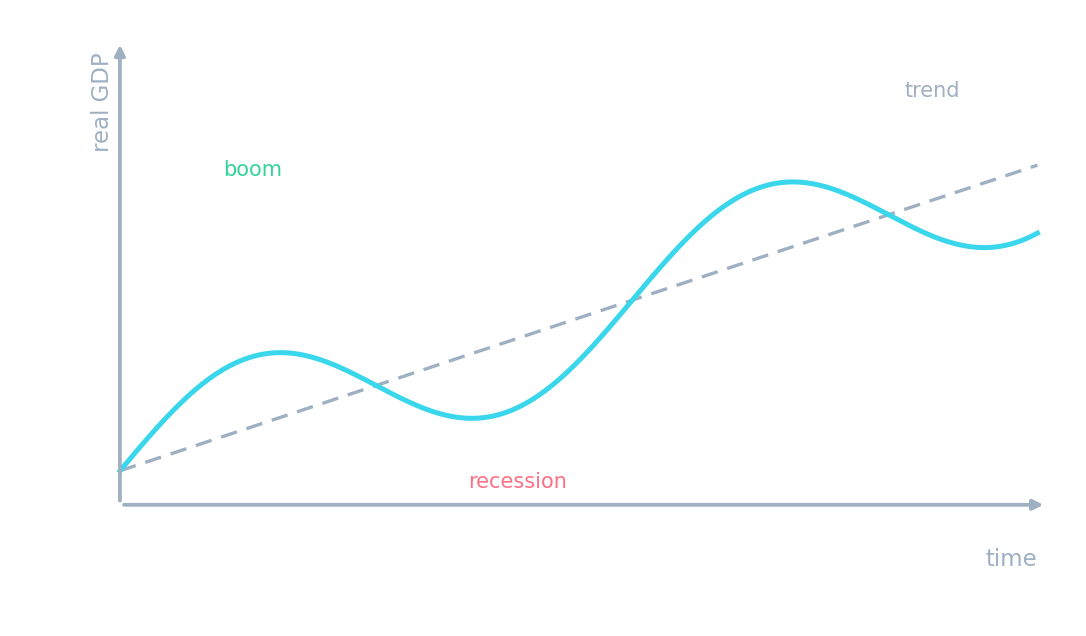
- The business cycle 经济周期 is these short-run swings of real GDP around its long-run trend, the path of potential growth.
Put the phases of the business cycle in order, starting from the peak.
Kesulitan 3/5 · 200 koin + bonus kecil pada penyelesaian pertama hari ini
The cycle then returns to a boom.
A recession is often defined as one quarter of falling real GDP.
Kesulitan 1/5 · 100 koin + bonus kecil pada penyelesaian pertama hari ini
The common definition is two consecutive quarters of falling real GDP.
Causes and consequences
- Causes of actual growth: rises in consumption, investment, government spending or net exports (AD shifts right). Causes of potential growth: investment in capital, new technology, a larger or better-educated labour force (human capital 人力资本), better institutions.
- Benefits: higher incomes and living standards, more jobs, more tax revenue for public services. Costs: inflation if AD grows faster than capacity, pollution and resource depletion, and incomes that may grow faster for some groups than for others.
Which are possible costs of rapid economic growth?
Kesulitan 2/5 · 140 koin + bonus kecil pada penyelesaian pertama hari ini
Higher tax revenue is a benefit.
Worked essay answer
(a) Explain the difference between actual and potential economic growth. [8] Actual growth is a rise in real GDP produced; on a PPC it is a move from a point inside the curve towards it, and in AD/AS it is AD shifting right while there is spare capacity. Potential growth is a rise in productive capacity: the PPC shifts out and LRAS shifts right, for example because firms invest in new machinery or workers become more skilled. Actual growth can happen without potential growth only until spare capacity is used up.
(b) Assess whether rapid economic growth always benefits a country. [12] Growth raises incomes and tax revenue, which can fund schools and hospitals, and it reduces unemployment. However, if AD grows faster than capacity, a positive output gap causes inflation. Fast industrial growth can also pollute air and water, harming health, and its gains may go mostly to capital owners and cities. Judgement: growth is usually beneficial when it comes from rising capacity (potential growth) and is spread widely; growth driven only by demand, or that damages the environment, may lower long-run welfare.
- Why it scores: (a) defines both terms (AO1) and uses two diagrams' language (AO2); (b) gives both sides and a judgement that depends on the type of growth (AO3).
Do not confuse a recovery with potential growth. Moving from a negative output gap back towards potential is actual growth; only a rise in capacity shifts the PPC or LRAS out.
Economic growth is a rise in real GDP. Actual growth uses spare capacity (AD rises); potential growth raises capacity (PPC and LRAS shift out). An output gap is actual minus potential output: negative means spare capacity, positive means overheating. The business cycle moves through boom, slowdown, recession and recovery. Growth raises living standards but can cause inflation, pollution and inequality.
Essay practice. Assess whether a government should aim for the fastest possible rate of economic growth. [12]
Both sides, then a judgement that depends on the kind of growth.