Other reasons for intervention
Diperkenalkan| English | Makna |
|---|---|
| public good/ˈpʌblɪk ɡʊd/ | barang publik |
| non-rival/nɒn ˈraɪvl/ | Non-rival |
| non-excludable/nɒn eksˈkluːdəbl/ | Tidak dapat dikecualikan |
| free-rider/friː ˈraɪdə/ | penumpang liar |
| merit goods/ˈmerɪt ɡʊdz/ | Barang bermanfaat |
| demerit goods/ˈdemərɪt ɡʊdz/ | Barang merugikan |
| asymmetric information/ˌeɪsɪˈmetrɪk ˌɪnfəˈmeɪʃn/ | Ketidakseimbangan informasi |
| monopoly power/məˈnɒpəli ˈpaʊə/ | Kekuasaan monopoli |
The fireworks nobody pays for
- Every New Year, cities such as Sydney and Hong Kong put on huge fireworks displays over their harbours. Anyone nearby can watch, and one more viewer does not spoil the view for others. If a private firm tried to sell tickets, most people would simply watch for free, so it would never earn enough to pay for the show.
- Externalities are not the only reason markets fail. Public goods, merit and demerit goods, information failure and monopoly power also give governments a reason to intervene.
Public goods
- A public good 公共物品 is non-rival 非竞争性 (one person's use does not reduce what is left for others) and non-excludable 非排他性 (people who do not pay cannot be stopped from benefiting). Examples: street lighting, national defence, flood barriers, lighthouses.
- Because people can benefit without paying, they become free-riders 搭便车: they wait for others to pay. Firms cannot make a profit, so the free market provides too little or none at all, and governments provide them, paid for by taxes.
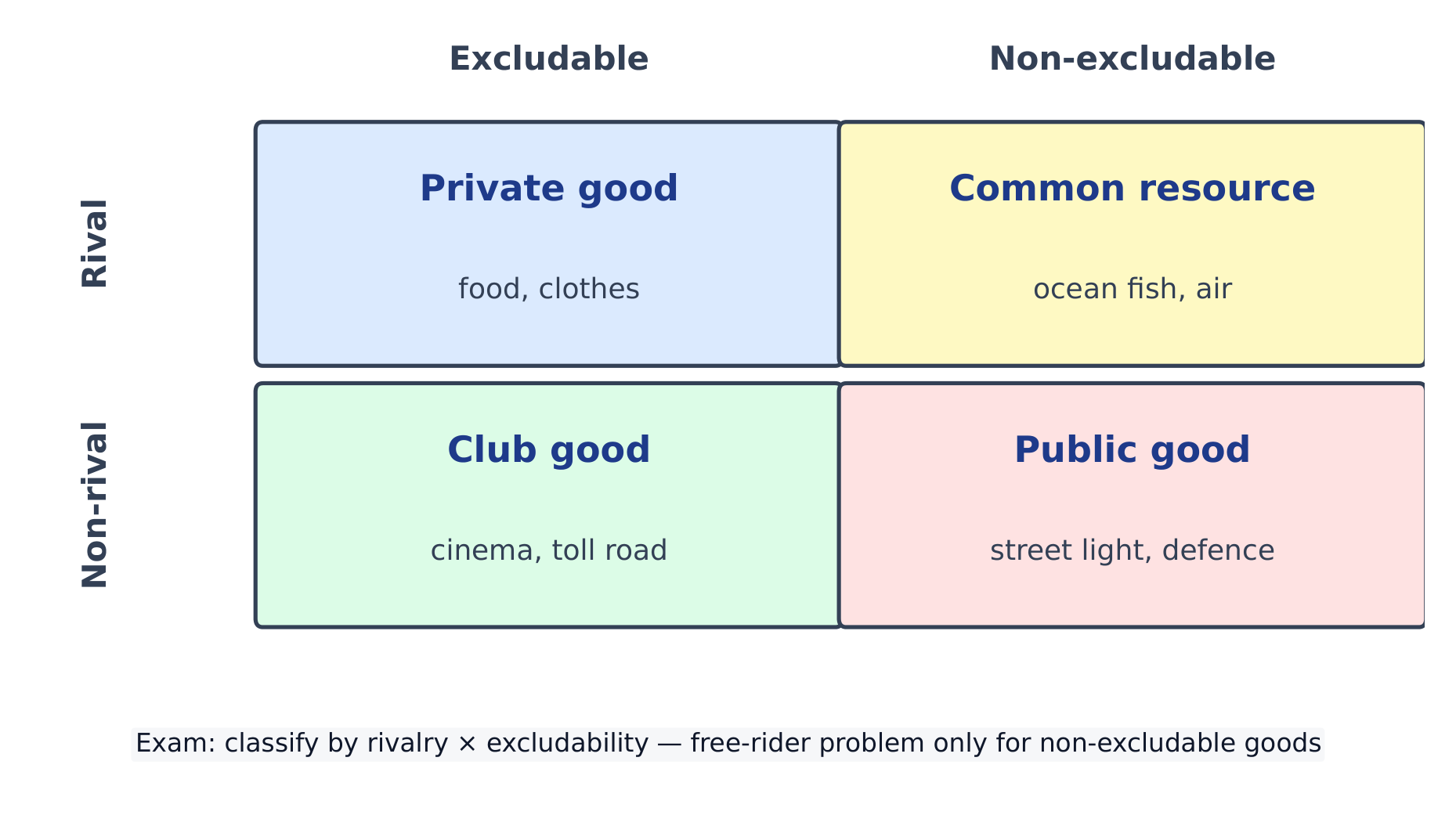
Reasons for intervention
Governments step into markets when the free-market equilibrium isn't the best outcome for society.
Match each good to its type.
Kesulitan 2/5 · 140 koin + bonus kecil pada penyelesaian pertama hari ini
Classify by rivalry and excludability.
Why does a free market under-provide public goods?
Kesulitan 1/5 · 100 koin + bonus kecil pada penyelesaian pertama hari ini
Non-excludability leads to free-riding.
Merit and demerit goods
| Merit goods 有益品 | Demerit goods 有害品 | |
|---|---|---|
| Examples | education, healthcare, vaccination | tobacco, alcohol, sugary drinks |
| Free market result | under-consumed | over-consumed |
| Why | people underestimate the long-term private benefit | people underestimate the long-term private harm |
| Typical policy | provide free, subsidise, make compulsory (school) | tax, ban, regulate, health warnings |
Match each good to its type and likely policy.
Kesulitan 2/5 · 140 koin + bonus kecil pada penyelesaian pertama hari ini
Encourage merit goods; discourage demerit goods.
Information failure and market power
- Asymmetric information 信息不对称: one side of a deal knows more than the other. A used-car seller knows if the car is faulty; the buyer does not. Buyers then offer only a low price, owners of good cars refuse to sell, and the market fills with poor cars ("the market for lemons").
- Monopoly power 垄断势力: a dominant firm can restrict output and raise the price above the competitive level, so consumers buy less than is efficient.
In a used-car market with asymmetric information, good cars may leave the market.
Kesulitan 1/5 · 100 koin + bonus kecil pada penyelesaian pertama hari ini
Buyers offer a low average price, so owners of good cars refuse to sell.
Worked exam answer
100 residents each value a new park at $2 (total$200). The park costs $150. Explain why a free market may not provide it. [4]
The total benefit ($200) is greater than the cost ($150), so the park is worth building. But the park is non-excludable: once built, residents who did not pay cannot be kept out. Each resident has an incentive to free-ride, hoping others will pay, so voluntary payments are likely to fall well short of $150, and no firm will build it. A local government could build it and pay with taxes of$1.50 per resident.
- Why it scores: compares benefit with cost, names the characteristic (non-excludable), explains free-riding as the mechanism, and offers a solution.
100 residents each value a park at 2. What is the total benefit?
Kesulitan 2/5 · 140 koin + bonus kecil pada penyelesaian pertama hari ini
100 × 2 = 200, more than the cost of 150.
"Provided by the government" does not make something a public good. Education and healthcare are often state-provided, but they are rival and excludable: they are merit goods, not public goods.
State schools are a public good.
Kesulitan 1/5 · 100 koin + bonus kecil pada penyelesaian pertama hari ini
Places are rival and excludable; education is a merit good.
Public goods are non-rival and non-excludable; the free-rider problem means markets under-provide them. Merit goods are under-consumed and demerit goods over-consumed because people misjudge their benefits or harms. Asymmetric information and monopoly power also lead to inefficient outcomes and reasons for intervention.
Exam practice. Explain why national defence is a public good, and why this means the government usually provides it. [4]
Characteristics, free-riding, provision.