The interaction of demand and supply
Diperkenalkan 14:43
Sistem harga dan mikroekonomi
Tidak ada yang memimpin pasar ini. Tidak ada pejabat yang memutuskan berapa harga satu kilogram tomat. Namun setiap stan memiliki harga, dan menjelang malam hampir semuanya…
Narasi bahasa Inggris · takarir bahasa Inggris dan 中文 yang dapat dipilih
In this lesson
| English | Makna |
|---|---|
| equilibrium/ˌiːkwɪˈlɪbrɪəm/ | keseimbangan |
| clears/klɪəz/ | bersih |
| shortage/ˈʃɔːtɪdʒ/ | kelangkaan |
| surplus/ˈsɜːpləs/ |
Why pork doubled in price
- In 2018–19, African swine fever spread through China's pig farms, and millions of pigs died or were culled. By late 2019, pork prices were more than twice as high as a year earlier. Many families bought chicken and beef instead, and their prices rose too.
- No one ordered these price changes. They came from the interaction of demand and supply, which move the market to a new equilibrium 均衡.
Equilibrium
- Equilibrium is the price at which quantity demanded equals quantity supplied: the market clears 出清, with nothing left unsold and no buyer turned away at that price.
- Worked algebra: Qd = 100 − 5P and Qs = 10 + 5P. Set Qd = Qs: 100 − 5P = 10 + 5P, so 10P = 90, P = 9. Then Q = 100 − 45 = 55.
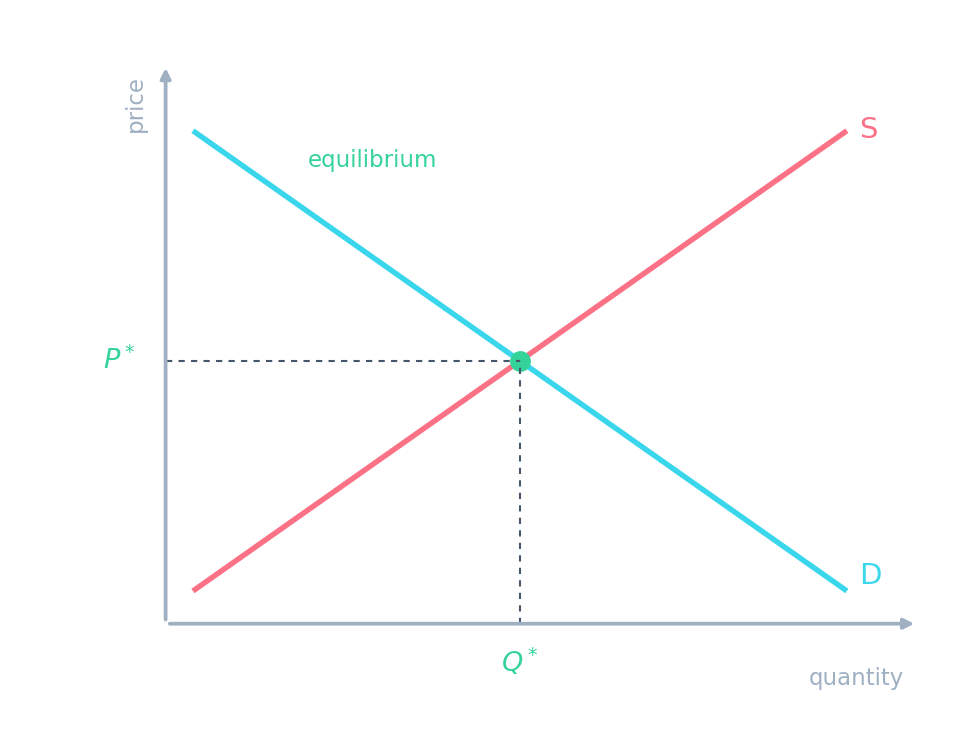
Permintaan & Penawaran
Di mana permintaan bertemu sumber sets the equilibrium price and quantity.
Qd = 120 − 4P and Qs = 20 + 6P. What is the equilibrium price?
Kesulitan 2/5 · 140 koin + bonus kecil pada penyelesaian pertama hari ini
120 − 4P = 20 + 6P, so 10P = 100 and P = 10.
Using Qd = 120 − 4P and Qs = 20 + 6P, what is the equilibrium quantity?
Kesulitan 2/5 · 140 koin + bonus kecil pada penyelesaian pertama hari ini
At P = 10, Qd = 120 − 40 = 80 (and Qs = 20 + 60 = 80).
Disequilibrium: shortages and surpluses
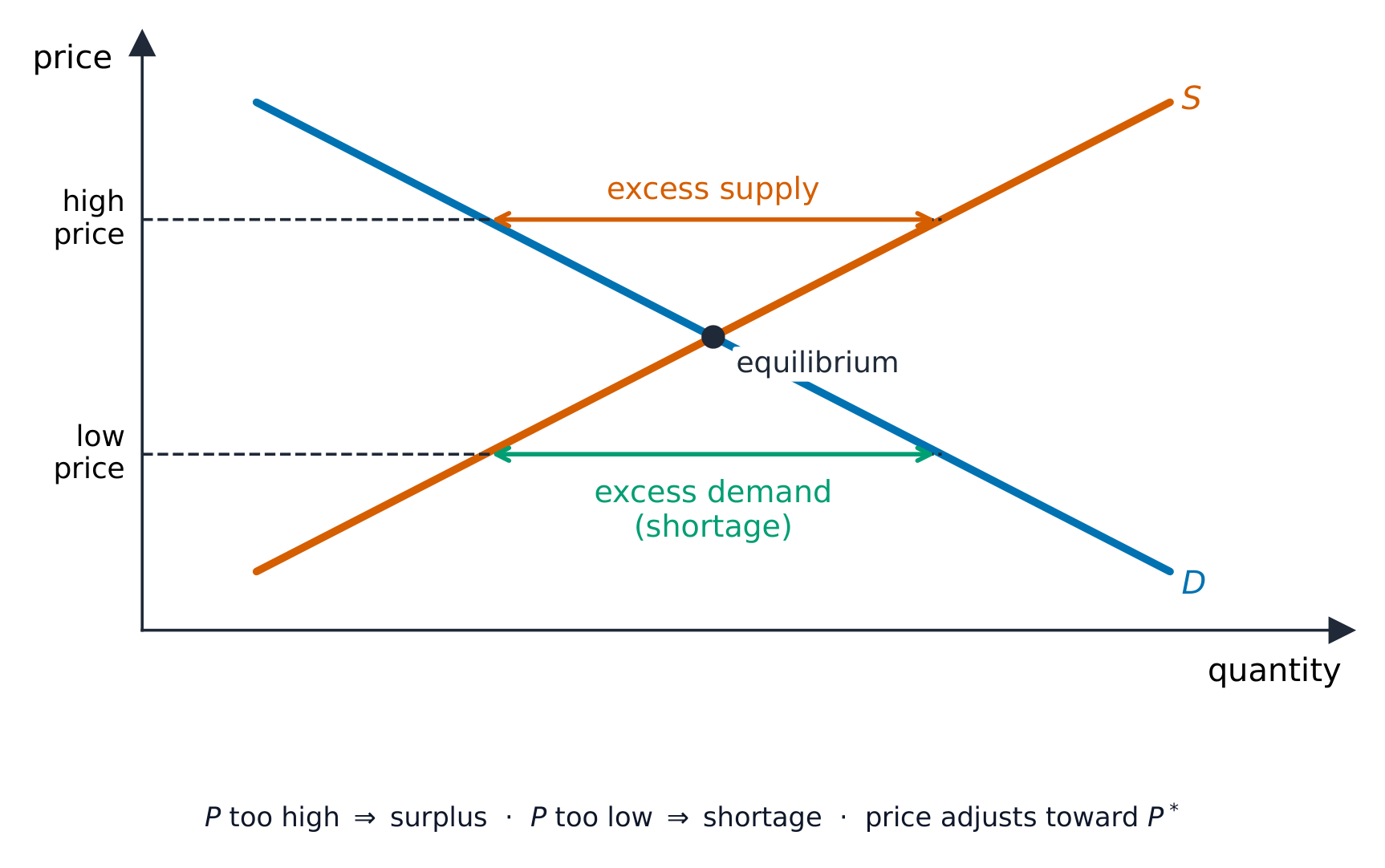
- Price below equilibrium → quantity demanded is greater than quantity supplied → a shortage 短缺 (excess demand) → buyers compete and sellers raise prices → price rises back to equilibrium.
- Price above equilibrium → quantity supplied is greater than quantity demanded → a surplus 过剩 (excess supply) → unsold stock builds up and sellers cut prices → price falls back to equilibrium.
At a price of 6, quantity demanded is 70 and quantity supplied is 40. How large is the shortage?
Kesulitan 2/5 · 140 koin + bonus kecil pada penyelesaian pertama hari ini
70 − 40 = 30 units of excess demand, so the price will rise.
Shifts change the equilibrium
| Change | Curve shift | Price | Quantity |
|---|---|---|---|
| Incomes rise (normal good) | D right | rises | rises |
| A substitute becomes cheaper | D left | falls | falls |
| Disease or bad harvest | S left | rises | falls |
| New technology lowers costs | S right | falls | rises |
| D right and S right together | both | uncertain | rises |
| D right and S left together | both | rises | uncertain |
- When both curves shift, the result for one variable depends on which shift is larger.
Match each event to its effect on the market for coffee.
Kesulitan 2/5 · 140 koin + bonus kecil pada penyelesaian pertama hari ini
Decide which curve shifts, and in which direction.
Demand and supply for phones both shift right. What happens?
Kesulitan 1/5 · 100 koin + bonus kecil pada penyelesaian pertama hari ini
Both shifts raise quantity, but they push price in opposite directions.
Related markets
- Substitutes (competitive demand): pork and chicken. A pork shortage raises demand for chicken, so its price rises. Complements (joint demand): cars and petrol.
- Derived demand: demand for a factor comes from demand for what it makes (demand for builders depends on demand for houses). Joint supply: producing one good also produces another (beef and leather).
Match each pair to its relationship.
Kesulitan 2/5 · 140 koin + bonus kecil pada penyelesaian pertama hari ini
Related markets move together in predictable ways.
Worked exam answer
With the help of a diagram, explain the effect of African swine fever on the market for pork and the market for chicken. [8]
Pork: the loss of pigs reduces supply, so the supply curve shifts left. At the old price there is a shortage, so the price rises; the new equilibrium has a higher price and lower quantity. Demand contracts along the curve as some buyers stop buying.
Chicken: chicken is a substitute, so the higher price of pork increases demand for chicken; the demand curve shifts right, raising both the price and quantity of chicken.
- Why it scores: correct curve and direction in each market, the movement from shortage to new equilibrium, and the substitute link between the markets (AO2). Label both diagrams with P, Q, D, S and the old and new equilibria.
A change in price does not shift its own curve. A higher pork price causes a contraction of demand for pork (a movement along the curve); only a change in another factor, such as income or the price of chicken, shifts the curve.
Equilibrium is where Qd = Qs and the market clears. Below it there is a shortage and price rises; above it there is a surplus and price falls. Demand shifts move P and Q in the same direction; supply shifts move them in opposite directions; two shifts together leave one result uncertain. Related markets are linked by substitutes, complements, derived demand and joint supply.
Exam practice. Explain, with a diagram, the effect on the market for electric cars of (i) a government subsidy to producers and (ii) a rise in the price of petrol. [8]
One shift at a time, then combine.