Lompat ke konten
Materi

OxfordAQA · International GCSE · Physics

  • 1

    3.1 · Forces and their effects

    Program pembelajaran segera hadir

    Lembar Kerja

    English

    Forces and their effects

    Every push, pull and hold in the world is a force — and OxfordAQA's first topic organises them: contact and non-contact interactions, scalars against vectors, Newton's three laws, vehicle safety, and the P-extension ideas of momentum, terminal velocity, centre of mass and moments.

    OxfordAQA International GCSE Physics 9203, topic 3.1 (Version 5.1, exams 2018 onwards). Statements marked (P) are Paper-2-only; paper details are in the specification's scheme of assessment. The specimen components on file are 9203-92031 and 9203-92032 — specimen practice in this package is always labelled as such.

    Forces and their interactions

    Objects interact by non-contact field forces (gravity, electrostatics, magnetism) and contact forces (friction, air resistance, tension, normal contact force). Friction 摩擦 acts between two surfaces, impedes motion and may heat them; air resistance is friction with a fluid.
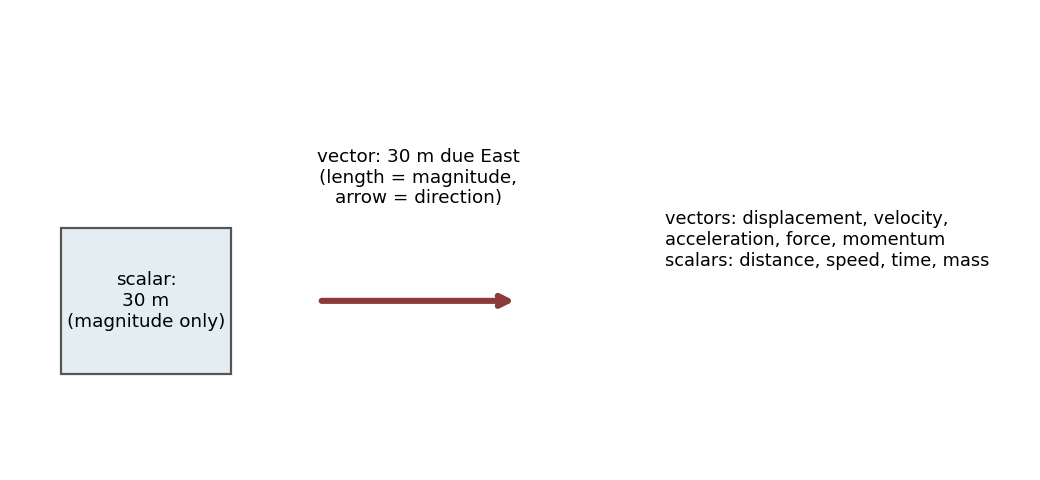
    A scalar has only a size; a vector is an arrow whose length is the magnitude and whose direction is the arrow.

    Scalars 标量 have magnitude only (distance, speed, time); vectors 矢量 add direction (displacement, velocity, acceleration, force, momentum) and can be drawn as arrows. Weight is the force of gravity: $W = m \times g$.

    Forces can change shape — stretching, bending, compressing. Elastic distortions recover; inelastic ones do not (P). A stretched spring stores elastic potential energy, and below the limit of proportionality:

    $$F = k \times e$$

    Required practical: investigate force against extension for a spring (hang masses, plot the line, gradient = k).

    Motion and Newton's laws

    Speed is the gradient of a distance–time graph; velocity adds direction: $v = s/t$ (usable for average speeds too). Acceleration is the rate of change of velocity: $a = \Delta v/t$ — from the gradient of a velocity–time graph, whose area gives distance travelled. Changing direction at constant speed is still acceleration.

    Two skaters push: the forces on each are equal and opposite — Newton's Third Law.
    • Newton's First Law: zero resultant force → rest stays rest, motion keeps its velocity.
    • Newton's Second Law: $F = m \times a$ in the direction of the resultant.
    • Newton's Third Law: interacting objects exert equal, opposite forces on each other.

    Resultants: opposite or parallel forces add along a line; two coplanar forces combine by scale drawing (drawn to scale, head to tail).

    (P) Momentum, safety and terminal velocity

    $$p = m \times v \qquad F = \frac{\Delta p}{t}$$

    Momentum 动量 is conserved in a closed system — collisions and explosions share a fixed total. Car safety: airbags, seat belts, side-impact bars, crumple zones, crash mats, cushioned playground surfaces and cycle helmets all lengthen the time of impact, so for the same momentum change the force is smaller.

    At a steady speed the driving force balances resistive forces. Stopping distance = thinking + braking distance; reaction time grows with tiredness, distraction, drugs and alcohol; braking force must grow with speed, and large decelerations overheat brakes. Braking converts the vehicle's kinetic energy into heating the brakes (friction work); braking distance lengthens on wet or icy roads and with worn brakes or tyres.

    An object falling through a fluid accelerates until drag equals weight — terminal velocity 终末速度; parachutes raise drag to cut the terminal velocity, and streamlining (a shark's shape, a car's design) reduces drag to raise the maximum speed.
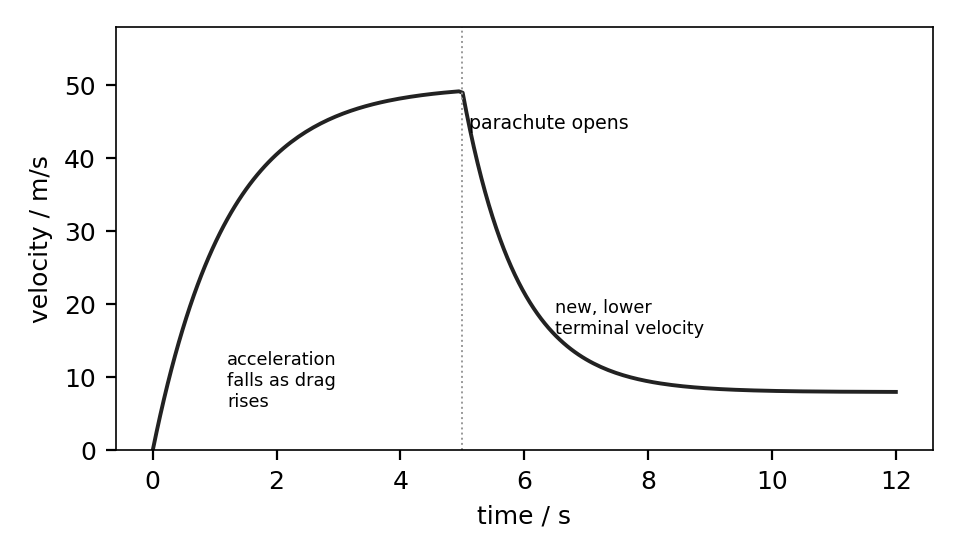
    Velocity against time for a parachutist: a first terminal velocity, then a lower one after opening.

    (P) Centre of mass and moments

    The centre of mass 质心 is where an object's mass may be thought concentrated; a freely suspended object rests with it below the suspension point, and a symmetrical object's centre of mass lies on the axis of symmetry. Find it for an irregular lamina by suspending it from two points and drawing plumb lines.

    $$M = F \times d$$

    A balanced object has equal total clockwise and anticlockwise moments 力矩; levers are force multipliers. If the weight's line of action falls outside the base, the resultant moment topples the object (vehicles, balancing toys).
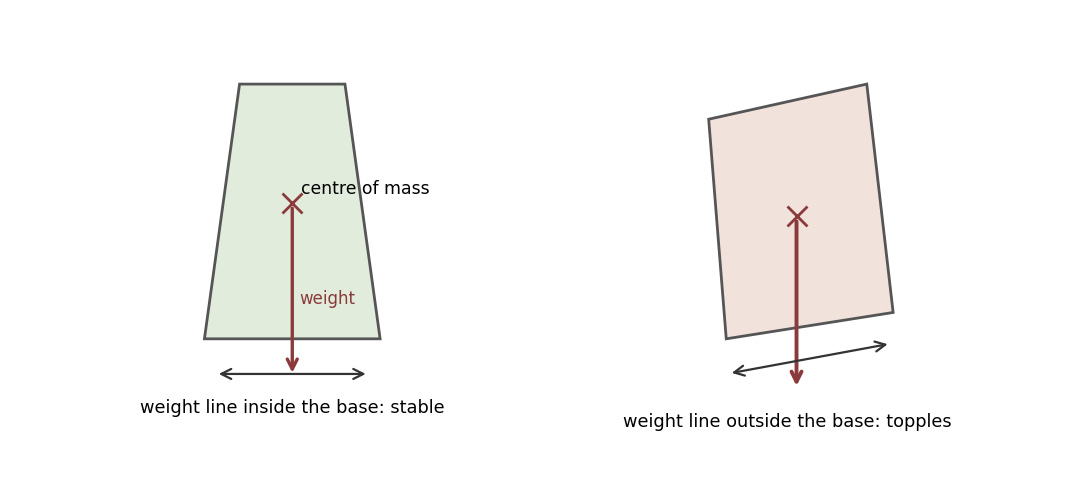
    A stable block has its weight line inside the base; a tilted block with the line outside topples.

    Check yourself

    1. Give one example each of a contact and a non-contact force.
    2. Which of these are vectors: speed, displacement, time, force?
    3. State the spring equation and the name of its constant.
    4. State Newton's three laws in one sentence each.
    5. A 900 kg car accelerates at 2 m/s². Calculate the resultant force.
    6. Name two factors that lengthen thinking distance and two that lengthen braking distance.
    7. (P) Explain how a crumple zone protects passengers, using F = Δp/t.
    8. (P) Why does a parachutist reach a lower terminal velocity after opening the parachute?
    9. (P) Where is the centre of mass of a symmetrical object?
    10. (P) A 250 N force acts 0.4 m from a pivot. Calculate its moment.

    Answers: 1 contact — friction/tension/air resistance/normal; non-contact — gravity/electrostatic/magnetic; 2 displacement and force; 3 $F = ke$, the spring constant (N/m); 4 first — no resultant force means no change in velocity; second — $F = ma$ in the resultant's direction; third — interactions give equal and opposite forces; 5 $F = 900 \times 2 = 1800$ N; 6 thinking — tiredness, distractions, drugs/alcohol (any two); braking — wet or icy roads, worn brakes or tyres (any two); 7 (P) the crumple zone lengthens the collision time; for the same momentum change, $F = \Delta p/t$ is smaller, so less force reaches the passengers; 8 (P) the parachute greatly increases drag, so drag balances weight at a much lower speed; 9 (P) on its axis of symmetry; 10 (P) $M = 250 \times 0.4 = 100$ N m.
    Kosa kata
    English Bahasa Indonesia
    friction/ˈfrɪkʃn/ gesekan
    scalar/ˈskeɪlə/ skalar
    vector/ˈvektə/ vektor
    momentum/məʊˈmentəm/ momentum
    terminal velocity/ˈtɜːmɪnl vəˈlɒsɪti/ kecepatan terminal
    centre of mass/ˈsentə ɒv mæs/ pusat massa
    moment/ˈməʊmənt/ torsi
  • 2

    3.2 · Energy

    Program pembelajaran segera hadir

    Lembar Kerja

    English

    Energy: the accountant of physics

    Nothing destroys energy — it is only moved between stores and partly dissipated into less useful forms. OxfordAQA's second topic builds the accounting: work and power, the three energy-store equations, conservation with Sankey diagrams, and the choices behind national energy resources.

    OxfordAQA International GCSE Physics 9203, topic 3.2 (Version 5.1). Statements marked (P) are Paper-2-only.

    Forces and energy

    $$W = F \times d \qquad E_e = \tfrac{1}{2}ke^2 \qquad E_p = mgh \qquad E_k = \tfrac{1}{2}mv^2 \qquad P = \frac{E}{t}$$

    Work 功 is done when a force moves its point of application through a distance; work against friction transfers energy by heating (shuttle re-entry, meteorites, brakes). A stretched spring stores elastic potential energy $\frac{1}{2}ke^2$; a raised mass stores gravitational potential energy mgh; a moving mass carries kinetic energy ½mv² — doubling mass doubles it, doubling speed quadruples it (the road-safety link). Power 功率 is the rate of energy transfer.

    Worked check. A 1500 kg car at 20 m/s brakes to rest: KE removed $= \frac{1}{2} \times 1500 \times 400 = 300\,000$ J — all transferred to heating the brakes. Lifting it 2 m at g = 10 N/kg stores $1500 \times 10 \times 2 = 30\,000$ J.

    Energy transfers and dissipation

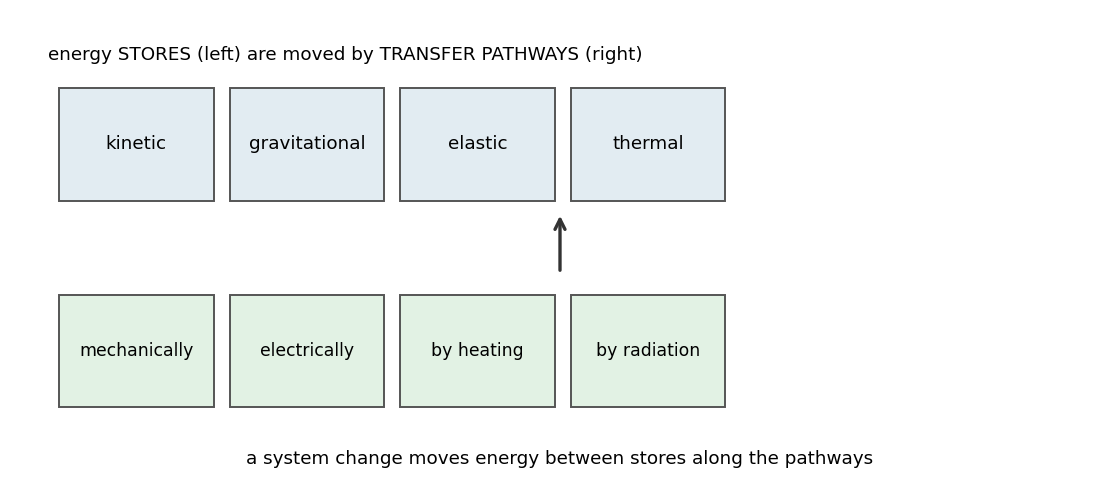
    Energy stores on top, transfer pathways below; a system change moves energy between stores.

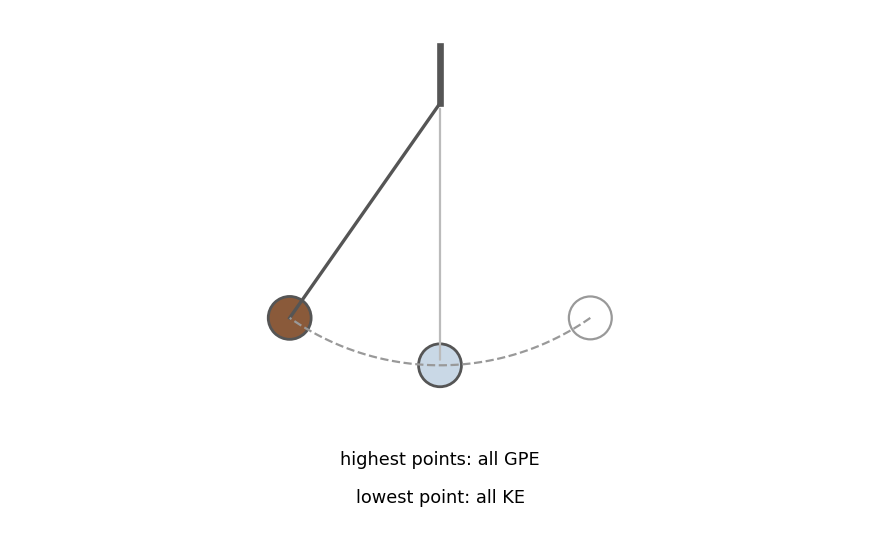
    When a system changes, energy is transferred — usefully, stored, or dissipated 耗散 ("wasted") into less useful stores; it is never created or destroyed. Friction and air resistance dissipate energy by heating. (P) A pendulum swaps kinetic and gravitational potential energy each swing.

    A pendulum: all GPE at the top of each swing, all KE at the bottom.
    $$\text{efficiency} = \frac{\text{useful energy out}}{\text{total energy in}} \times 100\% \ (=\frac{\text{useful power out}}{\text{total power in}})$$

    Sankey diagrams show the redistribution: arrows split in proportion to the energy flows (draw them to scale — width ∝ energy).

    Worked check. A 60 W lamp gives 6 W of light: efficiency 效率 $= 6/60 \times 100 = 10\%$.

    Energy resources

    Fuels are chosen for ease of storage, energy content and safety; some transfer more of their energy usefully than others. National generation trades renewability against cost, reliability and the environmental cost of extraction, use and disposal.

    Four renewable technologies with one advantage and one drawback each.

    Check yourself

    1. Calculate the work done by a 50 N force moving 4 m.
    2. Calculate the elastic energy in a spring (k = 200 N/m) stretched 0.15 m.
    3. A 2 kg book is lifted 3 m at g = 10 N/kg. Calculate the GPE gained.
    4. What happens to the kinetic energy of a car when it brakes?
    5. A motor transfers 800 J in 20 s. Calculate its power.
    6. State the efficiency equation in energy and power forms.
    7. A lamp gives out 12 J of light for every 100 J in. Calculate the efficiency.
    8. What does a Sankey diagram's arrow width show?
    9. Give one advantage and one drawback of wind power.
    10. What does "dissipated" mean?

    Answers: 1 $W = 50 \times 4 = 200$ J; 2 $E_e = \frac{1}{2} \times 200 \times 0.0225 = 2.25$ J; 3 $E_p = 2 \times 10 \times 3 = 60$ J; 4 it is transferred to thermal energy of the brakes and surroundings by the friction force (the brakes heat up); 5 $P = 800/20 = 40$ W; 6 useful energy out ÷ total energy in (×100 %); equally useful power out ÷ total power in; 7 $12/100 \times 100 = 12\%$; 8 the energy flowing in that direction — width is proportional to energy; 9 renewable with no fuel or emissions; unreliable output with visual impact; 10 transferred to less useful stores (often waste heat), so it cannot readily do what we want.

    Kosa kata
    English Bahasa Indonesia
    work/wɜːk/ usaha
    power/ˈpaʊə/ daya
    dissipation/ˌdɪsɪˈpeɪʃn/ dissipasi
    efficiency/ɪˈfɪʃənsi/ efisiensi
  • 3

    3.3 · Waves

    Program pembelajaran segera hadir

    Lembar Kerja

    English

    Waves: carrying energy and information

    Waves move energy from a source to a receiver without moving matter — light to an eye, sound to an ear, radio to a phone. This topic builds the wave model (frequency, wavelength, speed), then applies it across the electromagnetic spectrum, to sound and (P) ultrasound, reflection, refraction with total internal reflection, and (P) lenses and the eye.

    OxfordAQA International GCSE Physics 9203, topic 3.3 (Version 5.1). Statements marked (P) are Paper-2-only.

    General properties of waves

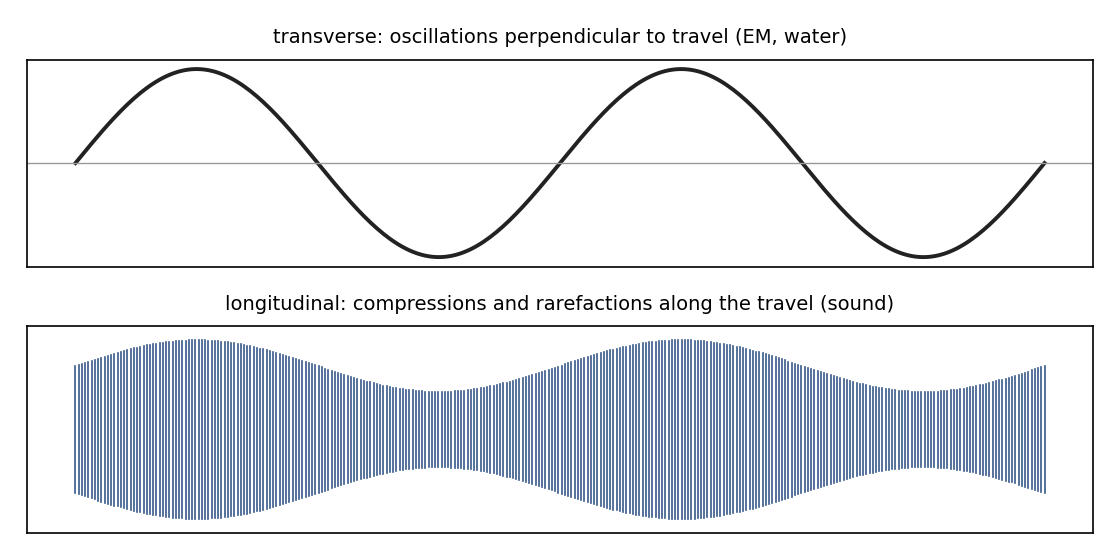
    Transverse waves oscillate across their travel; longitudinal waves compress along it.

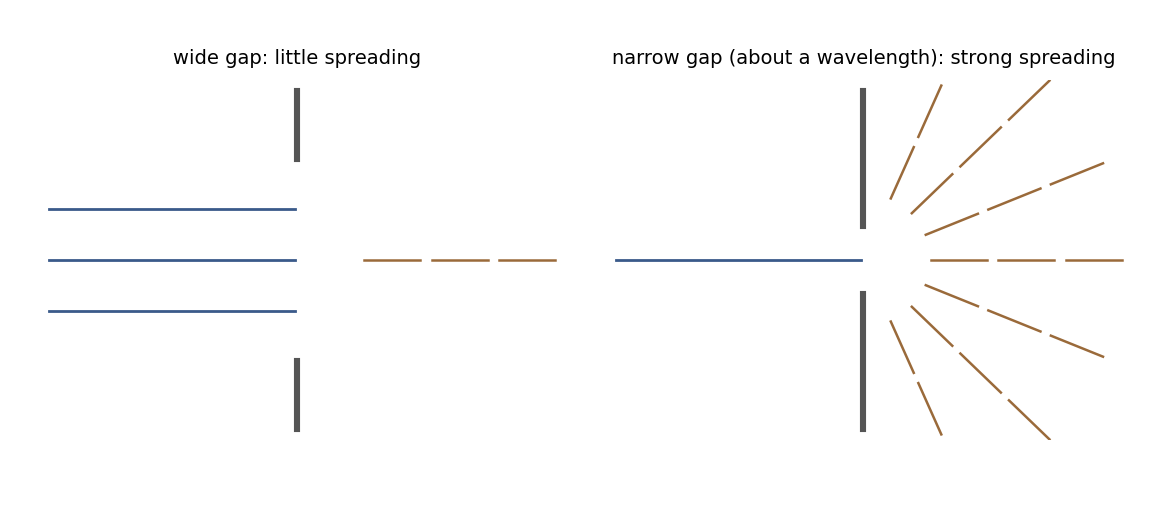
    Transverse 横波: oscillations perpendicular to travel — electromagnetic and water waves. Longitudinal 纵波: oscillations parallel, as compressions and rarefactions — sound; mechanical waves may be either. At a boundary, waves are reflected, transmitted or absorbed; refraction 折射 comes from a change of velocity between media, and diffraction 衍射 spreads waves through a gap — strongly when the gap is comparable to the wavelength.

    A wide gap gives little spreading; a gap near the wavelength spreads strongly.

    Amplitude, wavelength, frequency, period and wavefront define any wave, and:

    $$v = f \times \lambda$$

    Worked check. A water wave of frequency 2 Hz and wavelength 1.5 m travels at $2 \times 1.5 = 3$ m/s.

    The electromagnetic spectrum

    One continuous family, all transverse, all at the same speed in vacuum, ordered from radio (10⁴ m and beyond) down to gamma (10⁻¹⁵ m). Visible light is the narrow band our eyes detect — different wavelengths are different colours. Every object emits and absorbs infrared; (P) hotter objects radiate more and at higher frequencies (black-body radiation), dark matt surfaces absorb and emit best, light shiny ones reflect.

    Uses: radio — TV and radio including Bluetooth; microwaves — phones, satellite TV; infrared — remotes, night vision, heating; visible — photography, fibre optics; UV — security marking; X-rays — medical imaging; gamma — sterilising instruments and food. Hazards: microwaves heat tissue; infrared burns; UV causes skin cancer and blindness; X-rays kill cells in high doses; gamma causes mutations — limit exposure time and distance, and shield.

    X-rays: very short wavelength, high energy, ionising; they affect photographic film, are absorbed by metal and bone, and are transmitted by soft tissue — the basis of CT, fracture and dental imaging, and of cancer treatment (with careful monitoring of workers' doses).

    Sound and ultrasound

    Sound is longitudinal, vibrating a medium, heard between 20 Hz and 20 000 Hz; pitch follows frequency, loudness follows amplitude. Sound reflects (echoes) and diffracts. (P) Ultrasound 超声波 lies above 20 kHz: at a boundary between media it partially reflects, and the echo time locates the boundary:

    $$s = v \times t$$

    Worked check. An ultrasound pulse returns from a fetus boundary after $6.0 \times 10^{-5}$ s (speed 1500 m/s in tissue): boundary depth $= 1500 \times 6.0\times10^{-5}/2 = 4.5$ cm — divide by two for the round trip. Uses: prenatal scanning, breaking kidney stones.

    Reflection and refraction

    Law of reflection: angle of incidence = angle of reflection, measured from the normal. A plane mirror gives a virtual, upright, laterally inverted image; construct ray diagrams with the normal drawn in. (P) Light entering a denser medium slows and bends towards the normal; into a less dense one, away; a prism disperses white light into a spectrum. Refractive index compares speeds:

    $$n = \frac{\text{speed of light in vacuum}}{\text{speed in the medium}} = \frac{\sin i}{\sin r} \qquad \sin c = \frac{1}{n}$$

    Beyond the critical angle in the denser medium, light is totally internally reflected — how optical fibres carry visible light and infrared for medicine (endoscopes) and communications. Required practical: refraction of light by different substances.

    Lenses and the eye (P)

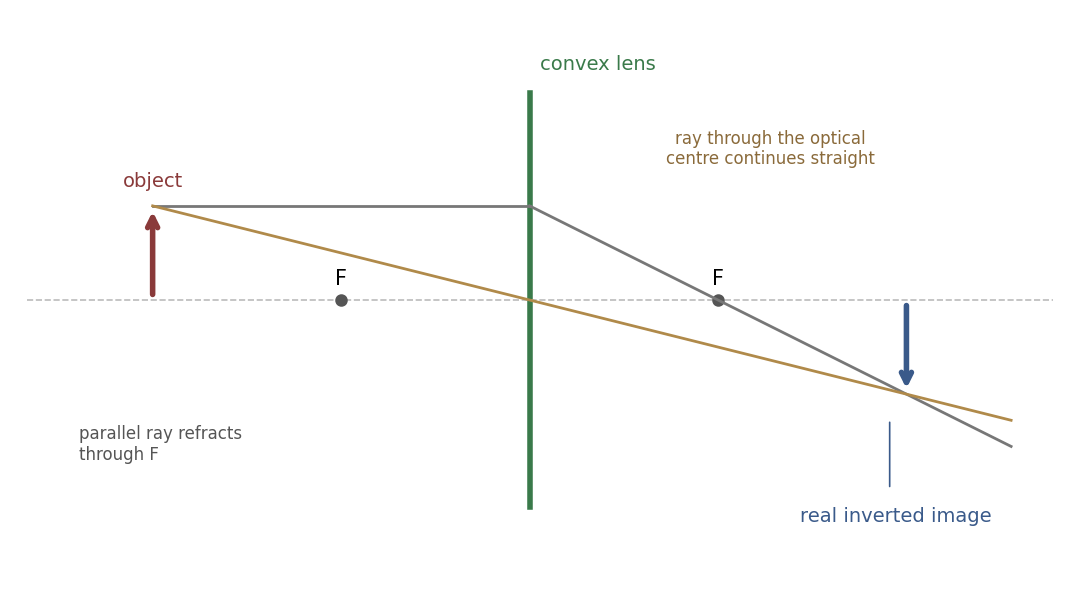
    A convex (converging) lens brings parallel rays to the principal focus (focal length from the lens); a concave (diverging) lens spreads them as if from the focus. Images are described as larger/smaller, upright/inverted, real/virtual — ray diagrams on graph paper show them, and magnification = image height ÷ object height. A converging lens held close acts as a magnifying glass (virtual, upright, enlarged).

    A convex lens forms a real, inverted image of an object beyond the focus.

    The eye: retina (detector), cornea (main refraction), variable-focus lens, pupil/iris (aperture), ciliary muscle and suspensory ligaments (change lens shape). Near point ≈ 25 cm; far point at infinity. Long sight (eyeball too short) is corrected with a convex lens; short sight (too long) with a concave lens; lasers can reshape the cornea in surgery. Against a camera: the eye focuses by changing lens shape, the camera by changing the lens–film distance; the retina plays the CCD's role.

    Check yourself

    1. Give the oscillation directions of transverse and longitudinal waves, with one example of each.
    2. State v = fλ and calculate the speed of a 500 Hz wave of wavelength 0.68 m.
    3. When is diffraction strongest through a gap?
    4. Order the EM spectrum by increasing frequency.
    5. Which surfaces best absorb infrared?
    6. State the frequency range of human hearing.
    7. (P) An ultrasound echo returns in 0.0001 s from 15 cm deep. What is the speed?
    8. State the law of reflection and the nature of a plane-mirror image.
    9. (P) Glass has n = 1.5. Calculate the critical angle.
    10. (P) Which lens corrects short sight, and why?

    Answers: 1 perpendicular — light; parallel, compressions — sound; 2 $v = 500 \times 0.68 = 340$ m/s; 3 gap ≈ one wavelength; 4 radio → microwave → IR → visible → UV → X-ray → gamma; 5 dark, matt; 6 20 Hz–20 kHz; 7 (P) $v = 0.3/10^{-4} = 3000$ m/s (round trip).

    Answers continued: 8 i = r; virtual, upright, laterally inverted; 9 (P) $\sin c = 1/1.5$, $c \approx 41.8°$; 10 (P) a concave lens — it spreads light so the too-long eye focuses it on the retina.

    Kosa kata
    English Bahasa Indonesia
    transverse wave/trænsˈvɜːs weɪv/ gelombang transversal
    longitudinal wave/ˌlɒŋɡɪˈtjuːdɪnl weɪv/ gelombang longitudinal
    refraction/rɪˈfrækʃn/ pembiasan
    diffraction/dɪˈfrækʃn/ difraksi
    ultrasound/ˌʊltrəˈsaʊnd/ ultrasonik
  • 4

    3.4 · Particle model of matter

    Program pembelajaran segera hadir

    Lembar Kerja

    Model partikel materi

    Segala sesuatu terdiri dari partikel. Energi, jarak antarpartikel, dan geraknya menjelaskan wujud zat, pemanasan dan pendinginan, serta mengapa jembatan memerlukan celah. Topik keempat OxfordAQA membangun model ini dan menguantifikasinya: kapasitas kalor spesifik, (P) kalor laten, penguapan, desain perpindahan energi, dan pemuaian termal.

    OxfordAQA International GCSE Fisika 9203, topik 3.4 (Versi 5.1). Pernyataan yang ditandai (P) hanya untuk Kertas-2-saja.

    Teori kinetik

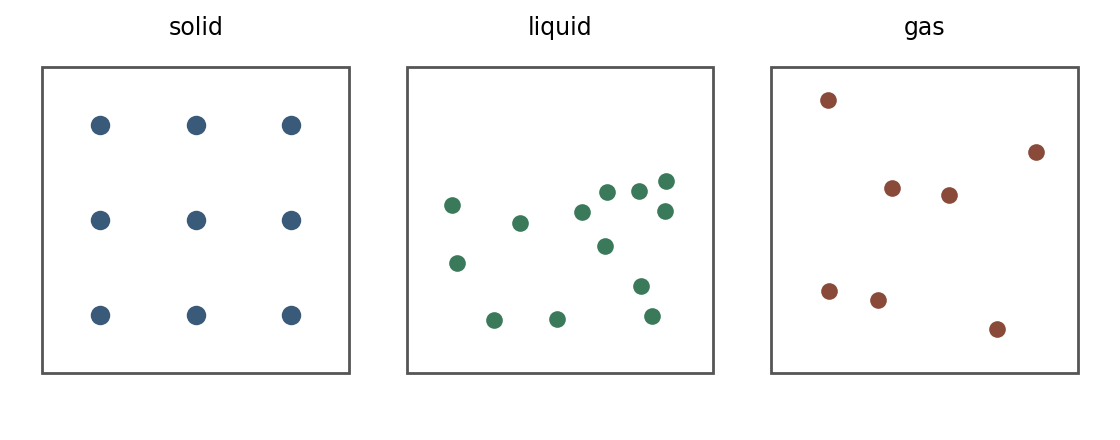
    Padat: partikel tetap, saling bersentuhan; cair: bersentuhan namun tidak teratur; gas: berjauhan dan bergerak cepat.

    Kapasitas kalor spesifik c adalah energi untuk menaikkan 1 kg suatu zat sebesar 1 °C:

    $$E = m \times c \times \Delta\theta$$

    Contoh terpecahkan. Memanaskan 1.5 kg air ($c = 4200$) sebesar 40 °C: $E = 1.5 \times 4200 \times 40 = 252\,000$ J.

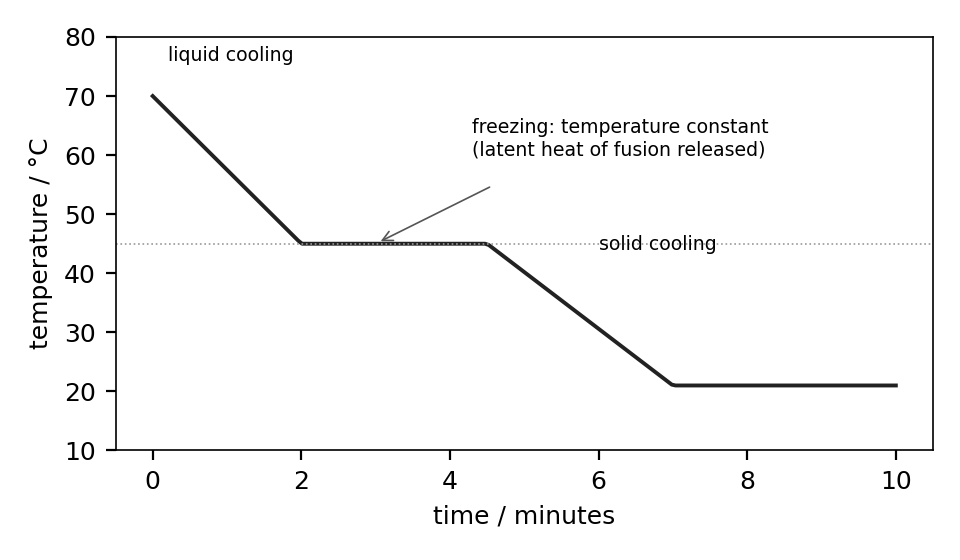
    (P) Mengubah wujud membutuhkan energi dengan tidak ada perubahan suhu: kalor laten penguapan $E = m \times L_V$ (cair → uap) dan kalor laten lebur $E = m \times L_F$ (padat → cair). Impurities mengubah titik lebur dan titik didih. Praktikum wajib (P): kurva pendinginan asam stearat.

    Kurva pendinginan: dataran saat pembekuan melepaskan kalor laten pada suhu konstan.

    Perpindahan energi dan gerak partikel

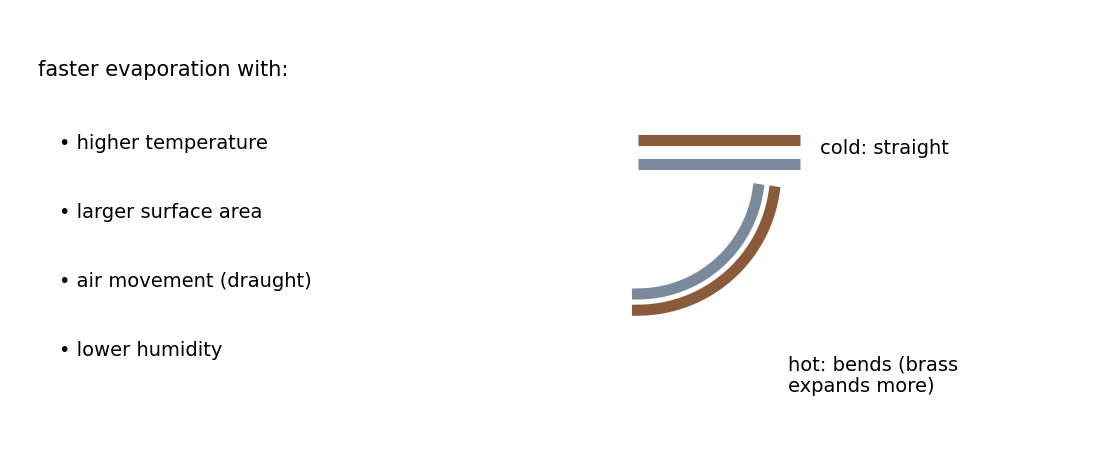
    Konduksi merambatkan energi sepanjang padat melalui getaran partikel, dibantu oleh elektron bebas dalam logam; isolator tidak memiliki keduanya. Konveksi mengedarkan fluida: partikel mendapatkan energi, menjauh satu sama lain, fluida menjadi kurang padat dan naik, fluida dingin tenggelam. Penguapan mengubah molekul permukaan berkecepatan tinggi menjadi uap, mendinginkan yang tersisa — lebih cepat dengan suhu lebih tinggi, luas permukaan lebih besar, angin sepoi-sepoi, dan kelembapan lebih rendah; kondensasi membalikkannya.

    Faktor penguapan dan strip bimetalik yang bengkok saat dipanaskan.

    Laju perpindahan energi oleh pemanasan meningkat seiring luas permukaan dan volume, material, permukaan yang bersentuhan, dan perbedaan suhu. Desain mengikuti: sirip pendingin memaksimalkan area; ukuran telinga relatif hewan sesuai dengan iklim. Sebagian besar zat memuai saat dipanaskan — bahaya untuk atap dan jembatan (celah dan rol), berguna dalam termostat strip bimetalik yang bengkok karena satu logam memuai lebih banyak dan memutus rangkaian listrik.

    Periksa diri Anda

    1. Jelaskan susunan partikel dalam cairan.
    2. Definisikan kapasitas kalor spesifik.
    3. Hitung energi untuk memanaskan 2 kg aluminium (c = 900) sebesar 30 °C.
    4. (P) Mengapa suhu tetap konstan saat suatu zat membeku?
    5. (P) 0.5 kg suatu zat memiliki L_F = 330 000 J/kg. Hitung energi untuk mencairkannya.
    6. Jelaskan konduksi dalam logam, sebutkan pembawa tambahan.
    7. Jelaskan mengapa air hangat naik.
    8. Sebutkan tiga faktor yang mempercepat penguapan.
    9. Sebutkan satu bahaya dan satu kegunaan pemuaian termal.
    10. Mengapa sirip pendingin memiliki luas permukaan yang besar?

    Jawaban: 1 partikel saling bersentuhan tetapi tersusun secara acak, bergerak melewati satu sama lain; 2 energi yang diperlukan untuk mengubah suhu 1 kg zat sebesar 1 °C; 3 $E = 2 \times 900 \times 30 = 54\,000$ J; 4 (P) energi yang dilepaskan saat ikatan terbentuk (kalor lebur) keluar pada laju yang sama dengan laju pelepasan panas, sehingga energi kinetik partikel tidak berubah; 5 (P) $E = 0.5 \times 330\,000 = 165\,000$ J; 6 partikel bergetar meneruskan energi ke tetangga, dan elektron bebas membawa energi dengan cepat melalui logam; 7 partikel yang lebih hangat bergerak menjauh, membuat air tersebut kurang padat daripada lingkungan sekitarnya, sehingga ia naik; 8 suhu lebih tinggi, luas permukaan lebih besar, aliran udara di atas permukaan (juga kelembaban lebih rendah); 9 bahaya — pemuaian jembatan/atap memerlukan celah; kegunaan — pelengkungan strip bimetalik dalam termostat; 10 area yang lebih besar mentransfer energi ke lingkungan lebih cepat melalui pemanasan.

    Kosa kata
    English Bahasa Indonesia
    specific heat capacity/spəˈsɪfɪk hiːt kəˈpæsɪti/ kapasitas kalor jenis
    latent heat of vaporisation/ˈleɪtənt hiːt ɒv ˌveɪpəraɪˈzeɪʃn/ kalor laten penguapan
    latent heat of fusion kalorlatent peleburan
    conduction/kənˈdʌkʃn/ konduksi
    convection/kənˈvekʃn/ konveksi
    evaporation/ɪˌvæpəˈreɪʃn/ penguapan
  • 5

    3.5 · Electricity and magnetism

    Program pembelajaran segera hadir

    Lembar Kerja

    Listrik dan kemagnetan

    Listrik adalah muatan yang bergerak, dipandu oleh beda potensial, dihambat oleh setiap komponen—dan setiap arus menghasilkan medan magnet. Topik terbesar OxfordAQA membangun alat ukur rangkaian, perilaku komponen, dan elektromagnet yang mengikutinya.

    OxfordAQA International GCSE Physics 9203, topik 3.5 (Versi 5.1). Pernyataan yang ditandai (P) hanya untuk Kertas-2.

    Rangkaian listrik

    Logam menghantarkan karena memiliki elektron bebas; (P) ketidakseimbangan muatan terisolasi adalah listrik statis, terdischarge ketika jalur konduksi muncul (petir). Arus adalah laju aliran muatan:

    $$I = \frac{Q}{t} \qquad V = \frac{E}{Q} \qquad V = I \times R$$

    Tegangan mendorong muatan mengelilingi rangkaian; beda potensial di sepanjang komponen mengukur energi yang ditransfer per satuan muatan (volt = joule per coulomb). Hafalkan simbol standar—sakelar, lampu, sekering, sel, baterai, dioda, resistor, resistor variabel, termistor, LDR, LED, ammeter, dan voltmeter.

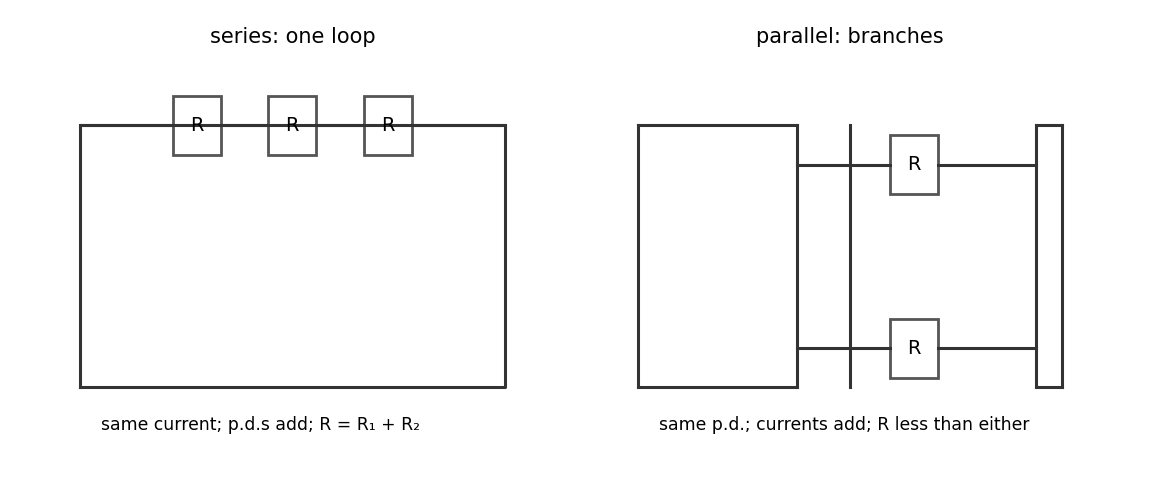
    Seri: satu loop, arus sama, hambatan dijumlahkan. Paralel: cabang berbagi b.p., arus dijumlahkan.

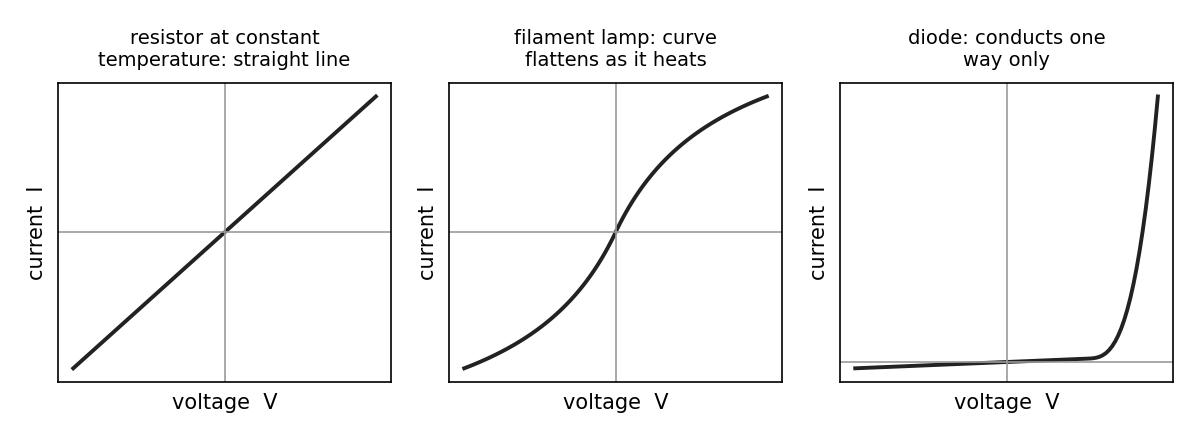
    Pada suhu tetap grafik V–I sebuah resistor adalah garis lurus (ohmik); lampu filamen melengkung karena ion-ionnya bergetar lebih kuat seiring kenaikan suhu; dioda menghantarkan maju saja; (P) termistor menghambatnya menurun saat suhu naik (termostat); LDR menghambatnya menurun saat cahaya naik (pencahayaan otomatis); LED memancarkan cahaya maju dan menghemat energi dibanding lampu filamen dan CFL.

    Tiga karakteristik V-I yang dibutuhkan.

    Seri: arus sama, b.p. dibagi, hambatan dijumlahkan. Paralel: b.p. sama, arus terbagi, hambatan gabungan lebih kecil dari masing-masing. Muatan yang menabrak kisi-kisi memanaskan setiap resistor.

    Contoh terarah. Lampu 230 V menarik 0.25 A: $R = 230/0.25 = 920\ \Omega$. Dua 4 Ω resistor seri di seberang 12 V mengalirkan $I = 12/8 = 1.5$ A; paralel, $R = 2\ \Omega$ dan sumber memberi $I = 12/2 = 6$ A.

    Kemagnetan dan elektromagnetisme

    Kutub: serupa tolak, berbeda tarik—gaya non-sentuhan. Garis medan berjalan dari U ke S di luar magnet; kutub berlawanan menghadap memberikan medan seragam di antaranya. Magnet induksi menarik selama berada dalam medan dan kehilangan kemagnetannya saat dilepas; medan Bumi memungkinkan kompas plotting untuk bernavigasi.

    Kawat yang dialiri arus memiliki garis medan melingkar di sekelilingnya (arus lebih kuat → medan lebih kuat; arah arus dibalik → arah dibalik). Solenoid memusatkan medan; dengan inti besi lunak, ia menjadi elektromagnet—bisa dinyalakan/dimatikan, dapat disesuaikan, digunakan dalam derek tempat sampah, relay, dan kunci pintu. Praktikum yang dibutuhkan: faktor-faktor yang menentukan kekuatan elektromagnet.

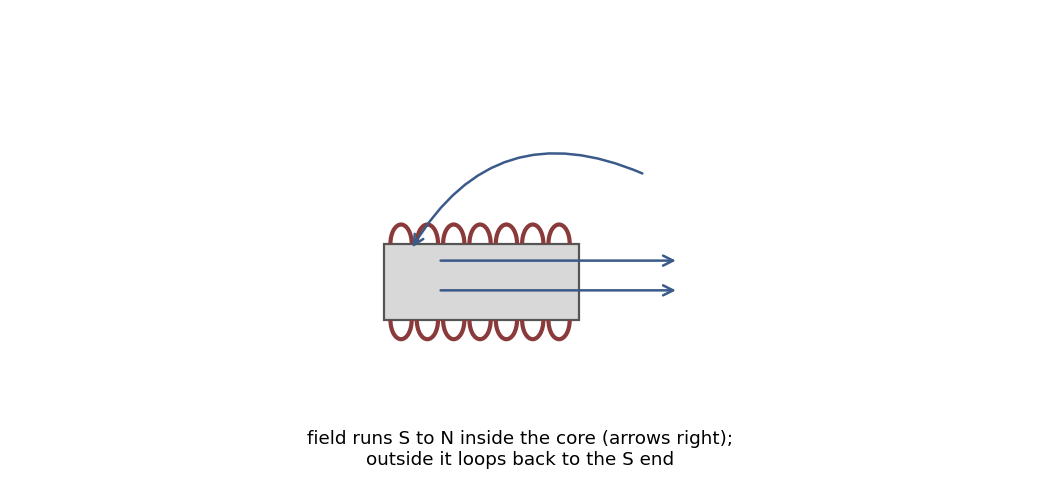
    Solenoid pada inti besi lunak: medan elektromagnet adalah seperti batang magnet, namun bisa dikendalikan.

    Periksa diri Anda

    1. Mengapa logam dapat menghantarkan listrik?
    2. Nyatakan hubungan antara arus, muatan, dan waktu beserta satuannya.
    3. Hitung muatan yang mengalir ketika 2 A melewati selama 30 s.
    4. Nyatakan bentuk kurva V-I untuk resistor pada suhu tetap dan untuk lampu filamen.
    5. (P) Apa yang terjadi pada hambatan termistor saat suhu meningkat?
    6. Nyatakan aturan arus dan beda potensial (p.d.) untuk rangkaian seri dan paralel.
    7. Hitung R untuk sumber tegangan 12 V yang mendorong arus 0.5 A.
    8. Nyatakan aturan kutub dan arah garis medan di luar magnet.
    9. Apa itu magnet induksi?
    10. Sebutkan dua cara untuk memperkuat elektromagnet.

    Jawaban: 1 karena mengandung elektron bebas yang bergerak saat p.d. diterapkan; 2 Q = It, muatan dalam coulomb = arus dalam ampere × waktu dalam detik; 3 Q = 2 × 30 = 60 C; 4 garis lurus melalui titik asal; kurva S melandai seiring kenaikan arus (dan suhu); 5 (P) turun — digunakan dalam termostat; 6 seri — arus sama di setiap bagian, p.d. bertambah; paralel — p.d. sama di setiap cabang, arus bertambah; 7 R = 12/0.5 = 24 Ω; 8 kutup sejenis tolak-menolak, berbeda tarik-menarik; dari N ke S di luar magnet; 9 bahan magnetik yang menjadi magnet hanya saat berada dalam medan — hanya menarik, kehilangan sebagian besar kemagnetan saat dilepas; 10 lebih banyak lilitan pada kumparan; arus lebih besar (juga inti besi lunak).

    Kosa kata
    English Bahasa Indonesia
    solenoid/ˈsəʊlənɔɪd/ solenoida
    electromagnet/ɪˌlektrəʊˈmæɡnɪt/ elektromagnet
  • 6

    3.6 · Generating and distributing electricity and household use

    Program pembelajaran segera hadir

    Lembar Kerja

    English

    Generating and distributing electricity

    Move a magnet, move a current — a p.d. appears. OxfordAQA's sixth topic runs the full chain from the generator effect through the national grid's transformers to the appliances and safety systems of the home. All statements in this topic are Paper-2 (P).

    OxfordAQA International GCSE Physics 9203, topic 3.6 (Version 5.1) — entirely (P) content.

    Generating electricity (P)

    The generator effect 发电机效应 induces a p.d. across a conductor that moves through a magnetic field, or sits in a changing field. Reverse the motion or the polarity and the induced p.d. reverses; the induced current's own field opposes the change. The p.d. grows with faster movement, stronger field, more turns and larger coil area.

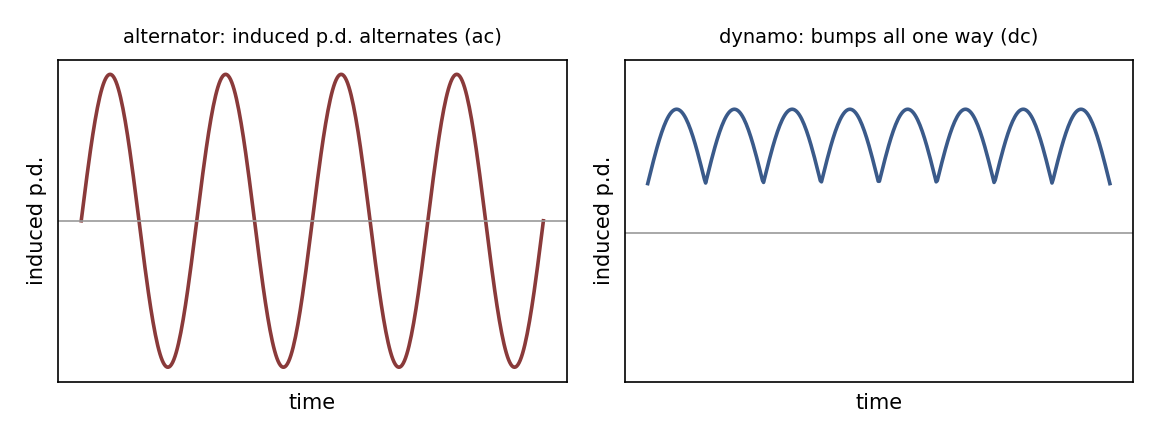
    An alternator spins a coil in a field to make a.c.; a dynamo gives d.c. — know the p.d.–time graphs. Power stations spin turbines to turn coils between magnets.

    An alternator's induced p.d. alternates; a dynamo's bumps point one way.

    Transmission, transformers and the home (P)

    From the station to the socket, every watt travels the same chain of coils and cables.

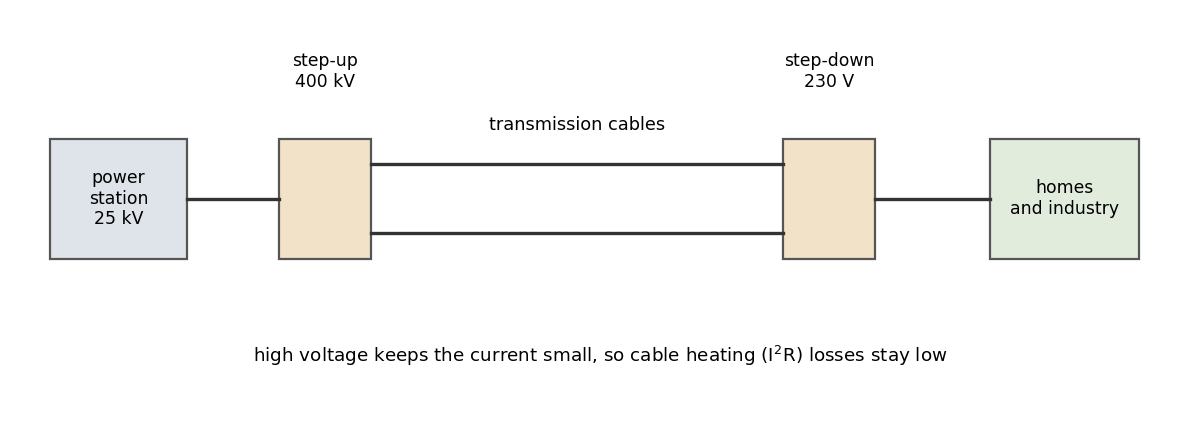
    Power station, step-up transformer, high-voltage cables, step-down transformer, consumers.

    For a given power, high transmission voltage means low current and so little cable heating. A transformer 变压器 is two coils on a soft-iron core: alternating current in the primary makes a changing field that induces a p.d. in the secondary.

    $$\frac{V_p}{V_s} = \frac{n_p}{n_s} \qquad V_p I_p = V_s I_s \ (100\%)$$

    Step-up before the lines, step-down after; switch-mode transformers (50–200 kHz) are small and light — phone chargers.

    Worked check. A transformer steps 25 kV up to 400 kV with 1000 primary turns: $n_s = 1000 \times 400/25 = 16\,000$ turns. At 100 MW the line current is $I = P/V = 10^8/(4 \times 10^5) = 250$ A.

    Cells give d.c.; mains is a.c. with fixed frequency and voltage — read period and frequency from oscilloscope-style traces. Safety: earthing 接地 drains fault current from metal casings; a fuse 保险丝 melts or a circuit breaker trips on excess current — the breaker is faster and resettable; double-insulated appliances need no earth.

    The motor effect (P)

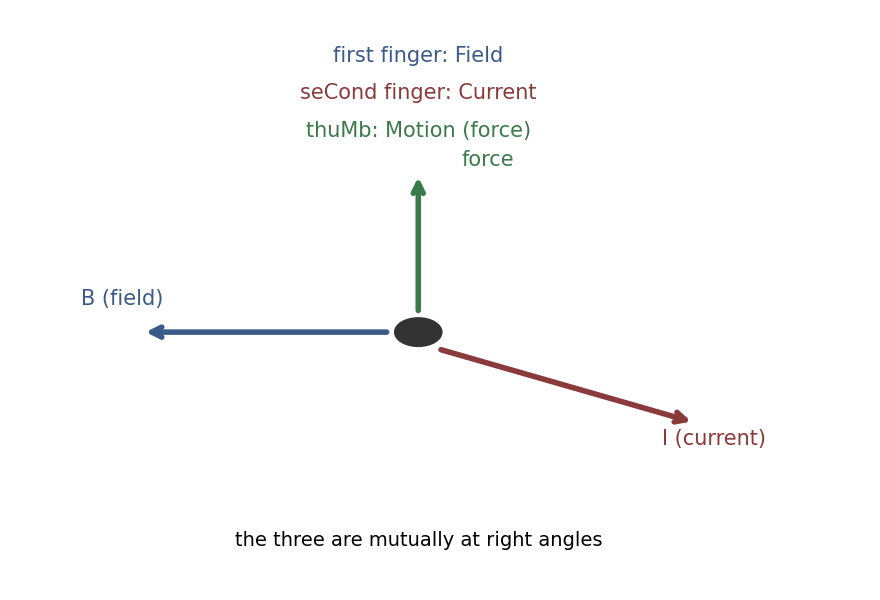
    A current-carrying wire across a magnetic field feels a force (zero if parallel to it). Force grows with stronger field, bigger current and more wire in the field; reverse either to reverse the force — Fleming's left-hand rule 左手定则 predicts the direction.

    Fleming's left-hand rule: field, current and force mutually at right angles.

    A current-carrying coil in a field rotates — the electric motor.

    Transferring electrical energy (P)

    $$P = \frac{E}{t} \qquad P = I \times V \qquad E = V \times Q \qquad E\,(\mathrm{kWh}) = P\,(\mathrm{kW}) \times t\,(\mathrm{h})$$

    Appliance labels give power; compute the current to choose a fuse, and the energy in kilowatt-hours for billing (E = Pt; cost = kWh × price per unit, read from meter readings).

    Worked check. A 2.0 kW heater for 3 h uses 6.0 kWh; at 0.9 per kWh that costs 5.4. A 230 V, 1.1 kW kettle draws I = 1100/230 ≈ 4.8 A — fit a 5 A or 13 A fuse (next rating above).

    Check yourself

    1. State two ways to induce a p.d. in a conductor.
    2. Give three factors that increase the size of an induced p.d.
    3. Sketch the p.d.–time graphs of an alternator and a dynamo.
    4. Why does the grid transmit at high voltage?
    5. A transformer has 200 primary and 3000 secondary turns on 12 V a.c. Calculate the secondary p.d.
    6. State the turns-ratio and power equations for a 100 % efficient transformer.
    7. Explain how earthing and a fuse protect a user together.
    8. State Fleming's left-hand rule.
    9. Calculate the current of a 230 V, 2.3 kW heater, and a sensible fuse.
    10. Calculate the energy in kWh used by a 1.5 kW kettle in 20 minutes.

    Answers: 1 move the conductor through a field; place it in a changing magnetic field; 2 faster motion; stronger field; more turns (also larger coil area); 3 alternator — a sine wave about zero; dynamo — humps all above (or all below) the axis; 4 for the same power the current is smaller, so I²R heating losses in the cables are far lower; 5 $V_s = 12 \times 3000/200 = 180$ V; 6 $V_p/V_s = n_p/n_s$ and $V_p I_p = V_s I_s$; 7 the earth wire gives the fault current a path to earth, and the surge blows the fuse, disconnecting the live wire; 8 first finger Field, second finger Current, thumb Motion — mutually at right angles; 9 I = 2300/230 = 10 A — use a 13 A fuse; 10 t = 1/3 h, so E = 1.5 × 1/3 = 0.5 kWh.

    Kosa kata
    English Bahasa Indonesia
    generator effect efek generator
    transformer/trænsˈfɔːmə/ Transformator
    earthing pembumian
    fuse/fjuːz/ sekat pemutus arus
    left-hand rule/left hænd ruːl/ aturan tangan kiri
  • 7

    3.7 · Nuclear physics

    Program pembelajaran segera hadir

    Lembar Kerja

    English

    Nuclear physics

    The nucleus is a millionth of the atom yet holds nearly all its mass — and unstable nuclei pour out energy as radiation, fission fragments, or the fusion that lights the stars. OxfordAQA's seventh topic covers the nuclear model, the three radiations, half-life, contamination versus irradiation, reactors and (P) fusion.

    OxfordAQA International GCSE Physics 9203, topic 3.7 (Version 5.1). Statements marked (P) are Paper-2-only.

    Atomic structure

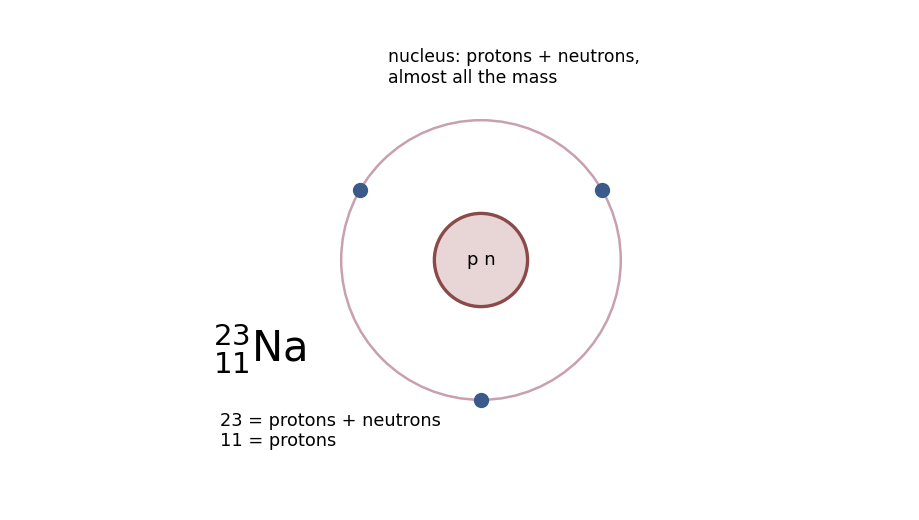
    An atom is about 10⁻¹⁰ m across: a tiny positive nucleus (protons and neutrons, nearly all the mass) with electrons around it — Rutherford's alpha-scattering evidence for the concentrated nucleus. Proton mass 1 charge +1; neutron mass 1 charge 0; electron charge −1, negligible mass. A neutral atom has equal protons and electrons; atoms lose or gain electrons to become ions.

    Nuclear notation: mass number and proton number.

    ${}^{A}_{Z}X$: A = mass number (protons + neutrons), Z = proton number; isotopes share Z and differ in neutrons.

    Ionising radiation from the nucleus

    Unstable nuclei decay randomly, unaffected by chemistry or physics, emitting:

    Radiation Nature Ionising Range in air
    alpha 2p + 2n (helium nucleus) strongest a few cm
    beta-minus fast electron (neutron → proton) medium tens of cm
    gamma electromagnetic wave weakest metres
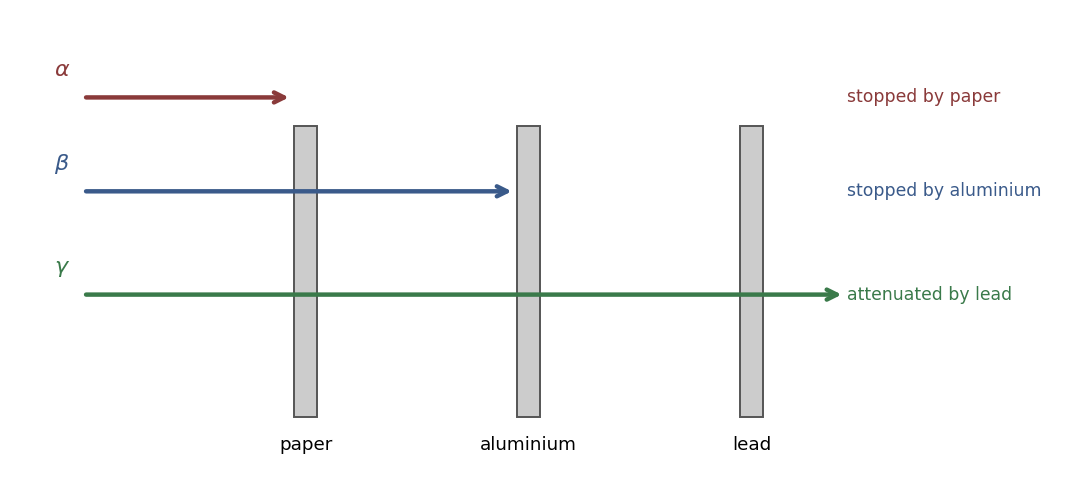
    Penetration: alpha stopped by paper, beta by aluminium, gamma attenuated by lead.

    Nuclear equations conserve mass number and charge: ${}^{238}_{92}U \rightarrow\, {}^{234}_{90}Th +\, {}^{4}_{2}He$ (alpha); ${}^{14}_{6}C \rightarrow\, {}^{14}_{7}N +\, {}^{0}_{-1}e$ (beta). Background radiation comes from rocks, space, food and medical devices. (P) The half-life 半衰期 is the time for half the nuclei (or half the count rate) to decay — most unstable nuclei have short half-lives; the least unstable last millennia. Contamination 沾污 (radioactive atoms on you) is a lasting hazard; irradiation 照射 exposes without making you radioactive. Dangers: mutations, cell and tissue damage.

    Nuclear fission and (P) fusion

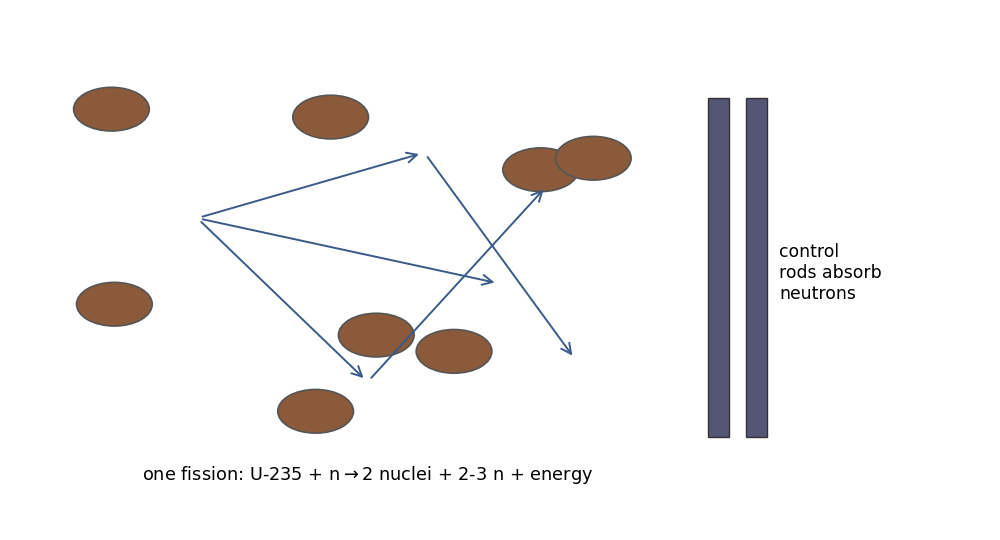
    Fission 裂变 splits a large unstable nucleus: U-235 or Pu-239 absorbs a neutron, splits into two smaller nuclei with 2–3 neutrons and far more energy than any chemical reaction. Neutrons striking further nuclei give a chain reaction; in a reactor control rods absorb neutrons to hold one fission per neutron.

    A chain reaction with control rods absorbing neutrons.

    Radioactive waste stays dangerous for times set by its half-life — a managed-disposal cost of nuclear power. (P) Fusion 聚变 joins two light nuclei into a heavier one, converting mass to energy: it powers the stars, but positive nuclei repel, so it needs extreme temperature and pressure.

    Check yourself

    1. Give the relative masses and charges of the proton, neutron and electron.
    2. In ${}^{19}_{9}F$, how many protons and neutrons?
    3. What did alpha scattering reveal about the atom?
    4. Name the three radiations and their natures.
    5. Which radiation is stopped by paper, and which penetrates aluminium?
    6. Balance the alpha decay of ${}^{226}_{88}Ra$.
    7. (P) Define half-life.
    8. (P) Explain the difference between contamination and irradiation.
    9. What do control rods do in a reactor?
    10. (P) Why does fusion need extreme temperatures?

    Answers: 1 proton 1/+1; neutron 1/0; electron negligible/−1; 2 9 protons, 10 neutrons; 3 mass and positive charge concentrate in a tiny nucleus — most alphas pass, a few bounce; 4 alpha — helium nucleus; beta — fast electron; gamma — EM wave; 5 alpha; gamma (needs thick lead); 6 ${}^{226}_{88}Ra \rightarrow\, {}^{222}_{86}Rn +\, {}^{4}_{2}He$; 7 (P) the time for half the nuclei (or the count rate) to halve; 8 (P) contamination — radioactive material on you, a hazard until removed; irradiation — exposure to radiation, ending when the source leaves; 9 absorb neutrons, holding the chain to one fission per neutron — steady; 10 (P) positive nuclei repel; they must collide at enormous speed to fuse.

    Kosa kata
    English Bahasa Indonesia
    half-life/hɑːf laɪf/ Waktu paruh
    contamination/kənˌtæmɪˈneɪʃn/ kontaminasi
    irradiation/ˌɪreɪdɪˈeɪʃn/ irradiasi
    fission/ˈfɪʃn/ fisi
    fusion/ˈfjuːʒn/ fusi
  • 8

    3.8 · Space physics

    Program pembelajaran segera hadir

    Lembar Kerja

    Fisika luar angkasa

    Gravitasi mengumpulkan debu menjadi bintang, bintang menyatukan elemen-elemen, dan pergeseran merah galaksi jauh mengindikasikan bahwa seluruh alam semesta sedang mengembang sejak awal 14 miliar tahun lalu. Topik terakhir OxfordAQA menutup kursus dengan siklus kehidupan bintang, orbit, dan bukti Teori Big Bang.

    OxfordAQA International GCSE Physics 9203, topik 3.8 (Versi 5.1). Pernyataan yang ditandai (P) hanya berlaku untuk Paper-2-saja.

    Siklus hidup bintang

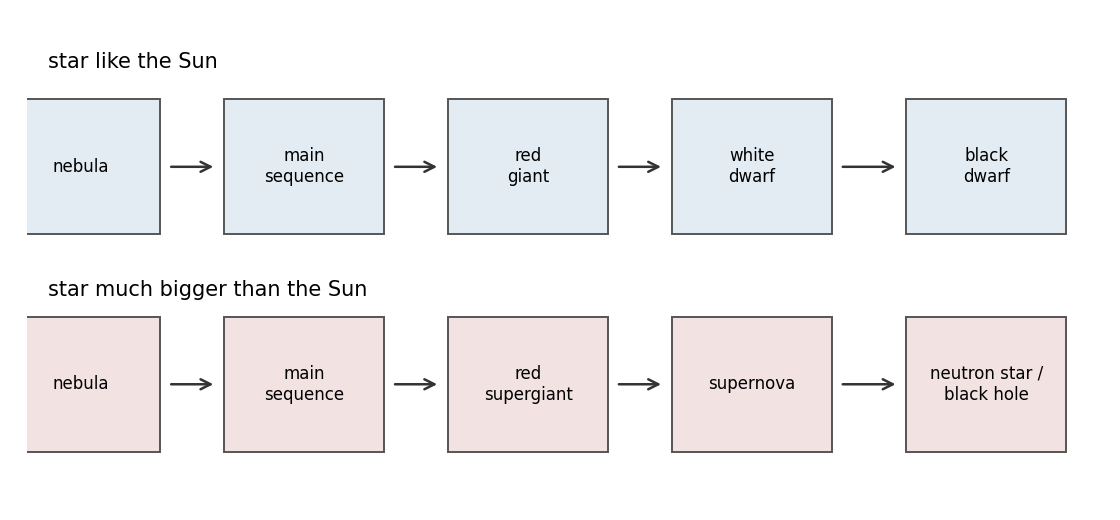
    Dua lintasan: Bintang mirip Matahari berakhir sebagai dwarf hitam; bintang masif berakhir dalam supernova serta bintang neutron atau lubang hitam.

    Bintang terbentuk ketika gravitasi menarik debu dan gas (terutama hidrogen dan helium) bersama-sama — gumpalan lebih kecil membentuk planet. Dalam fase urutan utama yang panjang, hidrogen menyatu menjadi helium di inti, dan gravitasi menyeimbangkan gaya dorong ke luar. Semakin masif sebuah bintang, semakin panas intinya dan semakin berat inti yang dapat dibangunnya melalui fusi.

    Ketika hidrogen habis, massa menentukan akhir hidupnya. Sebuah bintang mirip Matahari membengkak menjadi raksasa merah, melepaskan lapisan luarnya, dan inti yang terekspos mendingin dari dwarf putih menuju dwarf hitam. Sebuah bintang masif membengkak menjadi supergiant merah, menyatukan elemen yang semakin berat (karbon, nitrogen, oksigen), lalu meledak sebagai supernova — menyebarkan elemen-elemen tersebut (elemen yang lebih berat dari besi terbentuk sendiri dalam ledakan) — meninggalkan bintang neutron atau lubang hitam. Fusi di dalam bintang dan supernova menciptakan setiap elemen yang ada secara alami: alam semesta awal hanya berisi hidrogen.

    Sistem tata surya dan gerak orbit

    Sistem tata surya: delapan planet mengorbit Matahari, ditambah bulan, asteroid, planet kerdil, dan komet. Bima Sakti adalah salah satu dari jutaan miliar galaksi, masing-masing memiliki jutaan miliar bintang. Satelit buatan mengorbit Bumi dalam orbit geostasioner atau orbit polar rendah.

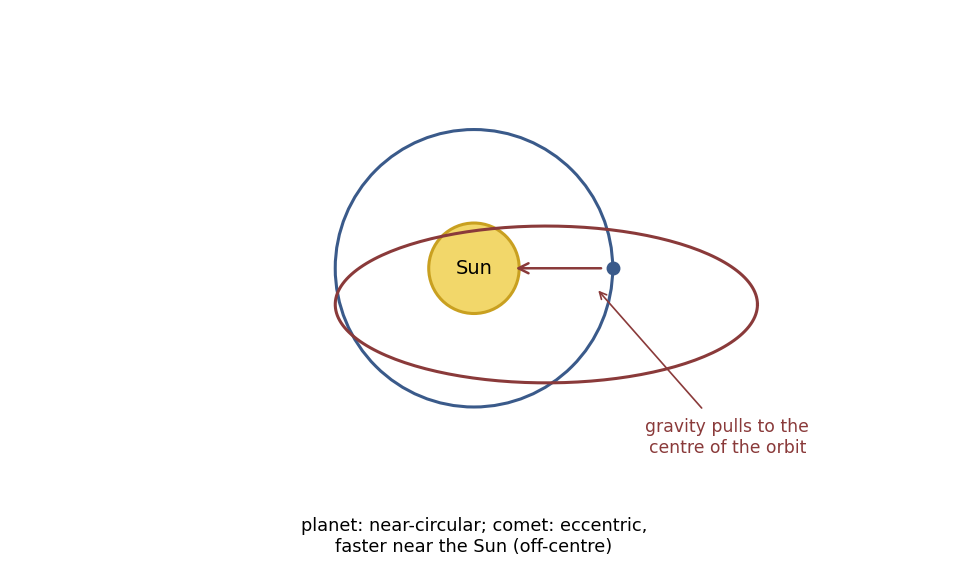
    Orbit planet yang hampir bulat dan orbit komet yang eksentrik, dengan gravitasi menyediakan tarikan sentripetal.

    Gravitasi menyediakan gaya sentripetal: ia bertindak ke arah pusat, mengubah arah pergerakan (kelajuan) tanpa mengubah kelajuan. Jarak yang lebih besar bermakna graviti yang lebih lemah, maka kelajuan orbit yang lebih rendah: untuk kekal pada jejari tertentu, satelit mesti bergerak pada kelajuan yang sepadan — ubah kelajuan dan jejari orbit akan berubah.

    Anjakan merah dan alam semesta yang mengembang (P)

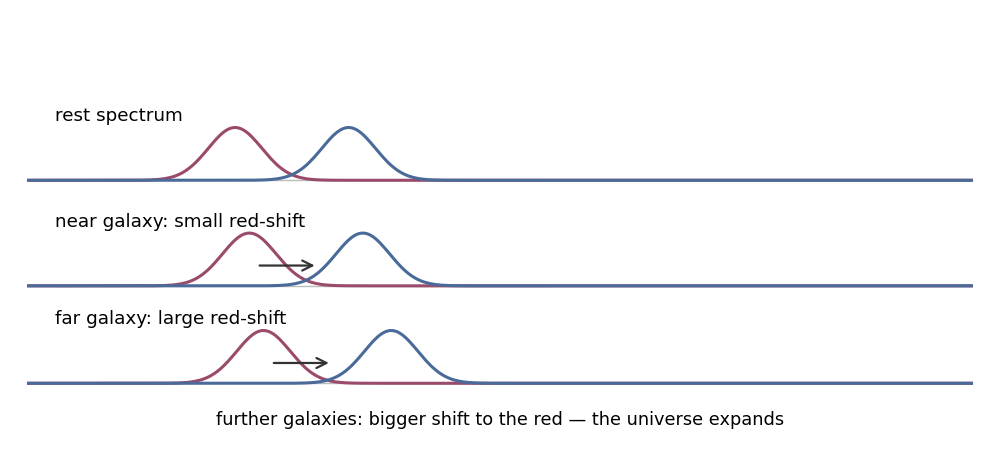
    Tiga spektrum: semakin jauh galaksi, semakin besar anjakan merahnya.

    Sumber gelombang yang bergerak mengubah panjang gelombang yang diperhatikan (kesan Doppler): sumber yang menjauh meregangkan gelombang — panjang gelombang lebih panjang, frekuensi lebih rendah. Semakin jauh sebuah galaksi, semakin laju ia menjauh dan semakin besar anjakan merah — ruang itu sendiri sedang mengembang, menunjuk kembali kepada permulaan yang sangat kecil: Letupan Besar. Latar belakang mikrogelombang kosmik — radiasi yang mengisi alam semesta dari sedikit selepas permulaan itu — adalah tiang kedua; teori Letupan Besar kini merupakan satu-satunya teori yang menjelaskannya.

    Periksa diri Anda

    1. Apa yang menarik habuk dan gas ke dalam bintang?
    2. Apa yang berlaku di teras bintang utama?
    3. Senaraikan tiga peringkat yang dilalui oleh bintang seperti Matahari selepas fasa utamanya.
    4. Bintang mana yang menjadi supernova?
    5. Di mana unsur yang lebih berat daripada besi dihasilkan?
    6. Namakan dua jenis orbit satelit buatan.
    7. Mengapa satelit dalam orbit yang lebih tinggi bergerak lebih perlahan?
    8. (P) Apa yang berlaku kepada panjang gelombang apabila sumbernya menjauh?
    9. (P) Nyatakan dua bukti Big Bang.
    10. (P) Apakah CMBR?

    Jawapan: 1 tarikan graviti; 2 nukleus hidrogen menyatu menjadi helium, membebaskan tenaga, dengan keseimbangan graviti; 3 raksasa merah, katai putih, katai hitam (tiga peringkat selepas fasa utama); 4 bintang yang jauh lebih masif daripada Matahari; 5 dalam letupan supernova; 6 geostasioner dan kutub rendah; 7 graviti melemah dengan jarak, maka gaya sentripetal — dan kelajuan yang dimintanya — adalah lebih kecil; 8 (P) ia bertambah (anjakan merah), dan frekuensi yang diperhatikan menurun; 9 (P) anjakan merah galaksi meningkat dengan jarak, dan latar belakang mikrogelombang kosmik; 10 (P) radiasi elektromagnetik yang mengisi alam semesta, baki dari sedikit selepas Letupan Besar.

    Kosa kata
    English Bahasa Indonesia
    red-shift/red ʃɪft/ pergeseran merah
    Big Bang/bɪɡ bæŋ/ Big Bang
    cosmic microwave background/ˈkɒzmɪk ˈmaɪkrəʊweɪv ˈbækɡraʊnd/ Radiasi latar belakang gelombang mikro kosmik

Masuk atau buat akun

IGCSE, A-Level & AP