Costing systems: choose your question
הוצג| English | משמעות |
|---|---|
| overhead | overhead |
| job costing | job costing |
| process costing | The other pole: continuous lines average costs over volume. |
What does one meal cost? Three answers
- The variable-coster says £3.10. The absorption-coster says £4.10. The catering manager prices batch J-77 at £3,182. All three are right — about different questions.
- A costing system is a choice of question. This lesson makes the choice visible.
Trace what you can, allocate what you must
- Direct costs attach by themselves: materials £1.20 a meal, direct labour £1.10. Overhead 制造费用 — variable £0.80 a meal plus the £4,200 fixed block — needs a driver.
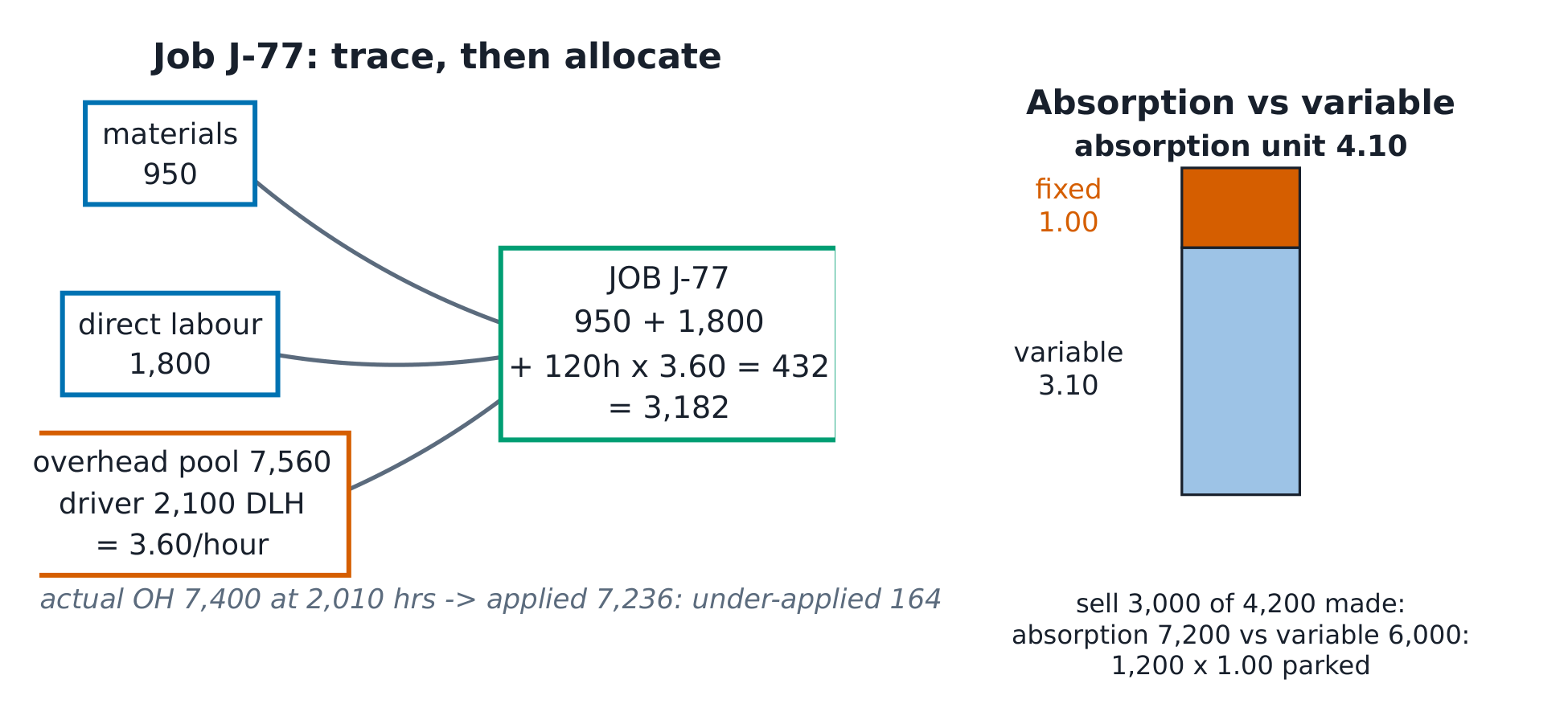
- Nimbus Kitchen's pool: $0.80 \times 4{,}200 + 4{,}200 = £7{,}560$ over 2,100 direct labour hours (0.5 h/meal at normal capacity) → £3.60 an hour ✓.
Overhead pool 7,560 over 2,100 budgeted direct labour hours. The rate per hour?
רמת קושי 2/5 · 140 מטבעות + בונוס קטן בהשלמה הראשונה היום
$7{,}560/2{,}100 = £3.60$ an hour - variable 0.80 a meal plus fixed 4,200, pooled at normal capacity 4,200 meals.
Job costing: batch J-77
- Job costing 分批法 attaches costs to a batch: materials £950 + labour £1,800 + overhead $120 \times 3.60 = £432$ → £3,182 ✓.
- If actual overhead is £7,400 at 2,010 hours, applied is £7,236 → under-applied £164 — the gap reconciles on the costing income statement, it never vanishes.
Which system, which question?
Route each costing situation to job costing, process costing, or the absorption-vs-variable contrast.
J-77: materials 950, labour 1,800, 120 hours of overhead at 3.60. The job total?
רמת קושי 2/5 · 140 מטבעות + בונוס קטן בהשלמה הראשונה היום
$950 + 1{,}800 + 432 = £3{,}182$ - the batch price question, answered by job costing.
Actual overhead 7,400; applied at 2,010 hours x 3.60. Over- or under-applied, and by how much?
רמת קושי 2/5 · 140 מטבעות + בונוס קטן בהשלמה הראשונה היום
Applied $= £7{,}236 < 7{,}400$: under-applied by £164 (the sign convention: negative = under). It reconciles on the costing statement.
Under-applied overhead can be ignored if it is small.
רמת קושי 1/5 · 100 מטבעות + בונוס קטן בהשלמה הראשונה היום
It reconciles on the costing income statement - small is a materiality judgement, never a licence to vanish.
Absorption vs variable income
- Absorption unit cost $= 3.10 + 4{,}200/4{,}200 = £4.10$ (fixed £1.00 a meal at normal capacity).
- Make 4,200, sell 3,000: absorption profit £7,200 vs variable £6,000 — the £1,200 gap is 1,200 unsold meals × £1.00 parked in inventory ✓. Production flatters absorption profit: know which arrow you read.
Absorption unit cost at normal capacity 4,200 meals (fixed 4,200, variable 3.10)?
רמת קושי 2/5 · 140 מטבעות + בונוס קטן בהשלמה הראשונה היום
$3.10 + 4{,}200/4{,}200 = £4.10$. At any other volume the fixed share changes - capacity is part of the unit cost's address.
Make 4,200, sell 3,000. The profit gap between absorption and variable costing?
רמת קושי 2/5 · 140 מטבעות + בונוס קטן בהשלמה הראשונה היום
Absorption 7,200 vs variable 6,000: the £1,200 gap is 1,200 unsold meals x £1.00 of fixed cost in inventory.
The driver is a pricing decision
- One labour-hour rate makes the hand-finished Alpha line carry the automation's cost. Two pools — machine-driven £4,536 over 1,800 hours (£2.52/h), the rest £3,024 over 2,100 labour hours (£1.44/h) — drop J-77's overhead from £432 to £173 ✓.
- Process costing 分步法 is the other pole: continuous lines average costs over volume. The system follows the production shape, not the accountant's mood.
Splitting overhead into a machine-hour pool and a labour-hour pool is best described as:
רמת קושי 1/5 · 100 מטבעות + בונוס קטן בהשלמה הראשונה היום
Drivers decide which products carry which costs - J-77's overhead fell from 432 to 173 when the pools split. That is allocation with consequences.
A continuous soup line should use job costing because every litre is distinct.
רמת קושי 1/5 · 100 מטבעות + בונוס קטן בהשלמה הראשונה היום
Identical continuous output is process costing's home ground - costs average over volume; distinct batches are job costing's.
Three costing slips
- Ignoring over/under-applied overhead. It reconciles or the statement lies.
- Reading absorption profit as performance. Inventory moved? Part of "profit" is parked fixed cost.
- Choosing drivers by data convenience alone. Convenience costing is still an allocation with an attitude.
Recap
- Trace direct, allocate indirect through a stated driver.
- Absorption parks fixed cost in inventory; variable exposes it.
- The driver decides who pays for capacity.