Your learning plan · Continue · Review →
Past modals
הוצגהמיקום המנוהל נשמר בדפדפן הזה. המשך אינו משלים את השיעור או עונה על שאלותיו.
Looking back with modals
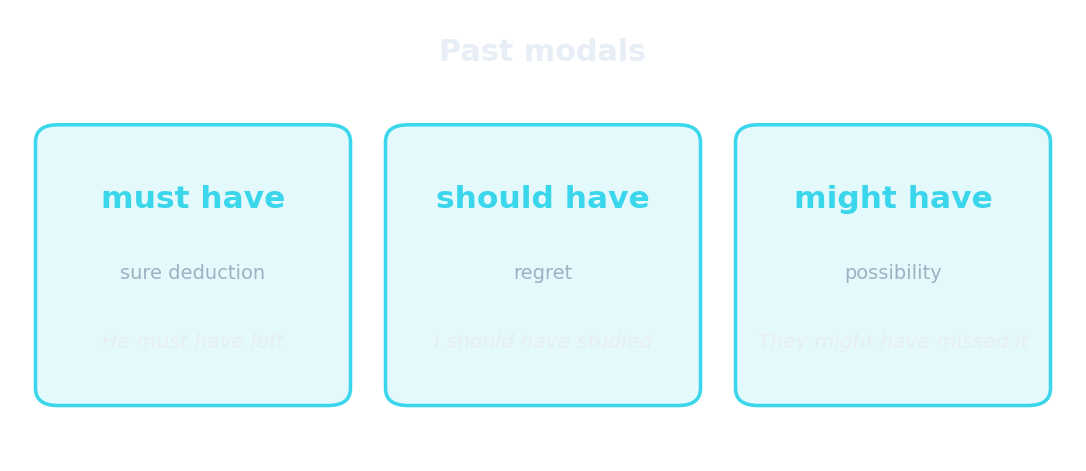
- Past modals = modal verb + have + past participle.
- These forms can express deduction, possibility, expectation, evaluation or a hypothetical opportunity. The complete message establishes the intended reading. A perfect-modal frame can also look back from a future point: By Friday, we should have finished. Find the reference time rather than treating every have + participle as past regret.
- He must have left. I should have called.
- Outcome: report a judgement with its evidence and uncertainty, and revise an overconfident or ambiguous message. Start with reported speech and hypothetical conditions. Starting check: does The parcel should have arrived by now confirm either arrival or non-arrival? It expresses an expectation; check what actually happened.
He must have forgotten the appointment; his calendar looked equally surprised.
must have / can't have (deduction)
- Must have can express a strong deduction: He must have forgotten. It presents the speaker's judgement, not independent proof of forgetting.
- Can't have can express a judgement that a past event is impossible: She can't have seen us. That judgement can be mistaken if the evidence is incomplete.
- Confidence is not a calibrated percentage. Separate what you observed from the explanation you infer.
Practise a strong deduction about an earlier event: “He’s not answering. He ___ his phone.” Choose the perfect-modal frame; the observation alone does not prove forgetting.
Difficulty 1/5 · 100 coins + a small bonus on first completion today
Must have forgotten supplies the requested retrospective deduction. Not answering has other possible explanations, so the sentence expresses the speaker’s confidence rather than a verified fact.
Can “can’t have + past participle” express the speaker’s judgement that a past event was impossible, without itself proving the judgement true?
Difficulty 1/5 · 100 coins + a small bonus on first completion today
Yes. “She can’t have seen us” presents a negative deduction. A speaker can overlook evidence or be mistaken; the grammar does not independently establish the actual event.
Translate into English: 他一定是忘了。
Difficulty 3/5 · 200 coins + a small bonus on first completion today
Must have forgotten expresses a strong retrospective deduction. “I’m sure he has forgotten” can also express that judgement; confidence alone does not confirm the event.
should have — evaluation or expectation
- In a regret or criticism context, should have evaluates a better past action: I didn't call; I should have called.
- It can also express an expectation: The courier should have delivered it by now; let's check. This does not establish that delivery failed.
- I should have studied harder. (regret)
- You shouldn't have said that. (criticism)
Past regret: “I ___ have studied harder.” Use the one-word modal meaning ought to.
Difficulty 1/5 · 100 coins + a small bonus on first completion today
Should supplies the requested ought-to evaluation. Could have can describe opportunity in another message, while should have can also express an expectation when its context differs.
could have / might have (possibility)
- could / might have + p.p. = it was possible, but we're not sure.
- They might have missed the train. It could have been worse.
- Could have can describe an available opportunity: I could have helped, but I chose not to. A plain could have does not, by itself, always establish whether the action happened.
What is the modal doing?
Read the intended deduction, possibility and criticism/regret readings in these examples. Other contexts allow expectation or opportunity, so the form alone is not a complete interpretation.
Common mistakes
- ❌ He must forgot. → ✓ He must have forgotten. — past deduction = modal + have + participle.
- ❌ should of gone → ✓ should have gone. — of is a mis-heard have.
- For a past opportunity that was not taken, I could have helped, but I was busy gives the intended retrospective frame. Ordinary past ability also uses could: As a child, I could swim. Identify the intended meaning before repairing.
- Near miss: The light is off, so Jo must have left adds a strong explanation to one observation. The light is off; Jo may have left, but I haven't checked the other room preserves the observation and admits another explanation.
In these intended contexts, match the statements to their readings: deduction about the bus, an open forgetting possibility, criticism because no call was made, and a negative deduction about seeing us.
Difficulty 2/5 · 140 coins + a small bonus on first completion today
The matches describe the intended speaker readings. Must/can’t have are judgements, not proof; might have leaves a possibility open; should have is criticism in the supplied missed-call context, but can express expectation elsewhere.
In a criticism after a late disclosure: “You ___ have told me earlier!” Use the one-word modal meaning ought to.
Difficulty 1/5 · 100 coins + a small bonus on first completion today
Should gives the requested ought-to evaluation in this criticism context. Do not generalise non-performance to every should-have sentence: a delivery expectation may still need checking.
- Strong deduction is a speaker's judgement: must have / can't have + participle. Do not label it a verified event.
- Should(n't) have may evaluate a past action; should have may also express an expectation.
- Read could/might have in context: possibility, opportunity and criticism can overlap. Later recall: use a new observation to write a cautious explanation and name one check. Continue with evidence in proposal writing. The later tasks here support retrieval without awarding proficiency.
Usage guidance checked 2026-10-20: British Council, modals with have. Local source checks; independent language, answer and learner review pending.
Write one sentence about a past regret, using “should have” + a past participle.
Difficulty 3/5 · 200 coins + a small bonus on first completion today
Example: “I should have called you earlier.”
Three worked decisions: form, evidence and context
1. An observation is not its explanation
At 18:00 the study-room light is off. No one has checked the room. A weak report says: Jo must have left; the room is empty. It turns one observation into two conclusions. A stronger report is: The light is off. Jo may have left, but I haven’t checked the room. The light is observed; departure is an explanation; occupancy remains unconfirmed. If a speaker chooses must have, it expresses a stronger judgement, not better evidence. Before strengthening the claim, check a relevant source rather than adding certainty words.
2. Expectation and regret need different evidence
At noon a dispatch note says the repair kit should have reached the workshop by now. No delivery confirmation is available. That is an expectation, not proof of a failed delivery. Compare: I didn’t send the access code. I should have sent it before the visit. The explicit first sentence establishes the omission; the second evaluates it. I ought to have sent it can make a similar evaluation. Keep the expected arrival open, but acknowledge the stated missed action. The word should does not decide both histories.
3. Opportunity is not automatic non-performance
I could have joined the tour, but I declined explicitly gives an unused opportunity. Nia could have joined; I haven’t checked the register leaves participation open. I could have joined, and in fact I did confirms participation in the added clause. The different outcomes come from the complete messages. In a repair, retain the opportunity claim and add only what the context establishes about the actual choice.
Suggested study: two sessions of about 30 minutes, including writing and revision; adjust to your pace. This is a planning allowance, not measured or official timing.
Use the guided decisions to identify the time, speaker judgement and decisive evidence. For each wrong choice, write the extra claim it adds before trying again.
A message concerns an earlier action: “He ___ his phone at home.” Practise a strong deduction with modal + have + participle. Which completion fits that requested frame?
Difficulty 1/5 · 100 coins + a small bonus on first completion today
Must have left supplies all three parts. Must left drops have; must have leave lacks the participle. This is a form exercise, not evidence that the phone was actually left at home.
“She can’t have seen the notice.” First identify whose judgement this is. What does the sentence itself communicate?
Difficulty 1/5 · 100 coins + a small bonus on first completion today
Can’t have expresses the speaker’s negative deduction here. No verified record or future instruction is supplied. Separate the judgement from proof before retelling it.
The service desk says, “The parcel should have arrived by noon.” It has not checked the tracking record. Which reading fits?
Difficulty 1/5 · 100 coins + a small bonus on first completion today
Should have gives an expectation here. The unchecked tracking record leaves both arrival and non-arrival unresolved. Do not turn an expectation into either confirmation.
“I did not call Ana. I should have called her.” Which words establish that the call was not made?
Difficulty 1/5 · 100 coins + a small bonus on first completion today
I did not call directly supplies the omission; should have evaluates it. For a new sentence, find the evidence of non-performance instead of guessing it from the modal.
“I could have taken the ferry, but I chose the bus.” Identify the opportunity and the stated choice.
Difficulty 1/5 · 100 coins + a small bonus on first completion today
Could have describes the ferry opportunity; chose the bus supplies the actual choice. Cancellation and using both are added claims. Rebuild opportunity and choice as separate notes.
“They might have used the side door; we haven’t checked the entry record.” Which report preserves the uncertainty?
Difficulty 1/5 · 100 coins + a small bonus on first completion today
Might have leaves the explanation open, and the record remains unchecked. Neither a definite entrance route nor non-entry is established. Keep the evidence gap visible.
In standard writing, which spelling supplies the perfect auxiliary in “I should ___ sent the form”?
Difficulty 1/5 · 100 coins + a small bonus on first completion today
Should have sent uses have + participle. Should of is a spelling error in this frame; should had also fails the modal auxiliary pattern. This written check does not assess how you pronounce the words.
“When I was ten, I could swim.” Is this automatically an unused past opportunity requiring could have swum?
Difficulty 1/5 · 100 coins + a small bonus on first completion today
The age context locates a past ability. Could have swum would create a different retrospective opportunity or possibility reading. Diagnose the intended meaning before changing a form.
“The gate might have been left open.” What does the passive modal report establish about the person responsible?
Difficulty 1/5 · 100 coins + a small bonus on first completion today
The passive leaves the agent unstated and might keeps the event possible. Naming a caretaker or deliberate damage invents information. Preserve both uncertainty and the unnamed agent.
Only observation: the office light is off. No occupancy check has been made. Which update best distinguishes observation from explanation?
Difficulty 1/5 · 100 coins + a small bonus on first completion today
The first update preserves the observation and marks an explanation as possible. All day, forgetting and tomorrow’s access are not supplied. Remove unsupported time and cause claims before strengthening a conclusion.
Independent messages: read before inferring
The next contexts are fresh. Read each complete message and decide what it does and does not establish. Do not use one modal as a shortcut for a whole event history. The short writing comparison then asks you to apply the distinction in your own update.
At 12:10 a lab note says, “The samples should have reached the cold room by noon.” No arrival scan is available. What does the note establish?
Difficulty 1/5 · 100 coins + a small bonus on first completion today
Should have states the expectation; no scan establishes arrival, storage conditions or damage. If you selected an outcome, locate the missing evidence and rewrite the note with status unconfirmed.
A visitor sees a locked door and says, “Mara must have left her key inside.” Which description distinguishes the statement from its evidence?
Difficulty 1/5 · 100 coins + a small bonus on first completion today
Must have marks the visitor’s confidence. A locked door does not independently establish key location, intention or spare-key availability. State the observation first, then label the explanation as an inference.
“I did not acknowledge the volunteer’s message. I should have replied before the shift.” Which account preserves the message?
Difficulty 1/5 · 100 coins + a small bonus on first completion today
Did not acknowledge supplies the omission; should have replied evaluates it. Do not replace the explicit past account with a confirmed or purely future reply. Identify both clauses’ jobs before revising.
“I could have used the lift, but I took the stairs to the fourth floor.” Which event is explicitly stated as occurring?
Difficulty 1/5 · 100 coins + a small bonus on first completion today
Took the stairs is the explicit event. Could have used describes an option; it does not establish a breakdown. Separate the available route from the route chosen.
An editor writes, “The author may have reused last year’s figures; I have not compared the files.” Which summary keeps the same evidential status?
Difficulty 1/5 · 100 coins + a small bonus on first completion today
May have suggests a possibility and have not compared identifies the missing check. Neither confirmed reuse nor confirmed originality follows. Keep the unperformed comparison in the summary.
A speaker says, “He can’t have taken the 07:10 bus if he reached the venue at 07:00.” The times have not been independently checked. What is the safest description of the statement?
Difficulty 1/5 · 100 coins + a small bonus on first completion today
The argument depends on the stated times. Can’t have gives the speaker’s negative conclusion, not verification of the clocks or the actual alternative route. Check the premise before reporting the deduction as settled.
“Nora might not have read the revised instructions.” Which outcome remains compatible with this message alone?
Difficulty 1/5 · 100 coins + a small bonus on first completion today
Might not have leaves non-reading possible, not certain. Reading remains possible too; refusal and a warning are unstated. Do not turn a tentative negative into a confirmed failure or intention.
On Tuesday a team plans next week’s work: “By Friday, we should have finished the first draft.” Which reading fits the time reference?
Difficulty 1/5 · 100 coins + a small bonus on first completion today
The Tuesday planning context places Friday ahead. Should have finished looks back from that future point at expected completion. A perfect-modal form is not automatically past regret; locate the reference time.
After a minor delay, a traveller says, “It could have been much worse; we still arrived before the doors closed.” What is explicitly stated?
Difficulty 1/5 · 100 coins + a small bonus on first completion today
The second clause supplies arrival before closure. Could have been worse compares with an imagined alternative; it does not make that worse alternative actual. Retain the actual outcome separately.
“I ought to have checked the room number. I went to the wrong room.” Which function fits ought to have here?
Difficulty 1/5 · 100 coins + a small bonus on first completion today
The wrong-room account supports the regret/evaluation reading, similar to should have checked. It does not predict a room change or confirm a successful check. Find the stated consequence before retelling the evaluation.
“The maintenance note says the lock has been replaced. It might have been damaged during the move.” Which part is an explicitly attributed report rather than a tentative explanation?
Difficulty 1/5 · 100 coins + a small bonus on first completion today
The note explicitly reports replacement; might have marks the damage explanation as tentative. Neither deliberate action nor a responsible individual is supplied. Attribute the source without treating every part as equally confirmed.
“The driver had to leave at six. The passenger says the driver must have left at six.” Which distinction matters?
Difficulty 1/5 · 100 coins + a small bonus on first completion today
Obligation and deduction are different meanings. Neither alone is a departure record. If you treated both as verified events, label the obligation and the speaker inference separately, then look for actual departure evidence.
“I posted the draft publicly. I shouldn’t have shared it before the group checked it.” Which reading follows?
Difficulty 1/5 · 100 coins + a small bonus on first completion today
The explicit first sentence supplies the posting. Shouldn’t have evaluates it as a mistake in this context; it does not erase the event. Keep event and evaluation separate when proposing a repair.
“I could have stayed for the final session. In fact, I did.” Which account respects the complete message?
Difficulty 1/5 · 100 coins + a small bonus on first completion today
In fact, I did confirms taking the opportunity. Could have alone does not compel non-performance. Read the resolving second sentence before deciding the event history.
“The alarm might have sounded while I was outside; I haven’t opened the log.” What relevant next check follows from the stated evidence gap?
Difficulty 1/5 · 100 coins + a small bonus on first completion today
The log is the identified unexamined source. Might have does not settle sounding, failure or a count. Name the missing check rather than inventing a result.
“Isha said Dan must have missed the connection.” There is no further evidence in the report. Whose deduction is explicitly attributed?
Difficulty 1/5 · 100 coins + a small bonus on first completion today
Isha is the source of the reported judgement. No admission or independent record is supplied. Preserve attribution instead of promoting a reported deduction into verified history.
“The parcel might have been delivered to reception instead of the office.” Which account preserves the status of the possible delivery?
Difficulty 1/5 · 100 coins + a small bonus on first completion today
The passive leaves the handler unnamed, and might leaves the delivery unresolved. Reception is a possible destination, not a confirmed one; theft is not alleged. Preserve those limits in your reply.
“We should have sent the invitation by yesterday; I need to check the outbox.” No one says whether it was sent. Which interpretation avoids adding a fact?
Difficulty 1/5 · 100 coins + a small bonus on first completion today
The request to check leaves the history open. Without a stated omission or sent record, should have is insufficient to establish either sending or failure. Ask for the outbox evidence before choosing a stronger account.
“At primary school, Luis could run fast. Yesterday he could have entered the race, but chose not to.” Which comparison fits?
Difficulty 1/5 · 100 coins + a small bonus on first completion today
The school context describes ability, while yesterday’s clause explicitly states a choice not to enter. Could need not always take have for past reference. Preserve the distinction rather than repairing an already grammatical ability statement.
An empty project folder prompts: “The files must have been deleted.” A colleague has not checked whether the folder was moved. Which revision best reflects that gap?
Difficulty 1/5 · 100 coins + a small bonus on first completion today
An empty folder supports an observation, not the added agent, intention or universal loss claim. The revision preserves alternatives and a check. Remove unsupported certainty before deciding the next action.
A colleague asks why a meeting room is empty. Your observations: at 17:30 the room’s light is off and the door is open. You have not checked the booking system or spoken to the group. Write a 3–4 sentence English update separating observation from one possible explanation and naming a relevant next check. Do not invent cancellation or who left. Compare, then revise one certainty, attribution or time-reference issue.
Compare evidence, reference time, modal meaning and the proposed next action. This is local written self-review, not an automatic correctness or proficiency judgement.
Transfer: update the message when evidence changes
Use the new event and travel contexts to separate an earlier expectation from a later report. Then write an English handoff that acknowledges a stated omission and gives a useful next action without pretending the uncertain event has been confirmed.
An event plan said the van should have arrived by ten. At 10:15 the driver messages, “I’m still at the depot; traffic near the exit is stopped.” Which update best distinguishes plan and later report?
Difficulty 1/5 · 100 coins + a small bonus on first completion today
The driver’s later report conflicts with the earlier expectation. It does not supply a new arrival time or establish permanent non-arrival. Update status with attribution instead of defending a stale expectation.
“I could have joined the rehearsal. I accepted the invitation and attended the whole session.” Which summary retains both opportunity and reported action?
Difficulty 1/5 · 100 coins + a small bonus on first completion today
Accepted and attended resolve the actual choice. Could have does not override those explicit statements. In a fresh handoff, preserve the sentence that resolves uncertainty.
Write a 3–4 sentence English handoff from these facts: you expected a delivery by ten; at 10:15 the driver reports still being at the depot and gives no arrival estimate; you did not call the event organiser before the expected time, although you could have. Acknowledge that omission, separate expectation from the driver’s report, and give one useful next action. After comparing, revise one unsupported certainty or unclear responsibility.
Compare evidence, reference time, modal meaning and the proposed next action. This is local written self-review, not an automatic correctness or proficiency judgement.
Later retrieval and the next decision
On a later study day, try the two review messages before rereading the worked examples. Explain one distinction from memory, then compare against the feedback. These familiar cards support retrieval; they are not a reserved assessment or proof of proficiency. For delayed-recall evidence, the same item needs an earlier successful attempt on an earlier session day. Continue with evidence-based proposal writing and keep a reader able to tell observation, inference, expectation and action apart.
A dashboard shows no new entries. A note says, “The upload may have failed, but this view has not been refreshed.” Which check should precede a definite failure claim?
Difficulty 1/5 · 100 coins + a small bonus on first completion today
The unrefreshed display is an identified alternative explanation. May have remains tentative. Name and perform a relevant check before strengthening a claim; this fictional task does not itself run a diagnostic.
Compare: A “I didn’t book early; I should have booked last week.” B “By tomorrow, the team should have finished the captions.” Which reading respects both contexts?
Difficulty 1/5 · 100 coins + a small bonus on first completion today
A contains explicit non-booking, while B places an expectation at tomorrow. The shared should-have frame does not make their event histories identical. Reconstruct time and evidence before choosing a label.