Your learning plan · Continue · Review →
can — ability and requests
הוצגהמיקום המנוהל נשמר בדפדפן הזה. המשך אינו משלים את השיעור או עונה על שאלותיו.
What you can do
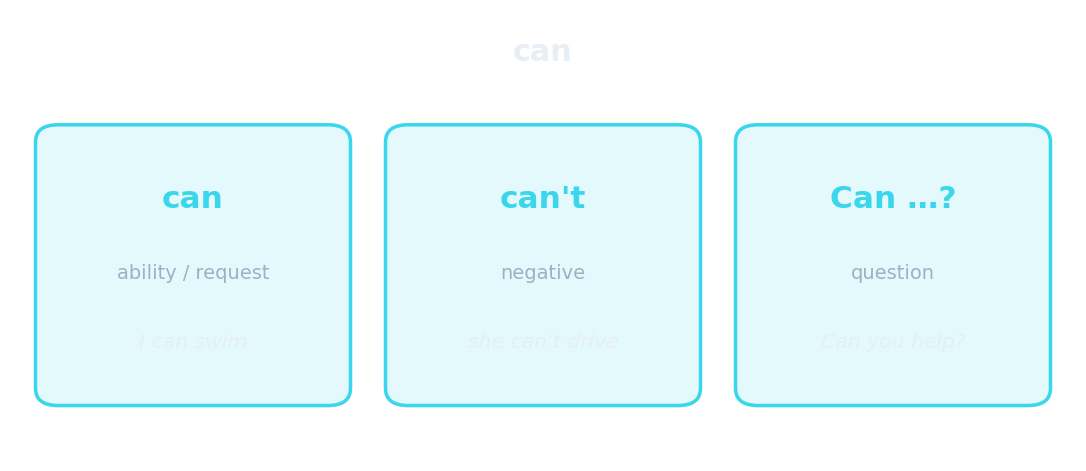
- Can can express ability: I can swim. It can also ask for help: Can you carry this, please? Read the situation to understand the meaning.
- Outcome: describe an ability and make or understand a simple request. Start with present simple. Starting check: does Can I sit here? have to ask about my skill at sitting? No — it can ask for permission.
I can sing. My neighbours can hear me.
can + base verb
- Use can + base verb with every subject: She can dance. My friends can dance. In this ability pattern, do not add -s to can or to the next verb.
- Use can swim, not can to swim or can swims. Can do is correct: I can do this exercise. Here do is the action verb.
can — correct or wrong?
In these ability/request examples, can takes a base verb and forms a full question before the subject.
Which sentence is correct?
Difficulty 1/5 · 100 coins + a small bonus on first completion today
can + base verb (no “to”): “I can swim.”
Translate into English: 我会游泳。
Difficulty 3/5 · 200 coins + a small bonus on first completion today
I can swim expresses ability. I know how to swim or I am able to swim can also translate the unrestricted meaning. Can here is not a report of a completed swim.
Negatives: can't
- Cannot = can't: He can't drive. In a conversation about driving skills, this means he is not able to drive.
- Context can give another meaning: a sign saying You can't park here can state a rule. It does not mean that drivers lack the skill to park.
Make it negative: She ___ drive. (cannot, short form)
Difficulty 1/5 · 100 coins + a small bonus on first completion today
cannot → can't: “She can't drive.”
Questions: Can …?
- For a full yes/no question, put Can before the subject: Can you swim? Can Jo cook? Short replies include Yes, I can and No, she can't.
- Can you close the window, please? can request an action. Can I use your pen? can ask permission. The words alone do not guarantee a polite tone; the situation and how you say them matter too.
Is this correct? “Does he can cook?”
Difficulty 1/5 · 100 coins + a small bonus on first completion today
The standard full question is Can he cook? without question-forming does. This does not ban every do near can: He can do this is a correct ability sentence with do as the action.
Common mistakes
- Say She can swim, not She cans swim. Say I can't drive, not I don't can drive.
- The full question is Can you swim? In conversation, You can swim? can check surprising information. It is a different question pattern, not always wrong.
- To describe the quality of singing, say She sings well. To describe its sound, Her voice sounds good is natural. Do not replace good with well after every verb.
Choose the full yes/no question that begins with Can.
Difficulty 1/5 · 100 coins + a small bonus on first completion today
Can you swim? has the specifically requested can-first form. You can swim? can be natural conversational checking of surprising information; it is not the requested full can-first question. Do you can swim? mixes question frames.
Put the words in order to make a question.
Difficulty 3/5 · 200 coins + a small bonus on first completion today
The supplied words form Can your friend play football? Can precedes your friend and play is a base verb. This frame can ask about ability; whether it requests an action depends on the situation.
- Keep the can + base verb frame. Form its full questions without question-making do/does: Can she cook? The action verb do can follow can.
- Use context to distinguish ability, a request and permission. A statement of ability does not promise that the person will help.
Write one sentence about something you can do, using “can”.
Difficulty 3/5 · 200 coins + a small bonus on first completion today
Example: “I can play the piano.”
Three worked contrasts
- Skill or request: at a swimming class, Can you swim? asks about ability. When a bag is heavy, Can you lift this for me, please? can ask for help. Someone may be able to lift it but choose not to help.
- Skill or rule: I can't drive can describe a missing skill. A teacher says You can't run in this room: that states a rule, not a claim that the student cannot run anywhere.
- Two useful questions: you hear that Lee can ski and say You can ski? to check the news. In a form exercise asking for a full question beginning with can, write Can you ski? Both can fit their own situations.
Complete the ability frame: Lina can ___ a bike.
Difficulty 1/5 · 100 coins + a small bonus on first completion today
After can use the base verb ride. Do not add -s or to in this ability frame. Try the same frame with Lina and Max; can ride stays the same.
A friend wants help with a box. Choose a full question starting with Can.
Difficulty 1/5 · 100 coins + a small bonus on first completion today
Can before you makes the requested full question. You can carry ...? can be conversational checking, but it does not start with Can; Do you can mixes question frames.
Nia is learning and is not able to swim yet. Choose the ability sentence.
Difficulty 1/5 · 100 coins + a small bonus on first completion today
Can’t swim keeps the negative and base verb. Don’t/doesn’t do not form this can negative, and swims is not the base form after can. Yet leaves room for later learning.
A sign gives a rule: “You can’t eat in this room.” What does it mean here?
Difficulty 1/5 · 100 coins + a small bonus on first completion today
The sign is a rule against eating in that room. It does not describe eating skill or require eating. Read the situation before choosing a meaning for can’t.
“Can Mila draw?” She is able to. Choose the short reply.
Difficulty 1/5 · 100 coins + a small bonus on first completion today
Yes, she can matches the question and ability. Can does not add -s with she, and does belongs to a different question pattern. Try a matching negative reply too.
Interpret new situations
- In the next twenty decisions, read who can do something and what the person wants. Check the full verb frame as well as the meaning. Do not turn a request into a promise or a rule into a statement about skill.
- Try about half today and half in another session. About 50 minutes across the lesson, practice and writing is a study suggestion, not a test time or a measured level.
At a skills class, a teacher asks, “Can you sew?” What is the question about?
Difficulty 1/5 · 100 coins + a small bonus on first completion today
The skills-class context makes ability the intended meaning. The question is not a ban or a promise. Name the action and the situation before deciding what can means.
You want to borrow a classmate’s ruler. Choose a permission question.
Difficulty 1/5 · 100 coins + a small bonus on first completion today
Can I use your ruler asks whether the classmate permits your use. The first asks about the other person using yours; the last asserts much broader permission. Keep the people and ownership clear.
Choose a standard ability sentence.
Difficulty 1/5 · 100 coins + a small bonus on first completion today
Can skate is the same with the children as with one child. Cans and can to skate do not fit this frame. A plural subject does not require a different can form.
A helper says, “I can carry one bag, but I can’t carry both.” What help is offered?
Difficulty 1/5 · 100 coins + a small bonus on first completion today
The helper offers to carry one bag and states a limit for both. Do not drop either clause. Ask which bag to take rather than assuming all the bags will be carried.
“Can you close the door, please?” said by someone who is cold is most likely what?
Difficulty 1/5 · 100 coins + a small bonus on first completion today
The speaker asks the listener to act. The question does not say the door is already closed or that all doors must stay open. A request and its result are different facts.
Use can with the action do. Choose the complete sentence.
Difficulty 1/5 · 100 coins + a small bonus on first completion today
Do is the base action verb after can. The instruction to avoid question-forming do with can does not ban can do. Does is not the base form in this frame.
A teacher says, “You can use the computer after lunch.” It is permission. What is allowed?
Difficulty 1/5 · 100 coins + a small bonus on first completion today
The permission names both an action and a time. It does not allow every time or taking the computer away. Keep the limit when you explain a permission sentence.
Choose the full can question about your cousins’ ability to cook.
Difficulty 1/5 · 100 coins + a small bonus on first completion today
Can goes before your cousins, followed by base cook. Do is not needed to form this question, and cooks is not the base form. The number of cousins does not change can.
“I can speak Japanese” is a statement about a skill. What does it NOT promise?
Difficulty 1/5 · 100 coins + a small bonus on first completion today
The sentence states ability, not a promise to do a job now. It also does not give a measured proficiency level. Ask whether the person is willing and available to help.
In a conversation about skills: “Bo can cook, but Bo can’t drive.” Choose the accurate report.
Difficulty 1/5 · 100 coins + a small bonus on first completion today
The first report preserves the positive cooking skill and negative driving skill. The others reverse or erase the contrast. Read both sides of but before you report a skill.
A child asks, “Can I open the gate?” The adult replies, “No, you can’t.” They are discussing a rule. What does the reply do?
Difficulty 1/5 · 100 coins + a small bonus on first completion today
In this rule context, the adult refuses permission. The reply does not test physical strength or describe an earlier event. A negative can sentence needs its context.
Choose the standard form for the requested skill description.
Difficulty 1/5 · 100 coins + a small bonus on first completion today
Can takes base sing; well describes how she sings in this standard pattern. Sings adds an unwanted ending, while good does not serve that adverb role here. Compare Her voice sounds good.
Choose a natural standard description of a song’s sound.
Difficulty 1/5 · 100 coins + a small bonus on first completion today
Good describes the song after sounds. The can frame would need base sound, and goodly is not the ordinary word for this meaning. Do not replace every adjective after a verb with well.
You hear surprising news that a friend can juggle. What can “You can juggle?” do in conversation?
Difficulty 1/5 · 100 coins + a small bonus on first completion today
A statement-shaped question can check what you heard. It is not automatically a command or a claim of inability. A full can-first question is another useful pattern, not the only possible conversational question.
Choose a standard short negative reply to “Can your dog swim?”
Difficulty 1/5 · 100 coins + a small bonus on first completion today
Can’t completes the short negative reply. Do not add doesn’t to this can frame or add -s to can’t. The sentence reports ability; it does not itself explain why the dog cannot swim.
“You can sit here, but the next seat is taken.” The speaker gives permission. Which seat may you use?
Difficulty 1/5 · 100 coins + a small bonus on first completion today
Here identifies the offered seat. The next seat is already taken, so the sentence does not offer it. Permission can be limited to one place.
Choose a complete ability sentence about Pat.
Difficulty 1/5 · 100 coins + a small bonus on first completion today
Can fix keeps both words in the correct frame with a name. To and the -s endings do not belong in this pattern. It says Pat has the ability, not that the repair is already complete.
A student asks, “Can I ask one more question?” This is usually a request for what?
Difficulty 1/5 · 100 coins + a small bonus on first completion today
The student asks for permission to speak again. The content of the next question is not stated, and the student is not testing the teacher’s skill. Track who I refers to.
“I can’t come today, but I can come on Friday.” Which plan fits the stated availability?
Difficulty 1/5 · 100 coins + a small bonus on first completion today
The contrast rules out today and gives Friday as possible. It does not say the person can never come. In this message, can concerns availability, not a general movement skill.
Choose the full yes/no question beginning with can.
Difficulty 1/5 · 100 coins + a small bonus on first completion today
Only Can your brother play chess begins with the requested can-first frame. The statement-shaped question can fit conversational checking; does ... can is not the standard frame here. Distinguish the requested form from all possible questions.
Ask for help
- Write a short English message using can to ask for help. Keep the facts clear and say what action you need. Compare with the hidden example, then repair one form or meaning mismatch.
- These are written language tasks. A written request does not establish how you pronounce it or how it sounds to another person.
You cannot reach a high shelf and want help from Sam. Which message asks for the needed action?
Difficulty 1/5 · 100 coins + a small bonus on first completion today
The last message asks Sam to take down the box. The first changes the actor and object; the second contradicts your need and adds an order. A useful request names the actual help needed.
At an art club, you are able to paint but the room rule bans paint near the computers. Which message keeps both facts?
Difficulty 1/5 · 100 coins + a small bonus on first completion today
The first separates ability from a place-specific rule. The rule does not remove the skill, and the skill does not remove the rule. Keep both meanings rather than treating every can as ability only.
Facts: you need help moving a heavy chair. You want to ask your classmate Jo to help. Write one English request with Can you …, please? Then add a short sentence explaining what you need. Do not claim Jo has agreed or already moved it. Compare and revise one form or meaning.
Compare your English with the facts and checklist. Revise one real mismatch, or explain why no change is needed. Several answers can fit. This is written self-review, not automatic correctness or a speaking/proficiency result.
Review later
- Tomorrow, try the two review decisions before rereading. Write one new ability sentence and one permission question. Explain which is which.
- Continue with imperatives and question words. Corrected answers and self-review support learning; they do not certify independent mastery or speaking proficiency.
Usage guidance checked 2026-10-20: British Council, permission, Cambridge, statement questions and linking verbs. The examples and practice here are original; independent language, key and learner review pending.
Choose the base verb after can: Our neighbour can ___ the violin.
Difficulty 1/5 · 100 coins + a small bonus on first completion today
Use base play after can, even with a singular noun subject. Plays and to play do not fit this frame. Later, make a full can question using a different name.
“Can we use this table?” The speaker wants permission. Which reply grants it?
Difficulty 1/5 · 100 coins + a small bonus on first completion today
Yes, you can use it grants the requested permission. No refuses it; ability to carry a table does not establish permission to use it. Keep ability and permission distinct when you review later.
Write two original English sentences: one says something you are able to do using can; the other asks permission to do a different action using Can I …? Label them Ability and Permission. Compare and revise one form or meaning. These are written practice examples.
Compare your English with the facts and checklist. Revise one real mismatch, or explain why no change is needed. Several answers can fit. This is written self-review, not automatic correctness or a speaking/proficiency result.