Your learning plan · Continue · Review →
Present simple — everyday habits
הוצגהמיקום המנוהל נשמר בדפדפן הזה. המשך אינו משלים את השיעור או עונה על שאלותיו.
Present simple: routines and facts
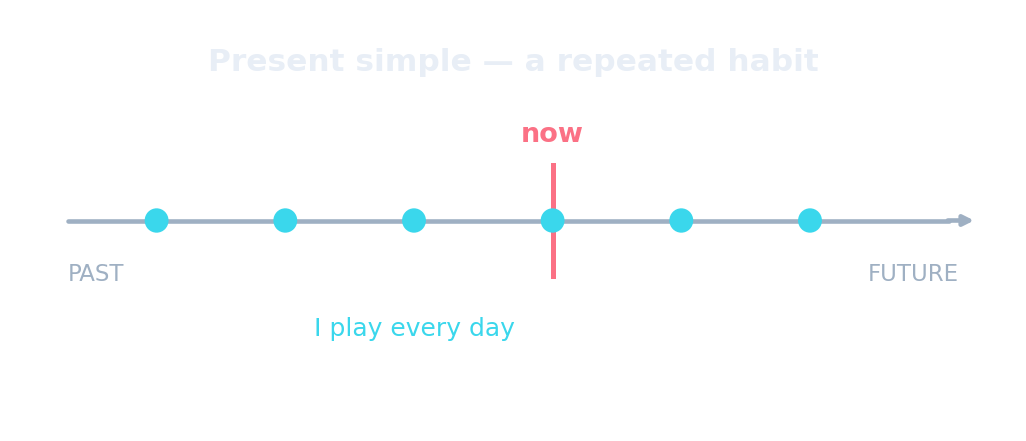
- The present simple can describe habits, routines and states: I walk on Sundays. I like tea. A habit need not happen every day.
- I get up at seven. The sun rises in the east.
- Outcome: describe a routine and make a question or negative. Start with be. Starting check: does Who lives here? need do? No — who asks about the person doing the action.
I drink tea every day. The tea does not get a day off.
Base form, and -s for he / she / it
- I / you / we / they → the base verb: I play, we work.
- In simple positive sentences here, use the third-person form with he / she / it or one name/thing: He plays. Mina works. The bus stops here. Some forms change differently: have → has.
- go → goes, watch → watches, study → studies.
Does the verb need -s?
These positive play/work examples use plays/works with he/she/it, and play/work with the other shown pronouns. One name follows the singular pattern too; be, can and questions have other forms.
Choose: He ___ football every day.
Difficulty 1/5 · 100 coins + a small bonus on first completion today
he / she / it → add -s: “He plays football.”
Use the present simple for her usual routine: She ___ (go) to school by bus.
Difficulty 1/5 · 100 coins + a small bonus on first completion today
The requested present-simple third-person form is goes. Learn this spelling with the example; it is not a rule for every verb or every sentence containing she.
Translate into English: 我喜欢茶。
Difficulty 3/5 · 200 coins + a small bonus on first completion today
I → base verb: “I like tea.” (not “I likes tea”)
Negatives: don't / doesn't
- I / you / we / they → don't + base verb: I don't eat meat.
- he / she / it → doesn't + base verb: He doesn't like tea.
- After don't / doesn't, no -s.
Is this correct? “He doesn't likes tea.”
Difficulty 1/5 · 100 coins + a small bonus on first completion today
After doesn't, use the base verb: “He doesn't like tea.”
Questions: Do / Does …?
- Do you …? · Does he …?
- Do you speak English? Does she live here?
- Short answers: Yes, I do. / No, he doesn't. These are full yes/no questions with verbs such as like and live. Is she tired?, Can she swim? and the subject question Who lives here? use other patterns.
Common mistakes
- To strengthen like here, use I like English very much or I very much like English, not I very like English. Use very much in these examples, not very alone before like.
- ❌ He go to school. → ✓ He goes to school. — remember the -s!
- Do you like tea? is a useful full question. You like tea? is common in conversation, for example when you are surprised or checking what you heard. Here we practise the full do/does question.
Match the verb to its he / she form.
Difficulty 2/5 · 140 coins + a small bonus on first completion today
-ch / -o → -es (watches, goes); consonant + y → -ies (studies); most verbs just add -s.
For a straightforward statement meaning “I like music a lot”, which of these supplied sentences uses the natural pattern?
Difficulty 1/5 · 100 coins + a small bonus on first completion today
I like music very much is natural. I very much like music is another natural order, though it is not one of these choices. The problem in I very like music is very alone before like, not a ban on every very phrase near a verb.
- Present simple = habits + facts.
- In these positive sentences, use the third-person form with he / she / it or one name/thing.
- For negatives and full yes/no questions with verbs such as like, use do / does + base verb. Be and can use other patterns. Later recall: write one new routine, its negative and a question. Continue with can: ability and requests. These guided form checks do not certify independent use.
Usage guidance checked 2026-10-20: British Council, present simple. Local source checks; independent language, answer and learner review pending.
Write one sentence about something you do every day. Use the present simple.
Difficulty 3/5 · 200 coins + a small bonus on first completion today
Example: “I get up at seven every day.”