המהפכה הצרפתית
הוצג| English | משמעות |
|---|---|
| mass conscription/mæs kɒnˈskrɪpʃn/ | גיוס המוני |
Long-term causes plus a short-term trigger
- The French Revolution resulted from a combination of long-term social and political causes, as well as Enlightenment ideas, exacerbated by short-term fiscal and economic crises.
- The CED's structure is precise: long-term causes, ideas, and a short-term crisis that exacerbated them.
- So an answer needs at least one of each, and must not present the fiscal crisis as the whole cause.
בחר את כל סוגי הגורמים ש-CED מציין.
רמת קושי 2/5 · 140 מטבעות + בונוס קטן בהשלמה הראשונה היום
המשבר לטווח קצר חיזק את האחרים; הוא אינו הסיבה היחידה.
The liberal phase
- The first, or liberal, phase of the French Revolution established a constitutional monarchy, increased popular participation, nationalised the Catholic Church, and abolished hereditary privileges.
- Four measures, and the third and fourth are attacks on 3.7's absolutist bargain — the privileges absolutism had preserved.
- So the liberal phase is 3.2's constitutional settlement attempted in a state built the other way.
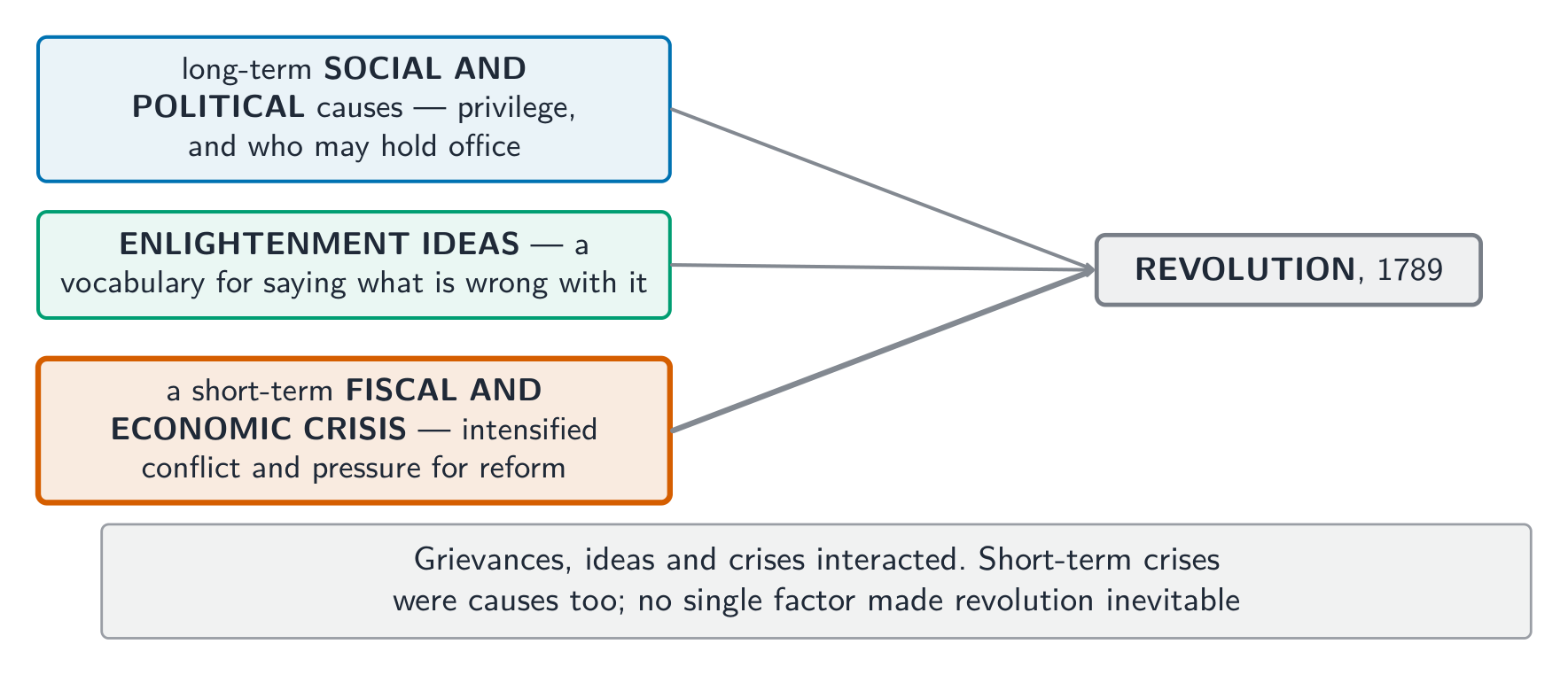
Grievances, ideas and short-term crises interacted; no single factor made revolution inevitable
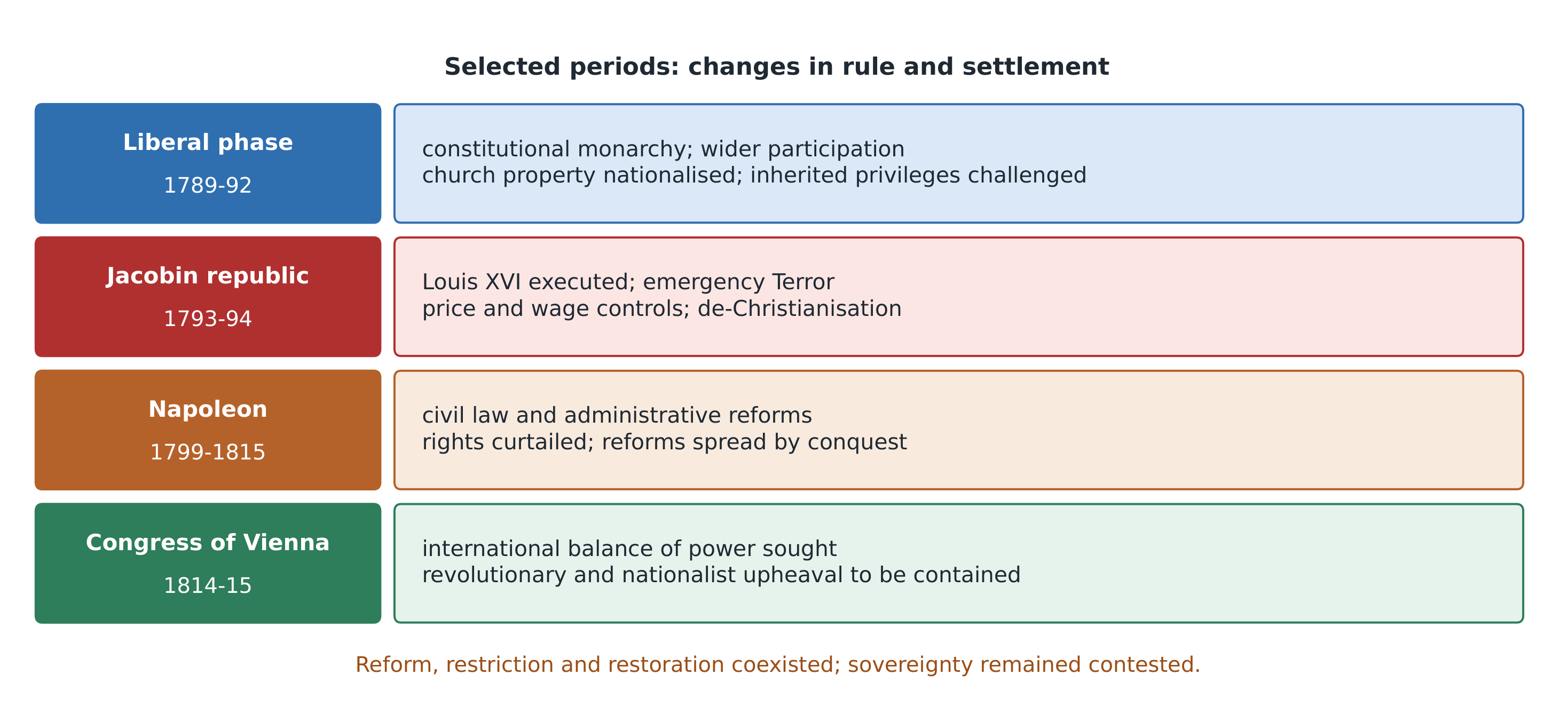
Selected periods and their different political changes; Vienna was an international settlement
בחרו את ארבעת המדידות מתקופת הליברלים.
רמת קושי 2/5 · 140 מטבעות + בונוס קטן בהשלמה הראשונה היום
שתי המדידות האחרונות פוגעות בזכויות שהשמירה המוחלטת שמרה עליהן.
The radical phase
- After the execution of Louis XVI, the radical Jacobin republic led by Robespierre responded to opposition at home and war abroad by instituting the Reign of Terror, fixing prices and wages, and pursuing a policy of de-Christianisation.
- The CED gives the cause of the radical turn: opposition at home and war abroad.
- Three measures follow — a political one, an economic one and a religious one, all emergency responses.
הפרדה בין התנאים לבין הגורם המיידי
ה-CED מבדיל בין גורמים ארוכי טווח ורעיונות הנורה (Enlightenment) לבין המשברים הקצרים הטווח שהחמירו אותם.
בחרו את כל מדידות תקופת הרדיקלים ש-CED מייחסת לה.
רמת קושי 2/5 · 140 מטבעות + בונוס קטן בהשלמה הראשונה היום
גיוס חובה היא שיטת הצבא, מצוינת בנפרד.
The fiscal crisis exacerbated causes that were already there. The CED's structure is long-term social and political causes, plus Enlightenment ideas, exacerbated by short-term fiscal and economic crises — so an answer resting on the deficit alone has taken the trigger for the whole explanation.
ה-CED טוען שהפנייה הרדיקלית הגיבה ל...
רמת קושי 1/5 · 100 מטבעות + בונוס קטן בהשלמה הראשונה היום
שלוש מדידות באות: פוליטית, כלכלית ודתית.
Armies and the export of the revolution
- Revolutionary armies, raised by mass conscription 大规模征兵, sought to bring the changes initiated in France to the rest of Europe.
- Mass conscription is possible only when a state can claim the nation as its own — a claim the revolution had just made.
- So the new political idea produces a new military capacity, which 5.6's Napoleon will inherit.
סדרו לפי הסדר את שלושת השלבים של CED עבור נשים.
רמת קושי 3/5 · 200 מטבעות + בונוס קטן בהשלמה הראשונה היום
שלושה שלבים במשפט אחד — המקרה הבולט ביותר לגבולות המפורשים של תנועת ההשכלה.
Women's participation and its limit
- Women enthusiastically participated in the early phases of the revolution; however, while there were brief improvements in the legal status of women, citizenship in the republic was soon restricted to men.
- The CED gives participation, a brief improvement, and a restriction — three stages in one sentence.
- It is 4.3's exclusion enacted in law, and the clearest single instance of the Enlightenment's stated limits.
A state with an empty treasury calls an assembly it has not called in generations. The deficit explains the meeting; it does not explain why the men who arrive already have a theory about consent, a list of grievances about privilege, and a vocabulary in which to state both.
The Revolution resulted from long-term social and political causes, plus Enlightenment ideas, exacerbated by short-term fiscal and economic crises. The liberal phase established a constitutional monarchy, increased participation, nationalised the Church and abolished hereditary privileges. The radical phase, responding to opposition at home and war abroad, brought the Terror, price and wage controls and de-Christianisation. Mass conscription carried the changes abroad, and citizenship was soon restricted to men.