אנומורפוזיס
הוצג| English | משמעות |
|---|---|
| Personification/pɜːˈsɒnɪfɪkeɪʃn/ | אישום |
A comparison, not a decoration
- Personification 拟人 is a type of comparison that assigns a human trait or quality to a nonhuman object, entity or idea.
- The CED classes it as a comparison, which means everything you know about metaphor applies.
- There is a main subject, a transferred quality, and a context that decides which quality.
When a clock “complains,” it has acquired a human trait and an unusually full schedule.
ההגדרה של CED לאישום מסתיימת במטרה של...
רמת קושי 1/5 · 100 מטבעות + בונוס קטן בהשלמה הראשונה היום
אישום עושה לדבר מה שתיאור עושה לאדם.
It characterises
- The CED ends the sentence with a purpose: thus characterizing that object, entity or idea.
- So personification does to a thing what description does to a person.
- The analysis therefore names a character — what kind of thing this river, grief or house now is.
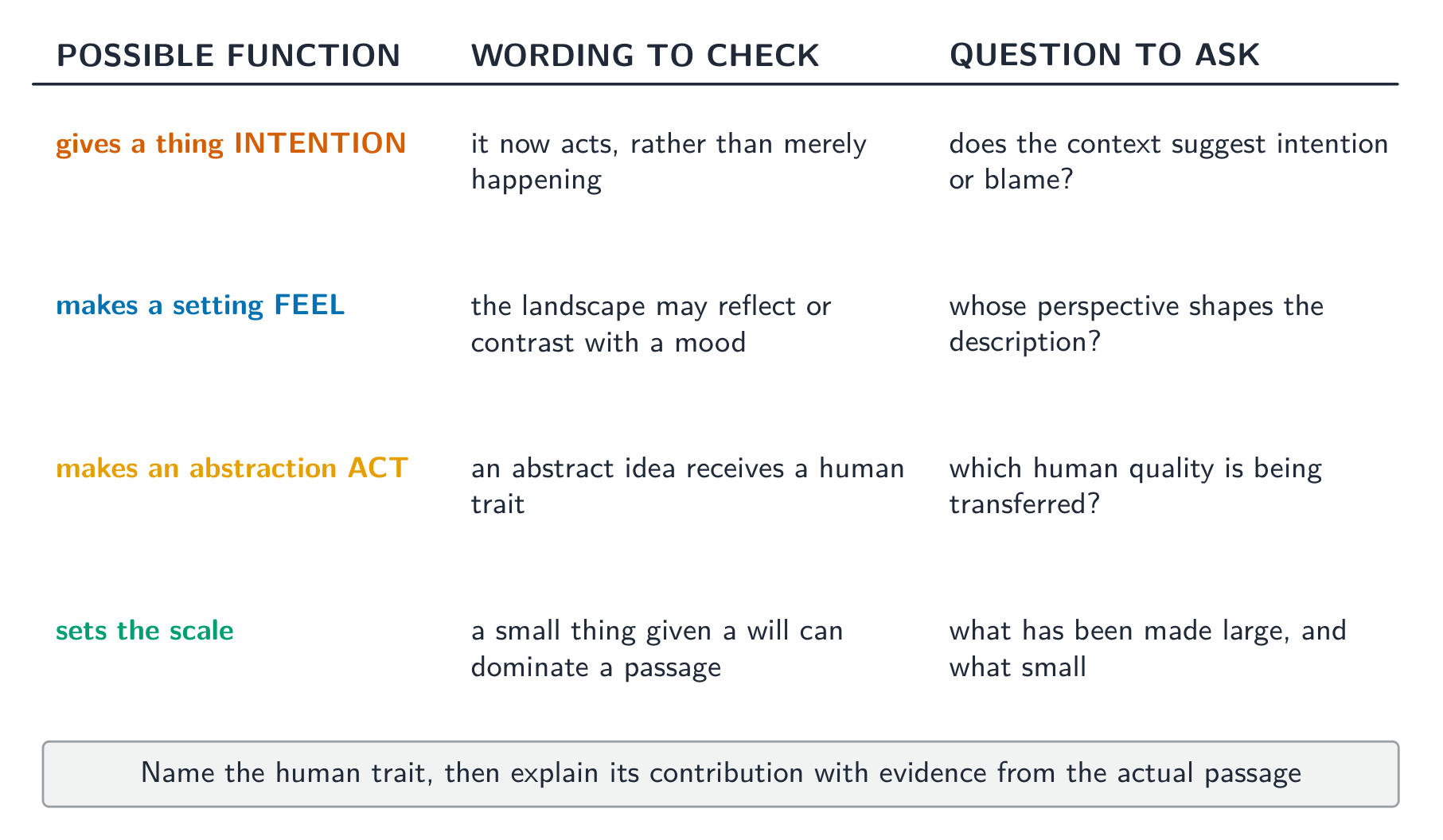
Explain the specific human trait and its contribution in context.
אישום מסווג על ידי CED כסוג של השוואה.
רמת קושי 1/5 · 100 מטבעות + בונוס קטן בהשלמה הראשונה היום
לכן כל מה שיודעים על מטאפורה חל: נושא ראשי, תכונה מועברת, הקשר.
Name the exact human trait
- The wind is personified identifies the device and stops.
- Which human trait? Patience, malice, indifference, exhaustion — each characterises differently.
- The trait is the analysable content; the label is not.
מה האישום מאפיין את הדבר?
סדר כל ביטוי לפי התכונה שהוא מעניק לנושא שאינו אנושי.
התוכן הניתוחי הוא התכונה האנושית ____ המדויקת שמועברה, לא התווית.
רמת קושי 1/5 · 100 מטבעות + בונוס קטן בהשלמה הראשונה היום
סבלן, זדוני ומותש הם שלושה סוגים שונים של שירה.
"The wind is personified" is identification, not analysis. The CED's definition ends in characterizing — so the answer must name the exact human trait assigned and what kind of thing the object thereby becomes. Patient, malicious and exhausted are three different poems.
בשירה בראשון, אישום שייך ל...
רמת קושי 1/5 · 100 מטבעות + בונוס קטן בהשלמה הראשונה היום
דובר שמצא בים סבלנות סיפר לך משהו על עצמו.
Who is doing the personifying
- A personification in a first-person poem belongs to the speaker, not to the world.
- A speaker who finds the sea patient has told you something about themselves.
- So ask, as with any comparison, what choosing it says about the one who chose it.
התאם כל אישום אישי למה שהוא מאפיין את הדבר כ.
רמת קושי 2/5 · 140 מטבעות + בונוס קטן בהשלמה הראשונה היום
שלושה תכונות, שלושה דמויות, שלושה שירים שונים.
A personification pass
- Name the nonhuman subject and the exact human trait assigned.
- Say how that trait characterises the subject.
- Then ask what the choice of that particular trait says about the speaker.
The sea is patient. Trait: patience. Characterisation: the sea now has intention and time, and is waiting for something. Speaker: someone who believes the sea is coming for the house eventually — which the poem confirms four lines later without ever saying so.
Personification is a type of comparison assigning a human trait to a nonhuman object, entity or idea, thus characterizing it. Name the exact trait, say how it characterises the subject, and — since it is a comparison — ask what choosing it says about the speaker.