הוכחה רלוונטית ומספקת
הוצגEvidence is used for a purpose
- Writers use evidence strategically and purposefully to illustrate, clarify, exemplify, associate, amplify or qualify a point.
- Six purposes, and they are not the same job.
- Knowing which one a quotation is doing tells you what your commentary has to say about it.
A quotation cannot do all six jobs at once; even evidence deserves a job description.
בחרו את כל המטרות שה-CED מפרט עבור ראיות.
רמת קושי 2/5 · 140 מטבעות + בונוס קטן בהשלמה הראשונה היום
הבהרה, קישור והרחבה משלימים את השש; סיכום אינו אחת מהן.
Effective means explained
- Evidence is effective when the writer uses commentary to explain a logical relationship between the evidence and the claim.
- So an unexplained quotation is not weak evidence — by this definition it is not yet effective evidence at all.
- The quotation does not argue; the sentence after it does.
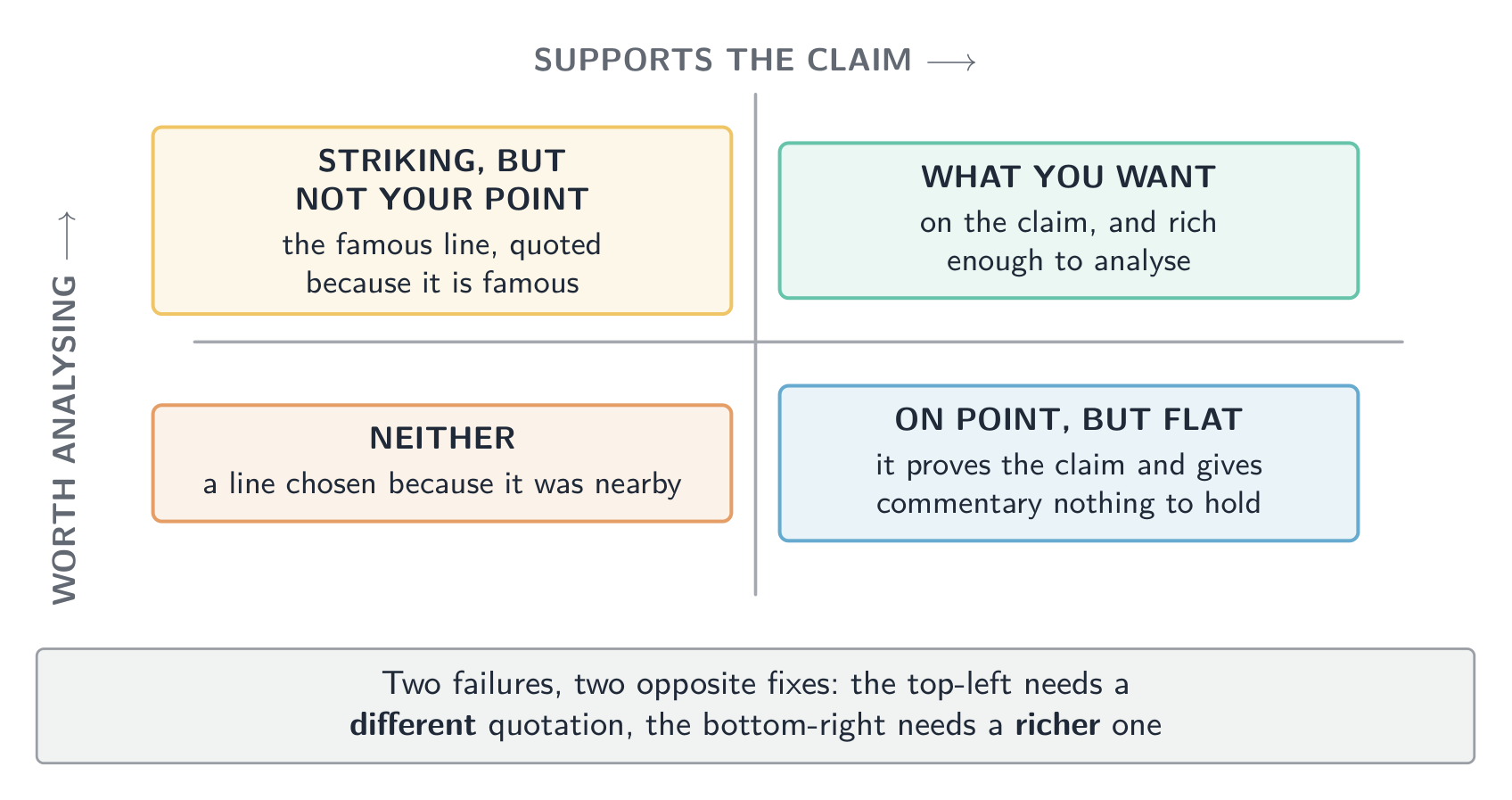
Two failures with two opposite fixes: a different quotation, or a richer one
ראיות יעילות כאשר...
רמת קושי 1/5 · 100 מטבעות + בונוס קטן בהשלמה הראשונה היום
הציטוט אינו טוען דבר; המשפט שלאחריו כן עושה.
Sufficient means quantity and quality
- Evidence is sufficient when its quantity and quality provide apt support for the line of reasoning.
- Both are named: five weak quotations are not sufficient, and one perfect one usually is not either.
- "Apt" is the standard — fitted to this reasoning, not impressive in general.
בחרו את כל הדברים עליהם תלוי הספיקות.
רמת קושי 2/5 · 140 מטבעות + בונוס קטן בהשלמה הראשונה היום
חמישה ציטוטים חלשים אינם מספיקים, ואף אחד מושלם בדרך כלל אינו מספיק גם הוא.
An unexplained quotation is not effective evidence at all. The CED's definition makes effectiveness depend on the commentary that explains the logical relationship — so a paragraph that quotes and moves on has supplied text, not support.
איזה מטרה השירות הזה של ההוכחה מבצע?
סדר כל שימוש לפי מילת המטרה של CED.
עליכם תמיד לעצב את קו ההסברה לפני שאתם מחפשים הוכחות.
רמת קושי 1/5 · 100 מטבעות + בונוס קטן בהשלמה הראשונה היום
התהליך הוא רקורסיבי — פרשנות יכולה להופיע מתוך ניתוח הוכחות תחילה.
The process is recursive
- Developing an interpretation is a recursive process: it can emerge from analysing evidence and then forming a line of reasoning, or from forming a line of reasoning and then finding evidence.
- So there is no single correct order of work, and either direction is legitimate.
- What is not legitimate is keeping a claim the evidence stopped supporting.
התאימו כל שימוש באותו ציטוט למטרתו.
רמת קושי 2/5 · 140 מטבעות + בונוס קטן בהשלמה הראשונה היום
אותם מילים, שלושה פירושים — המטרה קובעת מה עליכם לכתוב.
An evidence check
- For each quotation, name which of the six purposes it serves.
- Check there is a sentence explaining its relationship to the claim.
- Then ask whether the quantity and the quality are apt for this line of reasoning.
Same quotation, two purposes. To exemplify: "a small clerk of a man" is one instance of the narrator's habit of ranking. To qualify: it shows the habit is not malice but reflex — he says it about someone he likes. The commentary is different in each case, and the quotation alone said neither.
Evidence is used to illustrate, clarify, exemplify, associate, amplify or qualify. It is effective only when commentary explains its logical relationship to the claim, and sufficient when its quantity and quality aptly support the line of reasoning. The process is recursive — either direction is legitimate.