דמויות דינמיות ולא משתנות
הוצגA dynamic character bends the plot
- A dynamic character who develops over the course of the narrative often makes choices that directly or indirectly affect the climax and/or the resolution.
- That is the CED's own link between character and plot.
- So "she changes" is only half an answer — the other half is what her change did to the ending.
A character’s choices are the plot wearing shoes: they actually go somewhere.
דמות דינמית רלוונטית לעלילה כי הבחירות שלה...
רמת קושי 1/5 · 100 מטבעות + בונוס קטן בהשלמה הראשונה היום
לכן "היא משתנה" הוא מחצית התשובה; המחצית השנייה היא מה שהשינוי עשה.
Two kinds of change
- Changes can be visible and external — health, wealth, position.
- Or internal, psychological or emotional.
- And external changes can lead to internal changes, and vice versa — the causal arrow runs both ways.
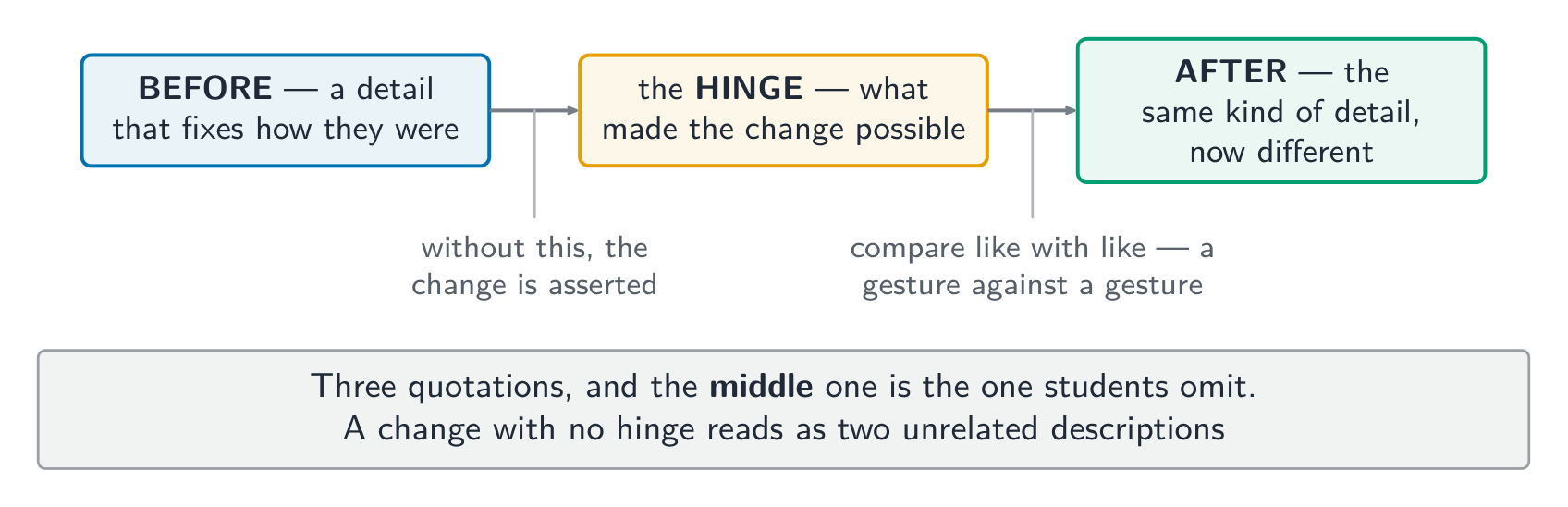
Three quotations, and the middle one is the one students omit
להוכיח שדמות השתנתה, בשלוש ציטוטים
לפני, צירוף, אחרי — והצירוף הוא זה שהתלמידים נוטים להתעלם ממנו.
שינויים חיצוניים יכולים להוביל לשינויים פנימיים, ופנימיים לחיצוניים.
רמת קושי 1/5 · 100 מטבעות + בונוס קטן בהשלמה הראשונה היום
ה-CED מציינים שהחץ הסיבתי זורם לשני הכיוונים.
Some characters do not change
- Some characters remain unchanged or are largely unaffected by the events of the narrative.
- That is not a failure of characterisation — it is a choice with a function.
- An unchanged character often measures the change in everyone else.
דמות שאינה משתנה היא חולשה בכתיבה.
רמת קושי 1/5 · 100 מטבעות + בונוס קטן בהשלמה הראשונה היום
ה-CED מציין זאת כקטגוריה אמיתית; דמות כזו נהוג למדוד את השינוי של כל האחרים.
An unchanged character is a choice, not an oversight. The CED says some characters remain largely unaffected — and such a character usually functions as a fixed measure against which everyone else's movement becomes visible. Treating them as underwritten misses their whole job.
כדי להוכיח שינוי, ציטטו את הדמות מוקדם וציטטו אותה ____.
רמת קושי 1/5 · 100 מטבעות + בונוס קטן בהשלמה הראשונה היום
ציטוט אחד מראה מצב; שניים מראים הבדל.
Change needs two measurements
- To claim a character changed, quote them early and quote them late.
- One quotation shows a state; two show a difference.
- The essay that only quotes the ending has asserted a change rather than evidenced it.
סדר את מעבר השינוי.
רמת קושי 3/5 · 200 מטבעות + בונוס קטן בהשלמה הראשונה היום
השלב האחרון הוא זה שה-CED מבקש בפועל.
A change pass
- Quote the character early. Quote them late. Name whether the change is external or internal.
- Say which caused which, if the text lets you.
- Then say what their choice did to the climax or the resolution.
The father loses the farm (external), and only afterwards stops speaking to his brother (internal) — the CED's arrow running from outside in. His sister, who changes in nothing across three hundred pages, is how the reader measures how far he has gone.
A dynamic character's choices affect the climax or resolution — so name what the change did, not just that it happened. Change may be external or internal, and each can cause the other. Some characters remain unchanged, and that is a function: they measure everyone else. Evidence a change with two quotations, early and late.