כיצד מטאפורה פועלת
הוצג| English | משמעות |
|---|---|
| metaphor/ˈmetəfɔː/ | מטאפורה |
Metaphor implies rather than states
- A metaphor 隐喻 implies similarities between two (usually unrelated) concepts or objects in order to reveal or emphasize something about one of them.
- Usually unrelated is the working part: the further apart the two are, the more the comparison does.
- And a metaphor has the same two roles as a simile — main subject and comparison subject.
When a poem calls time a thief, it is asking for interpretation, not a police report.
The differences may be revealing too
- The CED adds something students almost never use: the differences between the two may also be revealing.
- A metaphor claims a likeness, and the reader silently notes where the likeness fails.
- That failure is often the sharpest thing in the poem.
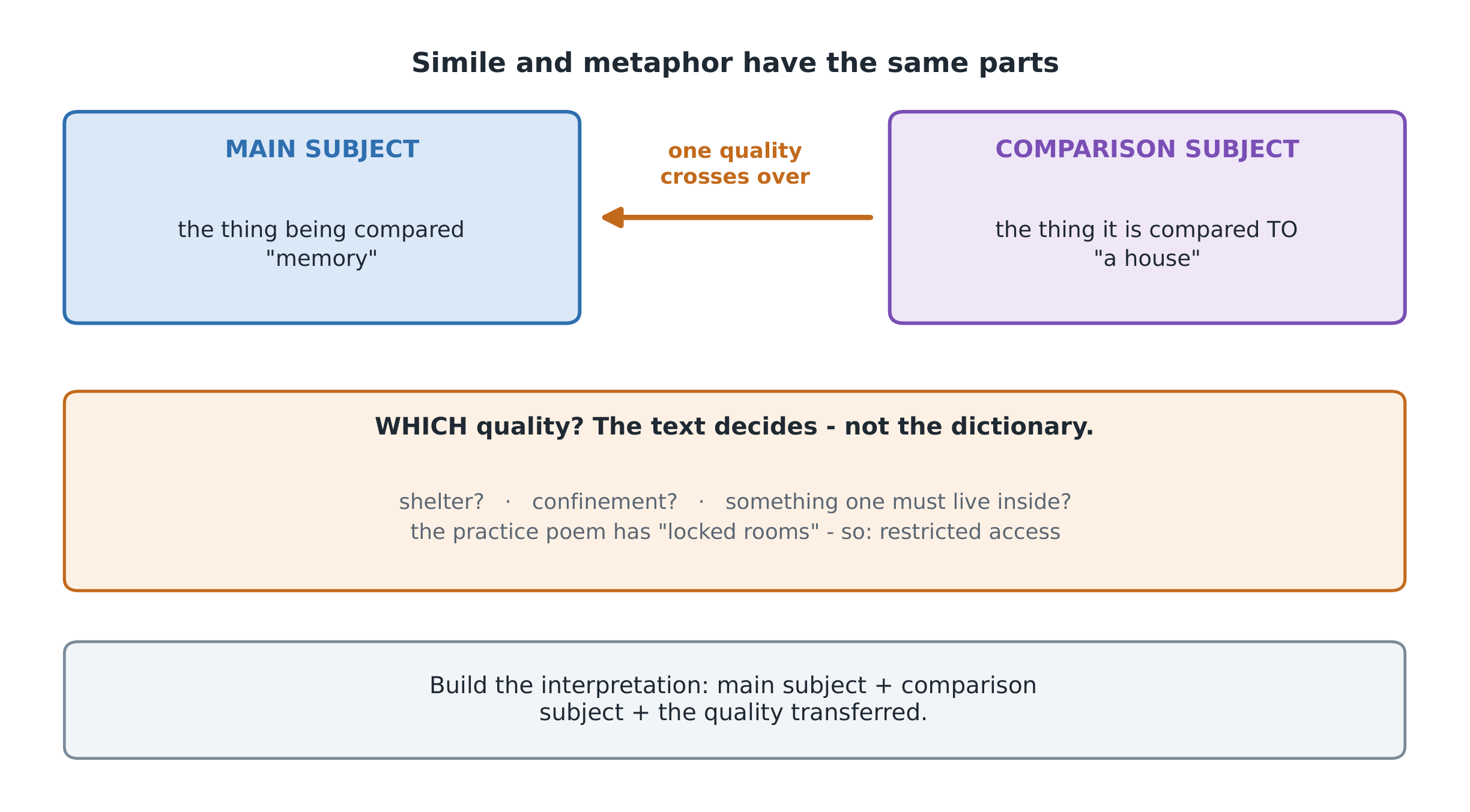
Name the main subject, name the comparison subject, then say which quality crossed over
ה-CED טוען שבמטאפורה, ההבדלים בין שני הדברים...
רמת קושי 1/5 · 100 מטבעות + בונוס קטן בהשלמה הראשונה היום
המקום שבו המשוואה נשברת הוא לעיתים הקריטי ביותר בשיר.
Comparisons draw on the reader
- Comparisons draw on the experiences and associations readers already have with those objects and concepts.
- So a metaphor is a transaction with the reader, not a property of the page.
- A comparison to something the reader has no associations with does nothing at all.
השוואות מתבססות על החוויות וה____ שהקוראים כבר יש להם.
רמת קושי 1/5 · 100 מטבעות + בונוס קטן בהשלמה הראשונה היום
לכן המטאפורה היא עסקה עם הקורא, ולא תכונה של העמוד.
התאם כל מונח לתפקידו.
רמת קושי 2/5 · 140 מטבעות + בונוס קטן בהשלמה הראשונה היום
שני התפקידים הראשונים משותפים לסימיליה; השלישי הוא מה שמייצר הבדלים בקריאות.
The differences between the two things may also be revealing. Most answers stop at what the two share. Asking where the likeness breaks down — and whether the poem knows it breaks down — is what separates an adequate reading from a sophisticated one.
משותף, שונה או בהתאם להקשר?
מיינו כל תצפית על הבכי הוא מדינה.
אותה מטאפורה בשני שירים שונים חייבת לדרוש את אותו משמעות.
רמת קושי 1/5 · 100 מטבעות + בונוס קטן בהשלמה הראשונה היום
הפרשנות עשויה לתלות בהקשר השימוש — מה שקורה קובע מה מעביר.
Context decides what transfers
- Interpretation of a metaphor may depend on the context of its use — what is happening in the text may determine what is transferred.
- The same metaphor in two poems can mean opposite things.
- So never analyse a metaphor from the metaphor alone; read the lines that surround it.
בחר את כל השלבים של מעבר המטאפורה.
רמת קושי 2/5 · 140 מטבעות + בונוס קטן בהשלמה הראשונה היום
השלב השלישי הוא שבו הסימונים בדרך כלל מופיעים.
A metaphor pass
- Name both subjects. Say what quality the context transfers.
- Then ask where the likeness fails, and whether the poem uses that failure.
- Two answers instead of one, and the second is where the marks usually are.
Grief is a country. Shared: it has borders, and you can be inside it. Different: you can leave a country, and the poem's next line — "no one is issued papers" — reaches for exactly that difference. The failure of the likeness is the point.
A metaphor implies similarities between two usually unrelated things — with a main subject and a comparison subject, as a simile has. The differences may also be revealing. Comparisons draw on readers' existing associations, and context determines what is transferred.