מה שנקודת מבט יכולה ולא יכולה לעשות
הוצגEvery point of view has a limit
- Point of view contributes to what narrators can and cannot provide, based on their level of involvement and intimacy with the details, events and characters.
- So the useful question is not "which type is it?" but "what is unavailable here?"
- What a narration cannot reach is where its meaning usually is.
An all-knowing narrator may know every character’s thoughts; a first-person narrator can know surprisingly little about their own.
השאלה המועילה ביותר לגבי נקודת מבט היא...
רמת קושי 1/5 · 100 מטבעות + בונוס קטן בהשלמה הראשונה היום
מה שהסיפור לא מגיע אליו הוא לרוב מקום המשמעות שלו.
First-person narrators are inside
- First-person narrators are involved in the narrative.
- Their relationship to the events and the other characters shapes their perspective.
- Narrators may also be characters, and that role influences everything they report.
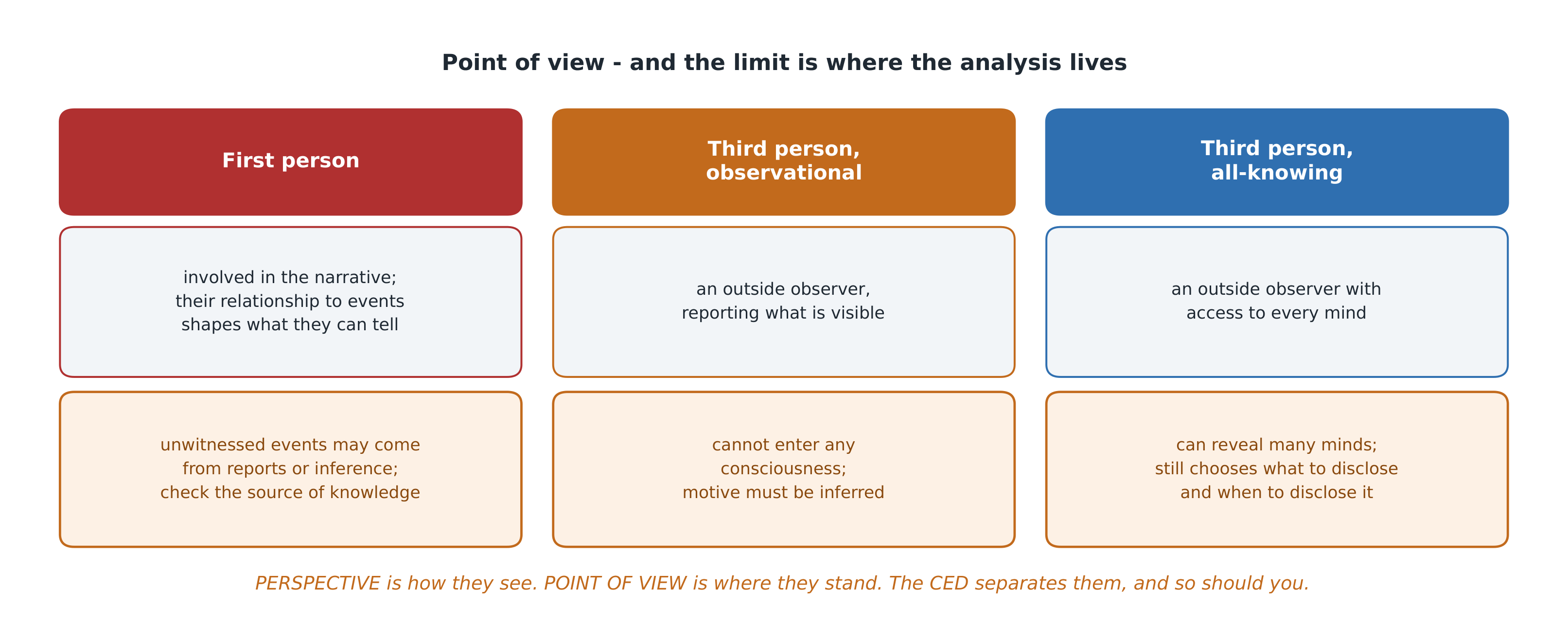
Perspective is how they see; point of view is where they stand. The CED separates them, and so should you
יחסו של המספר ב人称 ראשונה לדמויות האחרות מעצב את נקודת מבטו.
רמת קושי 1/5 · 100 מטבעות + בונוס קטן בהשלמה הראשונה היום
הם מעורבים בסיפור, ולכן היחס הוא חלק מהדיווח.
Third-person narrators are outside observers
- Third-person narrators are outside observers.
- Their knowledge ranges from observational to all-knowing, and that range shapes their perspective.
- Their outside perspective may not be affected by the events — a detachment worth noticing when the events are terrible.
מה עושה נקודת המבט הזו לא זמינה?
סדר את כל הסיפורים לפי מה שהקורא אינו מגיע אליו.
בחר את כולם מאמרי ה-ED לגבי מספרים בשלישי.
רמת קושי 2/5 · 140 מטבעות + בונוס קטן בהשלמה הראשונה היום
המספרים ב人称 ראשונה הם אלו שיכולים להיות גם דמויות.
נקודת המבט קובעת מה המספר יכול להעביר, בהתבסס על רמת ה____ והאינטימיות שלו.
רמת קושי 1/5 · 100 מטבעות + בונוס קטן בהשלמה הראשונה היום
מעורבות ואינטימיות עם פרטים, אירועים ודמויות.
Naming the point of view is not explaining its function. "It is first-person" is identification. The function is what that position makes unavailable — a first-person narrator cannot report what another character thinks, so everything the reader believes about that character has passed through one interested pair of eyes.
Range is a spectrum, not two boxes
- Observational third-person reports only what could be seen or heard.
- All-knowing third-person enters any mind at will.
- Most narration sits between, and where it sits — whose mind it enters, whose it does not — is the analysable choice.
התאם כל מספר למה שהקורא מופרד ממנו.
רמת קושי 2/5 · 140 מטבעות + בונוס קטן בהשלמה הראשונה היום
הNaming of the denial is the function; naming the type is only identification. → מינוי החוסר הוא התפקיד; מינוי הסוג הוא רק זיהוי.
A point-of-view pass
- Name the person. Name whose thoughts are accessible and whose are not.
- Ask whether the narrator is affected by what they report.
- Then say what the reader is therefore denied — that denial is the function.
A third-person narrator enters the mother's thoughts throughout, and never once the daughter's. The reader therefore knows the mother's reasons and only the daughter's behaviour — so the daughter seems unreasonable, and the story's final turn is the reader discovering that this was a choice of access, not a fact about her.
Point of view governs what a narrator can and cannot provide, by involvement and intimacy. First-person narrators are involved and may be characters; third-person narrators are outside observers whose knowledge ranges from observational to all-knowing and who may not be affected by the events. The function is what the reader is denied.