מי מספר זאת?
הוצג| English | משמעות |
|---|---|
| Point of view/pɔɪnt ɒv vjuː/ | נקודת תצפית |
Somebody is always telling it
- Narrators or speakers relate accounts to readers and establish a relationship between the text and the reader.
- That relationship is built before any event is described.
- So identifying the narrator is not preliminary work — it changes what every later detail means.
The narrator is your tour guide; notice which rooms the tour never enters.
מספרים ומדברים מקשרים חוקיות ומקימים ____ בין הטקסט לבין הקורא.
רמת קושי 1/5 · 100 מטבעות + בונוס קטן בהשלמה הראשונה היום
קשר זה נבנה לפני שמתואר כל אירוע.
Perspective and point of view are different terms
- Perspective refers to how narrators, characters or speakers see their circumstances.
- Point of view 叙述视点 refers to the position from which a narrator or speaker relates the events.
- One is a way of seeing; the other is a place to see from. Exam questions use them precisely.
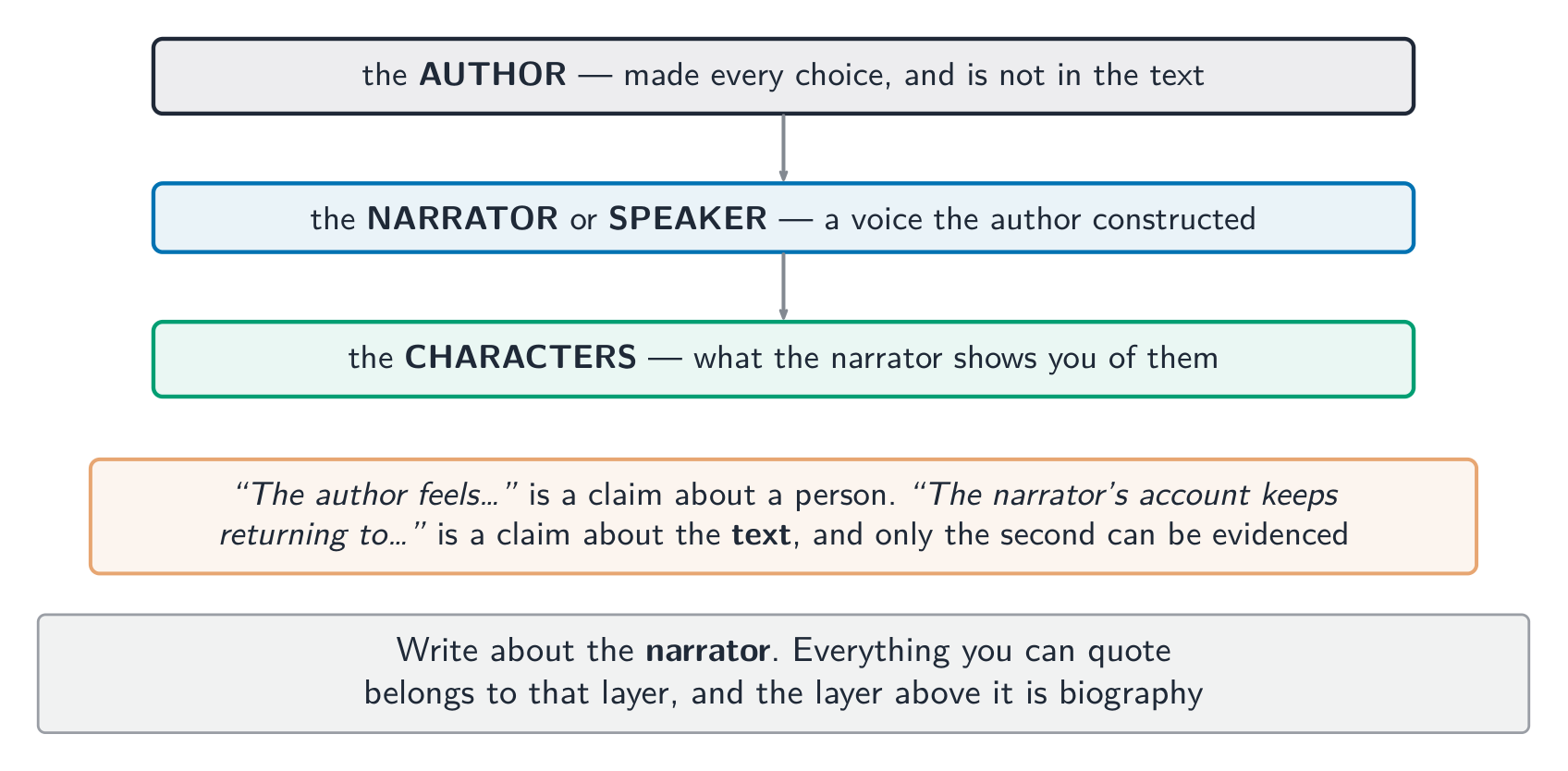
Write about the narrator: everything you can quote belongs to that layer
נקודת מבט, זווית ראייה, או טעות?
מיין כל ביטוי לפי המונח שהוא משתמש בו בפועל.
נקודת מבט מתייחסת ל...
רמת קושי 1/5 · 100 מטבעות + בונוס קטן בהשלמה הראשונה היום
האפשרות הראשונה מגדירה נקודת מבט — המבחן משתמש בשני המונחים בדיוק.
A speaker or narrator is not necessarily the author
- The CED states this outright, and it is the commonest error in student writing.
- "The author says she is frightened" attributes a character's state to a person outside the text.
- Write the speaker, the narrator, or the character's name — never the author's.
המספר של סיפור הוא המחבר של הסיפור הזה.
רמת קושי 1/5 · 100 מטבעות + בונוס קטן בהשלמה הראשונה היום
ה-CED קובע במפורש שמדובר או מספר אינם בהכרח המחבר.
The speaker is not the author. Writing "the author feels" hands a character's state to a real person outside the text and costs marks on every AP rubric. Name the speaker, the narrator, or the character — and keep the author for statements about the writing itself.
התאם כל מונח להגדרה שלו.
רמת קושי 2/5 · 140 מטבעות + בונוס קטן בהשלמה הראשונה היום
שלושה מונחים שהמבחן מבדיל ביניהם — אם כן, שמור עליהם נפרדים בכתיבתך.
Finding the narrator in a poem
- Poems rarely name their speaker, so read for the pronouns and what they claim to know.
- I who knows only their own mind is a different speaker from I who reports another's thoughts.
- An unnamed speaker still has a background, and the poem is where you read it.
בחר את כולם השלבים בתהליך זיהוי.
רמת קושי 2/5 · 140 מטבעות + בונוס קטן בהשלמה הראשונה היום
שתי העובדות ידעיות עושות יותר עבודה אנליטית מאשר כל תווית.
An identification pass
- Name the narrator or speaker. State their grammatical person.
- State one thing they know and one thing they cannot know.
- Those two facts do more analytical work than any label.
A poem's I says the sea forgets nothing. The speaker believes that; whether the poet does is unknowable and irrelevant. Analysis of the speaker's perspective is checkable; analysis of the poet's beliefs is not.
Narrators and speakers relate accounts and establish a relationship with the reader. Perspective = how they see their circumstances; point of view = the position they relate events from. A speaker or narrator is not necessarily the author — name the speaker, never the author.