נוקלאוטידים ומבנה ה-DNA
הוצג| English | משמעות |
|---|---|
| nucleotide/ˈnjuːklɪɒtaɪd/ | נוקלאוטיד |
| nucleic acid/njuːˈklɪɪk ˈæsɪd/ | חומצה גנטית |
| double helix/ˈdʌbl ˈhiːlɪks/ | הליקס כפול |
| purine/ˈpjʊəriːn/ | פיורין |
| pyrimidine/ˈpɪrɪmɪdiːn/ | פירימידין |
| deoxyribose/diːˈɒksɪrɪbəʊs/ | דאוקסיריבוז |
| phosphodiester bond/ˈfɒsfəʊdɪstə bɒnd/ | קשר פוספודיאסטרי |
| antiparallel/ˌæntɪˈpærəlel/ | אנטי-פראלל |
| complementary base pairing/ˌkɒmplɪˈmentəri beɪs ˈpeərɪŋ/ | צמודות בסיסים משלימה |
Nucleotides 核苷酸 and DNA
- DNA and RNA are nucleic acids 核酸 — polymers of small units called nucleotides.
- The same building block also powers the cell as ATP.
- DNA's famous shape, the double helix 双螺旋, comes from how its bases pair up.
Nucleotides and bases
- Each nucleotide has three parts: a phosphate, a 5-carbon sugar, and a base.
- ATP is a nucleotide with the base adenine, the sugar ribose, and three phosphates — breaking off the last one releases energy.
- Five bases, in two groups:
- purines 嘌呤 (double ring): adenine (A), guanine (G).
- pyrimidines 嘧啶 (single ring): cytosine (C), thymine (T), uracil (U).

Purines (A, G) have a double ring; pyrimidines (C, T, U) have a single ring

A space-filling model of the DNA double helix, showing its twisted-ladder shape
נוקלאוטיד יחיד מורכב מ:
Difficulty 1/5 · 100 coins + a small bonus on first completion today
לכל נוקלאוטיד יש שלושה חלקים: קבוצת פוספט, סוכר פנטוז ובסיס המכיל חנקן.
ATP משחרר אנרגיה לתא כאשר:
Difficulty 1/5 · 100 coins + a small bonus on first completion today
ATP מכיל שלושה פוספטים; ניתוק הפוספט הקצה משחרר אנרגיה.
The DNA backbone
- DNA is two strands twisted into a double helix.
- Each strand has a backbone of alternating deoxyribose 脱氧核糖 sugar and phosphate, joined by phosphodiester bonds 磷酸二酯键.
- The two strands run in opposite directions — they are antiparallel 反平行 (one 5′→3′, the other 3′→5′).

A nucleotide and ATP
חקור את סולם ה-DNA
לחצו על כל חלק מהדבל-הלוקס — שני גבולות אנטי-פראללים עם זוגות בסיסים משלימים כמדרגות.
שתי רצועות ה-DNA מתוארות כאנטיפראללליות כי הן:
Difficulty 1/5 · 100 coins + a small bonus on first completion today
אנטי-פראללי פירונו שהמחגים מצביעים בכיוונים מנוגדים: 5′→3′ באחד, ו-3′→5′ בשני.
Complementary base pairing 碱基互补配对
- The strands are held together by their bases in the middle, paired exactly:
- A pairs with T — 2 hydrogen bonds.
- C pairs with G — 3 hydrogen bonds (so C–G is harder to separate).
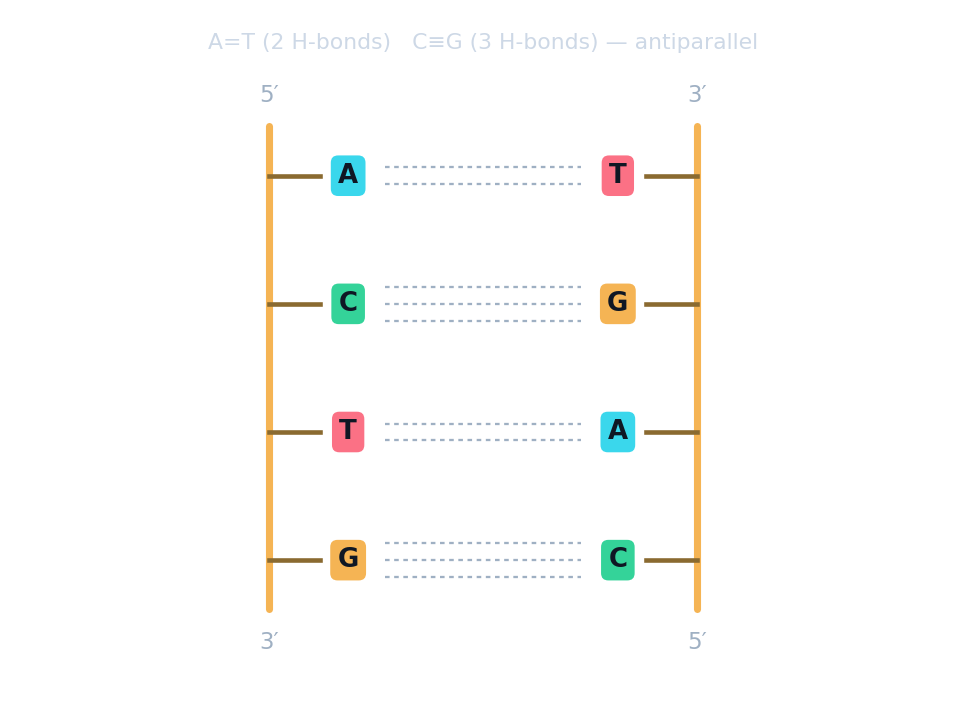
התאם כל קבוצת בסיסים לתיאורה המתאים.
Difficulty 2/5 · 140 coins + a small bonus on first completion today
פיורין (טבעת כפולה) תמיד מזווג עם פירימידין (טבעת יחידה): A–T ו-C–G.
ב-DNA, A תמיד זוגי עם T, ו-C תמיד זוגי עם ______.
Difficulty 1/5 · 100 coins + a small bonus on first completion today
זיווג בסיסים משלים: A–T (2 קשרי מימן) ו-C–G (3 קשרי מימן).
דגימת DNA מכילה 30% אדנין. מכיוון ש-A זוגי עם T, מהו אחוז התימין?
Difficulty 2/5 · 140 coins + a small bonus on first completion today
A תמיד זוגי עם T, ולכן %A = %T. עם 30% אדנין יש 30% תימין (שאר ה-40% מתחלקים בין C ל-G).
זוגות Bases C–G בעלי 3 קשרי מימן, ולכן קשה יותר לפרק אותם מאשר זוגות A–T.
Difficulty 1/5 · 100 coins + a small bonus on first completion today
C–G מחובר על ידי 3 קשרי מימן ואילו A–T רק על ידי 2, ולכן DNA עם יותר C–G הוא יציב יותר.
You've got it
- nucleotide = phosphate + sugar + base; ATP = adenine + ribose + 3 phosphates (energy)
- purines (A, G, double ring) vs pyrimidines (C, T, U, single ring)
- DNA = double helix; backbone = deoxyribose + phosphate (phosphodiester bonds); strands antiparallel
- A–T (2 H-bonds), C–G (3 H-bonds) — complementary base pairing