IGCSE Economics (0455) has six topics: the basic economic problem, the allocation of resources, microeconomic decision-makers, government and the macroeconomy, economic development, and international trade. There are two papers — one multiple-choice, one structured.
The structured paper decides grades, and diagrams decide the structured paper. A demand-and-supply answer written in prose will not score what the same answer scores with a labelled diagram and a stated direction of shift.
Learn to draw each diagram from a blank page — both axes labelled, the shift arrowed. In the exam you are drawing, not recognising. The higher-mark parts ask you to evaluate, which means saying when your answer would not hold.
understand the economic problem: finite (scarce) resources and unlimited wants
distinguish economic goods (scarce, have an opportunity cost) and free goods
understand that the economic problem forces consumers, workers, producers and governments to make choices
עברית
הבנת הבעיה הכלכלית: משאבים מוגבלים (נדירים) ורצונות בלתי מוגבלים
להבדיל בין סחורות כלכליות (נדירות, יש להן עלות הזדמנות) לסחורות חופשיות
להבין כי הבעיה הכלכלית מחייבת צרכנים, עובדים, יצרנים וממשלות לבצע בחירות
Source: Cambridge International syllabus · מקור: הסיילבוס הבינלאומי של קמבריד'ג'
English
Economics is about how people use resources 资源 to meet their needs and wants. The main idea is simple. People want a lot, but there are not enough resources to make everything. This is the economic problem 经济问题.
Two facts cause the economic problem:
Resources are finite 有限的. There is only a limited amount of them.
People's wants 欲望 are unlimited. People always want more and better things.
Because wants are unlimited but resources are limited, resources are scarce 稀缺. We call this problem scarcity 稀缺性. Scarcity is the root of all economics.
Goods, services, and choices
We use resources to make goods 物品 (things you can touch, like food and phones) and services 服务 (jobs done for you, like a haircut or a bus ride).
Because resources are scarce, we cannot have everything. So everyone must make choices. Scarcity forces four groups to choose:
consumers 消费者 — people who buy and use goods and services. They choose what to buy.
workers 工人 — they choose which job to do.
producers 生产者, also called firms 企业 — they make goods and services. They choose what to produce.
governments 政府 — they choose what to provide and how to spend public money.
Economic goods and free goods
Most things are economic goods 经济物品. They are scarce, so making or using one means giving something else up. Economic goods have an opportunity cost 机会成本 (explained below).
A few things are free goods 免费物品. They are not scarce — there is enough for everyone and they cost nothing to use. Examples are the air you breathe and sunlight. A free good has no opportunity cost.
Be careful: a "free" sample or a "free" gift is not a free good. Resources were used to make it, so it is still an economic good.
עברית
כלכל עוסק באופן שבו אנשים משמשים משאבים כדי לענות על צרכיהם ובקשותיהם. הרעיון המרכזי הוא פשוט: לאנשים יש ביקוש רב, אך אין מספיק משאבים ליצור הכל. זהו ה-בעיה הכלכלית.
שתי עובדות גורמות לבעיה הכלכלית:
המשאבים הם מוגבלים. קיים כמות מוגבלת שלהם.
הבקשות של האנשים אינסופיות. אנשים תמיד רוצים יותר ודברים טובים יותר.
מכיוון שבקשות אינסופיות אך משאבים מוגבלים, המשאבים הם נדירים. אנו מכנים בעיה זו מדירות. מדירות היא השורש לכלכל.
הבעיה הכלכלית: מדירות מחייבת בחירה, וכל בחירה כרוכה בעלות הזדמנות
סחורות, שירותים ובחירות
אנו משמשים משאבים ליצירת סחורות (דברים שניתן לגעת בהם, כמו מזון ומכשירי טלפון) ושירותים (עבודות שנעשות עבורנו, כמו גזירת שיער או נסיעה אוטובוס).
מכיוון שמשאבים נדירים, איננו יכולים לקבל הכל. לכן כל אחד חייב לבצע בחירות. מדירות מחייבת ארבעה קבוצות לבחור:
צרכנים — אנשים הקונים ומשתמשים בסחורות ושירותים. הם בוחרים מה לקנות.
עובדים — הם בוחרים איזה עבודה לעשות.
מייצרים, הנקראים גם חברות — הם מייצרים סחורות ושירותים. הם בוחרים מה לייצר.
ממשלות — הן בוחרות מה לספק וכיצד להוציא כסף ציבורי.
סחורות כלכליות וסחורות חינם
רוב הדברים הם סחורות כלכליות. הן נדירות, ולכן ייצור או שימוש באחת מהן דורש ויתור על דבר אחר. לסחורות כלכליות יש עלות הזדמנות (הסבר בהמשך).
כמה דברים הם סחורות חינם. הן אינן נדירות — יש מספיק עבור כולם והשימוש בהן אינו עולה כלום. דוגמאות הן האוויר שאנחנו נושמים והאור השמשי. לסחורה חינם אין עלות הזדמנות.
היזהרו: "דוגמית חינם" או "מתנה חינם" אינם סחורה חינם. משאבים שימשו ליצירתם, ולכן הם עדיין סחורות כלכליות.
Explore · חקור
Scarcity and choice · מדדים ובחירה
Limited resources mean producing more of one good costs some of the other — the opportunity cost, shown by the frontier. · משאבים מוגבלים אומרים שייצור יותר של מוצר אחד דורש ויתור על חלק ממשהו אחר — העלות ההזדמנות, המוצגת על ידי הגבול.
define the four factors of production: land, labour, capital and enterprise, with examples
state the reward to each factor (rent, wages, interest, profit)
explain the mobility of the factors of production and the causes of changes in their quantity and quality
עברית
להגדיר את ארבעת גורמי הייצור: אדמה, עבודה, הון וא enterprise, עם דוגמאות
לציין את התמורה לכל גורם (שכר ארץ, שכר עבודה, ריבית, רווח)
להסביר את תנועתיות גורמי הייצור ואת הגורמים לשינויים בכמות ובאיכות שלהם
Source: Cambridge International syllabus · מקור: הסיילבוס הבינלאומי של קמבריד'ג'
English
To make goods and services, firms use four types of resource. We call them the factors of production 生产要素.
The four factors
Factor
What it is
Example
land 土地
natural resources
fields, water, oil, forests
labour 劳动
human work
a teacher, a builder, a nurse
capital 资本
man-made things used to produce
machines, tools, factories
enterprise 企业家才能
organising the other three and taking risks
a person who starts a business
The person who provides enterprise is the entrepreneur 企业家. They bring the other factors together and risk their own money to start and run a business.
The reward to each factor
Each factor earns a reward 报酬 — the income it gets for being used:
Factor
Reward
land
rent 地租
labour
wages 工资
capital
interest 利息
enterprise
profit 利润
Mobility, quantity and quality
The mobility 流动性 of a factor means how easily it can move to a different use or place. A worker with many skills can change jobs easily, so labour is mobile. A worker with only one skill, or a factory that cannot be moved, is less mobile.
The quantity and quality of factors can change:
Quantity can rise or fall. The amount of labour grows if the birth rate rises or people move into the country to work. Land can be lost to the sea or gained by draining it.
Quality can rise. Training and education make labour better. New technology makes capital better. Higher quality means each factor can produce more.
עברית
כדי לייצר סחורות ושירותים, חברות משתמשות בארבעה סוגי משאבים. אנו מכנים אותם גורמי ייצור.
ארבעת גורמי הייצור והתמורה שקולט כל אחד מהם
הארבעה גורמים
גורם
מהו
דוגמה
קרקע
משאבים טבעיים
שדות, מים, נפט, יערות
עבודה
מאמץ אנושי
מורה, בונה, אחיות
הון
חפצים מעשה ידי אדם המשמשים לייצור
מכונות, כלי עבודה, מפעלים
עסקאות
ארגון השלושה גורמים האחרים וקיחת סיכונים
אדם שמייסד עסק
האדם המספק את הגורם של עסקאות הוא היזם. הוא מקבץ ביחד את גורמי הייצור האחרים ומסכן כסף משלו כדי להקים ולנהל עסק.
אדמה — משאבי טבע כמו אדמות חקלאיות — היא אחד מארבעת גורמי הייצור
התמורה לכל גורם
כל גורם מקבל תמורה – ההכנסה שהוא מקבל על כך ששימש:
גורם
תמורה
קרקע
שכירות
עבודה
שכר
הון
ריבית
עסקאות
רווח
תנועתיות, כמות ואיכות
תנועתיות של גורם היא עד כמה הוא יכול לעבור בקלות לשימוש או למיקום אחר. עובד עם הרבה כישורים יכול לשנות תפקיד בקלות, ולכן העבודה היא תנועתית. עובד בעל כישור אחד בלבד, או מפעל שלא ניתן להזיז, פחות תנועתי.
הכמות והאיכות של גורמים עשויים להשתנות:
כמות יכולה לעלות או לרדת. כמות העבודה גדלה אם שיעור הלידה עולה או אנשים נכנסים למדינה כדי לעבוד. אדמה עלולה לאבד לים או להיחצב.
איכות יכולה לעלות. הכשרה וחינוך משפרים את איכות העבודה. טכנולוגיה חדשה משפרת את איכות ההון. איכות גבוהה יותר פירושה שכל גורם מסוגל לייצר יותר.
Explore · חקור
Factors of production lab · מעבדת גורמי ייצור
Sort real resources by the factor of production they represent. · מיינו את המשאבים האמיתיים לפי גורם הייצור ש הם מייצגים.
define opportunity cost as the next best alternative given up when a choice is made
explain how opportunity cost influences decisions made by consumers, workers, producers and governments
עברית
להגדיר עלות הזדמנות כהחלופה הטובה ביותר שנעזבה בעת ביצוע בחירה
להסביר כיצד עלות הזדמנות משפיעה על החלטות של צרכנים, עובדים, יצרנים וממשלות
Source: Cambridge International syllabus · מקור: הסיילבוס הבינלאומי של קמבריד'ג'
English
The PPF and opportunity cost
When you choose one thing, you give up the next best choice. That is the real cost of your decision.
Opportunity cost is the next best alternative 替代选择 you give up when you make a choice.
It affects every decision-maker:
A consumer who buys a game gives up the book they could have bought instead.
A worker who takes one job gives up the pay of the next job they could have done.
A producer who makes more cars uses factors that could have made trucks.
A government that builds a hospital gives up the school it could have built with the same money.
Opportunity cost matters because resources are scarce. Every choice has a cost, even when no money changes hands.
עברית
PPF והעלות ההקפניתצרכנים בוחרים מה לקנות בשוק עמוס — הצמצות מחייבת את כולם להכריעבחירה בדבר אחד פירוניה לוותר על האלטרנטיבה הטובה הבאה
כשאתה בוחר דבר אחד, אתה מוותר על האפשרות הטובה ביותר הבאה. זהו הערך האמיתי של החלטתך.
עלות הזדמנות היא האלטרנטיבה הטובה ביותר שמפסידים כאשר עושים בחירה.
זה משפיע על כל קבלן החלטות:
צרכן שקונה משחק מוותר על הספר שהיה יכול לקנות במקום.
עובד שמקבל משרה אחת מוותר על השכר של המשרה הבאה שהיה יכול לבצע.
מייצר שמייצר יותר רכבים משתמש בגורמים שהיו יכולים לייצר משאיות.
ממשלה בונה בית חולים ומפסידה את בית הספר שהייתה יכולה לבנות באותו כסף.
עלות הזדמנות חשובה כי משאבים הם מצומצמים. לכל בחירה יש עלות, גם כשאין מעבר כסף.
Explore · חקור
Opportunity cost on the frontier · עלות הזדמנות לאורך הפנייה
Moving along the frontier, gaining more of one good always means giving up some of the other — that sacrifice is the opportunity cost. · בהתקדמות לאורך הפנייה, השגחה גדולה יותר של טוב אחד תמיד דורשת ויתור על חלק מהטוב השני — ויתור זה הוא עלות ההזדמנות.
Production possibility curve (PPC) diagrams · דיאגרמות עקומת האפשרויות לייצור (PPC)
Syllabus · סיילבוס
English
draw and interpret a PPC showing the maximum combinations of two goods that can be produced
explain points on, inside and outside the curve and movements along the curve (opportunity cost)
explain causes of shifts in the PPC (changes in the quantity/quality of resources, economic growth or decline)
עברית
לשרטט ולפרש קשת PPC המראה את השילובים המקסימליים של שני סוגי סחורות שיכולות להיות מיוצרות
להסביר נקודות על הקשת, בתוכה ובחוצה לה, ותנועות לאורך הקשת (עלות הזדמנות)
להסביר גורמים להזזות בקשת PPC (שינויים בכמות/איכות המשאבים, צמיחה או ירידה כלכלית)
Source: Cambridge International syllabus · מקור: הסיילבוס הבינלאומי של קמבריד'ג'
English
A production possibility curve 生产可能性曲线 (PPC) shows the largest amounts of two goods a country can make when it uses all its resources fully.
Imagine an economy that makes only two types of good, one on each axis:
capital goods — used to make other goods, like machines.
consumer goods — used up by people, like food and clothes.
The PPC is the line joining every point where the economy uses all its resources to make the most it can.
Reading the diagram
Picture the two goods on the two axes. The PPC is a curve that bends from one axis down to the other (it usually bows outward, away from the corner):
A point on the curve: all resources are used fully. The economy makes the most it can.
A point inside the curve: resources are wasted or not all used — for example, there is unemployment 失业. The economy could make more.
A point outside the curve: this is impossible now. There are not enough resources to reach it.
Movements along the curve
If the economy already uses all its resources (a point on the curve), making more of one good means making less of the other. You must move factors from one good to the other. This is a trade-off 取舍.
The amount of the second good you give up is the opportunity cost of the extra first good. This is why the PPC is a clear picture of opportunity cost.
Worked example. An economy on its PPC makes 40 machines and 60 tonnes of food. To make 50 machines it must cut food to 45 tonnes. Give the opportunity cost of the extra machines. Then say what a point of 30 machines and 40 tonnes of food would tell you. The economy is already on the curve, so more of one good must mean less of the other: the 10 extra machines cost 60 − 45 = 15 tonnes of food. That lost food is the opportunity cost, so quote it in tonnes of food - never in money. The second point lies inside the curve, which means resources are idle or wasted, most likely through unemployment; from there the economy could make more of both goods, so moving out to the curve costs nothing at all. Opportunity cost only bites once you are on the curve.
Shifts of the curve
The whole curve can move:
It shifts outward (to the right) when the country can make more of both goods. This is economic growth 经济增长. Causes: more resources (a bigger workforce, more land discovered) or better-quality resources (training, new technology).
It shifts inward (to the left) when the country can make less. This is economic decline 经济衰退. Causes: fewer or worse resources — for example a war, a natural disaster, or using up non-renewable resources 不可再生资源 (resources like oil and coal that cannot be replaced once used).
Do not confuse the two. Moving from inside the curve to the curve (by using idle resources) is a short-term gain. Moving the whole curve outward is a long-term change.
עברית
עקומת האפשרויות לייצור (PPC) מראה את הכמויות הגדולות ביותר של שני סוגי סחורות שארץ יכולה לייצר כאשר היא משתמשת במלא בכל משאביה.
דמיין כלכלה שמייצרת רק שני סוגי סחורות, אחד על כל ציר:
סחורות הון — משמשות לייצור סחורות אחרות, כמו מכונות.
סחורות צריכה — נצילות על ידי אנשים, כמו מזון ובגדים.
עקומת ה-PPC היא הקו המחבר כל נקודה בה הכלכלה משתמשת בכל משאביה כדי לייצר את המקסימום האפשרי.
קריאת הגרף
דמיינו את שני הסוגים של סחורות על שני צירי הקואורדינטות. פקודת האפשרויות לייצור (PPC) היא עקומה הנמתחת מאחד הצירים אל השני (בדרך כלל בולטת החוצה, הרחוקה מהפינה):
נקודה על העקומה: כל המשאבים מושקעים במלואם. הכלכלה מייצרת כמיטב יכולתה.
נקודה בתוך העקומה: משאבים מבוזבזים או לא מושקעים במלואם — לדוגמה, קיים אובדן תעסוקה. הכלכלה יכלה לייצר יותר.
נקודה חוץ לעקומה: מצב זה בלתי אפשרי כעת. אין מספיק משאבים כדי להגיע אליו.
נקודה על העקומה משקיעה את כל המשאבים; בתוך העקומה חלקם מבוזבזים (כגון אובדן תעסוקה); מחוץ לה אינה אפשרית עם המשאבים הקיימים היום.
תנועה לאורך העקומה
אם הכלכלה משקיעה כבר את כל משאביה (נקודה על העקומה), ייצור רב יותר של סוג אחד דורש ייצור פחות של השני. יש להעביר גורמי ייצור מסוג אחד לשני. זוהי התנגשות (trade-off).
כמות הסוג השני שהותרת היא עלות ההזדמנות של הסוג הראשון הנוסף. מכאן שמשתמע ה-PPC הוא תמונה ברורה של עלות הזדמנות.
דוגמה מופתרת. כלכלה הממוקמת על ה-PPC שלה מייצרת 40 מכונות ו-60 טון מזון. כדי לייצר 50 מכונות עליה להוריד את ייצור המזון ל-45 טון. חשבו את עלות ההזדמנות של המכונות הנוספות. לאחר מכן, אמרו מה הנקודה של 30 מכונות ו-40 טון מזון אומרת לנו. הכלכלה נמצאת כבר על העקומה, ולכן ייצור רב יותר של סוג אחד חייב להיות伴随着 פחות של השני: ה-10 המכונות הנוספות עולות 60 − 45 = 15 טון מזון. המזון שאבד הוא עלות ההזדמנות, ולכן יש לתרגם אותו בטון מזון - לעולם לא בכסף. הנקודה השנייה נמצאת בתוך העקומה, מה שמעיד על כך שמשאבים מושקעים או מבוזבזים, ככל הנראה בשל אובדן תעסוקה; משם הכלכלה יכלה לייצר יותר משני הסוגים, ולכן מעבר החוצה לעקומה אינו כרוך באף עלות. עלות ההזדמנות מופיעה רק כאשר אתם על העקומה.
הזזות של העקומה
ניתן להזיז את כל העקומה:
היא זזה החוצה (ימינה) כאשר המדינה יכולה לייצר יותר משני הסוגים. זהו צמיחה כלכלית. גורמים: משאבים נוספים (כוח עבודה גדול יותר, גילוי אדמות חדשות) או משאבים בעלי איכות טובה יותר (הכשרה, טכנולוגיה חדשה).
היא זזה פנימה (שמאלה) כאשר המדינה יכולה לייצר פחות. זהו ירידה כלכלית. גורמים: משאבים פחותים או גרועים יותר — לדוגמה מלחמה, אסון טבע, או שימוש במשאבים לא מתחדשים (משאבים כמו נפט ופחם שאין לחלופין לאחר השימוש בהם).
משאבים נוספים או טובים יותר מזיזים את כל ה-PPC החוצה (צמיחה); מלחמה, אסון או שימוש במשאבים מזיזים אותה פנימה (ירידה).
אל תבלבלו בין שניהם. מעבר מתוך העקומה אל העקומה (ע ידי שימוש במשאבים מושקעים) הוא רווח לטווח קצר. הזזת כל העקומה החוצה היא שינוי לטווח ארוך.
Explore · חקור
The production possibility curve · עקום אפשרויות הייצור
Move along the curve: making more of one good means making less of the other — that's opportunity cost. · זוז לאורך העקומה: יצירת יותר של מוצר אחד דורשת פחות ממוצר אחר — זהו עלות הזדמנות.
Scarcity (unlimited wants, limited resources) forces choice, and every choice has an opportunity cost — the next best alternative you give up.
Learn the four factors of production and the reward each earns: land–rent, labour–wages, capital–interest, enterprise–profit.
On a PPC, a point on the curve uses all resources fully, inside wastes some (e.g. unemployment), and outside is impossible for now. Moving along the curve shows opportunity cost.
Moving to the curve (using idle resources) is a short-term gain; shifting the whole curve outward is long-term economic growth from more or better resources.
עברית
חסכנות (רצונות בלתי מוגבלים, משאבים מוגבלים) מחייבות בחירה, ולכל בחירה יש עלות הזדמנות — האלטרנטיבה הטובה ביותר שנתנסתה.
למדו את ארבעת גורמי הייצור והתמורה שכל אחד מהם מייצר: אדמה–שכירות, עבודה–שכר, הון–ריבית, יוזמה–רווח.
ב-PPC, נקודה על העקומה משקיעה את כל המשאבים במלואם, בתוך בוזבזת חלקם (כגון אובדן תעסוקה), וחוץ ממנו בלתי אפשרי כעת. תנועה לאורך העקומה מדגימה עלות הזדמנות.
תנועה על העקומה (שימוש במשאבים מובטלים) היא רווח לטווח קצר; הזזת כל העקומה כלפי חוץ היא צמיחה כלכלית לטווח ארוך הנובעת ממשאבים רבים או טובים יותר.
Markets and the price mechanism · שווקים ומנגנון המחיר
Syllabus · סיילבוס
English
define microeconomics and macroeconomics
explain how the market (price mechanism) allocates resources through the signalling, incentive and rationing functions of price
עברית
להגדיר מיקרוכלכליות ומקרוכלכליות
להסביר כיצד השוק (מנגנון המחיר) מקצה משאבים באמצעות פונקציות המסר, העודד והקצונה של המחיר
Source: Cambridge International syllabus · מקור: הסיילבוס הבינלאומי של קמבריד'ג'
English
Economics is split into two parts:
microeconomics 微观经济学 — the study of single parts of the economy, such as one industry or one product.
macroeconomics 宏观经济学 — the study of the whole economy, like total jobs, prices, and growth.
A market 市场 is any place or system where buyers and sellers meet to trade. It does not need a building — it can be online or over the phone.
When a market is free, no one is in charge of deciding what to make. Instead, the price mechanism 价格机制 (the free movement of prices) allocates 配置resources 资源 — it decides what is made, how, and for whom. Price does three jobs:
the signalling 信号 function — a price change tells buyers and sellers what is happening. A rising price signals "make more"; a falling price signals "make less".
the incentive 激励 function — a higher price gives firms 企业 a reason to produce more, because they can earn more.
the rationing 配给 function — when a product is scarce, its price rises. The high price shares out the limited amount to those willing to pay.
עברית
כלכלה מחולקת לשני חלקים:
מיקרוכלכלות — עיון בחלקים בודדים מהכלכלה, כגון תעשייה אחת או מוצר אחד.
מקרוכלכלות — עיון בכלכלה כולה, כמו תעסוקה כוללת, מחירים וצמיחה.
שוק הוא כל מקום או מערכת בהם קונים ומוכרים נפגשים למטרת מסחר. אינו דורש מבנה — יכול להיות מקוון או בטלפון.
בורסה היא שוק: כאשר קונים ומוכרים סוחרים, הצעותיהם קובעות את מחיר כל מניה
כאשר שוק הוא חופשי, אין מי שמחליט מה לייצר. במקום זאת, מנגנון המחיר (הזזה חופשית של מחירים) מקצהמשאבים — הוא קובע מה מיוצר, איך, ולמי. למחיר יש שלושה תפקידים:
התפקיד האותותי — שינוי במחיר מודיע לקונים ולמוכרים מה קורה. עלייה במחיר מעידה "להגדיל ייצור"; ירידה במחיר מעידה "להקטין ייצור".
התפקיד המניע — מחיר גבוה נותן לחברות סיבה לייצר יותר, משום שהן יכולות להרוויח יותר.
התפקיד הקצאתי — כאשר מוצר מוגבל, מחירו עולה. המחיר הגבוה מחלק את הכמות המוגבלת לאלו המוכנים לשלם.
Explore · חקור
How markets allocate resources · כיצד שווקים מקצים משאבים
Price moves to where demand meets supply. That equilibrium price signals firms what to produce and rations goods to buyers. · המחיר זז למיקום בו הביקוש נפגש עם ההיצע. מחיר האיזון הזה מעיד על חברות מה לייצר ומחלק סחורות לקונים.
2.2
Demand · ביקוש
Syllabus · סיילבוס
English
define demand and explain the law of demand (inverse relationship with price), ceteris paribus
draw demand curves and distinguish a movement along (change in price) from a shift (change in conditions of demand)
list the conditions of demand (income, tastes, price of substitutes and complements, population, advertising)
עברית
הגדר ביקוש והסבר את חוק הביקוש (יחס הפוך עם המחיר), כל עוד דברים אחרים נשארים קבועים
צייר עקומות ביקוש והבחן בין תנועה לאורך (שינוי במחיר) לבין הזזה (שינוי בתנאי הביקוש)
רשום את תנאי הביקוש (הכנסה, טעמים, מחיר של מוצרים תחליפי ומשלים, אוכלוסייה, פרסום)
Source: Cambridge International syllabus · מקור: הסיילבוס הבינלאומי של קמבריד'ג'
English
Demand 需求 is the amount of a good 物品 that consumers 消费者 (buyers) are willing and able to buy at each price, in a period of time.
The law of demand 需求定律 says: when the price of a good rises, the quantity demanded falls; when the price falls, the quantity demanded rises. Price and quantity move in opposite directions — an inverse relationship 反向关系. This is true ceteris paribus 其他条件不变 (a Latin phrase meaning "all other things stay the same").
Movements and shifts
It helps to separate two ideas:
quantity demanded 需求量 — the amount bought at one price.
demand — the whole pattern of buying at every price.
On a demand diagram, price is on the up axis and quantity on the across axis. The demand curve 需求曲线 slopes downward from left to right: high price, low quantity; low price, high quantity.
A change in the good's own price causes a movement along the demand curve. You slide to a new point on the same line.
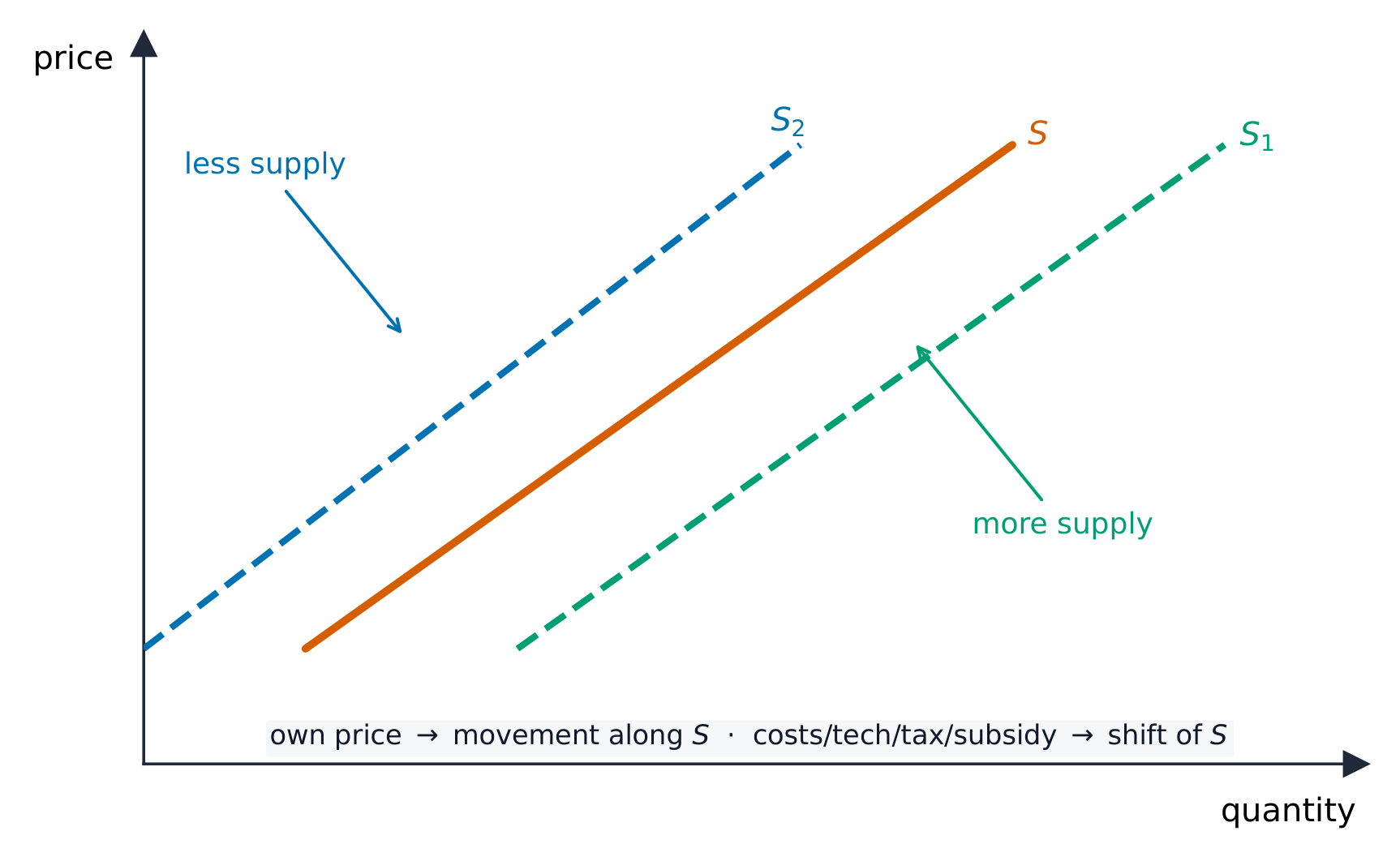
A change in any other condition causes a shift 移动 of the whole curve. A rightward shift means more is demanded at every price; a leftward shift means less.
Conditions of demand
These are the things (other than the good's own price) that shift the demand curve:
income 收入 — more income usually means more demand.
tastes 偏好 — if a good becomes popular, demand rises.
price of substitutes 替代品 — goods used instead of each other (tea and coffee). If coffee gets dearer, demand for tea rises.
price of complements 互补品 — goods used together (cars and fuel). If cars get dearer, demand for fuel falls.
population 人口 — more people means more demand.
advertising 广告 — good adverts raise demand.
עברית
ביקוש הוא הכמות של מוצר שצרכנים (קונים) מוכנים ויכולים לקנות בכל מחיר, בתקופת זמן נתונה.
חוק הביקוש קובע: כאשר מחיר מוצר עולה, הכמות הנבוקשת יורדת; כאשר המחיר יורד, הכמות הנבוקשת עולה. המחיר והכמות זזים בכיוונים הפוכים — יחס הפוך. הדבר נכון ceteris paribus (ביטוי לטיני שפירושו "כל שאר הדברים נשארים זהים").
תנועות והזזות
מועיל להפריד בין שני מושגים:
כמות נבוקשת — הכמות הנקנית במחיר אחד.
ביקוש — כלל הדפוסי הקנייה בכל מחיר.
בגרף ביקוש, המחיר נמצא בציר האנכי והכמות בציר האופקי. עקומת הביקוש יורדת משמאל לימין: מחיר גבוה, כמות נמוכה; מחיר נמוך, כמות גבוהה.
שינוי במחיר עצמי של המוצר גורם לתנועה לאורך עקומת הביקוש. אתה מחליק לנקודה חדשה באותו קו.
שינוי בכל תנאי אחר גורם להזזה של כל העקומה. הזזה ימינה פירושה שנקנית יותר בכל מחיר; הזזה שמאלה פירושה שנקנית פחות.
תנאי ביקוש
אלו הם הגורמים (בנוסף למחיר המוצר עצמו) המשנים את עקומת הביקוש:
הכנסה — הכנסה גבוהה יותר בדרך כלל מובילה לביקוש גבוה יותר.
טעמים — אם מוצר הופך לפופולרי, הביקוש בו עולה.
מחיר של תחליפים — מוצרים המשמשים במקום זה של זה (תה וקפה). אם הקפה יקר יותר, הביקוש לתה עולה.
מחיר של משלים — מוצרים המשמשים יחד (רכבים ואדומן). אם הרכבים יקרים יותר, הביקוש לאדומן יורד.
אוכלוסייה — אוכלוסייה גדולה יותר פירושה ביקוש גבוה יותר.
פרסום — פרסום טוב מעלה את הביקוש.
עקומת הביקוש נוטה לרדת. שינוי בהכנסה, בטעמים, באוכלוסייה או במחירים קשורים משנה את כל העקומה; שינוי במחיר המוצר עצמו הוא תנועה לאורך העקומה.
Explore · חקור
Demand & supply · ביקוש והיצע
Demand slopes down — cheaper means more wanted. · ביקוש נוטה מטה — זול יותר פירושו רצוי יותר.
define supply and explain the law of supply (direct relationship with price)
draw supply curves and distinguish a movement along from a shift
list the conditions of supply (costs of production, technology, taxes/subsidies, weather, number of firms)
עברית
הגדר הצפה והסבר את חוק ההצפה (יחס ישיר עם המחיר)
צייר עקומות הצפה והבחן בין תנועה לאורך לבין הזזה
רשום את תנאי ההצפה (עלויות ייצור, טכנולוגיה, מסים/סובסידיות, מזג אוויר, מספר חברות)
Source: Cambridge International syllabus · מקור: הסיילבוס הבינלאומי של קמבריד'ג'
English
Supply shifts right: P falls, Q rises
Supply 供给 is the amount of a good that firms are willing and able to sell at each price, in a period of time.
The law of supply 供给定律 says: when the price rises, the quantity supplied rises too. Price and quantity move the same way — a direct relationship 正向关系. Firms supply more at a high price because they can earn more.
Movements and shifts
quantity supplied 供给量 — the amount offered at one price.
The supply curve 供给曲线 slopes upward from left to right.
A change in the good's own price → a movement along the curve.
A change in any other condition → a shift of the whole curve.
Conditions of supply
costs of production 生产成本 — if costs rise, firms supply less (curve shifts left).
technology 技术 — better technology lowers costs, so supply rises.
taxes and subsidies — a tax 税收 on a good raises firms' costs (supply falls); a subsidy 补贴 (money from the government) lowers costs (supply rises).
weather — important for farm goods.
number of firms — more firms means more supply.
עברית
העברת ה offers ימינה: P יורד, Q עולה
היצע הוא כמות המוצר שחברות מוכנות ויכולות למכור בכל מחיר, בתקופת זמן נתונה.
חוק ההיצע קובע: כאשר המחיר עולה, גם כמות ההיצע עולה. המחיר וכמות ההיצע נעים באותה כיוון — יחס ישיר. חברות מציעות יותר במחיר גבוה כי הן יכולות להרוויח יותר.
תנועות והזזות
כמות היצע — הכמות המוצעת במחיר אחד.
עקומת ההיצע נוטה לעלות משמאל לימין.
שינוי במחיר המוצר עצמו → תנועה לאורך העקומה.
שינוי בכל תנאי אחר → הזזה של כל העקומה.
תנאי היצע
עלויות ייצור — אם עלויות עולות, חברות מציעות פחות (העקומה זזה שמאלה).
טכנולוגיה — טכנולוגיה טובה יותר מפחיתה עלויות, ולכן ההיצע עולה.
מסים וסובsidy — מס על מוצר מעלה עלויות לחברות (ההיצע יורד); סובsidy (כסף מהממשלה) מפחית עלויות (ההיצע עולה).
מזג אוויר — חשוב למוצרי חקלאות.
מספר חברות — יותר חברות אומר יותר אספקה.
עקומת האספקה תלולה כלפי מעלה. עלויות נמוכות, טכנולוגיה משופרת או סבסוד מזיזות אותה ימינה; עלויות גבוהות או מיסוי מזיזות אותה שמאלה.
Explore · חקור
Demand & supply · ביקוש והיצע
Supply slopes up — dearer means more made. · האספקה עולה — מחיר גבוה יותר פירושו ייצור מוגבר.
explain how shifts in demand and supply cause changes in equilibrium price and quantity
explain the consequences of disequilibrium (excess demand/shortage, excess supply/surplus)
עברית
הסבר כיצד הזזות בביקוש בהצפה גורמות לשינויים במחיר ובכמות שיווי המשקל
הסבר התוצאות של אי-שיווי משקל (ביקוש עודף/מחסור, הצפה עודפת/עודף)
Source: Cambridge International syllabus · מקור: הסיילבוס הבינלאומי של קמבריד'ג'
English
When a curve shifts, the crossing point moves, so price and quantity change:
Demand rises (shifts right): price rises and quantity rises.
Demand falls (shifts left): price falls and quantity falls.
Supply rises (shifts right): price falls and quantity rises.
Supply falls (shifts left): price rises and quantity falls.
Disequilibrium
If the price is not at equilibrium, the market is in disequilibrium 非均衡:
If price is below equilibrium, buyers want more than firms supply. This is excess demand 超额需求, also called a shortage 短缺. Buyers compete, so the price is pushed up until equilibrium returns.
If price is above equilibrium, firms supply more than buyers want. This is excess supply 超额供给, also called a surplus 过剩. Sellers cut the price until equilibrium returns.
עברית
כשהעקומה זזה, נקודת החיתוך זזה, ולכן המחיר והכמות משתנים:
ביקוש עולה (זזה ימינה): המחיר עולה והכמות עולה.
ביקוש יורד (זזה שמאלה): המחיר יורד והכמות יורדת.
אספקה עולה (זזה ימינה): המחיר יורד והכמות עולה.
אספקה יורדת (זזה שמאלה): המחיר עולה והכמות יורדת.
אי-איזון
אם המחיר אינו בשיווי משקל, השוק נמצא ב-אי-שיווי משקל:
אם המחיר הוא מתחת לשיווי משקל, הקונים רוצים יותר מהשאספקה של החברות. זהו ביקוש עודף, הנקרא גם חסר. הקונים מתחרים, ולכן המחיר דוחף כלפי מעלה עד שהשיווי משקל חוזר.
אם המחיר הוא מעל שיווי המשקל, החברות מספקות יותר מהרצון של הקונים. זהו אספקה עודפת, הנקראת גם עודף. המוכרים מקטנים את המחיר עד שהשיווי משקל חוזר.
מעל מחיר האיזון יש היצע עודף; מתחת לו יש ביקוש עודף (חסר). בכל מקרה המחיר מופרך חזרה לאיזון.
Explore · חקור
Demand & supply · ביקוש והיצע
A shift in demand or supply moves the equilibrium. · זז בביקוש או בהיצג מזיז את נקודת האיזון.
Price elasticity of demand (PED) · אלסטיות מחיר של ביקוש (PED)
Syllabus · סיילבוס
English
define and calculate PED (% change in quantity demanded ÷ % change in price)
interpret values (elastic, inelastic, unit) and the determinants of PED
explain the relationship between PED and total revenue and the usefulness of PED to firms and government
עברית
הגדר וחשב את PED (% שינוי בכמות המבוקשת ÷ % שינוי במחיר)
פרשן ערכים (אלסטי, אי-אלסטי, יחידתי) וגורמי ה- PED
הסבר הקשר בין PED לבין הכנסה כוללת והשימושיות של PED לחברות ולממשלה
Source: Cambridge International syllabus · מקור: הסיילבוס הבינלאומי של קמבריד'ג'
English
Elastic vs inelastic demand
Price elasticity of demand 需求价格弹性 measures how much the quantity demanded changes when the price changes.
PED = (% change in quantity demanded) ÷ (% change in price)
(We usually ignore the minus sign and read the size of the number.) The determinants 决定因素 (the things that decide PED) include whether the good has close substitutes, whether it is a need or a luxury, and what share of income it takes.
Worked example. When the price of a good rises by 20%, the quantity demanded falls by 10%. Find the PED.
PED = (% change in quantity demanded) ÷ (% change in price) = 10 ÷ 20 = 0.5.
Because 0.5 is less than 1, demand is inelastic — the quantity changed by a smaller percentage than the price.
Reading the value
PED greater than 1: demand is elastic 富有弹性. Quantity changes by a large %. (Goods with many substitutes, like one brand of crisps.)
PED less than 1: demand is inelastic 缺乏弹性. Quantity changes by a small %. (Needs with few substitutes, like petrol or salt.)
PED equal to 1: unit elastic 单位弹性. Quantity changes by the same % as price.
PED and total revenue
Total revenue 总收益 is the money a firm gets from sales: price × quantity sold. (To the buyer, the same money is total expenditure 总支出.) PED tells a firm what happens to revenue if it changes its price:
If demand is inelastic, raising the price raises total revenue (quantity falls only a little).
If demand is elastic, raising the price lowers total revenue (quantity falls a lot).
This is useful. A firm sets prices knowing how buyers will react. A government taxes inelastic goods (like cigarettes) because people keep buying them, so the tax raises a lot of money.
Worked example. A bus company sells 1,000 tickets a day at £2 each. It raises the price by 10% to £2.20, and daily sales fall by 5% to 950. Find the PED and what happens to total revenue.
PED = 5 ÷ 10 = 0.5, so demand is inelastic (less than 1).
old revenue = £2 × 1,000 = £2,000.
new revenue = £2.20 × 950 = £2,090.
Total revenue rose by £90. Because demand is inelastic, the price rose by a bigger percentage than the quantity fell, so raising the price raised revenue.
עברית
ביקוש אלסטי לעומת אי-אלסטי
גמישות מחיר בביקוש מודדת עד כמה כמות הביקוש משתנה כאשר המחיר משתנה.
PED = (% שינוי בכמות הביקוש) ÷ (% שינוי במחיר)
(אנו לרוב מתעלמים מהסימן השלילי וקוראים את גודל המספר.) ה-גורמים הקובעים (הדברים שמשפיעים על PED) כוללים האם למוצר יש תחליפים קרובים, האם מדובר בצורך או בפריט יוקרתי, ואיזה חלק מהכנסה הוא דורש.
דוגמה פתורה. כאשר מחיר מוצר עולה ב-20%, הכמות הנבזקת יורדת ב-10%. מצאו את ה-PED.
PED = (% שינוי בכמות הביקוש) ÷ (% שינוי במחיר) = 10 ÷ 20 = 0.5.
מכיוון ש-0.5 קטן מ-1, הביקוש אינאלסטי — הכמות השתנתה באחוזים קטנים יותר מאשר המחיר.
קריאת הערך
PED גדול מ-1: הביקוש אלסטי. הכמות משתנה באחוזים רבים. (מוצרים עם הרבה תחליפים, כמו מותג מסוים של צ'יפס.)
PED קטן מ-1: הביקוש אינאלסטי. הכמות משתנה באחוזים מעטים. (צרכים עם מעט תחליפים, כמו בנזין או מלח.)
PED שווה ל-1: אלסטיות יחידית. הכמות משתנה באותו אחוז כמו המחיר.
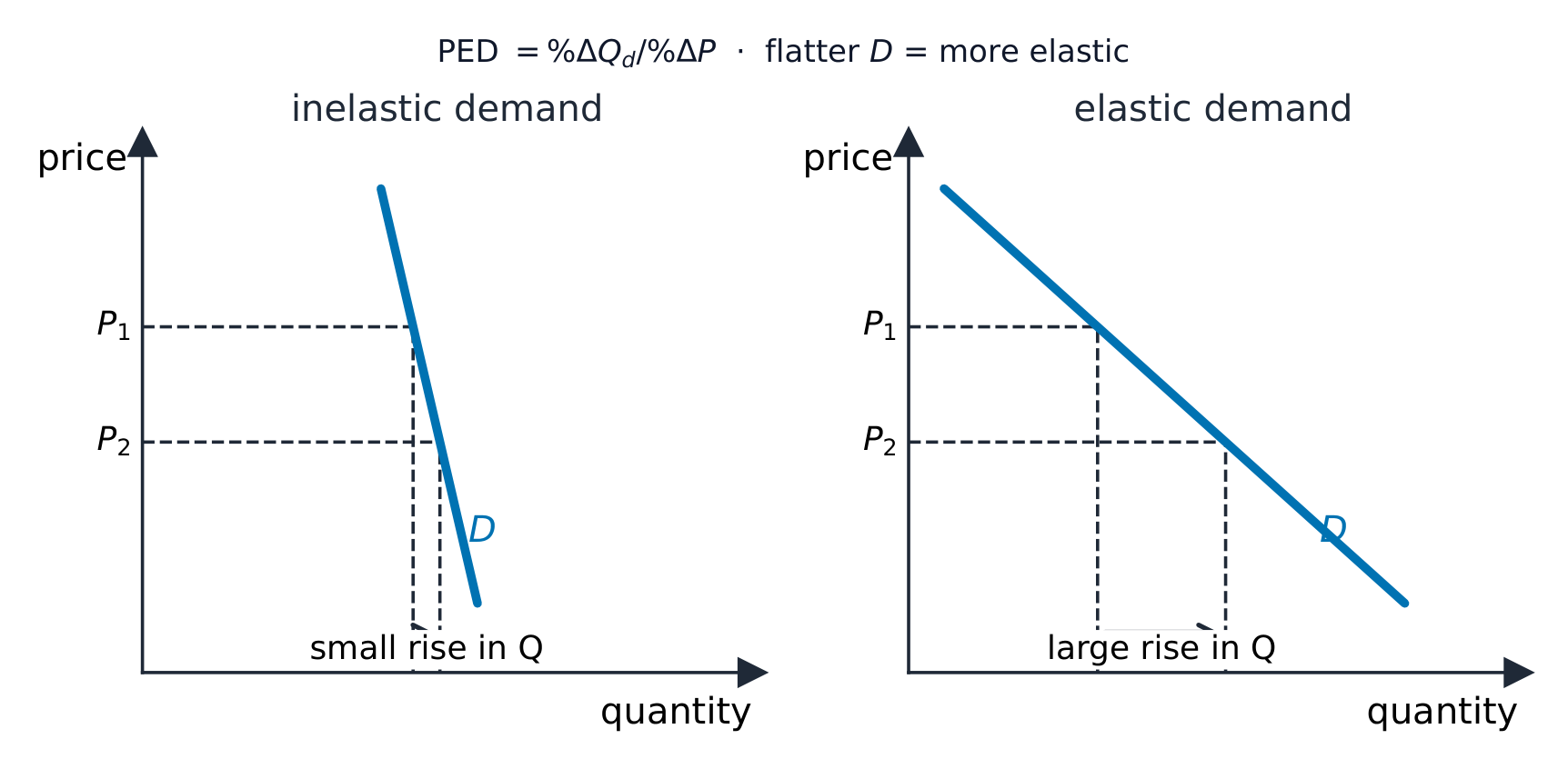
כאשר הביקוש אינאלסטי (שיפוע תלול), שינוי במחיר משפיע מעט על הכמות; כאשר הוא אלסטי (שיפוע נמוך), אותו שינוי גורם לשינוי רב בכמות.
אלסטיות מחיר והכנסה כוללת
הכנסה כוללת היא הסכום שהחברה מקבלת מהמכירות: מחיר × כמות שנמכרה. (לקונה, אותו סכום נקרא הוצאה כוללת). ה-PED אומר לחברה מה יקרה להכנסה אם היא תשנה את המחיר:
אם הביקוש אינאלסטי, העלאת המחיר מגבירה את ההכנסה הכוללת (הכמות יורדת רק מעט).
אם הביקוש אלסטי, העלאת המחיר מפחיתה את ההכנסה הכוללת (הכמות יורדת הרבה).
דבר זה שימושי. חברה קובעת מחירים תוך התחשבות בתגובת הקונים. ממשלה מטילה מכסים על מוצרים אינאלסטיים (כמו סיגריות) כי אנשים ממשיכים לקנות אותם, ולכן המכס מייצר הרבה כסף.
דוגמה פתורה. חברת אוטובוסים מוכרת 1,000 כרטיסים ביום במחיר £2 כל אחד. היא מעלה את המחיר ב-10% ל-£2.20, ומכירות היומיות יורדות ב-5% ל-950. מצאו את ה-PED ואת מה שקורה להכנסה הכוללת.
ההכנסה הכוללה עלתה ב-£90. מכיוון שהביקוש אינאלסטי, המחיר עלה באחוזים גדולים יותר מאשר הכמות ירדה, ולכן העלאת המחיר הגבירה את ההכנסה.
העלאה זהה במחיר מעלה את ההכנסה כאשר הביקוש אינאלסטי, אך מפחיתה אותה כאשר הביקוש אלסטי
Explore · חקור
Elasticity & total revenue · אלסטיות והכנסה כוללת
PED is the % change in quantity over the % change in price; whether it is above or below 1 decides how total revenue moves. · PED היא השינוי באחוזים בכמות חלקי השינוי באחוזים במחיר; כך שהוא מעל או מתחת ל-1 קובע כיצד ההכנסה הכוללת זזה.
Explore · חקור
Demand & supply · ביקוש והיצע
Elasticity of demand is the steepness of the curve. · אלסטיות בביקוש היא תלילות העקומה.
explain how a market economy allocates resources through the price mechanism
explain the advantages and disadvantages of the market economic system
עברית
הסבר כיצד משק כלכלי שוקי מקצה משאבים דרך מנגנון המחיר
הסבר על היתרונות והחסרונות של המשק הכלכלי השוקי
Source: Cambridge International syllabus · מקור: הסיילבוס הבינלאומי של קמבריד'ג'
English
In a market economy 市场经济, the price mechanism makes all the choices. There is no government planning. (The opposite is a planned economy 计划经济, where the government makes the choices.)
Advantages of the market system:
Prices guide resources to where they are wanted, without anyone planning.
Firms compete, so they cut costs and create new and better goods.
Consumers have wide choice.
Disadvantages:
Some useful goods are not made because they earn no profit.
The strong (rich firms and people) do well; the weak may be left with nothing.
Markets can fail (see below).
עברית
ב-כלכלת שוק, מנגנון המחיר קובע את כל ההחלטות. אין תכנון ממשלתי. (הניגוד הוא כלכלת תכנון, שבה הממשלה מקבלת את ההחלטות.)
יתרונות של מערכת השוק:
המחירים מכוונים משאבים למקומות שבהם הם נדרשים, ללא תכנון על ידי אף אחד.
חברות מתחרות זו בזו, ולכן הן מקצרות על עלויות ויוצרות מוצרים חדשים וטובים יותר.
לצרכנים יש מגוון רחב לבחירה.
חסרונות:
חלק מהמוצרים המועילים אינם מיוצרים מכיוון שהם אינם מייצרים רווח.
החזקים (חברות ואנשים עשירים) מצליחים; החלשים עשויים להישאר ללא כלום.
השוק עשוי לכשל (ראו להלן).
Explore · חקור
How a market allocates · איך שוק מקצה
In a market system, price moves to where demand meets supply — that price signal decides what gets made. Shift the curves and watch it settle. · במערכת שוק, המחיר זז למקום בו הביקוש נפגש עם ההיצע — אותה אות מחיר קובעת מה ייוצר. הזז את העקומות וצפה כיצד המערכת מתייצבת.
define market failure as the inefficient allocation of resources
explain the causes: external costs and external benefits (social vs private costs/benefits), merit and demerit goods, public goods and the abuse of monopoly power
עברית
הגדר כשל בשוק כהקצאה לא-יעילה של משאבים
הסבר על הסיבות: עלויות חיצוניות ותועלות חיצוניות (עלויות/תועלות חברתיות מול פרטיות), סחורות מועילות ובלתי-מועילות, סחורות ציבוריות ופגיעה בכוח מונופולי
Source: Cambridge International syllabus · מקור: הסיילבוס הבינלאומי של קמבריד'ג'
English
Market failure 市场失灵 happens when the price mechanism leads to an inefficient 低效率 use of resources — resources are not shared out in the best way for society. The main causes:
External costs and benefits
When you produce or consume something, the cost or benefit to you is not always the cost or benefit to everyone.
a private cost 私人成本 is the cost to the person doing the activity.
an external cost 外部成本 is a cost paid by other people — for example, smoke from a factory harms nearby families.
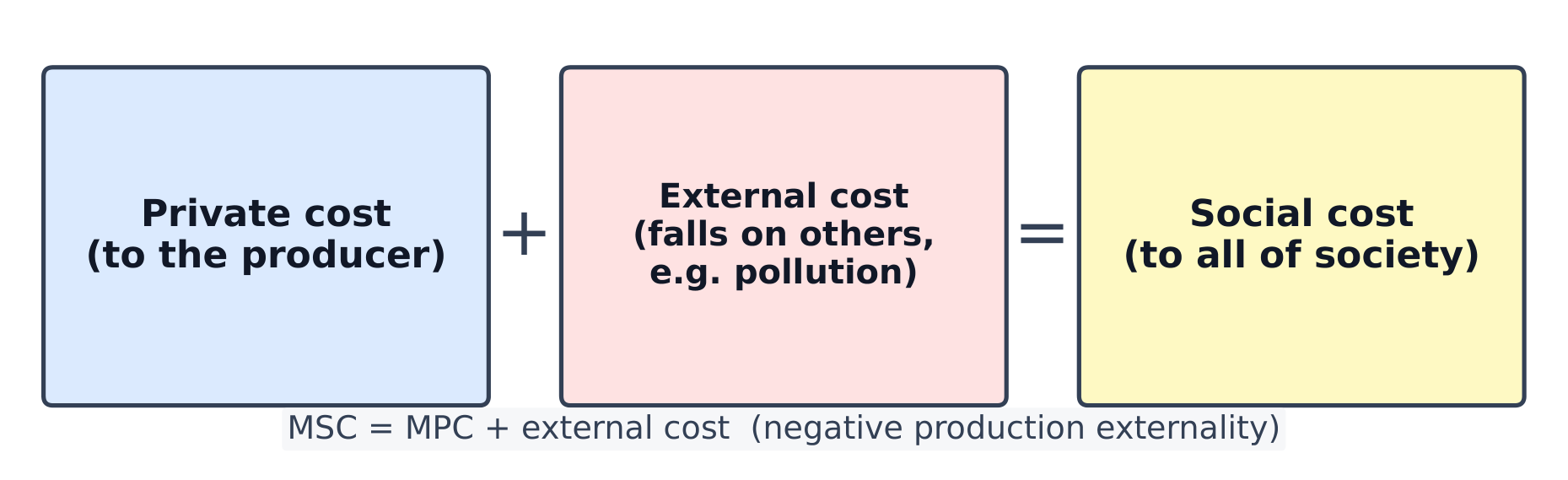
the social cost 社会成本 is the private cost plus the external cost (the cost to the whole of society).
In the same way:
a private benefit 私人效益 is the benefit to the person doing the activity.
an external benefit 外部效益 is a benefit that others get for free — for example, your neighbour's tidy garden is nice for you too.
the social benefit 社会效益 is the private benefit plus the external benefit.
Markets fail because firms and consumers only think about their private costs and benefits, not the external ones.
Merit, demerit and public goods
merit goods 有益物品 are better for you than you realise, so the market makes too few (education, healthcare).
demerit goods 有害物品 are worse for you than you realise, so the market makes too many (cigarettes, alcohol).
public goods 公共物品 are things everyone can use and no one can be stopped from using, like street lights or national defence. The market makes none, because firms cannot charge for them.
Abuse of monopoly power
A monopoly 垄断 is a single firm that controls a market. With no competition, it can charge high prices and make poor-quality goods. This is another market failure.
עברית
כשל בשוק מתרחש כאשר מנגנון המחיר מוביל לשימוש לא יעיל במשאבים — המשאבים אינם מחולקים בצורה הטובה ביותר עבור החברה. הסיבות העיקריות:
עלויות ותועלות חיצוניות
*זיהום מתחנת כוח הוא עלות חיצונית — הוא נופל על צדדים שלישיים, ולא רק על המייצר
כאשר אתה מייצר או צורך דבר מה, העלות או התועלת לך אינה תמיד העלות או התועלת לכולם.
עלות פרטית היא העלות לאדם שמבצע את הפעילות.
עלות חיצונית היא עלות שמשולמים אחרים — לדוגמה, עשן ממפעל פוגע בבעלי הבית הסמוכים.
עלות חברתית היא העלות הפרטית בתוספת העלות החיצונית (העלות לכלל החברה).
באותו אופן:
תועלת פרטית היא התועלת לאדם שמבצע את הפעילות.
תועלת חיצונית היא תועלת שאחרים מקבלים בחינם — לדוגמה, הגינה המסודרת של השכן שלך נעימה גם לך.
תועלת חברתית היא התועלת הפרטית בתוספת התועלת החיצונית.
שוקים נכשלים כי חברות וצרכנים מתחשבים רק בעלויות והתועלות הפרטיות שלהם, ולא בעלויות והתועלות החיצוניות.
עלות חיצונית (למשל זיהום) מוטלת על צדדים שלישיים, ולכן העלות החברתית גבוהה מעלות הפרטית של המייצר
סחורות תועלת, סחורות פגם וסחורות ציבור
סחורות תועלת טובות יותר עבורך מאשר אתה מבין, ולכן השוק מספק כמות קטנה מדי מהן (חינוך, בריאות).
סחורות פגם רעות יותר עבורך מאשר אתה מבין, ולכן השוק מספק כמות גדולה מדי מהן (סיגריות, אלכוהול).
סחורות ציבור הן דברים שכל אחד יכול להשתמש בהם ואף אחד לא יכול למנוע אחרים מלהשתמש בהם, כמו תאורת רחוב או ביטחון לאומי. השוק אינו מספק אותן כלל, מכיוון שמפעילים אינם יכולים לגבות תמורה על כך.
סחורה פרטית היא ירודה ותקופית (החברה מספקת אותה); סחורה ציבורית היא לא-ירודה ולא-תקופית (הממשלה חובה לספק אותה)סחורות תועלת ופגם נשפטות באופן שגוי בשל כשל מידע
פגיעה בכוח מונופולי
מונופול הוא חברה בודדת השולטת בשוק. ללא תחרות, היא יכולה להעלות מחירים ולהיצר מוצרים באיכות ירודה. זוהי משמעות נוספת לכשל בשוק.
Explore · חקור
Demand & supply · ביקוש והיצע
Market failure: the free-market crossing isn't always best for society. · כשל בשוק: החוצה החופשי אינו תמיד הטוב ביותר עבור החברה.
explain the features of a mixed economy (private sector and public sector)
explain methods of government intervention to address market failure: maximum and minimum prices, indirect taxes, subsidies, regulation and direct provision
evaluate the effects of intervention
עברית
להסביר את מאפייני כלכלית מעורבת (מגזר פרטי ומגזר ציבורי)
להסביר שיטות של התערבות ממשלתית כדי להתמודד עם כשל שוק: מחיר מקסימלי ומינימלי, מיסים עקיפים, סבסודים, ויסות וספקות ישירה
הערך את השפעות ההתערבות
Source: Cambridge International syllabus · מקור: הסיילבוס הבינלאומי של קמבריד'ג'
English
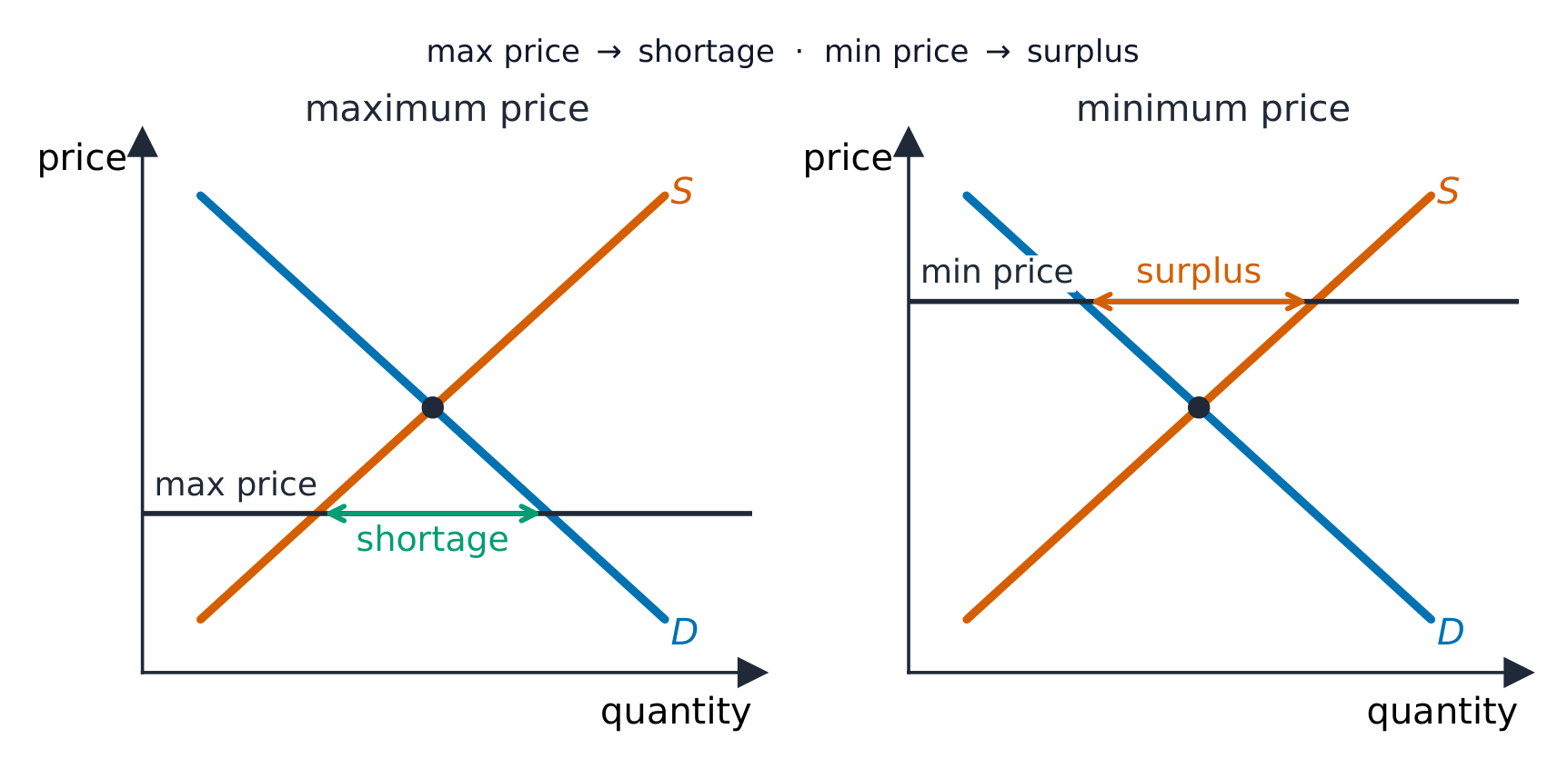
A maximum price creates a shortage
A mixed economy 混合经济 has both:
a private sector 私营部门 — firms owned by people, guided by the price mechanism.
a public sector 公共部门 — activity run by the government.
Most real economies are mixed; China's, for example, is a socialist market economy. The government steps in to correct market failure. This is government intervention 干预. The main methods:
Method
What it does
maximum price 最高价格
a price ceiling, set below equilibrium, to keep a good (like rent) cheap — but it causes a shortage
minimum price 最低价格
a price floor, set above equilibrium, to keep a price up (like a fair wage) — but it causes a surplus
indirect tax 间接税
a tax on a good (added to its price) to cut demand for demerit goods
subsidy
money paid to firms to cut the price and raise output of merit goods
regulation 监管
rules and laws, like banning smoking in public
direct provision 直接提供
the government makes and gives out goods itself, like state schools
Judging intervention
Intervention can fix market failure, but it has costs. Taxes and rules cost money to collect and check. Governments can get things wrong too (this is called government failure). So you should always weigh the good effects against the bad ones before deciding.
עברית
מחיר מקסימום יוצר מחסור
למשק מעורב יש גם:
מגזר פרטי — חברות בבעלות אנשים, המונחות על ידי מנגנון המחיר.
מגזר ציבורי — פעילות המנוהלת על ידי הממשלה.
רוב המשקאות האמיתיים הם מעורבים; לדוגמה, משק סין הוא משק סוציאליסטי. הממשלה נכנסת לפעול כדי לתקן כשל בשוק. זהו התערבות ממשלתית. השיטות העיקריות:
שיטה
מה היא עושה
מקסימום מחיר
תקרת מחיר, הנקבעת מתחת למחיר שיווי המשקל, כדי לשמור על מחיר זול עבור סחורה (כגון שכירות) — אך היא גורמת לחוסר אספקה
מחיר מינימום
רצפת מחיר, הנקבעת מעל שיווי המשקל, כדי לשמור על מחיר גבוה (כמו שכר הוגן) — אך הוא גורף לעודף אספקה
מס עקיף
מס המטיל על מוצר (נוסף למחירו) לצמצום ביקוש למוצרים מזיקים
סבסוד
תשלום כספי לחברות לצמצום המחיר ולהגדיל את היצע המוצרים החיוביים
וויסות
חוקים ותקנות, כמו איסור על עישון במקומות ציבוריים
אספקה ישירה
הממשלה מייצרת ומחלקת מוצרים בעצמה, כמו בתי ספר מדינתיים
מחיר מקסימום הנקבע מתחת לשיווי המשקל גורף למחסור; מחיר מינימום הנקבע מעל שיווי המשקל גורף לעודף אספקה.
הערכת התערבות
התערבות יכולה לתקן כשל שוק, אך היא כרוכה בעלויות. מסים וכללים דורשים כסף לאיסוף ולבדיקה. ממשלות גם הן עלולות לטעות (דבר זה מכונה כשל ממשלתי). לכן עליך תמיד לשקול את ההשפעות הטובות מול הרעות לפני קבלת החלטה.
Explore · חקור
Economics case lab · מעבדת מקרים בכלכלה
Classify real examples by the economic idea they show. · סווג דוגמאות אמיתיות לפי הרעיון הכלכלי שהן מדגישות.
A change in a good's own price is a movement along the curve; a change in anything else (income, tastes, related prices) shifts the whole curve.
Equilibrium is where demand meets supply. Below it there is excess demand (a shortage, so price rises); above it there is excess supply (a surplus, so price falls).
PED = %ΔQ ÷ %ΔP. Demand is inelastic if PED < 1 (raising price raises revenue) and elastic if PED > 1 (raising price lowers revenue).
Market failure (external costs, merit/demerit/public goods, monopoly) means resources are used badly; the government corrects it with taxes, subsidies, rules and direct provision.
עברית
שינוי ב-מחיר עצמי של מוצר הוא תנועה לאורך העקומה; שינוי בכל דבר אחר (הכנסה, טעמים, מחירים רלוונטיים) מזיז את כל העקומה.
שיווי משקל הוא המקום בו הביקוש פוגש את האספקה. מתחת אליו יש ביקוש עודף (מחסור, ולכן המחיר עולה); מעליו יש אספקה עודף (עודף אספקה, ולכן המחיר יורד).
PED = %ΔQ ÷ %ΔP. ביקוש הוא אלסטי אם PED < 1 (raising price raises revenue) and elastic if PED > 1 (הגבהת המחיר מורידה את ההכנסה).
כשל שוק (עלויות חיצוניות, מוצרים חיוביים/מזיקים/ציבוריים, מונופול) מצביע על שימוש לקוי במשאבים; הממשלה מתקנת זאת באמצעות מסים, סבסודים, וויסות ואספקה ישירה.
3
Microeconomic decision-makers · קבלני החלטות במיקרו-כלכלה
state the functions of money (medium of exchange, store of value, unit of account, means of deferred payment) and the characteristics of money
explain the role of central banks and commercial banks
עברית
ציין את הפונקציות של הכסף (אמצעי תמורה, מאגר ערך, יחידת חשבון, אמצעי תשלום בעתיד) ומאפיין הכסף
הסבר על התפקיד של הבנקים המרכזיים והבנקים המסחרים
Source: Cambridge International syllabus · מקור: הסיילבוס הבינלאומי של קמבריד'ג'
English
Long ago, people swapped goods directly. This is called barter 物物交换. Barter is hard: you must find someone who has what you want and wants what you have. Money 货币 solves this problem.
The functions of money
Money does four jobs:
a medium of exchange 交换媒介 — you swap money for goods, so you do not need barter.
a store of value 价值储藏 — you can hold money now and spend it later, because it keeps its value.
a unit of account 记账单位 — money measures and compares the value of things (this is the price).
a means of deferred payment 延期支付手段 — you can buy now and pay later.
The characteristics of money
Good money must be:
durable 耐用的 — it lasts a long time.
portable 便于携带的 — easy to carry.
divisible 可分割的 — can be split into small amounts for small payments.
limited in supply, hard to copy, and accepted by everyone.
Banks
A central bank 中央银行 is the government's bank. It issues notes, looks after the banking system, and sets interest rates 利率. There is one in each country.
commercial banks 商业银行 are the ordinary banks that people and firms 企业 use. They keep savings safe, lend money, and let people pay each other.
עברית
בעבר, אנשים היו מחליפים סחורות ישירות. הדבר נקרא חילופין. חילופין הם קשה: עליך למצוא מי שיש לו מה שאתה רוצה וגם רוצה מה שיש לך. כסף פותר בעיה זו.
הפונקציות של כסף
לכסף יש ארבע משימות:
אמצעי תמורה — אתה מחליף כסף לסחורות, כך שאין צורך בחילופין.
אמצעי שמירת ערך — ניתן להחזיק בכסף כעת ולהוציא אותו מאוחר יותר, משום שהוא שומר על ערכו.
מדד ערך — כסף מודד ומשווה את ערכם של דברים (זהו המחיר).
אמצעי תשלום מאוחר — ניתן לקנות כעת ולשלם מאוחר יותר.
ארבעת תפקידי המטבע: אמצע תמורה, אוצר ערך, יחידת חשבון ואמצע לתשלום מודחהכסף — שטרות ומטבעות — משמש כאמצעי תשלום, מאגר ערך, יחידת חשבון ואמצעי לתשלום מודח
מאפייני המטבע
מטבע טוב חייב להיות:
עמיד — מחזיק מעמד לאורך זמן רב.
נייד — קל לנשיאה.
מתחלק — ניתן לחלוקה לסכומים קטנים עבור תשלומים זעירים.
מוגבל באספקה, קשה להדפסה/העתקה ומוסכם על ידי כולם.
בנקים
בנק מרכזי הוא הבנק של הממשלה. הוא מנפיק שטרות, שומר על מערכת הבנקאות וקובע ריבית. יש בנק מרכזי אחד בכל מדינה.
בנקים מסחריות הם הבנקים הרגילים אותם משתמשים אנשים וחברות. הם שומרים על חיסונות בטוחים, מעניקים הלוואות ומאפשרים לאנשים לשלם זה לזה.
Explore · חקור
Economics case lab · מעבדת מקרים בכלכלה
Classify real examples by the economic idea they show. · סווג דוגמאות אמיתיות לפי הרעיון הכלכלי שהן מדגישות.
explain the factors that determine an individual's choice of occupation (wage and non-wage factors)
explain the reasons for differences in earnings (skills, qualifications, danger, trade unions, discrimination)
explain division of labour/specialisation and its advantages and disadvantages
עברית
הסבר על הגורמים הקובעים בחירת מקצוע אישית (גורמי שכר וגוראי שאינם שכר)
הסבר על הסיבות להבדלים בתגמולים (מיומנויות, תעודות, סיכון, איגודים מקצועיים, אפליה)
הסבר על חלוקת העבודה/התמחות והיתרונות והחסרונות שלה
Source: Cambridge International syllabus · מקור: הסיילבוס הבינלאומי של קמבריד'ג'
English
Choosing a job
When a worker chooses an occupation 职业 (a type of job), two kinds of factor matter:
wage factors — the pay. The wage 工资 is the money you earn. Higher pay attracts more workers.
non-wage factors — everything else: working hours, holidays, how safe or pleasant the job is, whether you enjoy the work, distance from home, and the chance to move up to a higher job.
Why workers earn different amounts
Workers are not all paid the same. The reasons include:
skill 技能 and qualifications 资格 — workers who are hard to replace, or who studied for years, earn more.
danger — risky or dirty jobs may pay more to attract workers.
trade unions 工会 — a trade union is a group of workers who join together to bargain for better pay and conditions. Strong unions can raise pay.
discrimination 歧视 — unfair treatment because of gender, race, or age can cause unfair pay gaps.
Division of labour
Division of labour 劳动分工 (also called specialisation 专业化) means splitting a job into small tasks, with each worker doing one task again and again.
Advantages: workers get faster and better at their one task; less time is wasted moving between tasks; this raises output.
Disadvantages: doing one task is boring, so workers may make mistakes or leave; if one worker is absent, the whole line can stop; each worker learns only one skill.
עברית
בחירת תפקיד
כאשר עובד בוחר בתעודה (סוג של עבודה), שני סוגי גורמים משפיעים:
גורמי שכר — התשלום. השכר הוא הכסף שמרווחים. תשלום גבוה מושך יותר עובדים.
גורמים שאינם כרוכים בשכר — הכל השאר: שעות עבודה, חופשות, עד כמה העבודה בטוחה או נעימה, האם אתם נהנים מהעבודה, המרחק מהבית והסיכוי לקדם לעבודה גבוהה יותר.
למה עובדים רוכשים סכומים שונים
לא כל העובדים מקבלים אותה תמורה. הסיבות כוללות:
שכירות תלויות במיומנויות, קושי המשרה ובביקוש
מיומנות והסמכות — עובדים שקשה להחליף או שעשו לימודים לשנים רבות מרוויחים יותר.
סיכון — עבודות מסוכנות או מלוכלכות עשויות לשלם יותר כדי למשוך עובדים.
איגודי עובדים — איגוד עובדים הוא קבוצת עובדים שנצמדים יחד כדי לגבש תנאי שכר ושיפור תנאי עבודה. איגודים חזקים יכולים להעלות את השכר.
אפליה — טיפול לא הוגן על רקע מגדר, גזע או גיל יכול לגרום לפער בכספים לא הוגן.
חלוקת עבודה
חלוקת עבודה (הנקראת גם התמחות) פירוניה לחלק עבודה למשימות קטנות, כאשר כל עובד מבצע משימה אחת שוב ושוב.
יתרונות: עובדים הופכים למהירים וטובים יותר במשימה שלהם; פחות זמן אבד בעבר בין משימות; זה מגביר את התפוקה.
חסרונות: ביצוע משימה אחת משעמם, ולכן עובדים עשויים לבצע טעויות או להתפרק; אם עובד אחד נעדר, כל הקו עשוי לעצור; כל עובד לומד רק מיומנות אחת.
חלוקת עבודה: חלוקת עבודה למשימות חוזרות קטנות מעלה את התפוקה לעובד
Explore · חקור
Economics case lab · מעבדת מקרים בכלכלה
Classify real examples by the economic idea they show. · סווג דוגמאות אמיתיות לפי הרעיון הכלכלי שהן מדגישות.
classify firms by size and explain why some firms remain small and why/how firms grow (mergers: horizontal, vertical, conglomerate)
explain the causes of business failure
עברית
סווג חברות לפי גודל והסבר מדוע חלקן נשארות קטנות וכיצד/מדוע חברות צומחות (מיזוגים: אופקי, אנכיים, קונגלומרט)
הסבר על הסיבות לכישלון עסקי
Source: Cambridge International syllabus · מקור: הסיילבוס הבינלאומי של קמבריד'ג'
English
Economies of scale: average cost falls
The size of firms
Firms come in many sizes, from one person to huge companies. We can measure size by the number of workers, the amount of capital 资本 used, or the output.
Some firms stay small because: the market 市场 is small; the product is personal (like a hairdresser); the owner wants to stay in control; or there is little money to grow.
How firms grow
Firms grow by selling more, or by joining with other firms. When two firms join, it is a merger 合并 (or takeover). There are three types:
horizontal merger 横向合并 — two firms at the same stage of the same industry join (two car makers).
vertical merger 纵向合并 — two firms at different stages of the same industry join (a car maker and a tyre maker). "Backward" is towards the supplier; "forward" is towards the seller.
conglomerate merger 混合合并 — two firms in different industries join (a car maker and a food company).
Business failure
Firms can suffer business failure 企业倒闭 (they close down) for many reasons: costs too high, too few sales, poor management, too many rivals, not enough cash, or a fall in demand 需求.
עברית
חסכוניות בקנה מידה: עלות ממוצעת יורדת
גודל החברות
לחברות יש גודלים שונים, מאדם אחד ועד לחברות ענק. ניתן למדוד גודל באמצעות מספר העובדים, כמויות ההון המשמשות או התפוקה.
חברות נשארות קטנות מכיוון ש: השוק קטן; המוצר אישי (כמו ספר); הבעלים רוצה לשמור על שליטה; או שיש מעט כסף לצמיחה.
כיצד חברות צומחות
חברות צומחות על ידי מכירת יותר, או על ידי הצטרפות לחברות אחרות. כאשר שתי חברות מצטרפות, מדובר במיזוג (או acquisition). ישנם שלושה סוגים:
מיזוג אופקי — שתי חברות באותו שלב באותו תעשייה מצטרפות (שני יצרני מכוניות).
מיזוג אנכי — שתי חברות בשלבים שונים באותה תעשייה מצטרפות (יצרן מכוניות ויצרן צמיגים). "אחורי" הוא לכיוון הספק; "קדמי" הוא לכיוון המוכר.
מיזוג קונגלומרט — שתי חברות בתעשיות שונות מצטרפות (יצרן מכוניות וחברת מזון).
שלושת סוגי המיזוגים: אופקי (אותו שלב), אנכי (שלבים שונים בתעשייה אחת), וקונגלומרט (תעשיות שונות)
כשל עסקי
חברות יכולות לסבול מכשל עסקי (סגירה) מסיבות רבות: עלויות גבוהות מדי, מכירות מועטות, ניהול לקוי, מתחרים מרובים, מזומנים לא מספיקים, או ירידה בביקוש.
Explore · חקור
Firm objective lab · מעבדת מטרת חברה
Classify real firm decisions by the objective they reveal. · מיון החלטות של חברות אמיתיות לפי המטרה שהן חושפות.
3.5
Firms and production · חברות וייצור
Syllabus · סיילבוס
English
distinguish labour-intensive and capital-intensive production and explain productivity
explain demand for and supply of factors of production and economies and diseconomies of scale
עברית
להבחין בין ייצור אינטנסיבי לעבודה וייצור אינטנסיבי לרأس (הון) ולהסביר פרודוקטיביות
להסביר את הביקוש וההיצע לגורמי הייצור ולתמורות סקאלה (כלכליות ולא-כלכליות)
Source: Cambridge International syllabus · מקור: הסיילבוס הבינלאומי של קמבריד'ג'
English
Labour-intensive and capital-intensive
labour-intensive 劳动密集型 production uses a lot of labour 劳动 (many workers) and little machinery — for example, hand-made crafts.
capital-intensive 资本密集型 production uses a lot of capital (machines) and few workers — for example, a modern car factory.
Productivity
Productivity 生产率 means output per worker (or per machine) in a set time. Higher productivity means each worker makes more, so the cost of each unit falls. Training, better machines, and good management all raise productivity.
Demand for and supply of factors
Firms buy factors of production 生产要素 (land 土地, labour, capital, and enterprise 企业家才能). The price and amount of each factor are set by its own demand and supply, just like any market. For example, if many firms want skilled workers, the wage for those workers rises.
Economies and diseconomies of scale
As a firm grows and makes more, the cost of each unit can change:
economies of scale 规模经济 — as output rises, the average cost of each unit falls. Reasons: buying materials in bulk is cheaper, big machines work more efficiently, and large firms borrow money cheaply.
diseconomies of scale 规模不经济 — if a firm grows too big, the average cost of each unit starts to rise. Reasons: a huge firm is hard to manage, messages travel slowly, and workers may feel less important.
These can be internal (caused by the firm's own size) or external (caused by the whole industry growing).
עברית
מאתנטיב ומודרני
ייצור מאתנטיב משתמש בהרבה עבודה (עובדים רבים) ומעט מכונה — לדוגמה, מלאכת יד.
ייצור מודרני משתמש בהרבה הון (מכונות) ועובדים מעטים — לדוגמה, מפעל מכוניות מודרני.
קו הרכבה של מכוניות הוא אינטנסיבי בון (מכונות רבות, עובדים מעטים) ומשתמש בחלוקת העבודה — כל עובד מבצע משימה אחת
פרודוקטיביות
פרודוקטיביות היא התפוקה לכל עובד (או למכונה) בזמן נתון. פרודוקטיביות גבוהה יותר פירושה שעובד אחד מייצר יותר, ולכן העלות ליחידה יורדת. הכשרה, מכונות טובות יותר וניהול טוב מרים את הפרודוקטיביות.
ביקוש והיצע לגורמי ייצור
חברות קונים גורמי ייצור (קרקע, עבודה, הון, וארגון). המחיר והכמות של כל גורם נקבעים על ידי הביקוש וההיצע שלו, בדיוק כמו בשוק כלשהו. לדוגמה, אם הרבה חברות מחפשות עובדים מיומנים, השכר עבור עובדים אלה עולה.
תמורות ומתמורות גודל
ככל שהחברה צומחת ומייצרת יותר, העלות ליחידה עשויה להשתנות:
חסכי היקף — ככל שהתפוקה עולה, העלות הממוצעת ליחידה יורדת. סיבות: קניית חומרים בכמויות גדולות זולה יותר, מכונות גדולות עובדות ביעילות רבה יותר, וחברות גדולות לוקחות הון במחירים נמוכים.
חוסר יעילות מיקרוסקופי — אם חברה גדלה מדי גדולה, העלות הממוצעת לכל יחידה מתחילה לעלות. סיבות: חברה ענקית קשה לניהול, הודעות נעות לאט, ועובדים עשויים להרגיש פחות חשובים.
העלות הממוצעת יורדת כשחברה גדלה (יעילות מיקרוסקופית), מגיעה לנקודה מינימלית, ואז עולה אם היא גדלה מדי (חוסר יעילות מיקרוסקופי).
אלו יכולות להיות פנימיות (נגרמות בגודל החברה עצמה) או חיצוניות (נגרמות מהגדלת התעשייה כולה).
Explore · חקור
Factors of production lab · מעבדת גורמי ייצור
Sort real resources by the factor of production they represent. · מיינו את המשאבים האמיתיים לפי גורם הייצור ש הם מייצגים.
Firms' costs, revenue and objectives · עלויות, הכנסות ומטרות של חברות
Syllabus · סיילבוס
English
define and calculate fixed, variable, total and average costs
define and calculate total and average revenue
explain the objectives of firms (profit, survival, growth, social objectives)
עברית
להגדיר ולחשב עלויות קבועות, משתנות, כוללות וממוצעות
להגדיר ולחשב הכנסה כוללת וממוצעת
להסביר את מטרות החברות (רווח, הישרדות, צמיחה, מטרות חברתיות)
Source: Cambridge International syllabus · מקור: הסיילבוס הבינלאומי של קמבריד'ג'
English
Costs
A cost 成本 is money a firm spends to produce. Costs split into:
fixed costs 固定成本 — costs that do not change with output, such as rent and insurance. You pay them even if you make nothing.
variable costs 可变成本 — costs that change with output, such as materials and power. More output means more variable cost.
total cost 总成本 — fixed cost plus variable cost.
average cost 平均成本 — the cost of each unit: total cost divided by the number of units made.
Revenue
Revenue 收益 is the money a firm gets from selling its goods.
total revenue 总收益 — the price multiplied by the quantity sold.
average revenue 平均收益 — total revenue divided by the quantity sold (this is the same as the price).
Profit and other objectives
Profit 利润 is what is left after costs:
profit = total revenue − total cost
Worked example. A firm has fixed costs of £2,000 and variable costs of £3 per unit. It makes 500 units and sells them at £10 each. Find its total cost, total revenue, profit and average cost.
variable cost = 3 × 500 = £1,500, so total cost = 2,000 + 1,500 = £3,500.
total revenue = 10 × 500 = £5,000.
profit = 5,000 - 3,500 = £1,500.
average cost = total cost ÷ units = 3,500 ÷ 500 = £7 per unit.
The firm makes a profit because the price (£10) is above the average cost (£7).
Most firms want as much profit as possible. But firms can have other objectives 目标:
survival 生存 — a new firm first just wants to stay open.
growth 增长 — getting bigger, to gain economies of scale and market power.
social objectives — some firms aim to help people or protect the environment, not only to earn profit.
עברית
עלויות
עלות היא כסף שחברה משלמת כדי לייצר. העלויות מתחלקות ל:
עלויות קבועות — עלויות שלא משתנות עם ההפקה, כמו שכירות וביטוח. אתה משלם אותן גם אם אינך מייצר כלום.
עלויות משתנות — עלויות ש-משתנות בהתאם להפקה, כמו חומרי גלם וחשמל. יותר הפקה אומר יותר עלויות משתנות.
עלות כוללת — עלות קבועה פלו עלות משתנת.
עלות ממוצעת — העלות של כל יחידה: עלות כוללת חלקי מספר היחידות שיוצרו.
העלות הקבועה נשארת זהה כשההפקה עולה; העלות המשתנה עולה; העלות הכוללת היא סכום הקבועה והמשתנה, ולכן הפער בין העלות הכוללת למשתנה הוא העלות הקבועה.
הכנסה
הכנסה היא הכסף שמגיע לחברה מכירוך המוצרים שלה.
הכנסה כוללת — המחיר כפול כמות הנמכית.
הכנסה ממוצעת — הכנסה כוללת חלקי כמות הנמכית (זהו אותו דבר כמו המחיר).
רווח ומטרות אחרות
רווח הוא מה שנשאר לאחר שהוצאו העלויות:
רווח = הכנסה כוללת − עלות כוללת
דוגמה מפורטת. לחברה יש עלויות קבועות של £2,000 ועלויות משתנות של £3 ליחידה. היא מייצרת 500 יחידות ומוכרת אותן ב-£10 כל אחת. מצאו את העלות הכוללת, ההכנסה הכוללת, הרווח והעלות הממוצעת.
עלות משתנת = 3 × 500 = £1,500, ולכן עלות כוללת = 2,000 + 1,500 = £3,500.
הכנסה כוללת = 10 × 500 = £5,000.
רווח = 5,000 - 3,500 = £1,500.
עלות ממוצעת = עלות כוללת ÷ יחידות = 3,500 ÷ 500 = £7 לכל יחידה.
לחברה יש רווח כי המחיר (£10) גבוה מהעלות הממוצעת (£7).
לרוב החברות שואפות לרווח מקסימלי. אך לחברות יכולים להיות מטרות אחרות:
הישרדות — לחברה חדשה חשוב קודם כל להישאר פעילה.
גידול - הגדלת היקף הפעילות כדי להשיג חסכוני סולם וכוח בשוק.
מטרות חברתיות - לחברות מסוימות יש מטרה לעזור לאנשים או לשמור על הסביבה, ולא רק להרוויח.
Explore · חקור
A firm's cost curves · עקומות העלות של חברה
Change output and see how average cost falls then rises — and where marginal cost crosses it. · שנה את התפוקה והצפה איך העלות הממוצעת יורדת ואז עולה — ובאיזה נקודה העלות השולית חוצה אותה.
describe the characteristics of competitive markets and monopoly
explain the advantages and disadvantages of competition for consumers and firms
עברית
לתאר את מאפייני שווקים תחרותיים ומונופול
להסביר את היתרונות והחסרונות התחרות עבור צרכנים וחברות
Source: Cambridge International syllabus · מקור: הסיילבוס הבינלאומי של קמבריד'ג'
English
Markets differ by how many firms there are and how hard it is for new firms to join.
Competitive markets
A competitive market has many firms selling similar goods, and it is easy for new firms to enter. This is strong competition 竞争. In such a market:
firms must keep prices low and quality high, or buyers go elsewhere.
firms work hard to cut costs and make new products.
This is good for consumers: low prices, wide choice, and good quality.
Monopoly
A monopoly 垄断 is a market with only one firm, or one firm that controls most of it. New firms find it hard to enter because of barriers to entry 进入壁垒 — for example, very high start-up costs, or the one firm controlling key supplies.
In a monopoly:
the firm can charge high prices, because buyers have no other choice.
there is little pressure to improve quality or cut costs.
but a large monopoly may gain economies of scale, and may use its profit to pay for research.
Competition versus monopoly
Consumers
Firms
competition
lower prices, more choice, better quality
lower profit; must work hard to survive
monopoly
higher prices, less choice
higher profit and an easy life, but may grow lazy
עברית
שווקים נבדלים לפי מספר החברות הקיימות ובנוסף לכך לפי רמת הקושי של חדירה של חברות חדשות.
שוקים משתנים ממונופול (מוכר אחד) ועד תחרות מושלמת (רבים)
שווקים תחרותיים
שוק תחרותי כולל מספר רב של חברות המוכרות מוצרים דומים, וקל לחברות חדשות להיכנס אליו. זהו תחרות חזקה. בשוק כזה:
חברות חייבות לשמור על מחירים נמוכים ואיכות גבוהה, אלא הלקוחות ילכו למקום אחר.
חברות עובדות קשה כדי להפחית עלויות ולפתח מוצרים חדשים.
דבר זה טוב לצרכנים: מחירים נמוכים, מגוון רחב ואיכות טובה.
בשוק תחרותי חברות רבות מוכרות סחורות דומות, ולכן כל אחת צריכה לשמור על מחירים נמוכים ועל איכות גבוהה כדי לזכות בלקוחות
מונופול
מונופול הוא שוק בו פועלת רק חברה אחת, או חברה אחת השולטת ברוב השוק. חברות חדשות מתקשות להיכנס בשל מחסומי כניסה – לדוגמה, עלות הקמה גבוהה מאוד, או שליטה של החברה הקיימת באספקה מרכזית.
במונופול:
לחברה יש אפשרות לגבות מחירים גבוהים, מכיוון שלקוחות אין להם אלטרנטיבה אחרת.
קיים בלחץ מינימלי לשפר את האיכות או לצמצם עלויות.
אך מונופול גדול עשוי ליהנות ממחירי ירידה (כלכלת היקף), ועשוי להשתמש ברווחים שלו למימון מחקר ופיתוח.
תחרות לעומת מונופול
צרכנים
חברות
תחרות
מחירים נמוכים יותר, מגוון רחב יותר, איכות טובה יותר
רווח נמוך יותר; חייבת לפעול בקפדנות כדי להתקיים
מונופול
מחירים גבוהים יותר, מגוון מוגבל יותר
רווח גבוה יותר וחיים נוחים יותר, אך עשויה להפוך לעצלה
Explore · חקור
Economics case lab · מעבדת מקרים בכלכלה
Classify real examples by the economic idea they show. · סווג דוגמאות אמיתיות לפי הרעיון הכלכלי שהן מדגישות.
state the macroeconomic aims of government (economic growth, full employment/low unemployment, price stability, balance of payments stability, redistribution of income)
explain why aims may conflict
עברית
לפרט את המטרות המקרו-כלכליות של הממשלה (צמיחה כלכלית, תעסוקה מלאה/אבטלה נמוכה, יציבות מחירים, יציבות במאזן התשלומים, חלוקת מחדש של הכנסות)
להסביר מדוע מטרות עשויות להיות בסתירה זו לזו
Source: Cambridge International syllabus · מקור: הסיילבוס הבינלאומי של קמבריד'ג'
Governments try to manage the whole economy — the macroeconomy 宏观经济. They have five main aims:
Five main aims: growth, low unemployment, stable prices, balance of payments stability, fair incomes
economic growth 经济增长 — the economy makes more goods and services each year.
full employment 充分就业 — almost everyone who wants a job has one, so unemployment 失业 is low.
price stability 价格稳定 — prices rise only slowly, so inflation 通货膨胀 is low.
balance of payments 国际收支 stability — the money flowing in and out of the country (from trade) is roughly even.
redistribution of income 收入再分配 — sharing income more fairly, so the gap between rich and poor is not too wide.
These aims can conflict 冲突 (work against each other). For example, fast growth can pull prices up, causing inflation. Cutting unemployment can do the same. So a government must balance its aims.
The government's three sets of policy tools for managing the macroeconomy
Explore · חקור
Managing aggregate demand · ניהול ביקוש כולל
Government policy moves aggregate demand against aggregate supply to steer output and the price level. · מדיניות הממשלה מזזה ביקוש כולל נגד היצע כולל כדי לכוון לתוצר ולימת המחירים.
redistribution of income/ˌriːˌdɪstrɪˈbjuːʃn ɒv ˈɪŋkʌm/
החלוקת מחדש של הכנסות
conflict/ˈkɒnflɪkt/
מחלוקת
4.2
Fiscal policy
Syllabus · סיילבוס
English
define fiscal policy (government spending and taxation) and the government budget (surplus, deficit, balance)
distinguish direct and indirect taxes and progressive, regressive and proportional taxes
explain the effects of fiscal policy on government macroeconomic aims
עברית
להגדיר מדיניות פיסקלית (הוצאות ממשלתיות ומיסוי) ותקציב הממשלה (עודף, גירעון, איזון)
להבחין בין מיסים ישירים ועקיפים ומיסים הולכים, יורדים ופרופורציונליים
להסביר את השפעות המדיניות הפיסקלית על המטרות המקרו-כלכליות של הממשלה
Source: Cambridge International syllabus · מקור: הסיילבוס הבינלאומי של קמבריד'ג'
Fiscal policy 财政政策 means the government changing two things to manage the economy:
government spending 政府支出 — money the government spends, for example on schools, hospitals, and roads.
taxation 税收 — money the government takes from people and firms.
The government budget 预算 sets spending against tax. There are three outcomes:
a budget deficit 预算赤字 — spending is more than the tax raised, so the government must borrow.
a budget surplus 预算盈余 — the tax raised is more than spending.
a balanced budget — the two are equal.
Types of tax
Taxes are grouped in two ways. By what is taxed:
a direct tax 直接税 is paid straight to the government from income 收入 or profit 利润 (income tax, corporation tax).
an indirect tax 间接税 is added to the price of goods and paid when you spend (a sales tax).
By how the rate changes with income:
a progressive tax 累进税 takes a bigger % from higher incomes. This helps redistribute income.
a regressive tax 累退税 takes a smaller % from higher incomes, so it hits the poor harder.
a proportional tax 比例税 takes the same % from everyone.
Under a progressive tax the average rate rises with income; under a regressive tax it falls; under a proportional tax it stays the same.
What fiscal policy does
To boost the economy (raise growth and jobs), the government can spend more or cut taxes. This raises total demand 需求 — but if demand grows too fast, it can cause inflation.
To slow the economy (fight inflation), the government can spend less or raise taxes. This lowers demand, but can raise unemployment.
Explore · חקור
Fiscal policy shifts AD · מדינית פיסקלית מזיזה את הביקוש הכולל
Spending more or taxing less shifts aggregate demand right — raising output, but also the price level. · הגדלת ההוצאות או הפחתת המסים מזיזה את הביקוש הכולל ימינה — מה שמגביר את התפוקה, אך גם את רמת המחירים.
define monetary policy (interest rates, money supply) and the role of the central bank
explain the effects of changes in interest rates on the economy
עברית
להגדיר מדיניות מוניטרית (ריבית, אספקת כסף) ואת תפקיד הבנק המרכזי
להסביר את השפעות השינויים בריבית על הכלכלה
Source: Cambridge International syllabus · מקור: הסיילבוס הבינלאומי של קמבריד'ג'
Monetary policy 货币政策 is the central bank 中央银行 changing interest rates 利率 (and the money supply 货币供给) to manage the economy. The interest rate is the cost of borrowing and the reward for saving.
Lower interest rates: borrowing is cheaper, so people and firms spend and invest 投资 more. Demand rises, giving more growth and jobs — but maybe more inflation.
Higher interest rates: borrowing is dearer, so spending falls. Demand falls, giving less inflation — but maybe more unemployment.
The central bank runs monetary policy: it sets the interest rate to manage demand, inflation and growth
Explore · חקור
Monetary policy shifts AD · מדיניות מונוטארית מזיזה את AD
Lower interest rates encourage borrowing and spending, shifting aggregate demand right. · ריבית נמוכה מעודדת הלוואות והוצאות, ומזיזה את הביקוש הכולל ימינה.
define supply-side policy (education and training, privatisation, deregulation, incentives)
explain the effects of supply-side policy on government macroeconomic aims
עברית
הגדרת מדיניות צד האספקה (חינוך וקידום מקצועי, פרטיות, הסרת רגולציה, עמלות)
הסבר השפעות מדיניות צד האספקה על המטרות המאקרו-כלכליות של הממשלה
Source: Cambridge International syllabus · מקור: הסיילבוס הבינלאומי של קמבריד'ג'
Supply-side policy 供给侧政策 tries to raise the amount the economy can produce. It improves the quantity and quality of the factors of production 生产要素. Methods include:
education and training — better skills raise productivity 生产率.
privatisation 私有化 — selling state-owned firms to private owners, who may run them better.
deregulation 放松管制 — removing rules that hold firms back.
incentives 激励 — lower taxes on income and profit, so people work harder and firms invest more.
Supply-side policy can raise growth and jobs and lower inflation at the same time. Its weakness is that it works slowly.
Explore · חקור
Economics case lab · מעבדת מקרים בכלכלה
Classify real examples by the economic idea they show. · סווג דוגמאות אמיתיות לפי הרעיון הכלכלי שהן מדגישות.
define economic growth as an increase in real GDP; define GDP and real GDP
describe the business cycle (boom, recession, slump, recovery)
explain the causes, consequences (costs and benefits) of economic growth and recession
עברית
הגדרת צמיחה כלכלית כעלייה ב-GDP נומינלי; הגדרת GDP ו-GP נומינלי
תיאור מחזור העסקים (שיא, מרדף, שפל, התאוששות)
הסבר גורמים, תוצאות (עלויות ותועלות) של צמיחה כלכלית ומרדפים
Source: Cambridge International syllabus · מקור: הסיילבוס הבינלאומי של קמבריד'ג'
Economic growth is a rise in real GDP.
GDP (gross domestic product 国内生产总值) is the total value of all goods and services a country produces in a year. Real 实际 GDP is GDP after the effect of rising prices is removed, so it shows the true change in output.
Worked example. A country's real GDP was £500 billion last year and £515 billion this year. Find the rate of economic growth.
economic growth = (515 - 500) ÷ 500 × 100 = 3%.
Because this uses real GDP (with the effect of rising prices taken out), the 3% is a true rise in output, not just higher prices. If prices had risen but output had not, real GDP — and so growth — would be zero.
Investment in new buildings and capital, seen in Shanghai's Pudong skyline, drives economic growth
The business cycle
Real GDP does not rise smoothly. It moves through a business cycle 经济周期 with four stages:
boom 繁荣 — fast growth; output and jobs are high, but prices rise quickly.
recession 衰退 — output falls and jobs are lost. (A recession is often defined as falling real GDP for six months.)
slump 萧条 — the bottom of the cycle; very low output and high unemployment.
recovery 复苏 — output starts to rise again.
Real GDP moves through boom, recession, slump and recovery around its rising trend.
Causes and effects
Growth comes from more or better factors of production: investment in new machines, a bigger or more skilled workforce, and new technology.
Good effects: higher incomes, more jobs, better living standards 生活水平, and more tax for the government to spend.
Bad effects: prices may rise (inflation); the gap between rich and poor may grow; and there may be more pollution and use of scarce resources.
A recession brings the opposite: lower incomes, more unemployment, and business failures.
Explore · חקור
Economic growth · צמיחה כלכלית
Growth shifts the whole frontier outward — the economy can now produce more of both goods. · גידול מזיז את כל הגבול החוצה — כעת הכלכלה יכולה לייצר יותר משני הסוגים.
define and measure unemployment (claimant count, labour force survey)
explain the types of unemployment (frictional, structural, cyclical/demand-deficient) and their causes
explain the consequences of unemployment and the patterns/changes in employment
עברית
הגדרה ומדידת אבטלה (מניית טוענים, סקר כוח העבודה)
הסבר סוגי האבטלה (שחיקה, מבניתית, מחזורית/מחסור בביקוש) וגורמיה
הסבר השפעות האבטלה ותבניות/שינויים בתעסוקה
Source: Cambridge International syllabus · מקור: הסיילבוס הבינלאומי של קמבריד'ג'
Measuring unemployment
Unemployment is people who can work and want to work, but cannot find a job. There are two ways to measure it:
the claimant count 失业救济申领人数 — it counts people who claim unemployment benefit 失业救济金. It misses those who want work but cannot claim.
the labour force survey 劳动力调查 — a survey that counts people who are not working but are looking for work and are ready to start.
The labour force 劳动力 is everyone who is working plus everyone who is unemployed (and looking for work).
Worked example. A country has 24 million people in work and 2 million people who are unemployed and looking for work. Find the labour force and the unemployment rate.
labour force = 24 + 2 = 26 million.
unemployment rate = 2 ÷ 26 × 100 = 7.7%.
People who are not looking for work (for example retired people or full-time students) are counted in neither figure, so a fall in the rate is good news only if it means more people found jobs, not that they stopped looking.
Types of unemployment
frictional unemployment 摩擦性失业 — short-term unemployment between jobs (a worker who just left one job and is looking for the next).
structural unemployment 结构性失业 — a whole industry shrinks and workers' skills are no longer wanted (for example, coal miners after the mines close).
cyclical unemployment 周期性失业 — caused by a recession, when total demand is low so firms need fewer workers. (It is also called demand-deficient unemployment.)
Unemployment means people who want a job cannot find oneThe four types of unemployment: frictional (between jobs), structural (skills no longer match), cyclical (low demand in a recession) and seasonal
Effects of unemployment
workers lose income and may lose their skills.
the country loses the output those workers could have made.
the government pays more in benefits and collects less in tax.
crime and poor health may rise.
Sectors and the changing pattern of employment
The economy has three sectors:
the primary sector 第一产业 extracts raw materials (farming, fishing, mining);
the secondary sector 第二产业 makes things (manufacturing, construction);
the tertiary sector 第三产业 provides services (banking, tourism, retail, transport).
As a country develops, jobs shift primary → secondary → tertiary. Early on most work is farming; industrialisation moves workers into factories; then deindustrialisation 去工业化 and rising incomes grow the service sector, so most jobs end up tertiary. Modern economies also see more part-time and flexible work.
A long queue of people — unemployment is people willing and able to work who cannot find jobs
Explore · חקור
Development chain lab · מעבדת שרשרת הפיתוח
Follow how policy and resources can change living standards. · עקבו אחר כך המדיניות והמשאבים יכולים לשנות את רמת החיים.
define inflation and deflation and explain how they are measured (Consumer Prices Index)
explain the causes (demand-pull and cost-push) and the consequences of inflation and deflation
עברית
הגדרת אינפלציה והתכווצות והסבר כיצד הן נמדדות (מדד מחירי הצרכן)
הסבר גורמים (משיכת ביקוש והגברת עלויות) והשפעות של אינפלציה והתכווצות
Source: Cambridge International syllabus · מקור: הסיילבוס הבינלאומי של קמבריד'ג'
Inflation is a rise in the average level of prices over time. The opposite — falling prices — is deflation 通货紧缩.
Measuring inflation
Inflation is measured by the Consumer Prices Index 消费者价格指数 (CPI). We pick a "basket" of goods a typical family buys, give each good a weight 权重 (a bigger weight for things people spend more on), and track how the price of the whole basket changes each year.
Worked example. A country's Consumer Prices Index (CPI) was 100 last year and 104 this year. Find the rate of inflation.
inflation rate = (104 - 100) ÷ 100 × 100 = 4%.
Prices rose by 4% on average. If next year the index reaches 107, the inflation rate is (107 - 104) ÷ 104 × 100 = 2.9%. Prices are still rising, but more slowly — a smaller inflation rate is not the same as deflation, because for deflation the index itself would have to fall.
Causes
demand-pull 需求拉动 inflation — total demand grows faster than the economy can supply, so prices are pulled up.
cost-push 成本推动 inflation — firms' costs rise (wages, materials), so they raise prices to cover them.
The two causes of inflation: demand-pull (excess demand) and cost-push (rising costs)
Effects of inflation
money loses purchasing power 购买力 — each unit of money buys less.
savings become worth less.
firms must keep changing prices on labels and lists, which costs time and money.
the country's goods become dearer than other countries' goods, which hurts exports.
Deflation
Falling prices sound good, but deflation can be harmful. People put off buying, hoping for lower prices later. So demand falls, firms cut output, and unemployment rises.
Explore · חקור
Demand-pull inflation · אינפלציה ממשכת
When aggregate demand rises faster than supply, the price level is pulled up — that is inflation. Push demand and watch prices climb. · כשהביקוש הכולל עולה מהר יותר מההיצע, רמת המחירים מוגבהת — זהו אינפלציה. דחף את הביקוש ותראה את המחירים עולים.
Learn the government's five aims (growth, low unemployment, low inflation, balance of payments, fair incomes) — they can conflict, e.g. fast growth can pull up inflation.
Fiscal policy = government spending and taxes; monetary policy = the central bank changing interest rates; supply-side policy = raising what the economy can produce.
Key rates: unemployment rate = unemployed ÷ labour force × 100; inflation rate = change in CPI ÷ old CPI × 100; growth = change in real GDP ÷ old real GDP × 100.
Deflation (falling prices) can be harmful, because people delay buying, so demand and jobs fall.
explain the indicators of living standards (real GDP per head, Human Development Index — HDI)
compare living standards and income distribution within and between countries and the limitations of comparisons
עברית
הסבר מדדי רמת חיים (GDP נומינלי לנפש, מדד פיתוח אנושי — HDI)
השוואת רמות חיים וחלוקת הכנסות בתוך ובין מדינות ואתגרי ההשוואה
Source: Cambridge International syllabus · מקור: הסיילבוס הבינלאומי של קמבריד'ג'
"Living standards" means how well people live — their income, health, education, and quality of life.
Indicators of living standards
An indicator 指标 is a number we use to measure something. Two indicators of living standards 生活水平 are common.
Real GDP per head is the main one. GDP (gross domestic product 国内生产总值) is the total value of goods and services a country makes in a year. Real 实际 means after rising prices are taken out. Per head 人均 means divided by the number of people. So real GDP per head shows the average output — and roughly the average income 收入 — of each person. Higher real GDP per head usually means higher living standards.
Worked example. A country produces real GDP of £600 billion and has a population of 50 million people. Find its real GDP per head.
real GDP per head = 600 billion ÷ 50 million = £12,000 per person.
This is only an average. It does not show how the income is shared: the same £12,000 average could hide most people being much poorer while a few are very rich. That is why HDI, below, adds health and education.
The Human Development Index 人类发展指数 (HDI) is a wider measure. It combines three things: income per head, education (years of schooling), and health (measured by life expectancy 预期寿命 — how long people are expected to live). HDI gives a fuller picture than GDP alone.
The HDI combines income (GNI per head), education (years of schooling) and health (life expectancy) into one number between 0 and 1
Limits of the comparison
Comparing living standards is not simple:
GDP per head is an average. It hides the income distribution 收入分配 — a country can have a high average but a few rich people and many poor people.
it leaves out unpaid work, and work in the hidden economy.
it does not measure pollution, free time, or safety.
prices and money differ between countries, so the same income buys different amounts.
This is why HDI, which adds health and education, is often a better guide.
Explore · חקור
Economics case lab · מעבדת מקרים בכלכלה
Classify real examples by the economic idea they show. · סווג דוגמאות אמיתיות לפי הרעיון הכלכלי שהן מדגישות.
Human Development Index/ˈhjuːmən dɪˈveləpmənt ˈɪndeks/
מדד הפיתוח האנושי
life expectancy/laɪf ekˈspektənsi/
תוחלת חיים
income distribution/ˈɪŋkʌm ˌdɪstrɪˈbjuːʃn/
חלוקת הכנסה
5.2
Poverty
Syllabus · סיילבוס
English
distinguish absolute and relative poverty and explain the causes of poverty
explain policies to alleviate poverty and redistribute income
עברית
הבדלה בין עוני מוחלט לעוני יחסי והסבר גורמי העוני
הסבר מדיניות למיצוב עוני ולחלוקת הכנסות מחדש
Source: Cambridge International syllabus · מקור: הסיילבוס הבינלאומי של קמבריד'ג'
Poverty 贫困 is when people cannot afford a basic standard of living. There are two types:
absolute poverty 绝对贫困 — people cannot afford even the basics: enough food, clean water, shelter, and clothing.
relative poverty 相对贫困 — people are poor compared with others in the same country. They can afford the basics but much less than most people around them.
Two types of poverty: absolute (cannot afford basic needs) and relative (poor compared with others in the same country)Absolute poverty: in informal settlements many people lack basic needs such as safe housing, clean water and sanitation
Causes of poverty
low income, low wages 工资, or no job (unemployment).
poor education and poor health, which make it hard to get good work.
old age, or having many children to support.
Policies to reduce poverty
economic growth 经济增长 — a growing economy creates jobs and income.
redistribute 再分配 income — use progressive taxes on the rich to pay for help for the poor.
a minimum wage 最低工资 — a legal lowest wage, so low-paid workers earn more.
state benefits 福利 — money paid by the government to the poor, old, or unemployed.
better state education and healthcare, so the poor can improve their lives.
Explore · חקור
Economics case lab · מעבדת מקרים בכלכלה
Classify real examples by the economic idea they show. · סווג דוגמאות אמיתיות לפי הרעיון הכלכלי שהן מדגישות.
explain the factors affecting population growth (birth rate, death rate, net migration) and the structure of a population (population pyramids)
explain the effects of changes in the size and structure of population (e.g. ageing population) on an economy
עברית
הסבר הגורמים המשפיעים על צמיחת האוכלוסייה (קצב ילודים, קצב פטירות, נדידת ניקיטה) והמבנה של אוכלוסייה (פירמידות גיל).
הסבר השפעות השינויים בגודל ובמבנה האוכלוסייה (כגון הזדקנות האוכלוסייה) על כלכלה.
Source: Cambridge International syllabus · מקור: הסיילבוס הבינלאומי של קמבריד'ג'
A country's population 人口 is the number of people living in it. Three things change its size.
the birth rate 出生率 — the number of births each year for every 1000 people.
the death rate 死亡率 — the number of deaths each year for every 1000 people.
migration 移民 — people moving between countries. immigration 迁入 is people moving in; emigration 迁出 is people moving out. Net migration 净移民 is immigration minus emigration.
The population grows when births plus immigration are more than deaths plus emigration.
Worked example. In one year a country has 800,000 births, 500,000 deaths, 300,000 immigrants and 100,000 emigrants. Find the net migration and the total change in population.
net migration = immigration - emigration = 300,000 - 100,000 = 200,000 (a net gain).
total change = natural change + net migration = 300,000 + 200,000 = 500,000.
So the population grew by 500,000 people that year.
A country's population grows when births plus immigration are greater than deaths plus emigration
Population structure
The population structure 人口结构 is how the population is split by age and sex. We often draw it as a population pyramid 人口金字塔 — a chart with age groups stacked up, males on one side and females on the other.
A developing country has a wide-based, youthful pyramid; a developed country is more column-shaped with a wider top (an ageing population).
An ageing population
In many richer countries the ageing population 人口老龄化 is a big change: people live longer and have fewer children, so the share of old people rises. Effects:
fewer workers compared with the number of retired people, so each worker must support more people.
the government spends more on pensions and healthcare.
it may need higher taxes, or workers from other countries, to fill the gap.
The main effects of an ageing population
Explore · חקור
Development chain lab · מעבדת שרשרת הפיתוח
Follow how policy and resources can change living standards. · עקבו אחר כך המדיניות והמשאבים יכולים לשנות את רמת החיים.
Differences in economic development between countries
Syllabus · סיילבוס
English
explain the differences in economic development between countries (income, productivity, population, resources, education, health, debt, trade)
explain how these differences affect living standards and the relationship between developed and developing economies
עברית
הסבר ההבדלים בפיתוח כלכלי בין מדינות (הכנסה, פרודוקטיביות, אוכלוסייה, משאבים, חינוך, בריאות, חוב, מסחר).
הסבר כיצד הבדלים אלו משפיעים על רמת החיים ועל היחס בין כלכלות מפותחות ומתפתחות.
Source: Cambridge International syllabus · מקור: הסיילבוס הבינלאומי של קמבריד'ג'
Economic development 经济发展 means a rise in people's well-being, not just more output. We often split the world into developed countries 发达国家 (rich, like Japan or Germany) and developing countries 发展中国家 (poorer, with lower incomes).
A developed economy: high incomes support a modern city of offices, finance and services
Why countries differ
income — developed countries have much higher income per head.
productivity 生产率 — developed countries use more capital and skill, so each worker produces more. In many developing countries, farmers do subsistence farming 自给农业 (growing food just for their own family), which produces little to sell.
population — developing countries often have higher birth rates and younger populations.
resources, education, and health — better schools, hospitals, and use of resources all raise development.
debt 债务 — many developing countries owe large amounts of money, and paying it back leaves less for schools and hospitals.
trade 贸易 — developed countries trade more, and often sell higher-value goods.
How developed and developing countries are linked
The two groups depend on each other. Developing countries sell raw materials and cheap goods to developed countries, and buy machines and skills from them. Trade, aid, and investment from richer countries can help poorer countries develop — but developing countries can also become too dependent on them.
Explore · חקור
Development chain lab · מעבדת שרשרת הפיתוח
Follow how policy and resources can change living standards. · עקבו אחר כך המדיניות והמשאבים יכולים לשנות את רמת החיים.
Specialisation and free trade · התמחות ומסחר חופשי
Syllabus · סיילבוס
English
explain specialisation at national level and the benefits and disadvantages of free international trade
explain the role of free trade in raising living standards
עברית
הסבר התמחות ברמה הלאומית והיתרונות והחיסרונות של סחר בינלאומי חופשי.
הסבר תפקיד הסחר החופשי בהעלאת רמת החיים.
Source: Cambridge International syllabus · מקור: הסיילבוס הבינלאומי של קמבריד'ג'
English
Countries trade 贸易 with each other: they sell some goods and buy others. Just as one worker can focus on one task, a whole country can focus on making the goods it is best at. This is specialisation 专业化 at a national level.
When a country specialises, it sells the goods it makes well (exports 出口) and buys the goods other countries make well (imports 进口).
Free trade
Free trade 自由贸易 means trade between countries with no barriers — no taxes or limits on imports. Its benefits:
countries can buy some goods more cheaply from abroad than by making them at home.
consumers get a wider choice of goods.
firms can sell to bigger markets, so they gain economies of scale.
more competition makes domestic 国内的 firms (firms in your own country) work harder and improve.
All of this can raise living standards 生活水平: lower prices and more goods for everyone.
Free trade also has disadvantages:
domestic firms may not be able to compete 竞争 with cheaper foreign goods, so they close. This causes job losses.
a country can become too dependent 依赖 on other countries for important goods.
new, small industries may never grow if they face strong foreign rivals from the start.
עברית
מדינות סוחרות זו עם זו: הן מוכרות סחורות מסוימות וקונות אחרות. בדיוק כמו שעובד אחד יכול להתמקד במשימה אחת, ככלל המדינה יכולה להתמקד בייצור הסחורות בהן היא הטובה ביותר. זהו התמחות ברמה לאומית.
כל מדינה מייצרת את מה שהיא טובה ביותר בו, ולאחר מכן סוחרתיצוא מוכר בחו"ל; יבוא נקנה מחו"לנמל תעבורה: מדינות מתמחות וסוחרות כמות ענקית של סחורות דרך הים
כשמדינה מתמחה, היא מוכרת את הסחורות שהיא מייצרת היטב (יבוא) וקונה את הסחורות שמדינות אחרות מייצרות היטב (יצוא).
מסחר חופשי
מסחר חופשי פירונו מסחר בין מדינות ללא מחסומים – ללא מיסים או מגבלות על יבוא. היתרונות שלו:
מדינות יכולות לקנות סחורות מסוימות זול יותר מחו
צרכנים מקבלים מגוון רחב יותר של מוצרים.
חברות יכולות למכור בשווקים גדולים יותר, ולכן נהנות ממחירי יחידה יורדים עם הגדלת הייצור.
תחרות גבוהה גורמת לחברות פנימיות (חברות במדינה שלך) לעבוד קשה יותר ולהשתפר.
כל זה יכול להעלות את רמות החיים: מחירים נמוכים ויותר מוצרים לכל אחד.
סחר חופשי יש לו גם יתרונות:
חברות פנימיות עשויות לא להצליח להתחרות עם מוצרים זרים זולים יותר, ולכן נסגרות. דבר זה גורם לאבדן מקומות עבודה.
מדינה יכולה להפוך לתלויה מדי במדינות אחרות לגבי מוצרים חשובים.
תעשיות חדשות וקטנות עשויות לעולם לא לצמוח אם הן נתונות להתחרות חזקה מהזר מראשית הדרכים.
Explore · חקור
Specialisation and trade · התמחה ומסחר
By specialising where its opportunity cost is lowest and trading, a country can consume beyond its own frontier. · על ידי התמחה בתחום שבו העלות האלטרנטיבית נמוכה ביותר והמסחר, מדינה יכולה לצרוך מעבר לגבול הייצור שלה.
Globalisation and trade protection · גלובליזציה והגנת סחר
Syllabus · סיילבוס
English
define globalisation and explain the role and impact of multinational companies (benefits and drawbacks to host countries)
describe methods of trade protection (tariffs, quotas, subsidies, embargoes) and the reasons for and consequences of protection
עברית
הגדרת גלובליזציה והסבר התפקיד והשפעת חברות רב-לאומיות (יתרונות וחיסרונות עבור המדינות המרחיבות).
תיאור שיטות הגנת סחר (מכסים, квотות, סבסודים, אמברגו) וסיבותיהן ותוצאותיהן.
Source: Cambridge International syllabus · מקור: הסיילבוס הבינלאומי של קמבריד'ג'
English
Globalisation 全球化 is the way the world's economies are becoming more and more joined together — through trade, travel, the internet, and firms working across borders.
Multinational companies
A multinational company 跨国公司 (MNC) is a firm that produces in more than one country — for example, a car maker with factories in several countries. The country an MNC sets up in is the host country 东道国.
Benefits to the host country: new jobs, investment, new skills and technology, and more tax.
Drawbacks: profits may flow back to the MNC's home country; local firms may be pushed out; and some MNCs pay low wages or pollute (for example, by sending waste to poorer countries).
Trade protection
Trade protection 贸易保护 is a government putting up barriers to limit imports and protect its own firms. The main methods:
a tariff 关税 — a tax on imports, which makes them dearer.
a quota 配额 — a limit on the amount of a good that can be imported.
a subsidy 补贴 — money paid to domestic firms so they can sell more cheaply than foreign rivals.
an embargo 禁运 — a total ban on trade in a good, or with a country.
Reasons for protection: to protect jobs; to protect an infant industry 幼稚产业 (a new industry too small to compete yet); to stop dumping 倾销 (foreign firms selling below cost to destroy local rivals); and to raise government revenue from tariffs.
But protection has costs. Prices rise and choice falls for consumers; protected firms stay weak and lazy; and other countries may hit back with their own barriers — a trade war.
עברית
גלובליזציה היא האופן שבו כלכלות העולם הופכות越来越相连 — דרך סחר, נסיעות, האינטרנט וחברות הפועלות על פני גבולות.
חברות רב-לאומיות
חברה רב-לאומית (MNC) היא חברה המייצרת במדינה אחת ומעלה — לדוגמה, יצרן רכב עם מפעלים במדינות שונות. המדינה בה MNC מתיישבת היא המדינה המארחת.
יתרונות עבור המדינה המארחת: תעסוקה חדשה, השקעות, כישורים וטכנולוגיה חדשים, ומיסוי מוגבר.
חסרונות: הרווחים עשויים לחזור למדינת המקור של החברה הרב-לאומית; חברות מקומיות עלולות להידחק מהשוק; וחלק מהחברות הרב-לאומיות משלמת שכר נמוך או גורמות לזיהום (למשל, על ידי שילוח פסולת למדינות עניות יותר).
הגנה סחרית
הגנה סחרית היא מדיניות ממשלתית העומדת בפני יבוא מחסומים כדי לצמצם את היבוא ולהגן על חברותיה. השיטות העיקריות הן:
מכס — מס על מוצרי יבוא, שמעלה את מחירם.
מכסה — מגבלה על כמות המוצר שיכולה להיות מיובאת.
סבסוד — תשלום כסף לחברות מקומיות כדי שהן יוכלו למכור במחירים זולים יותר מאשר המתחרות הזרות.
אמברגו — איסור מוחלט על מסחר במכנה או עם מדינה.
ארבע השיטות המרכזיות להגנת מסחר
סיבות להגנה: שמירה על מקומות עבודה; הגנה על תעשייה תינוקית (תעשייה חדשה שאינה יכולה להתחרות עדיין); מניעת ביזוי (חברות זרות המוכרות מתחת לעלות כדי להשמיד יריבים מקומיים); והגדלת הכנסות הממשלה ממכסים.
אולם ההגנה כרוכה בעלויות. המחירים עולים והבחירה נפגעת לצרכנים; חברות מוגנות נשארות חלשות ומצטנעות; ומדינות אחרות עשויות לנקוט בתגובה באמצעות מחסומים משלהן — מלחמת סחר.
המכס מעלה את המחיר מהמחיר העולמי ל"מחיר עולמי פלו מכס": הה Offers המקומית עולה, הביקוש יורד, הייבואים מצטמצמים, והתיבה הצלולה היא הכנסות המכס לממשלה
Explore · חקור
Trade restrictions in the market · מגבלות סחר בשוק
A tariff raises the price of imports, shifting effective supply and protecting home producers at consumers' expense. · מכס מעלה את מחיר היבוא, משנה את הצמצוח היעיל ומגן על יצרנים מקומיים על חשבון הצרכנים.
define the exchange rate and explain how it is determined by demand and supply of currency (floating system)
explain the causes and consequences of changes in the exchange rate (appreciation and depreciation) for the economy
עברית
הגדרת שער החילוף והסבר כיצד הוא נקבע על ידי ביקוש והיצע מטבע (מערכת צפה).
הסבק הסיבות והתוצאות של שינויים בשער החילוף (התייקרות והתערכות) לכלכלה.
Source: Cambridge International syllabus · מקור: הסיילבוס הבינלאומי של קמבריד'ג'
English
Exchange rates: appreciation
The exchange rate 汇率 is the price of one currency 货币 in terms of another — for example, £1 = 1.30 US dollars.
How the rate is set
In a floating exchange rate 浮动汇率 system, the rate is set by the demand 需求 for and supply 供给 of the currency, just like any market.
if more people want a currency — to buy that country's exports, or to invest there — demand for it rises, so its price (the exchange rate) rises.
for example, if a country's interest rates rise, foreigners want to save money there, so demand for its currency rises and the rate goes up.
Appreciation and depreciation
appreciation 升值 — the currency rises in value (it buys more foreign money).
depreciation 贬值 — the currency falls in value.
A change in the rate changes the price of exports and imports:
if a currency appreciates (rises), its exports become dearer for foreigners and its imports become cheaper. So exports fall and imports rise.
if a currency depreciates (falls), its exports become cheaper for foreigners and its imports become dearer. So exports rise and imports fall.
Worked example. The exchange rate is £1 = 1.30 US dollars. (a) A UK firm sells a machine for £2,000 — what is its price to a US buyer? (b) A US laptop costs 650 dollars — what does it cost a UK buyer?
To change pounds into dollars you multiply by the rate; to change dollars into pounds you divide. Now suppose the pound appreciates to £1 = 1.50 dollars. The same £2,000 machine then costs a US buyer 2,000 × 1.50 = 3,000 dollars — dearer than before, which is why a stronger pound makes a country's exports harder to sell abroad.
עברית
שיעורי חילוף: הערכת ערך
שיעור החילוף הוא המחיר של מטבע אחד ביחס למטבע אחר — לדוגמה, £1 = 1.30 דולרים אמריקאיים.
קביעת שיעור החילוף
במערכת שיעור חילוף צף, השיעור נקבע על ידי הביקוש להOffers המטבע, בדיוק כמו בשוק כלשהו.
אם אנשים רבים יותר רוצים מטבע מסוים — לקנות את היצוא של אותה מדינה, או להשקיע בה — הביקוש לו עולה, ולכן מחירו (שיעור החילוף) עולה.
לדוגמה, אם שיעורי הריבית במדינה עולים, זרים רוצים לשמור כסף שם, ולכן הביקוש למטבע שלהם עולה והשיעור עולה.
שיעור החילוף נקבע במקום בו הביקוש למטבע פוגש את הה Offers. אם הביקוש יורד ($D \to D_1$), השיעור יורד — הערךה.
עליית ערך וירידת ערך
הערךה — המטבע עולה בערכו (קונה יותר כסף זר).
הערךה — המטבע יורד בערכו.
שינוי בשיעור משנה את מחיר היצוא והייבוא:
אם המטבע נערך (עולה), היצוא שלו נהיה יקר יותר לזרים והייבוא שלו זול יותר. לכן היצוא יורד והייבוא עולה.
אם המטבע נערך (יורד), היצוא שלו נהיה זול יותר לזרים והייבוא שלו יקר יותר. לכן היצוא עולה והייבוא יורד.
כיצד שינוי בקурс המטבע משפיע על יצוא ויבוא
דוגמה פתורה. קурс המטבע הוא £1 = 1.30 דולר אמריקאי. (א) חברת בריטית מוכרת מכונה בתמורה של £2,000 — מהו מחירה לקונה אמריקאי? (ב) מחשב נייד אמריקאי עולה 650 דולר — מהו עלותו לקונה בריטי?
(א) המחיר בדולרים = 2,000 × 1.30 = 2,600 דולר.
(ב) המחיר בפונטים = 650 ÷ 1.30 = £500.
כדי להמיר פונטים לדולרים יש להכפיל בקурс; כדי להמיר דולרים לפונטים יש לחלק. כעת נניח שהפונט העריך ל-£1 = 1.50 דולר. אותה מכונה בעלת £2,000 תעלה לקונה אמריקאי 2,000 × 1.50 = 3,000 דולר — יותר מאשר לפני כן, ולכן פונט חזק יותר מקשה על יצוא המוצרים של המדינה לשווקים בחו"ל.
Explore · חקור
The foreign-exchange market · שוק המטבע החו
A currency is bought and sold like any good. More demand for it raises its exchange rate — it appreciates. · מטבע נקנה ונמכר כמו כל סחורה. ביקוש מוגבר ממנה מעלה את שיער החליפין שלה — היא מתחזקת.
The current account of the balance of payments · החשבון הנוכחי במאזן התשלומים
Syllabus · סיילבוס
English
describe the structure of the current account (trade in goods, trade in services, primary income, secondary income)
explain the causes and consequences of, and policies to correct, a current account deficit or surplus
עברית
תיאור מבנה החשבון הנוכחי (סחר בסחורות, סחר בשירותים, הכנסה ראשונית, הכנסה משנייה).
הסבק הסיבות והתוצאות של, והמדיניות לתיקון, גירעון או עודף בחשבון הנוכחי.
Source: Cambridge International syllabus · מקור: הסיילבוס הבינלאומי של קמבריד'ג'
English
The balance of payments 国际收支 is a record of all the money flowing into and out of a country. Its main part is the current account 经常账户, which has four sections:
trade in goods 货物贸易 — exports and imports of physical goods (cars, food, oil).
trade in services 服务贸易 — exports and imports of services (tourism, banking, shipping).
primary income 初次收入 — wages, interest, and profit earned from abroad.
secondary income 二次收入 — money sent with nothing given in return, such as aid and gifts.
Deficit and surplus
a current account deficit 逆差 — more money flows out than in (the country buys more from abroad than it sells).
a current account surplus 顺差 — more money flows in than out.
Correcting a deficit
A country with a large deficit must borrow money or sell assets to pay for it. To correct a deficit, a government can:
cut total demand, so people buy fewer imports.
let the currency depreciate, to make exports cheaper and imports dearer.
use trade protection (tariffs and quotas) to cut imports.
use supply-side policy to improve the competitiveness 竞争力 of its firms, so exports rise.
עברית
מאזן התשלומים הוא רישום כל הכסף הזורם לתוך מדינה וממנה. חלקו המרכזי הוא החשבון הנוכחי, המורכב מארבעה סעיפים:
יצוא מעל יבוא מייצר עודף; מתחת לו חוסר מאזן
סחר בסחורות — יצוא ויבוא של סחורות פיזיות (רכבים, מזון, שמן).
סחר בשירותים — יצוא ויבוא של שירותים (תיירות, בנקאות, משלוחים).
הכנסה ראשונית — שכר, ריבית ורווח שנצברו מחו"ל.
הכנסה משניית — כסף הנשלח ללא קבלת תמורה, כגון סיוע וענודות.
אוניות מטען מעבירות סחורות בין מדינות — הסעיף סחר בסחורות בחשבון הנוכחי
גירעון ועודף
גירעון בחשבון הנוכחי — זרימת כסף החוצה גדולה מזו הפנימה (המדינה קונה מחו"ל יותר ממה שהיא מוכרת).
עודף בחשבון הנוכחי — זרימת כסף הפנימה גדולה מזו החוצה.
תיקון גירעון
מדינה עם גירעון גדול חייבת להתחייב או למכור נכסים כדי לספק את ההפרש. כדי לתקן גירעון, ממשלה יכולה:
להפחית את ביקוש הכולל, כך שקונים ירכשו פחות מיובאים.
לאפשר לטבעת המטבע להתערער, כדי להפוך את היצוא בזול ואת המיובאים במהור.
להשתמש בהגנת סחר (מכסים ומגבלות כמותיות) כדי להפחית את המיובאים.
להשתמש במדיניות צד האספקה כדי לשפר את העליבות של חברותיה, כך שהיצוא יגדל.
Explore · חקור
Current account flow · זרימת חשבון הזרמים הנוכחי
Track exports, imports and income flows into the current account. · מעקב אחר זרימות יצוא, יבוא והכנסה אל תוך חשבון הזרמים הנוכחי.
To convert currency: pounds → dollars, multiply by the rate; dollars → pounds, divide by the rate.
When a currency appreciates, its exports become dearer and its imports cheaper (so exports fall, imports rise); a depreciation does the opposite.
Trade protection (tariffs, quotas, subsidies, embargoes) can protect jobs and infant industries, but it raises prices, cuts choice, and can start a trade war.
A current account deficit means more money flows out than in. It can be reduced by cutting demand, letting the currency depreciate, or improving competitiveness.
כאשר מטבע מתעלה, היצוא שלו נהיה במהור והמיובאים זולים יותר (ולכן היצוא יורד, המיובאים עולים); התעררות עושה בדיוק ההפך.
הגנת סחר (מכסים, מגבלות כמותיות, סבסוסים ואיסורי מסחר) יכולה להגן על מקומות עבודה ותעשיית תינוקות, אך היא מרימה מחירים, מצמצמת בחירה ועלולה להפעיל מלחמת סחר.
גירעון בתשלומים משמעותו שיותר כסף יוצא מאשר נכנס. ניתן לצמצם אותו על ידי הפחתת ביקוש, השארת המטבע להתערער או שיפור העליבות.
Pick one and the site follows you — notes, papers, videos and practice all open on it. · בחרו נושא אחד והאתר יעקוב אחריו — הערות, מסמכים, וידאו ותרגולים פתוחים בו.
Type to search notes, lessons, code, vocabulary and past-paper questions across every subject. · הקלד כדי לחפש הערות, שיעורים, קוד, אוצר מילים ושאלות מבחנים בכל הנושאים.