Virus
Introduit| English | Sens |
|---|---|
| envelope/ˈenvələʊp/ | envelope |
| capsid/ˈkæpsɪd/ | The protein coat surrounding a virus's genetic material. |
| antigenic drift | antigenic drift |
| antigenic shift | antigenic shift |
Why antibiotics do nothing for flu
- One influenza particle that reaches a cell in your airway can become millions within half a day, and no antibiotic can touch it.
- A virus is a genome in a protein coat that can only copy itself inside a cell. Its life cycle is both the disease and the list of drug targets.
Genome, coat and envelope
- A virus has a genome of DNA or RNA inside a protein shell, the capsid 衣壳.
- Many viruses also have an envelope 包膜: a piece of host-cell membrane carrying viral proteins, picked up as the virus leaves.
The life cycle
- Attachment to a receptor, entry, uncoating, copying of the genome and proteins, assembly, then release.
- Each step is a drug target: for example, neuraminidase inhibitors such as oseltamivir stop new influenza particles from being released.
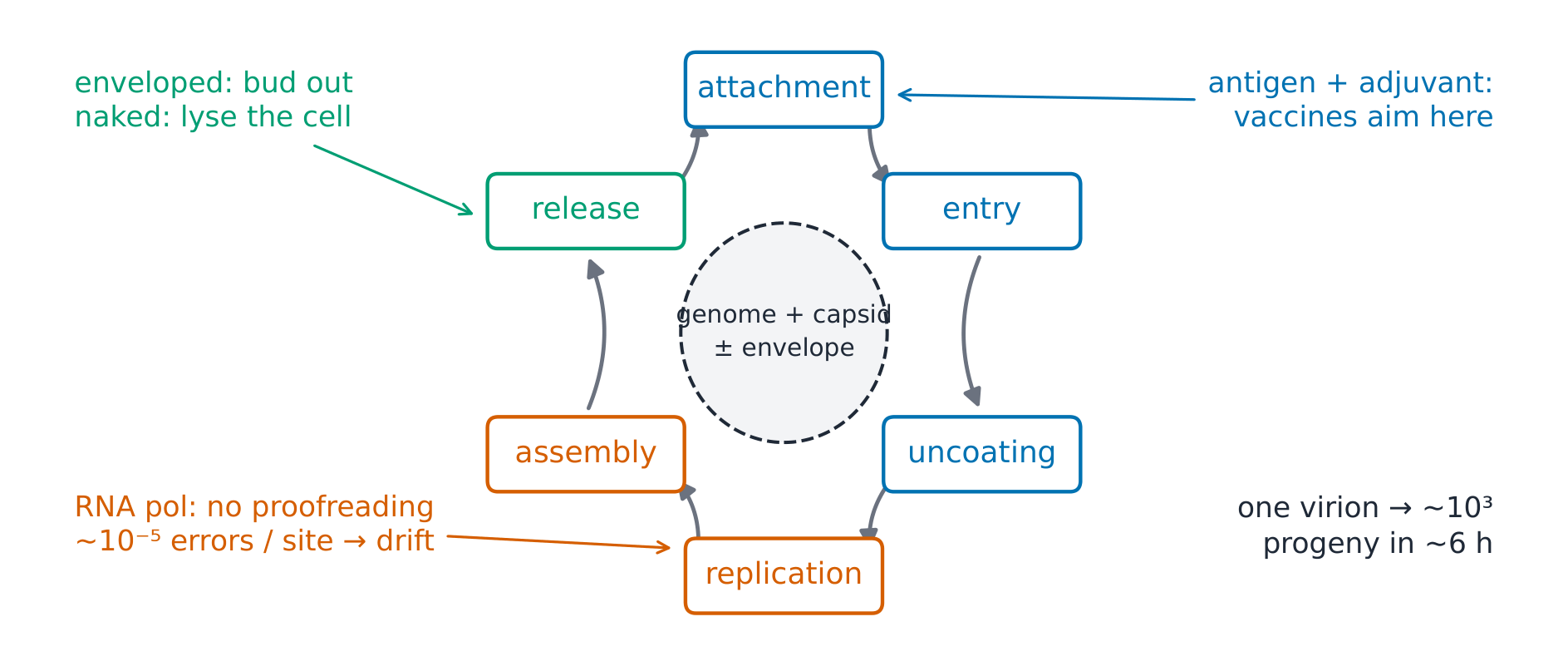
Put the steps of the virus life cycle in order.
Difficulté 3/5 · 200 pièces + un petit bonus lors de la première réussite aujourd'hui
Every antiviral drug blocks one of these steps.
Which step do neuraminidase inhibitors such as oseltamivir block?
Difficulté 1/5 · 100 pièces + un petit bonus lors de la première réussite aujourd'hui
Neuraminidase cuts new influenza particles free from the cell surface; blocking it traps them.
Enveloped or naked
- Enveloped viruses bud out through the membrane; the envelope is easily destroyed by detergents, alcohol and drying.
- Naked (non-enveloped) viruses burst the cell and survive much longer outside the body. Norovirus is one, which is why soap and water beat alcohol gel against it.
Alcohol hand gel works as well against norovirus as against enveloped viruses.
Difficulté 1/5 · 100 pièces + un petit bonus lors de la première réussite aujourd'hui
Norovirus has no envelope for alcohol to destroy, so soap and water are better.
Fast mutation: antigenic drift
- RNA viruses copy their genomes without proofreading: influenza makes about $10^{-5}$ errors per base per copy, against about $10^{-8}$–$10^{-6}$ for DNA viruses.
- Small changes build up in the surface proteins year by year: antigenic drift 抗原漂移. That is why the flu vaccine is updated every year.
Why is the influenza vaccine updated every year?
Difficulté 1/5 · 100 pièces + un petit bonus lors de la première réussite aujourd'hui
Uncorrected copying errors gradually change the proteins antibodies recognise.
Swapping segments: antigenic shift
- Influenza A carries its genome in 8 separate segments. If a human and an animal strain infect the same cell, new particles can mix their segments.
- That sudden new combination is antigenic shift 抗原转变, and it is how pandemic strains arise.
Match each term to its meaning.
Difficulté 2/5 · 140 pièces + un petit bonus lors de la première réussite aujourd'hui
Structure and genetics together explain a virus's behaviour.
Worked example: the burst arithmetic
- (Fictional figures) One infected airway cell releases about $10^3$ new particles after about 6 hours. Two rounds (12 hours) can give $10^3 \times 10^3 = 10^6$.
- An incubation of 1–2 days is only 4–8 rounds of 6 hours. Viruses reach symptoms faster than any culture can grow.
A virus completes a round of replication every 6 hours. How many rounds fit into a 2-day incubation period?
Difficulté 2/5 · 140 pièces + un petit bonus lors de la première réussite aujourd'hui
48 hours ÷ 6 hours = 8 rounds.
Worked example: counting reassortants
- Two influenza strains infect one cell. Each of the 8 segments in a new particle can come from either parent.
- Possible combinations: $2^8 = 256$. Most fail, but the few that combine a new surface protein with good human spread cause pandemics.
Two influenza strains with 8 segments each infect one cell. How many segment combinations are possible?
Difficulté 2/5 · 140 pièces + un petit bonus lors de la première réussite aujourd'hui
Each of 8 segments comes from one of 2 parents, so 2⁸ = 256.
Three common slips
- Giving antibiotics for a viral infection. Antibiotics hit bacterial structures that viruses do not have.
- "All RNA viruses are fragile." The envelope decides survival; naked RNA viruses such as norovirus and polio are hardy.
- Mixing up drift and shift. Drift is gradual mutation; shift is a sudden swap of whole segments.
Recap
- A virus is DNA or RNA in a capsid, with or without an envelope.
- The cycle: attach, enter, uncoat, copy, assemble, release; each step is a target.
- No proofreading gives drift and yearly vaccines; 8 segments allow shift and pandemics.