Current, e.m.f. and potential difference · Courant, f.e.m. et différence de potentiel
| English | Français |
|---|---|
| electric current/ɪˈlektrɪk ˈkʌrənt/ | courant électrique |
| potential difference/pəˈtenʃl ˈdɪfrəns/ | différence de potentiel |
| amperes/ˈæmpeəz/ | ampères |
| ammeter/ˈæmiːtə/ | ampèremètre |
| conventional current/kənˈvenʃənl ˈkʌrənt/ | courant conventionnel |
| direct current/daɪˈrekt ˈkʌrənt/ | courant continu |
| alternating current/ˈɔːltəneɪtɪŋ ˈkʌrənt/ | courant alternatif |
| volts/vəʊlts/ | volts |
| voltmeter/ˈvəʊltmiːtə/ | voltmètre |
What is flowing?
- Switch on a lamp and something flows through the wires — an electric current 电流.
- A cell gives that flow the push it needs.
- Three quantities describe it all: current, e.m.f. and potential difference 电势差.
Qu'est-ce qui circule ?
- Allumer une lampe et quelque chose circule dans les fils — un courant électrique 电流.
- Une pile donne à ce flux la poussée dont il a besoin.
- Trois grandeurs le décrivent tout : courant, f.é.m. et différence de potentiel 电势差.
Electric current
- An electric current is a flow of electric charge, measured in amperes 安培 (A) with an ammeter 电流表 joined in series.
- Current is the charge passing a point each second:
- $I$ in amperes, $Q$ in coulombs (C), $t$ in seconds.
Conventional current 常规电流 flows from the positive terminal to the negative terminal, through the external circuit. The ammeter (A) is connected in series to measure the current.
Worked example. A current of $2\ \text{A}$ flows for $30\ \text{s}$. Charge $= It = 2 \times 30 = 60\ \text{C}$.
Conventional current vs electron flow. Conventional current is drawn from $+$ to $-$, but the actual electrons in a metal wire drift the opposite way ($-$ to $+$). The convention was set before electrons were discovered, and we still use it today.
Courant électrique
- Un courant électrique est un flux de charge électrique, mesuré en ampères 安培 (A) avec un ampèremètre 电流表 branché en série.
- Le courant est la charge passant par un point chaque seconde :
- $I$ en ampères, $Q$ en coulombs (C), $t$ en secondes.

Le courant conventionnel 常规电流 circule de la borne positive à la borne négative, à travers le circuit externe. L'ampèremètre (A) est connecté en série pour mesurer le courant.
Exemple résolu. Un courant de $2\ \text{A}$ circule pendant $30\ \text{s}$. Charge $= It = 2 \times 30 = 60\ \text{C}$.
Courant conventionnel vs flux d'électrons. Le courant conventionnel est dessiné de $+$ vers $-$, mais les électrons réels dans un fil métallique dérivent dans le sens contraire (de $-$ vers $+$). La convention a été établie avant la découverte des électrons, et nous l'utilisons toujours aujourd'hui.
Ohm's law · Loi d'Ohm
V = IR
For an ohmic conductor the current is proportional to the voltage — the gradient is 1/resistance. · Pour un conducteur ohmique, le courant est proportionnel à la tension — la pente est 1/résistance.
A charge of $30\ \text{C}$ flows past a point in $10\ \text{s}$. What is the current, in A? · Une charge de $30\ \text{C}$ passe par un point en $10\ \text{s}$. Quelle est le courant, en A ?
$I = \dfrac{Q}{t} = \dfrac{30}{10} = 3.0\ \text{A}$.
A current of $2.0\ \text{A}$ flows for $5.0\ \text{s}$. How much charge passes, in C? · Un courant de $2.0\ \text{A}$ circule pendant $5.0\ \text{s}$. Quelle charge passe, en C ?
$Q = It = 2.0 \times 5.0 = 10\ \text{C}$.
How is an ammeter connected to measure the current through a lamp? · Comment un ampèremètre est-il connecté pour mesurer le courant dans une lampe ?
An ammeter goes in series so the same current flows through it and the lamp. (A voltmeter goes in parallel.) · Un ampèremètre se met en série afin que le même courant traverse l'appareil et la lampe. (Un voltmètre se met en parallèle.)
Direction and type of current
- Conventional current flows from + to − round the outside of the cell.
- The free electrons in a metal really drift the other way (− to +).
- Direct current 直流电 (d.c.) always flows one way (a battery). Alternating current 交流电 (a.c.) keeps swapping direction (the mains).
Direct current is steady in one direction; alternating current keeps swapping direction, crossing zero many times each second
Resistors, components that control the current in a circuit
Sens et type de courant
- Le courant conventionnel circule de + vers − autour de l'extérieur de la pile.
- Les électrons libres dans un métal dérivent réellement dans l'autre sens (− vers +).
- Le courant continu 直流电 (c.c.) circule toujours dans un seul sens (une batterie). Le courant alternatif 交流电 (c.a.) change constamment de direction (le secteur).
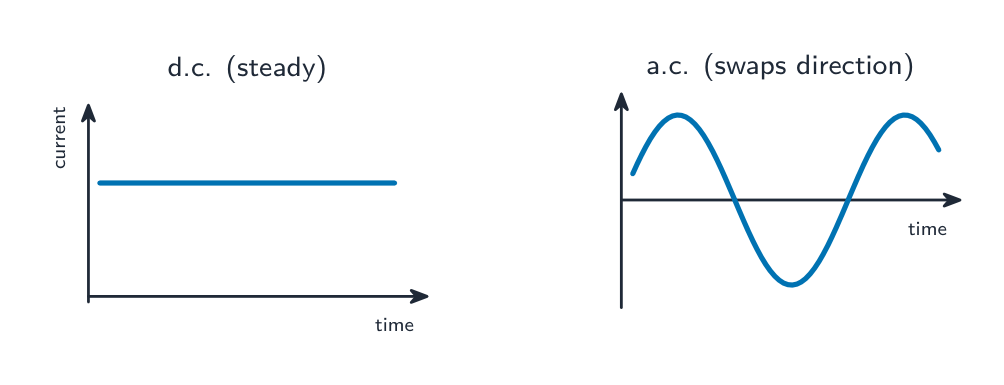
Le courant continu est constant dans un sens ; le courant alternatif change constamment de direction, traversant zéro de nombreuses fois par seconde
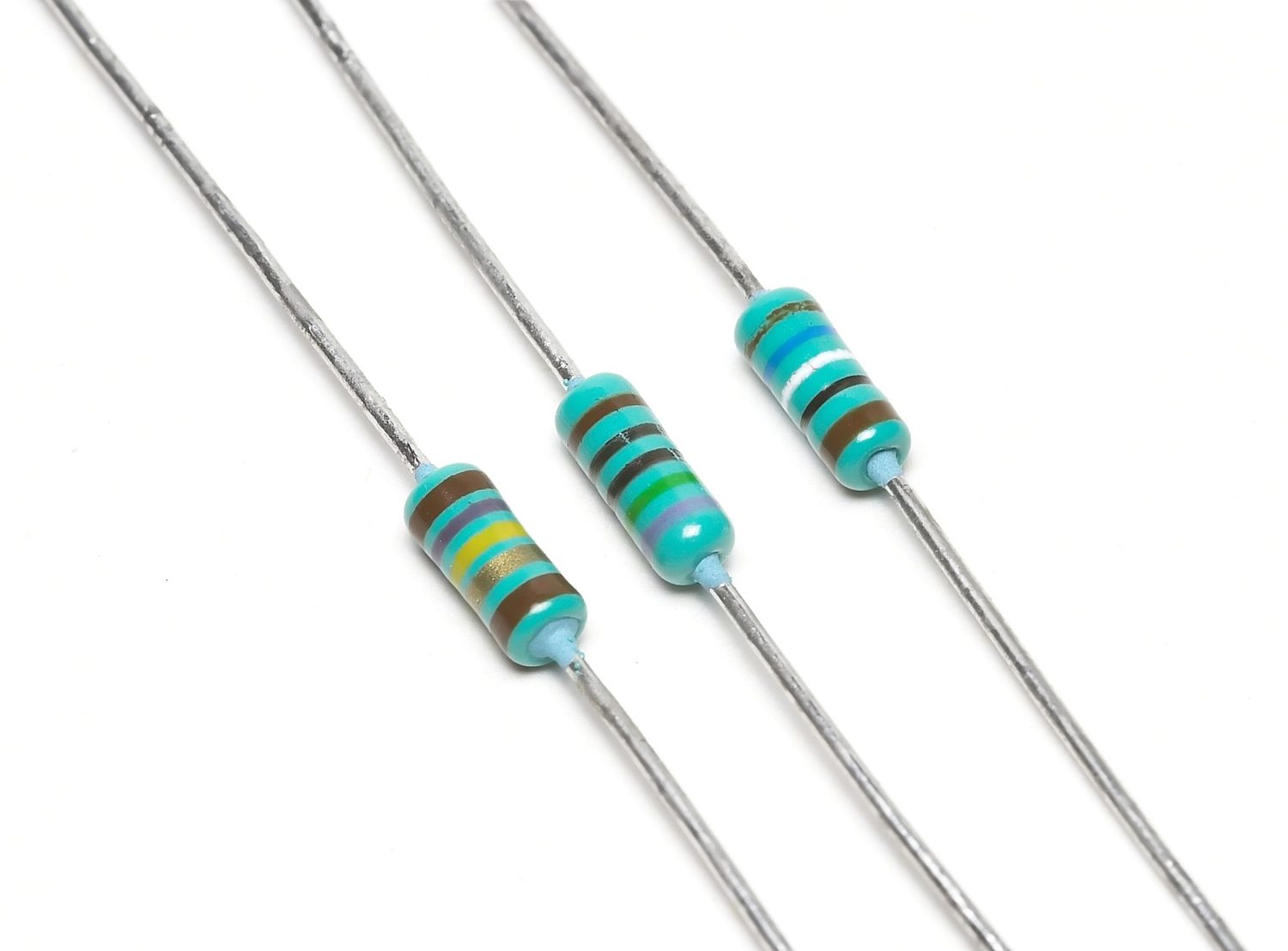
*Résistances, composants qui contrôlent le courant dans un circuit
Conventional current flows around the outside of a cell from: · Le courant conventionnel circule à l'extérieur d'une pile depuis :
Conventional current is taken from + to −. The electrons themselves drift the opposite way (− to +). · Le courant conventionnel va de + à −. Les électrons eux-mêmes dérivent en sens inverse (de − à +).
E.m.f. and potential difference
- Both are measured in volts 伏特 (V) and both are work done per unit charge:
- e.m.f. is the energy a source gives each coulomb to drive it round the whole circuit.
- potential difference (p.d.) is the energy each coulomb gives up in one component.
- A voltmeter 电压表 measures them, joined in parallel (across the component).
F.é.m. et différence de potentiel
- Tous deux sont mesurés en volts 伏特 (V) et tous deux représentent un travail effectué par unité de charge :
- La f.é.m. est l'énergie qu'une source fournit à chaque coulomb pour le faire parcourir le tout le circuit.
- La différence de potentiel (d.p.) est l'énergie que chaque coulomb cède dans un seul composant.
- Un voltmètre 电压表 les mesure, branché en parallèle (aux bornes du composant).
A cell does $120\ \text{J}$ of work driving $60\ \text{C}$ of charge round a circuit. What is its e.m.f., in V? · Une pile effectue $120\ \text{J}$ de travail pour déplacer $60\ \text{C}$ de charge autour d'un circuit. Quelle est sa f.e.m., en V ?
$E = \dfrac{W}{Q} = \dfrac{120}{60} = 2.0\ \text{V}$.
A voltmeter is connected: · Un voltmètre est connecté :
A voltmeter measures the p.d. across a component, so it is connected in parallel with it. · Un voltmètre mesure la p.d. aux bornes d'un composant, il est donc connecté en parallèle avec lui.
Match each electrical quantity to its meaning. · Reliez chaque grandeur électrique à sa signification.
Each item links the term to its correct meaning. · Chaque élément relie le terme à sa signification correcte.
You've got it
- current = flow of charge: $I = \dfrac{Q}{t}$; ammeter in series, in amperes
- conventional current + → −; electrons drift − → +; d.c. one way, a.c. swaps
- e.m.f. (whole circuit) and p.d. (one component) are both $\dfrac{W}{Q}$ in volts
- voltmeter in parallel
Vous avez compris
- courant = flux de charge : $I = \dfrac{Q}{t}$ ; ampèremètre en série, en ampères
- courant conventionnel + → − ; électrons dérivent − → + ; c.c. un sens, c.a. inverse
- f.é.m. (tout le circuit) et d.p. (un composant) sont tous deux $\dfrac{W}{Q}$ en volts
- voltmètre en parallèle