Son
Introduit| English | Sens |
|---|---|
| longitudinal/ˌlɒŋɡɪˈtjuːdɪnl/ | longitudinale |
| compressions/kəmˈpreʃnz/ | compressions |
| rarefactions/ˌreərɪˈfækʃnz/ | rarefactions |
| vacuum/ˈvækjuːm/ | vide |
| echo/ˈekəʊ/ | écho |
| loudness/ˈlaʊdnəs/ | The perceived intensity of a sound, influenced by its physical intensity, frequency and the listener. |
| pitch/pɪtʃ/ | The perceived highness or lowness of a sound, mainly related to its frequency. |
| ultrasound/ˌʊltrəˈsaʊnd/ | Sound with a frequency above the upper limit of normal human hearing, conventionally above 20 kilohertz. |
Good vibrations
- Every sound starts with something vibrating — a guitar string, a drum skin, your vocal cords.
- In space films, explosions are silent for a real reason: sound needs a material to travel through.
- Let's see how sound moves.
Sound is a longitudinal 纵波 wave
- A vibrating object pushes the air into compressions 压缩 (particles squeezed together) and rarefactions 稀疏 (particles spread apart).
- This makes sound a longitudinal wave — the air vibrates along the direction of travel.
- Because it needs particles, sound cannot travel through a vacuum 真空 (empty space).
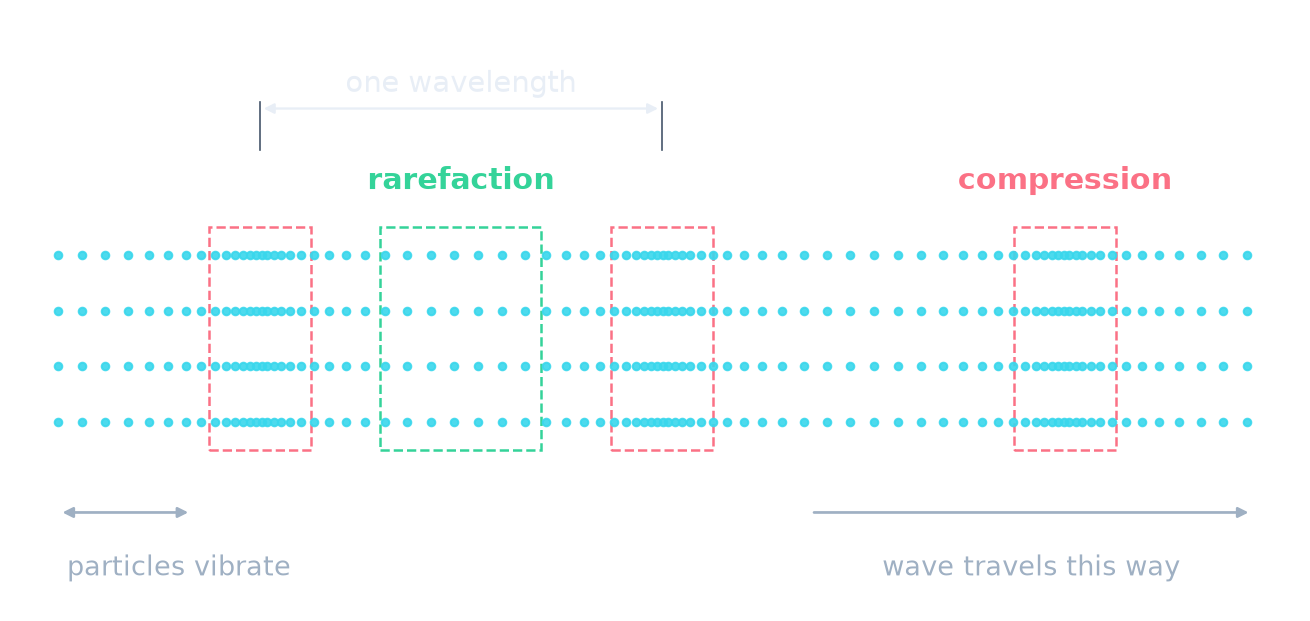
Sound as a longitudinal wave: particles vibrate back and forth, creating regions of high density (compressions) and low density (rarefactions).
Sound is NOT like light. Light can travel through empty space (a vacuum); sound cannot. In space films, explosions are silent for a real physics reason — there are no particles to carry the vibration.
Son
y = a sin(bt + c)
Louder = bigger amplitude; higher pitch = higher fréquence.
Sound travels as a series of:
Difficulté 1/5 · 100 pièces + un petit bonus lors de la première réussite aujourd'hui
A vibrating source squeezes and stretches the air into compressions and rarefactions — a longitudinal wave.
Sound can travel through a vacuum (empty space).
Difficulté 1/5 · 100 pièces + un petit bonus lors de la première réussite aujourd'hui
Sound needs particles to pass the vibration along, so it cannot travel through a vacuum.
Speed and hearing range
- Humans can hear from about $20\ \text{Hz}$ to $20\,000\ \text{Hz}$.
- Sound travels at about $340\ \text{m/s}$ in air — far slower than light.
- It travels faster in liquids and solids than in gases, because their particles are closer together.
The approximate range of human hearing is:
Difficulté 1/5 · 100 pièces + un petit bonus lors de la première réussite aujourd'hui
Most people hear from about 20 Hz (very low) up to about 20 000 Hz (very high).
Sound travels fastest through:
Difficulté 1/5 · 100 pièces + un petit bonus lors de la première réussite aujourd'hui
The closer the particles, the faster the vibration is passed on — so sound is fastest in solids, slowest in gases.
Loudness and pitch
- Amplitude sets loudness 响度: a bigger vibration gives a bigger amplitude and a louder sound.
- Frequency sets pitch 音调: more vibrations each second give a higher note. Sound above $20\,000\ \text{Hz}$ is ultrasound 超声波 — too high for humans to hear.
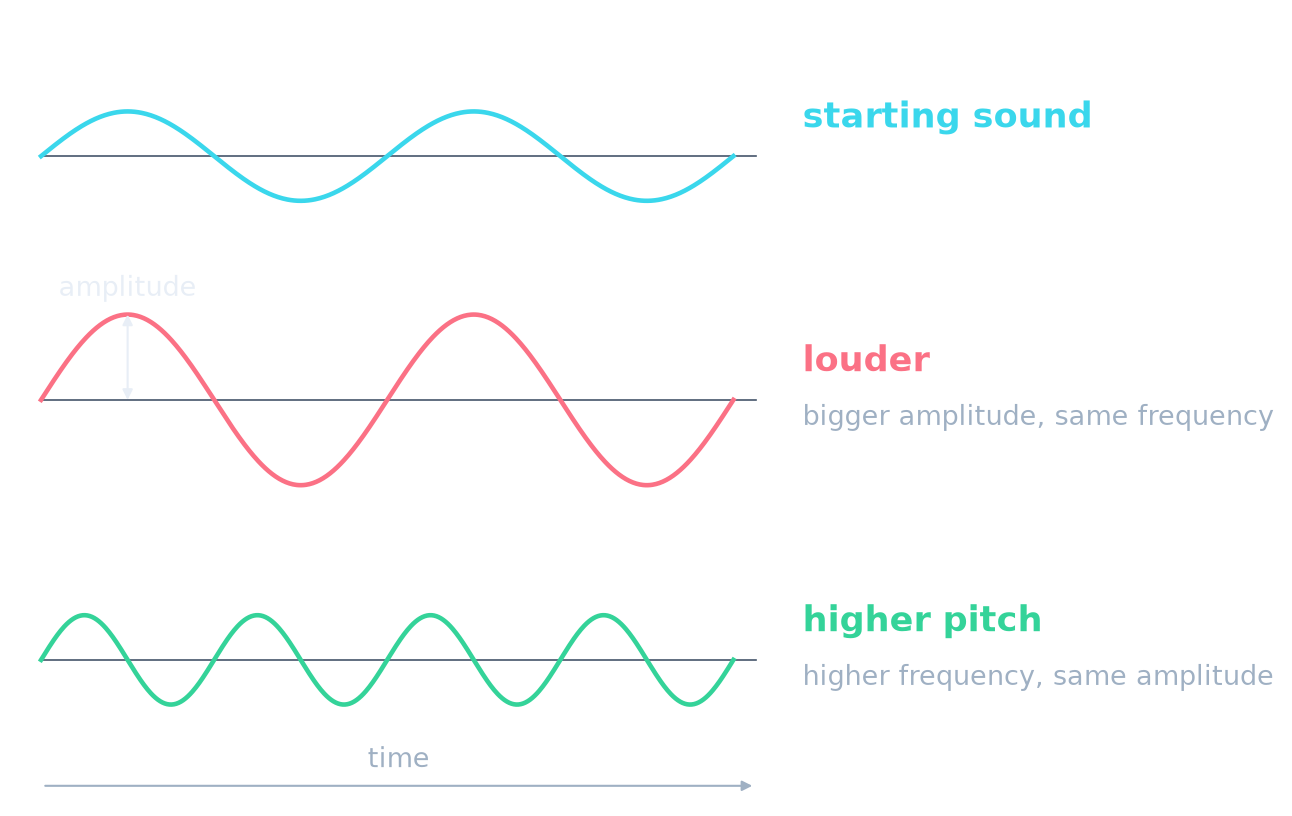
A guitarist plucks the same string harder. What changes about the sound wave?
Difficulté 1/5 · 100 pièces + un petit bonus lors de la première réussite aujourd'hui
Plucking harder makes a bigger vibration: a bigger amplitude and a louder sound. The note (frequency) stays the same.
Trace B shows twice as many waves as trace A in the same time, with the same height. Compared with A, sound B is:
Difficulté 1/5 · 100 pièces + un petit bonus lors de la première réussite aujourd'hui
More waves in the same time means a higher frequency, so a higher pitch. The same height means the same amplitude, so the same loudness.
Echoes 回声
- A reflected sound is an echo.
- You can measure the speed of sound by timing an echo over a known distance.
- The sound travels to the wall and back, so it covers twice the distance.
Worked example. A ship sends a sonar pulse to the seabed $150\ \text{m}$ below. Sound travels at $1500\ \text{m/s}$ in water. The pulse goes down and back, $2 \times 150 = 300\ \text{m}$, so the echo returns after $\dfrac{300}{1500} = 0.2\ \text{s}$.
A boy shouts at a cliff $660\ \text{m}$ away and hears the echo $4.0\ \text{s}$ later. What is the speed of sound, in m/s?
Difficulté 2/5 · 140 pièces + un petit bonus lors de la première réussite aujourd'hui
The sound travels there and back: $2 \times 660 = 1320\ \text{m}$ in $4.0\ \text{s}$, so $v = \dfrac{1320}{4.0} = 330\ \text{m/s}$.
You've got it
- sound is made by vibrations and is a longitudinal wave (compressions + rarefactions)
- it needs a medium — no sound in a vacuum
- human hearing: about $20\ \text{Hz}$ to $20\,000\ \text{Hz}$; speed ≈ $340\ \text{m/s}$ in air
- an echo is reflected sound — remember it travels there and back
Write from the data: find the sound speed
- A shout returns from a cliff 400 m away after 2.5 s.
- Find the speed. Remember the sound travels there and back.
A shout at a cliff 400 m away returns as an echo after 2.5 s. What is the speed of sound, and why is there no sound in a vacuum?
Twice 400 m is 800 m. 800 divided by 2.5 is 320 metres per second.
What speed does this echo give?
Difficulté 1/5 · 100 pièces + un petit bonus lors de la première réussite aujourd'hui
800 divided by 2.5 is 320 metres per second.