Reflection and refraction · Réflexion et réfraction
| English | Français |
|---|---|
| normal/ˈnɔːml/ | normale |
| angle of incidence/ˈæŋɡl ɒv ˈɪnsɪdəns/ | angle d'incidence |
| angle of reflection/ˈæŋɡl ɒv rɪˈflekʃn/ | angle de réflexion |
| virtual/ˈvɜːtʃuːəl/ | virtuel |
| refractive index/rɪˈfræktɪv ˈɪndeks/ | indice de réfraction |
| total internal reflection/ˈtəʊtl ɪnˈtɜːnl rɪˈflekʃn/ | réflexion totale interne |
| critical angle/ˈkrɪtɪkl ˈæŋɡl/ | angle critique |
| optical fibres/ˈɒptɪkl ˈfaɪbəz/ | fibres optiques |
Bouncing and bending light
- A mirror bounces light back; a straw in a glass of water looks bent.
- These are reflection and refraction — the two basic things light does at a surface.
- We measure all angles from the normal 法线: a line at $90°$ to the surface.
Réfléchir et plier la lumière
- Un miroir renvoie la lumière ; une paille dans un verre d'eau semble tordue.
- Ce sont la réflexion et la réfraction — les deux phénomènes fondamentaux subis par la lumière à une surface.
- Nous mesurons tous les angles par rapport à la normale 法线 : une ligne à $90°$ de la surface.
Reflection
- The law of reflection: the angle of incidence 入射角 equals the angle of reflection 反射角 (both from the normal).
- A plane mirror makes an image that is: the same size, the same distance behind the mirror, and virtual 虚的 (it cannot be caught on a screen).
The law of reflection
Réflexion
- La loi de réflexion : l'angle d'incidence 入射角 est égal à l'angle de réflexion 反射角 (les deux mesurés depuis la normale).
- Un miroir plan forme une image qui est : de même taille, à la même distance derrière le miroir, et virtuelle 虚的 (elle ne peut pas être captée sur un écran).

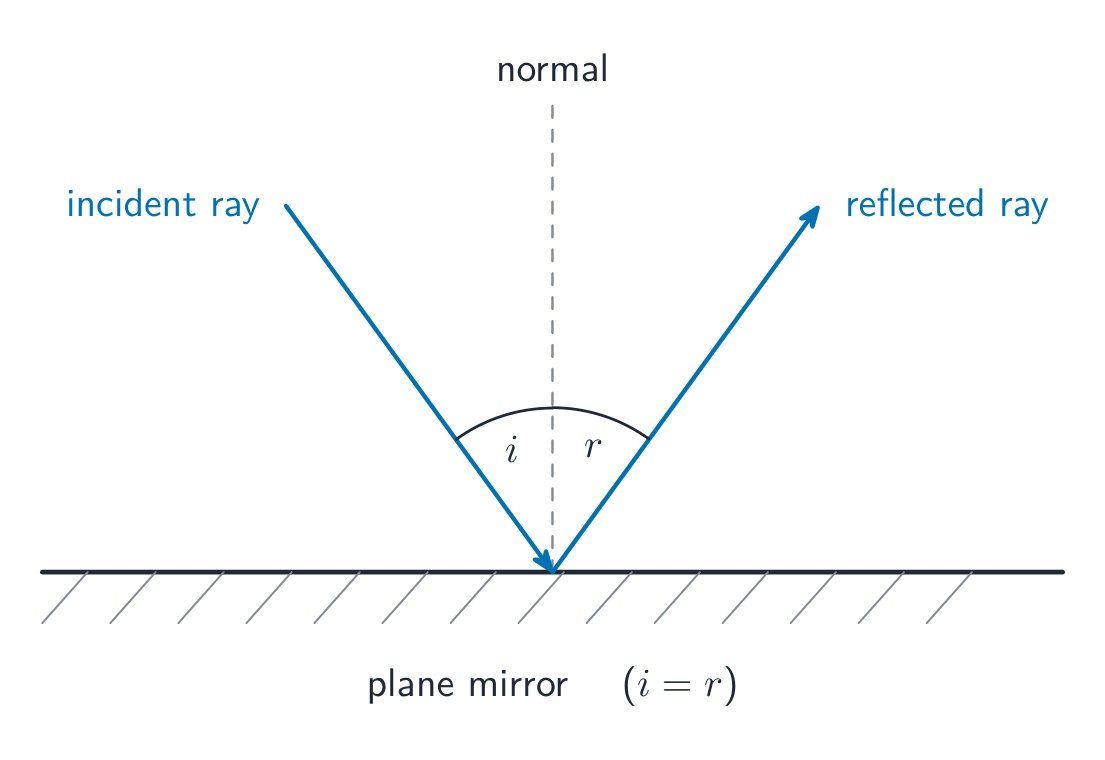
La loi de réflexion
Bend a light ray · Courber un rayon lumineux
Shine light into water, glass or diamond and change the angle. The ray slows and bends toward the normal — the denser the material (higher n), the more it bends. That bending is why a straw looks broken in a glass, and why diamonds sparkle. · Faire entrer la lumière dans l'eau, le verre ou le diamant et changer l'angle. Le rayon ralentit et se courbe vers la normale — plus le matériau est dense (n élevé), plus il se courbe. C'est cette courbure qui rend un pailletoir brisé dans un verre, et pourquoi les diamants étincellent.
A ray hits a plane mirror at $30°$ to the normal. At what angle to the normal does it reflect? · Un rayon frappe un miroir plan à $30°$ par rapport à la normale. À quel angle par rapport à la normale se reflète-t-il ?
The law of reflection: the angle of reflection equals the angle of incidence, both measured from the normal. · La loi de la réflexion : l'angle de réflexion est égal à l'angle d'incidence, tous deux mesurés par rapport à la normale.
An image in a plane mirror is: · Une image dans un miroir plan est :
A plane mirror gives a virtual image, the same size, the same distance behind the mirror — it cannot be caught on a screen. · Un miroir plan donne une image virtuelle, de même taille, à la même distance derrière le miroir — elle ne peut pas être captée sur un écran.
Refraction
- When light passes into a new material it changes speed and bends.
- Going from air into glass, it slows down and bends toward the normal (so $i > r$).
- The refractive index 折射率 compares the bending:
Réfraction
- Quand la lumière pénètre dans un nouveau matériau, elle change de vitesse et se courbe.
- Passant de l'air dans le verre, elle ralentit et se courbe vers la normale (donc $i > r$).
- L'indice de réfraction 折射率 compare la courbure :

A ray of light passes from air into glass. It: · Un rayon de lumière passe de l'air vers le verre. Il :
Light travels slower in glass, so going air → glass it bends toward the normal ($i > r$). · La lumière voyage plus lentement dans le verre, donc en passant de l'air vers le verre, elle se courbe vers la normale ($i > r$).
For light entering glass, $\sin i = 0.80$ and · et $\sin r = 0.50$. What is the refractive index? · Pour la lumière entrant dans le verre, $\sin i = 0.80$ et $\sin r = 0.50$. Quel est l'indice de réfraction ?
$n = \dfrac{\sin i}{\sin r} = \dfrac{0.80}{0.50} = 1.6$.
Total internal reflection 全反射
- Light leaving glass bends away from the normal. Past a certain angle — the critical angle 临界角 $c$ — it cannot get out at all and reflects completely.
- This is total internal reflection, and it happens when the angle inside is bigger than $c$:
- It keeps light bouncing along optical fibres 光纤, the thin glass threads that carry internet and phone signals.
Total internal reflection keeps light bouncing along each optical fibre until it shines out at the tip
Réflexion totale interne 全反射
- La lumière quittant le verre s'éloigne de la normale. Au-delà d'un certain angle — l'angle critique 临界角 $c$ — elle ne peut plus sortir et se réfléchit entièrement.
- C'est la réflexion totale interne, qui se produit lorsque l'angle intérieur est supérieur à $c$ :
- Elle maintient la lumière rebondissant le long des fibres optiques 光纤, ces fins fils de verre transportant les signaux internet et téléphoniques.


La réflexion totale interne maintient la lumière rebondissant le long de chaque fibre optique jusqu'à ce qu'elle s'échappe à l'extrémité
Total internal reflection happens when light inside glass hits the surface at an angle that is: · La réflexion totale interne se produit lorsque la lumière à l'intérieur du verre frappe la surface avec un angle qui est :
Above the critical angle the light cannot escape and is reflected completely back inside. · Au-dessus de l'angle critique, la lumière ne peut pas s'échapper et est totalement réfléchie vers l'intérieur.
Optical fibres use total internal reflection to carry light signals. · Les fibres optiques utilisent la réflexion totale interne pour transporter des signaux lumineux.
Light bounces along the fibre by total internal reflection, carrying internet and phone signals over long distances. · La lumière rebondit le long de la fibre par réflexion totale interne, transportant les signaux internet et téléphoniques sur de longues distances.
You've got it
- measure angles from the normal; reflection: angle i = angle r
- a plane mirror image is virtual, same size, same distance behind
- refraction: into glass → slows, bends toward the normal; $n = \dfrac{\sin i}{\sin r}$
- past the critical angle, light is totally internally reflected (optical fibres)
Vous avez compris
- mesurez les angles par rapport à la normale ; réflexion : angle i = angle r
- l'image d'un miroir plan est virtuelle, de même taille, à la même distance derrière
- réfraction : dans le verre → ralentit, se courbe vers la normale ; $n = \dfrac{\sin i}{\sin r}$
- au-delà de l'angle critique, la lumière est réfléchie totalement par internally (fibres optiques)