Equations · Équations
| English | Français |
|---|---|
| linear equations/ˈlɪnɪə ɪˈkweɪʒnz/ | équations linéaires |
| simultaneous equations/ˌsɪməlˈteɪnɪəs ɪˈkweɪʒnz/ | équations simultanées |
| eliminate/ɪˈlɪmɪneɪt/ | éliminer |
| quadratic/kwɒˈdrætɪk/ | quadratique |
| subject/ˈsʌbdʒekt/ | sujet |
The ancient art of balancing
- The word "equation" comes from "equal" — both sides must be the same, like a balance scale.
- Babylonians solved linear equations 一次方程 4000 years ago using clay tablets. Today we use the same principle: do the same to both sides.
L'art ancien de l'équilibre
- Le mot "équation" vient de "égal" — les deux côtés doivent être identiques, comme une balance.
- Les Babyloniens résolveient des équations linéaires il y a 4000 ans en utilisant des tablettes d'argile. Aujourd'hui, nous utilisons le même principe : faire la même chose des deux côtés.
Linear equations
- Solve by doing the same operation to both sides until the unknown is alone.
- $3x + 7 = 22 \Rightarrow 3x = 15 \Rightarrow x = 5$.
Watch the signs. $-2x + 5 = 11 \Rightarrow -2x = 6 \Rightarrow x = -3$. Dividing by a negative flips the sign of the answer.
Solve by doing the same to both sides
Équations linéaires
- Résoudre en effectuant la même opération des deux côtés jusqu'à ce que l'inconnue soit seule.
- $3x + 7 = 22 \Rightarrow 3x = 15 \Rightarrow x = 5$.
Surveiller les signes. $-2x + 5 = 11 \Rightarrow -2x = 6 \Rightarrow x = -3$. Diviser par un négatif inverse le signe de la réponse.

Résoudre en faisant la même chose des deux côtés
Solving an equation · Résolution d'une équation
y = ax² + bx + c
Solving means finding the roots · racines — where the curve crosses the x-axis. · Résoudre signifie trouver les racines — là où la courbe croise l'axe des x.
Solve 3x + 7 = 22. · Résoudre 3x + 7 = 22.
3x = 22 − 7 = 15, so x = 5. · 3x = 22 − 7 = 15, donc x = 5.
Simultaneous equations 联立方程
- Two equations, two unknowns. Eliminate 消元 one variable by adding or subtracting.
- $2x + y = 7$ and $3x - y = 8$: adding gives $5x = 15$, so $x = 3$, then $y = 1$.
Check your answer. Substitute back: $2(3) + 1 = 7$ ✓ and $3(3) - 1 = 8$ ✓.
Systèmes d'équations simultanées
- Deux équations, deux inconnues. Éliminer une variable en additionnant ou en soustrayant.
- $2x + y = 7$ et $3x - y = 8$ : l'addition donne $5x = 15$, donc $x = 3$, puis $y = 1$.
Vérifier votre réponse. Substituer : $2(3) + 1 = 7$ ✓ et $3(3) - 1 = 8$ ✓.
Solve 2x + y = 7 and 3x − y = 8. What is x? · Résoudre 2x + y = 7 et 3x − y = 8. Quelle est x ?
Adding the equations: 5x = 15, so x = 3 (then y = 1). · En additionnant les équations : 5x = 15, donc x = 3 (ensuite y = 1).
From 2x + y = 7 and 3x − y = 8, what is y? · De 2x + y = 7 et 3x − y = 8, quelle est y ?
x = 3 from adding. Substituting: 2(3) + y = 7 → y = 1. · x = 3 par addition. En substituant : 2(3) + y = 7 → y = 1.
Quadratic 二次 equations (Extended)
- A quadratic $ax^2 + bx + c = 0$ can have two, one, or zero real solutions.
- By factorising: $x^2 + 5x + 6 = 0 \Rightarrow (x+2)(x+3) = 0 \Rightarrow x = -2$ or $x = -3$.
- By the formula: $x = \dfrac{-b \pm \sqrt{b^2 - 4ac}}{2a}$ (given in the exam).
The roots of a quadratic are where the parabola crosses the $x$-axis — the solutions of $y = 0$.
Équations quadratiques (étendues)
- Un quadratique $ax^2 + bx + c = 0$ peut avoir deux, une ou zéro solutions réelles.
- Par factorisation : $x^2 + 5x + 6 = 0 \Rightarrow (x+2)(x+3) = 0 \Rightarrow x = -2$ ou $x = -3$.
- Par la formule : $x = \dfrac{-b \pm \sqrt{b^2 - 4ac}}{2a}$ (donnée dans l'examen).
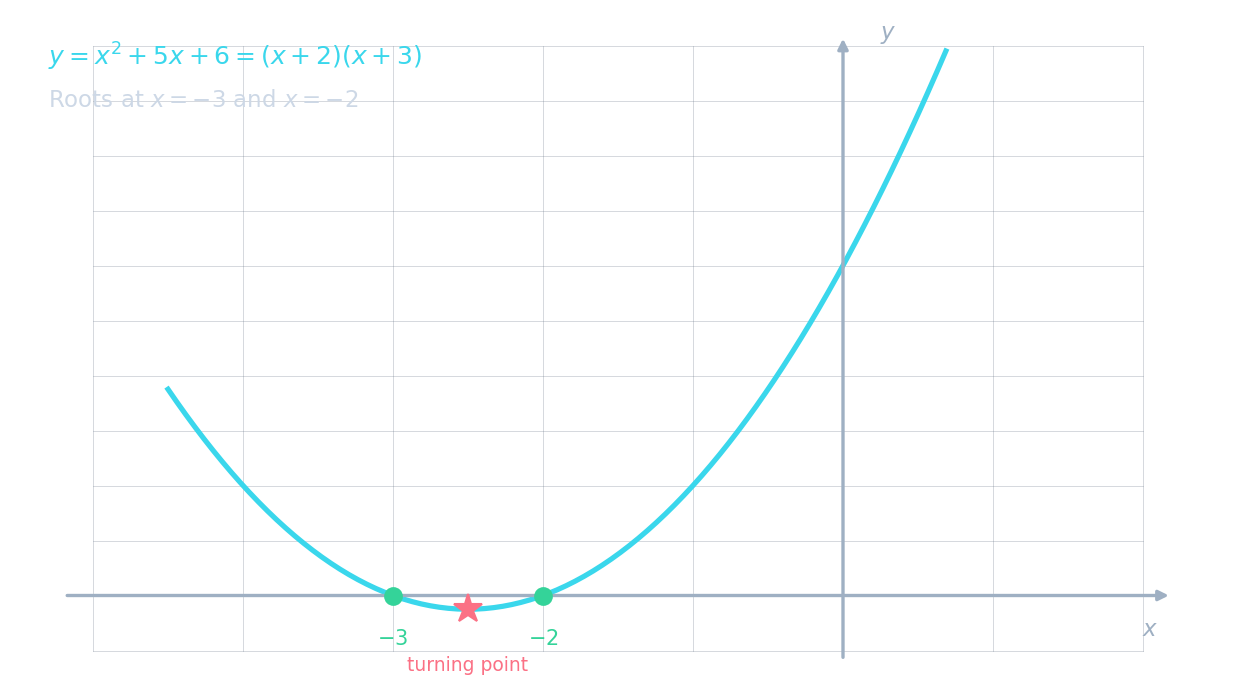
Les racines d'un quadratique sont là où la parabole croise l'axe $x$ — les solutions de $y = 0$.
Solve x² + 5x + 6 = 0 by factorising. · Résoudre x² + 5x + 6 = 0 par factorisation.
(x + 2)(x + 3) = 0, so x = −2 or x = −3. · (x + 2)(x + 3) = 0, donc x = −2 ou x = −3.
The quadratic formula is x = (−b ± √(b² − 4ac)) / (2a). · La formule quadratique est x = (−b ± √(b² − 4ac)) / (2a).
This formula solves any quadratic ax² + bx + c = 0. · Cette formule résout toute équation quadratique ax² + bx + c = 0.
Powers in rearranging formulae (Extended)
- Make a letter the subject 主项 by reversing the operations applied to it.
- Make $r$ the subject of $V = \dfrac{4}{3}\pi r^3$: $\;r^3 = \dfrac{3V}{4\pi}$, so $r = \sqrt[3]{\dfrac{3V}{4\pi}}$.
Puissances dans la réarrangement de formules (étendues)
- Rendre une lettre le sujet en inversant les opérations appliquées à celle-ci.
- Rendre $r$ le sujet de $V = \dfrac{4}{3}\pi r^3$ : $\;r^3 = \dfrac{3V}{4\pi}$, donc $r = \sqrt[3]{\dfrac{3V}{4\pi}}$.
Make r the subject of V = (4/3)πr³. r = ∛(). · Exprimer r en fonction de V = (4/3)πr³. r = ∛().
Multiply by 3/(4π): r³ = 3V/(4π), then take the cube root. · Multiplier par 3/(4π) : r³ = 3V/(4π), puis prendre la racine cubique.
Build an equation, then choose a method
- A ticket problem gives $2a+c=31$ and $a+2c=26$. Double the second and subtract the first: $3c=21$, so $c=7$, then $a=12$. Check both original totals.
- Core rearrangement: $C=5t+8$ gives $C-8=5t$, then $t=(C-8)/5$. The subject appears once and has no power or root.
Construire une équation, puis choisir une méthode
- Un problème de billets donne $2a+c=31$ et $a+2c=26$. Doubler le second et soustraire le premier : $3c=21$, donc $c=7$, puis $a=12$. Vérifier les deux totaux originaux.
- Réarrangement fondamental : $C=5t+8$ donne $C-8=5t$, puis $t=(C-8)/5$. Le sujet apparaît une seule fois et n'a ni puissance ni racine.
For 2a + c = 31 and a + 2c = 26, find a. · Pour 2a + c = 31 et a + 2c = 26, trouver a.
Eliminate a: 3c = 21, c = 7. Then 2a = 24, a = 12. · Éliminer a : 3c = 21, d'où c = 7. Puis 2a = 24, donc a = 12.
Completing the square and the formula (Extended)
- $x^2+6x+5=0$ becomes $(x+3)^2-4=0$, so $x+3=\pm2$, giving $x=-1,-5$.
- For $2x^2+x-3=0$, choose $a=2,b=1,c=-3$ in $x=(-b\pm\sqrt{b^2-4ac})/(2a)$. Thus $x=(-1\pm5)/4=1,-1.5$. Substitution checks each root.
Compléter le carré et la formule (étendues)
- $x^2+6x+5=0$ devient $(x+3)^2-4=0$, donc $x+3=\pm2$, donnant $x=-1,-5$.
- Pour $2x^2+x-3=0$, choisir $a=2,b=1,c=-3$ dans $x=(-b\pm\sqrt{b^2-4ac})/(2a)$. Ainsi $x=(-1\pm5)/4=1,-1.5$. La substitution vérifie chaque racine.
Find the positive root of 2x² + x − 3 = 0. · Trouver la racine positive de 2x² + x − 3 = 0.
The formula gives (−1+5)/4 = 1; the other root is −1.5. · La formule donne (−1+5)/4 = 1 ; l'autre racine est −1.5.
Fractional equations (Extended)
- For $x/(x+2)=3/5$, exclude $x=-2$. Multiply by $5(x+2)$: $5x=3(x+2)$, so $2x=6$ and $x=3$. Check $3/5=3/5$.
- For $2/(x+1)+1/(x-1)=1$, exclude $x=-1,1$. Multiply through by $(x+1)(x-1)$: $2(x-1)+(x+1)=x^2-1$. This gives $x^2-3x=0$, so $x=0$ or 3; both are allowed.
Équations fractionnaires (Étendu)
- Pour $x/(x+2)=3/5$, exclure $x=-2$. Multiplier par $5(x+2)$ : $5x=3(x+2)$, donc $2x=6$ et $x=3$. Vérifier $3/5=3/5$.
- Pour $2/(x+1)+1/(x-1)=1$, exclure $x=-1,1$. Multiplier tout par $(x+1)(x-1)$ : $2(x-1)+(x+1)=x^2-1$. Cela donne $x^2-3x=0$, donc $x=0$ ou 3 ; les deux sont autorisés.
Solve x/(x+2) = 3/5. · Résoudre x/(x+2) = 3/5.
5x = 3x+6, so x = 3, which is not the excluded value −2. · 5x = 3x+6, donc x = 3, ce qui n'est pas la valeur exclue −2.
One line and one curve (Extended)
- Solve $y=x+2$ and $y=x^2$ by substituting: $x^2=x+2$, so $(x-2)(x+1)=0$. Thus $x=2$ or $-1$.
- Find the matching $y$ for each: the pairs are $(2,4)$ and $(-1,1)$. Do not mix one root with the other root's $y$ value.
Une droite et une courbe (Étendu)
- Résoudre $y=x+2$ et $y=x^2$ par substitution : $x^2=x+2$, donc $(x-2)(x+1)=0$. Ainsi $x=2$ ou $-1$.
- Trouver la correspondance de $y$ pour chacun : les paires sont $(2,4)$ et $(-1,1)$. Ne pas mélanger une racine avec la valeur de $y$ de l'autre racine.
Solve y = x+2 and y = x². Give the positive x solution. · Résolvez y = x+2 et y = x². Donnez la solution positive pour x.
x²−x−2 = (x−2)(x+1), so the positive solution is 2. · x²−x−2 = (x−2)(x+1), donc la solution positive est 2.
A subject appearing twice (Extended)
- Rearrange $y=(3x+2)/(x-1)$ for $x$: $y(x-1)=3x+2$, then $yx-3x=y+2$.
- Factor the subject: $x(y-3)=y+2$, giving $x=(y+2)/(y-3)$, $y\ne3$. The original also requires $x\ne1$.
Un sujet apparaissant deux fois (Étendu)
- Réarranger $y=(3x+2)/(x-1)$ pour $x$ : $y(x-1)=3x+2$, puis $yx-3x=y+2$.
- Factoriser le sujet : $x(y-3)=y+2$, donnant $x=(y+2)/(y-3)$, $y\ne3$. L'original exige également $x\ne1$.
You've got it
- linear: same operation to both sides; simultaneous: add/subtract to eliminate
- quadratics: factorise, complete the square, or use the formula
- rearrange: undo the operations in reverse order to make a letter the subject
Vous avez compris
- linéaire : même opération sur les deux côtés ; simultané : additionner/soustraire pour éliminer
- quadratiques : factoriser, compléter le carré, ou utiliser la formule
- réarranger : annuler les opérations dans l'ordre inverse pour rendre une lettre le sujet